Mount Gambier – Nelson – Port McDonnell – Lake Bonney
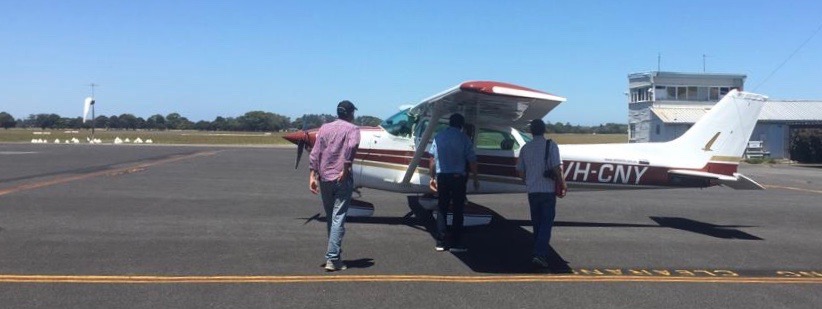
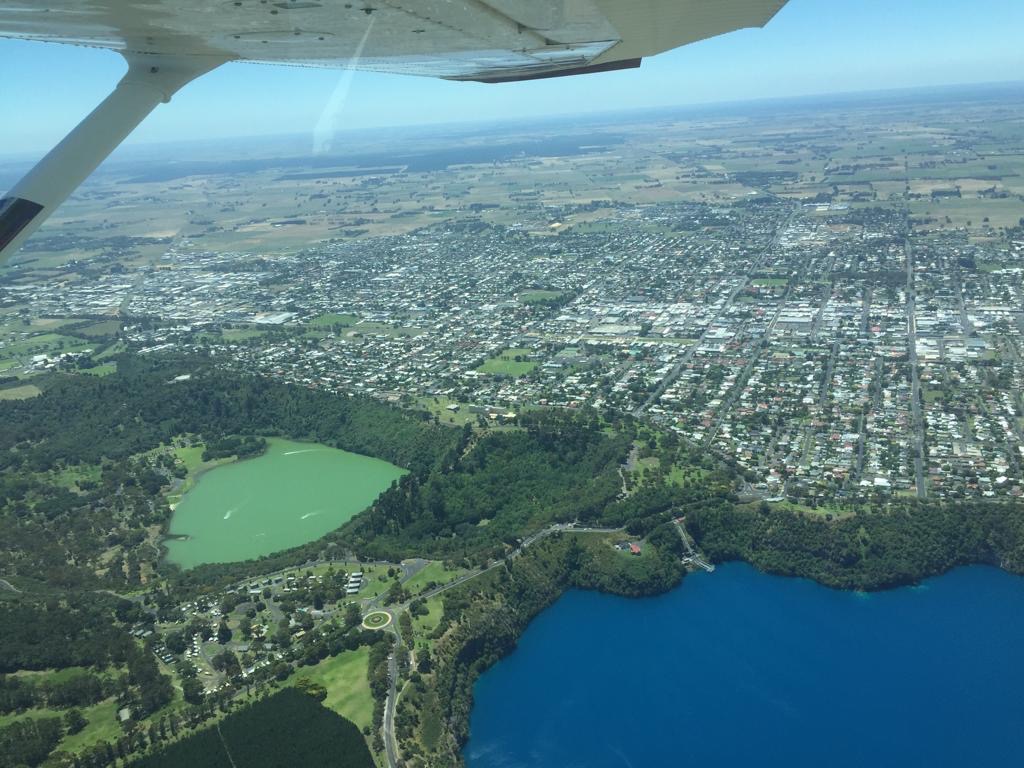
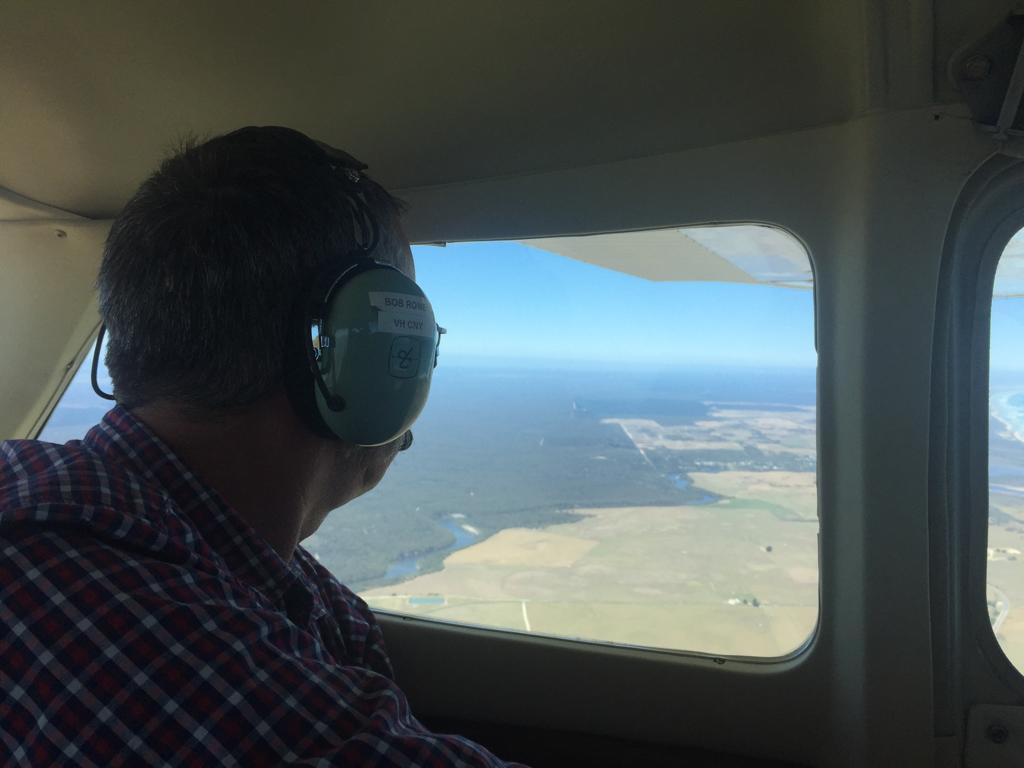
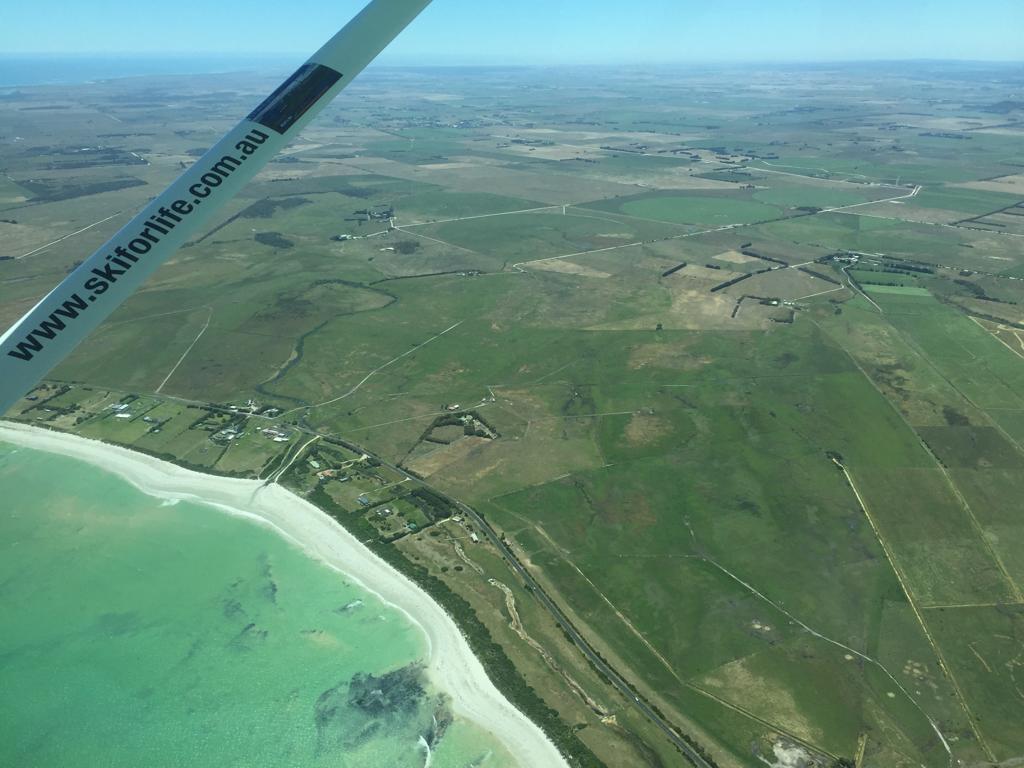
On New Year’s Eve 2018 I took Alan, Brian and Holly for a scenic flight in Bob Rowe’s 172 over Mount Gambier, down to Nelson on the coast then followed the coast up to Lake Bonney, cut across to Millicent then back to the Mount. Perfect conditions. It was Holly’s first flight in a light aircraft and she seemed to really enjoy it.
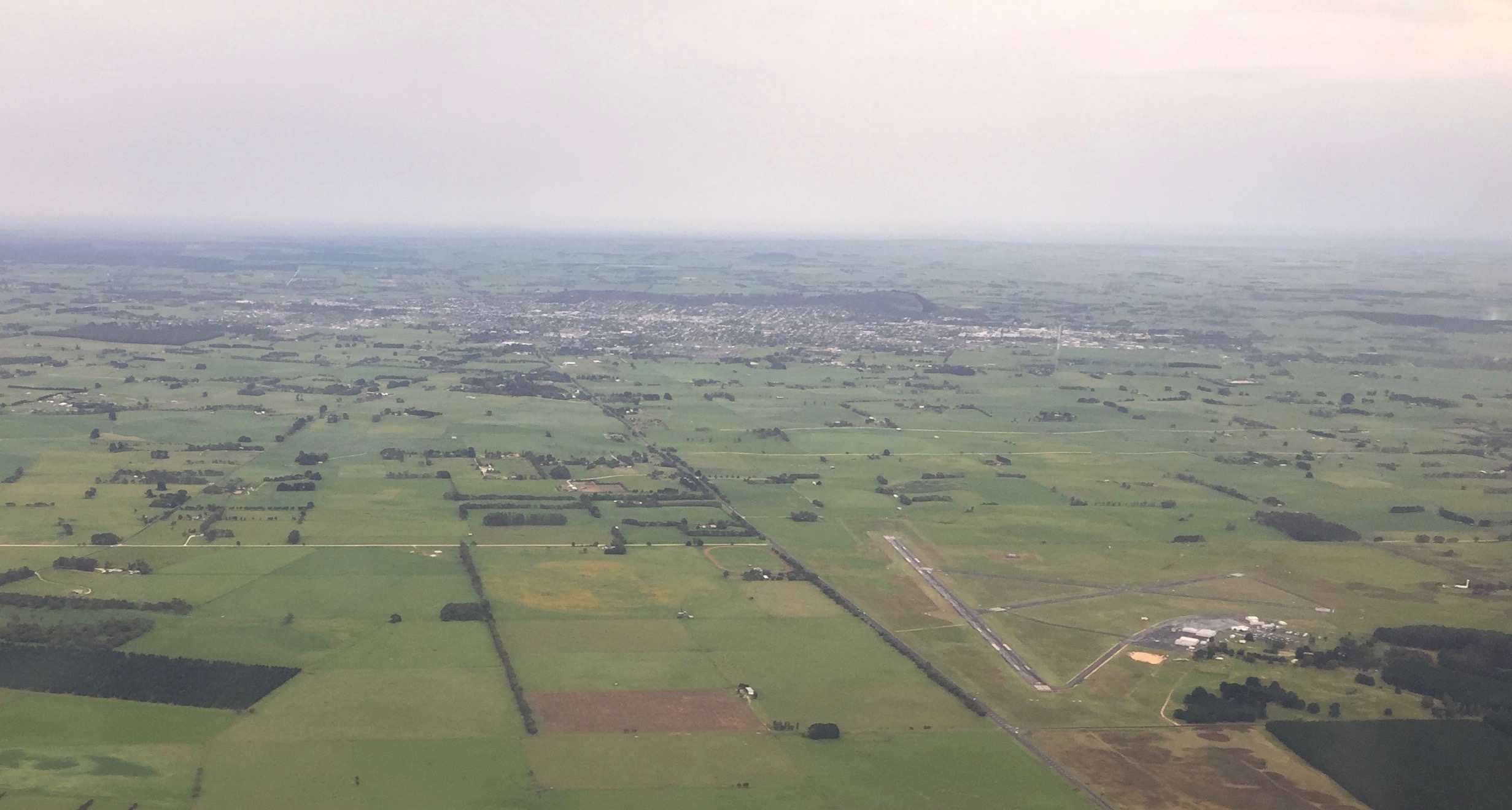
First we flew over the city of Mount Gambier and its famous crater lakes (Valley Lake and Blue Lake). No prizes for guessing which is which! In summer the colour contrast is spectacular while in winter the “Blue Lake” is actually grey.
We flew down to the Glenelg River and over Donovan’s Landing, shown in the background below.
Then along the coast past Eight Mile Creek.
Then on further and over Lake Bonney that has been the source of much debate about water pollution from the neighbouring paper mill for decades. The colour is perhaps evidence of something being not quite right.
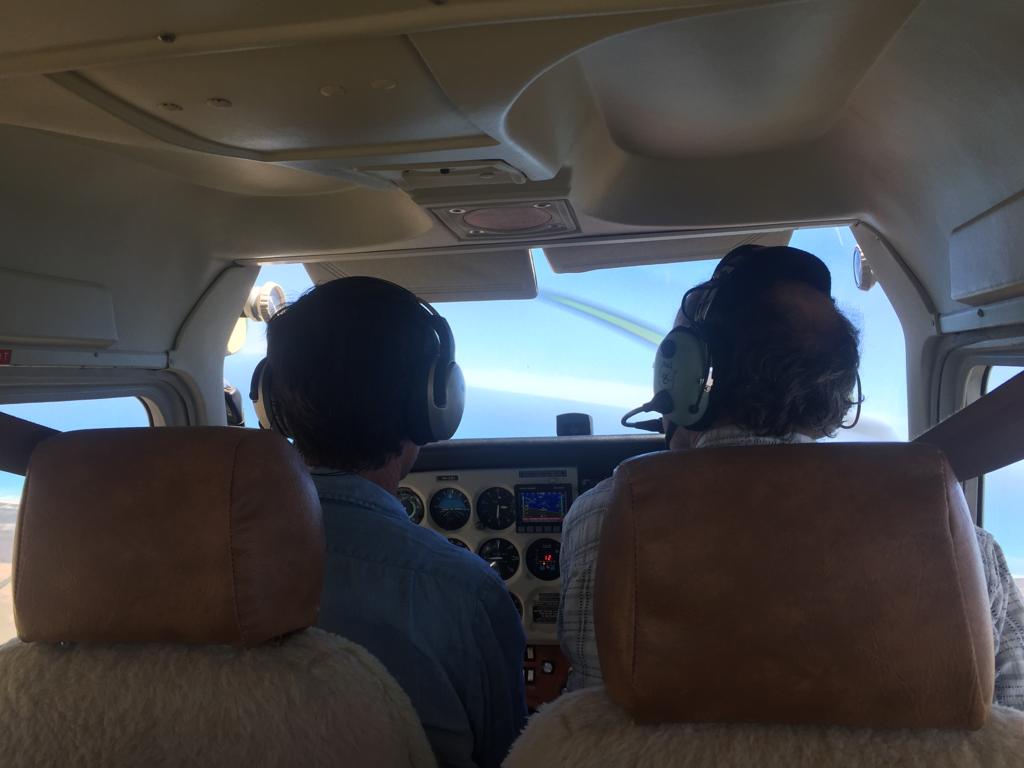
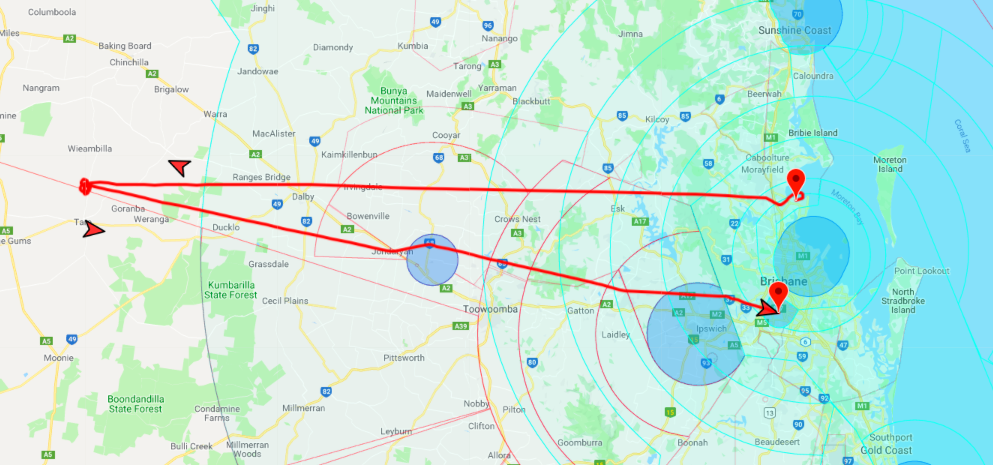
My first Angel Flight as PIC was on 5th December 2018. Sigi and I flew IFR from Redcliffe to a little place called Tara, west of Dalby. It was about 50 minutes in MSF.
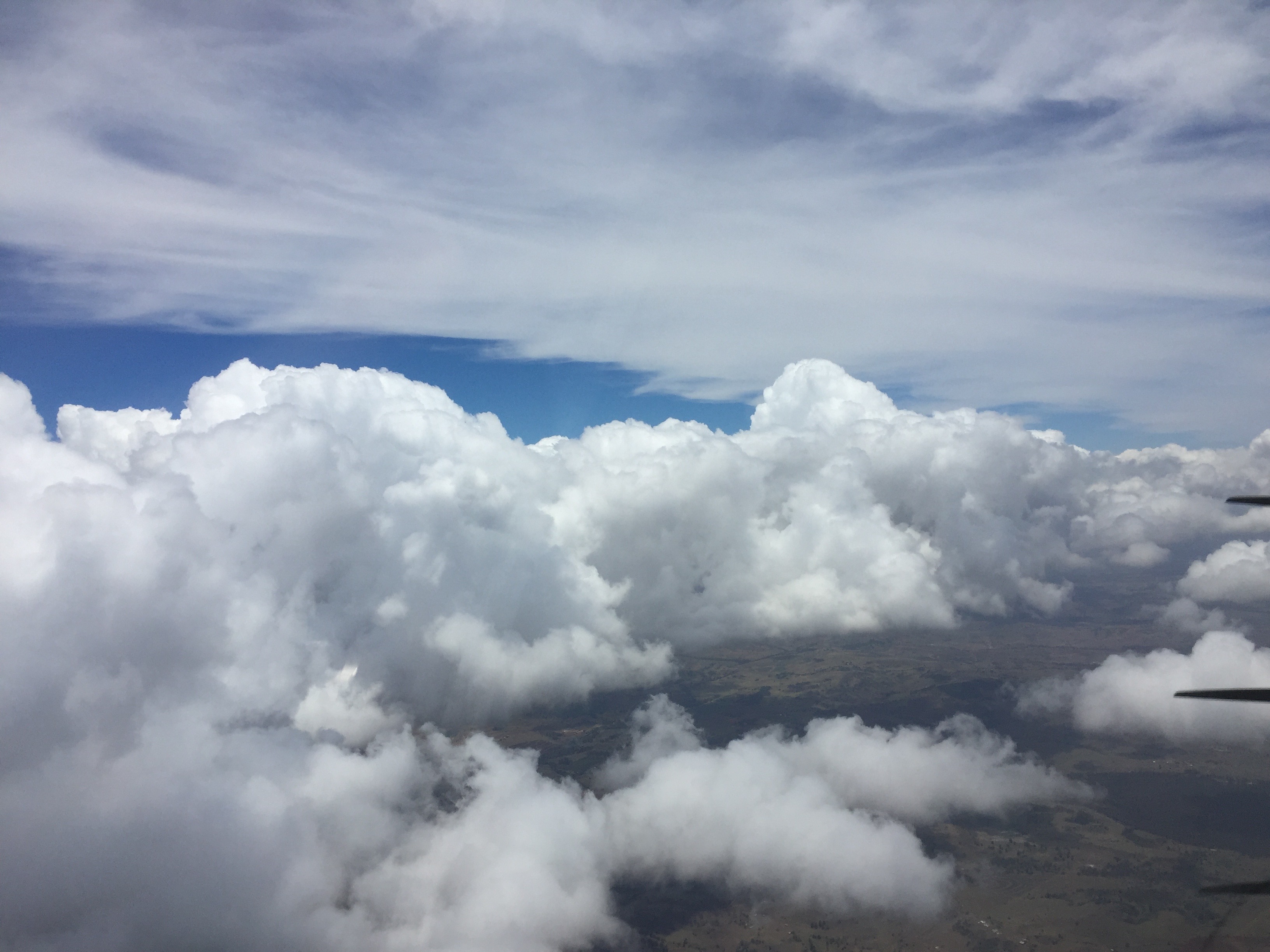
There was a bit of friendly cumulus on the way over the generally flat landscape.
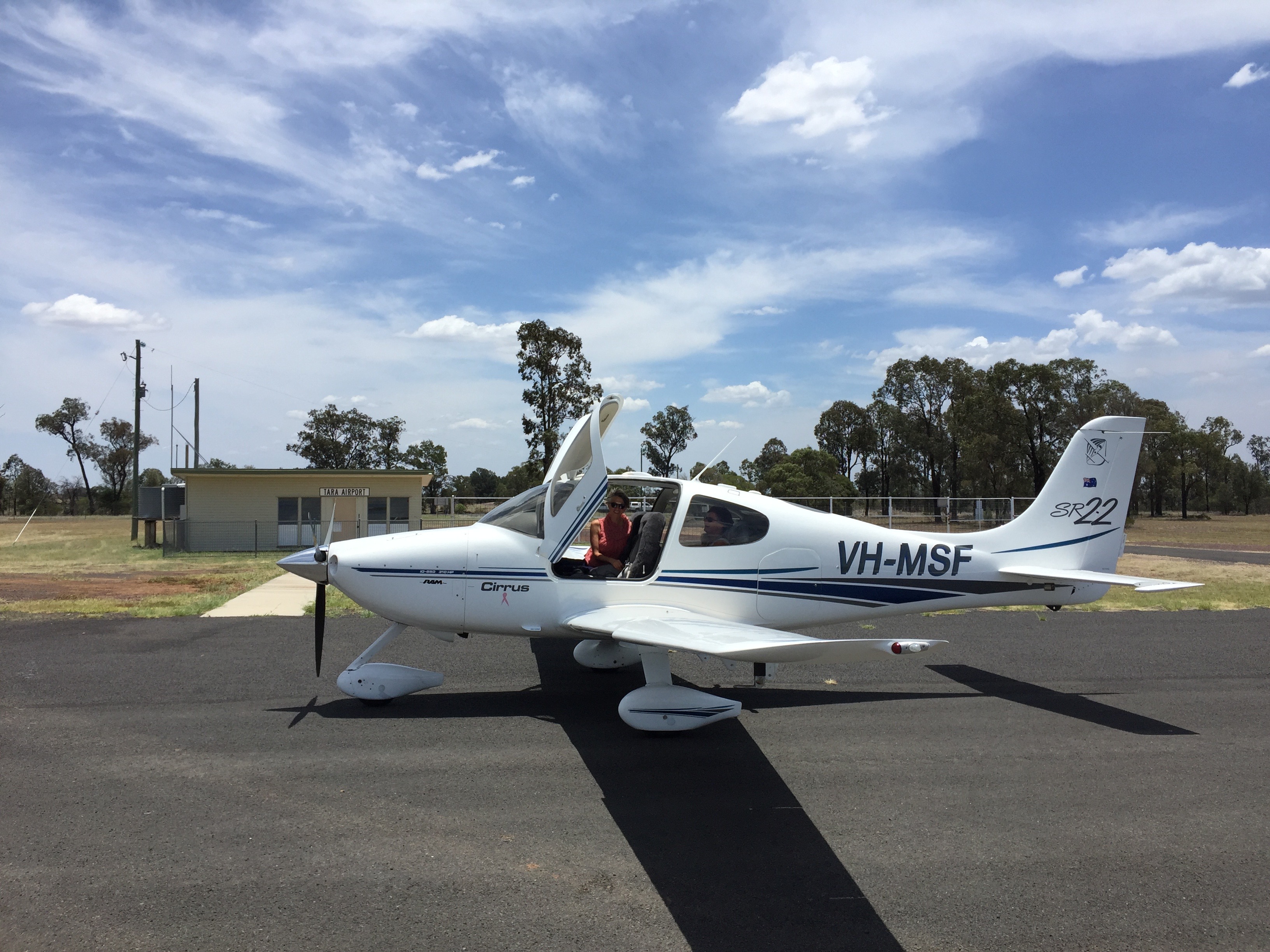
We landed on their wonderful long sealed strip that really was in the middle of nowhere.
Our two passengers were waiting for us so after a short preflight briefing we took off and took off to Archerfield. Once again it was scattered clouds as we passed Dalby. On the way my private nurse made sure that the passengers felt at ease and were well looked after!
After passing over Oakey we flew the RNAV into Archerfield where we were met by the ground transport volunteer.
In November 2018 Mike Cahill, Tom Hassall and I flew down to Orange, NSW, for a weekend to attend a Cirrus Pilot Proficiency Program (CPPP). These are held every 2 years in Australia by the Cirrus Owners and Pilots Association. Cirrus put a lot of emphasis on pilot training and COPA has been formed as an additional channel for training and created a virtual university to organise the programs.
Very professionally run and an ideal forum to learn how to fly better from highly qualified pilots in presentations/discussions and actual flying practice. We flew down on Friday via Glen Innes, Quirindi and Mudgee, a 3 hour flight, with each of us flying about one third of the way. It was fairly cloudy along the way so we flew over the top, IFR.
Turning final at Mudgee
A one hour lunch stop at Mudgee allowed us to check out the local aero club facilities there and the Hangar House BNB. These would both be great places for a future flyaway given the proximity of many great wineries. It was a short 20 minute hop over to Orange from there.
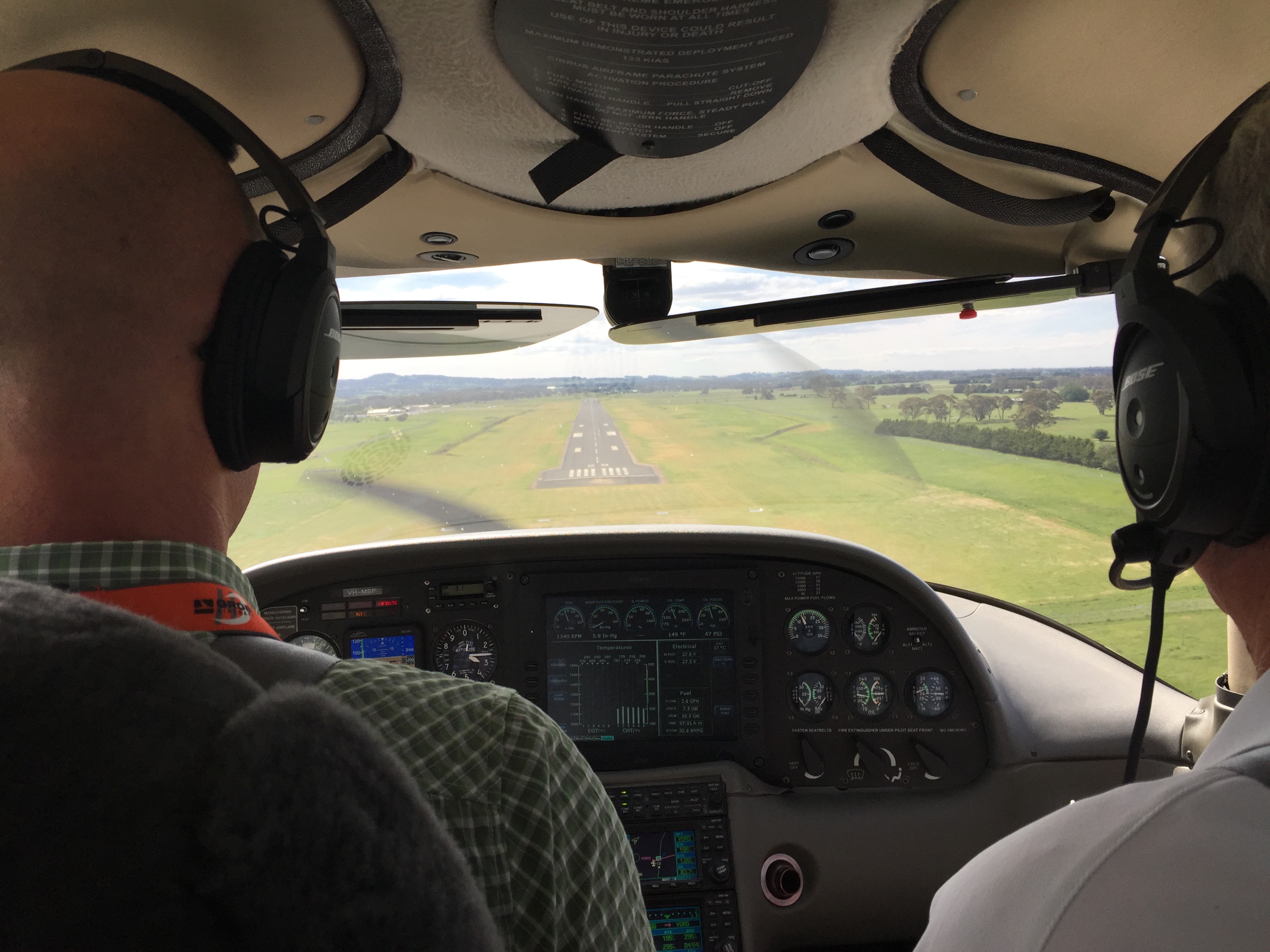
Short final at Orange
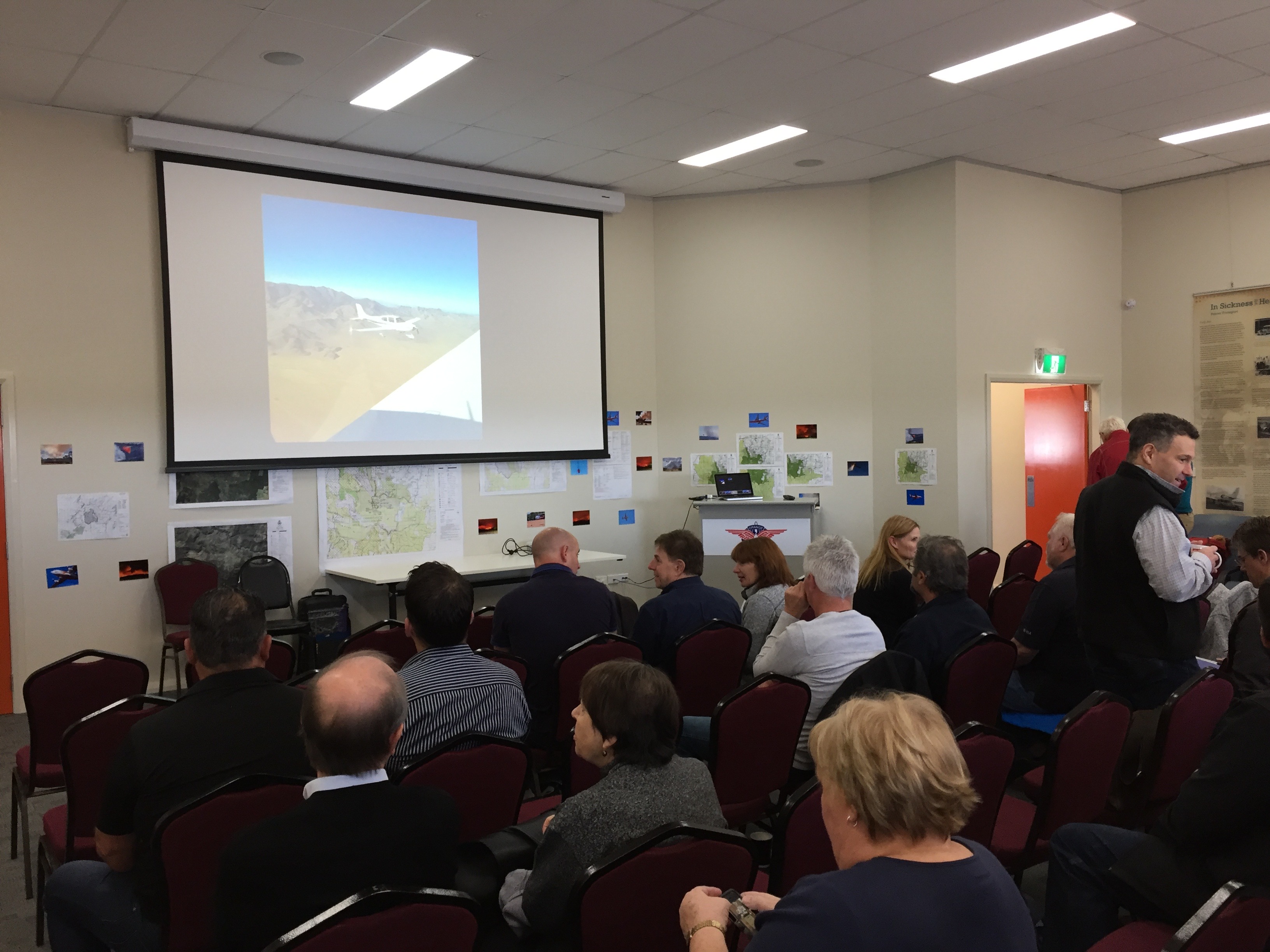
The local aero club hosted the CPPP. They have great facilities and did a superb job. There were about 40 Cirrus aircraft and about 70 course attendees. We arrived about 4pm and after refuelling and parking the plane, were taken into town to check into our accommodation, then picked up again and transported back to the aero club for a get to know you barbecue. Saturday was an early start with presentations and discussion from 8am until 5pm.
I had a 2 hour flight with Jason, one of the Cirrus instructors from California, who had some great ideas on how to improve my flying. On the Saturday evening there was a formal dinner at a lovely old restaurant in the centre of Orange and Sunday was another full day of presentations from 8am until 3pm.
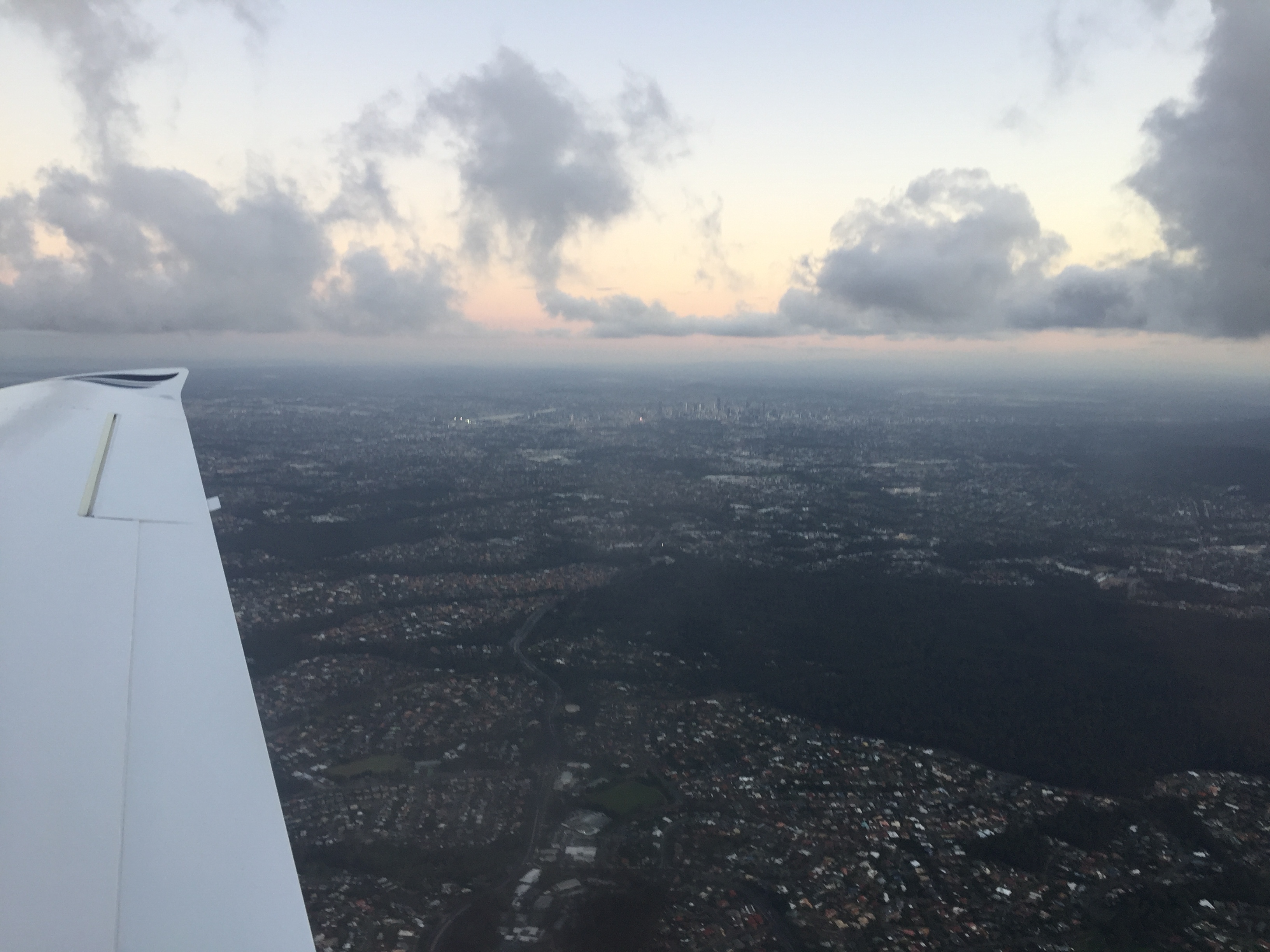
Then it was back into MSF for the flight home, this time skipping Mudgee, and encountering some IMC on the part across south east Queensland. The weather was very kind to us all weekend, with the cloud on the way into Queensland providing some amazing scenery. That’s just one of the reasons we fly IFR!
Departing Glen Innes for RedcliffeOn descent into Redcliffe
While visiting mum and dad in Mt Gambier in October 2018 I hired a Cessna 172 from one of the guys in the local aero club and flew over to Barwon Heads, near Geelong, to catch up with Henrik, who’s building an elaborate beach house in Anglesea nearby. It was great weather and after the winter rains southern Victoria was looking extremely green.
Departing Mt Gambier
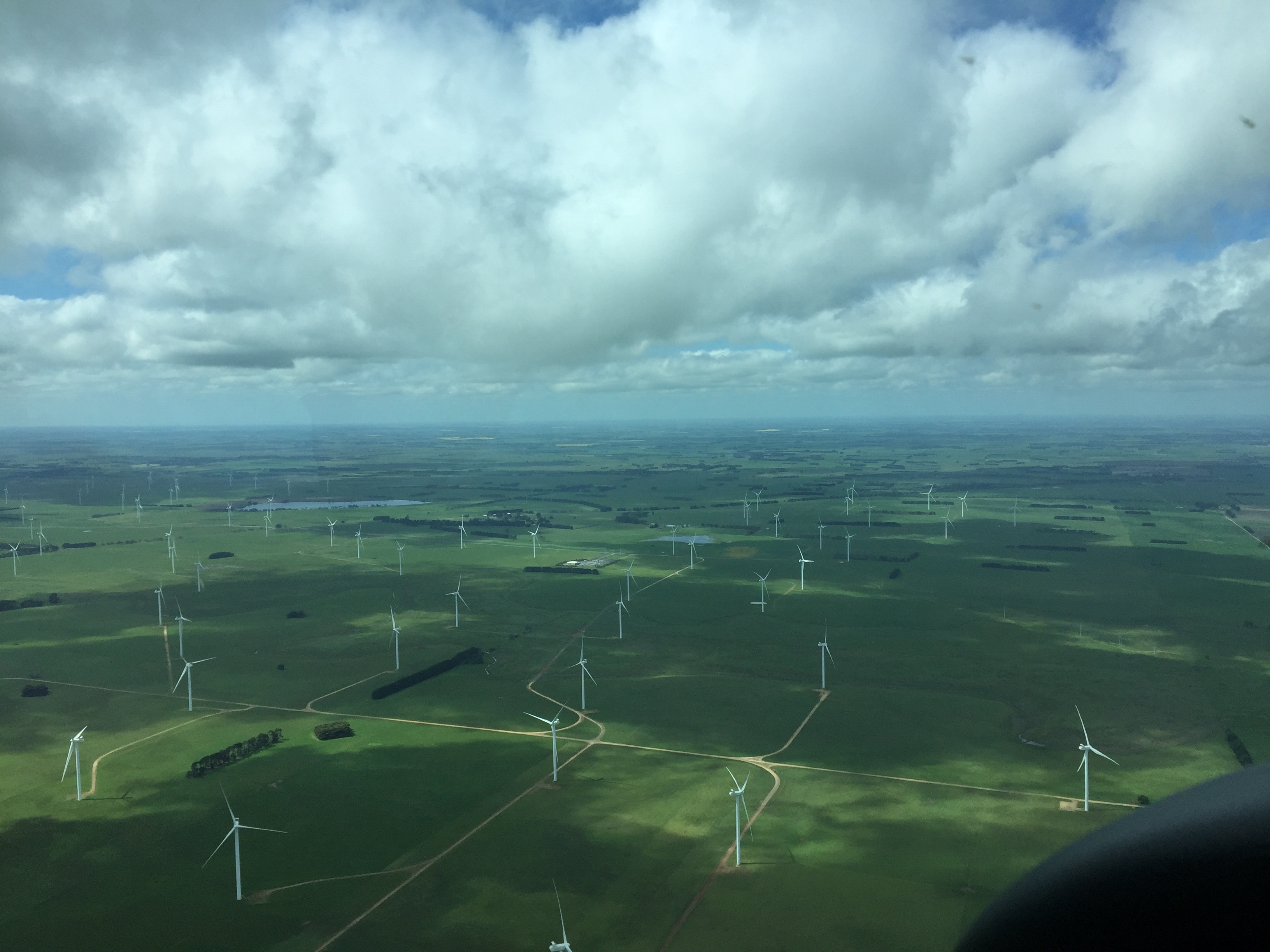
From Mount Gambier I headed east and flew over Dartmoor and Macarthur then on to Colac.
Macarthur Wind Farm
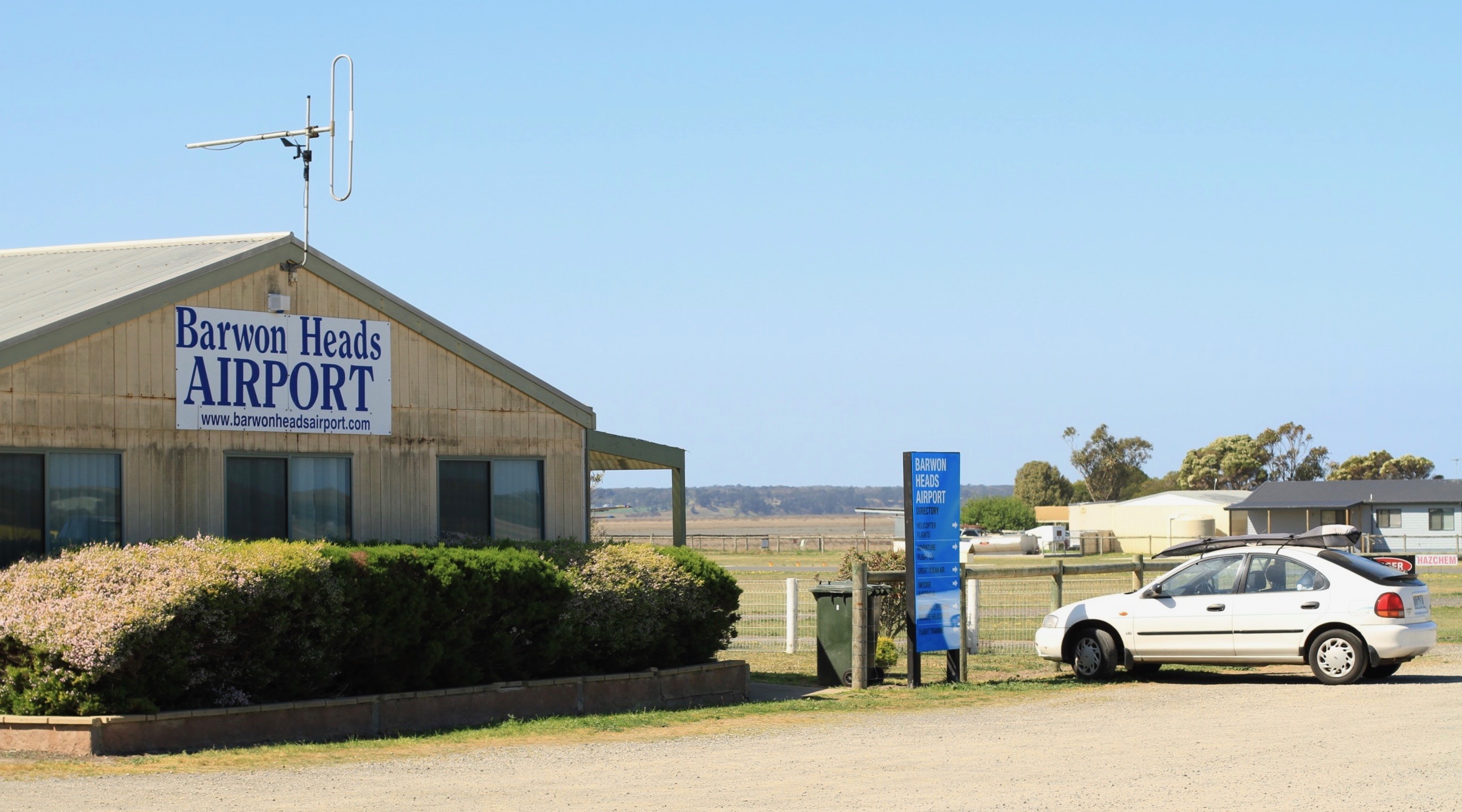
A few puffy cumulus clouds made for interesting flying along the way. I could hear plenty of flight training activity at Colac on the radio so stayed south of it and flew over the Otway Ranges to the coast and followed it from Lorne to Barwon Heads via Anglesea and Torquay. I had to land at Barwon Heads as that was the closest airstrip. Henrik was waiting for me and we went off for some lunch.
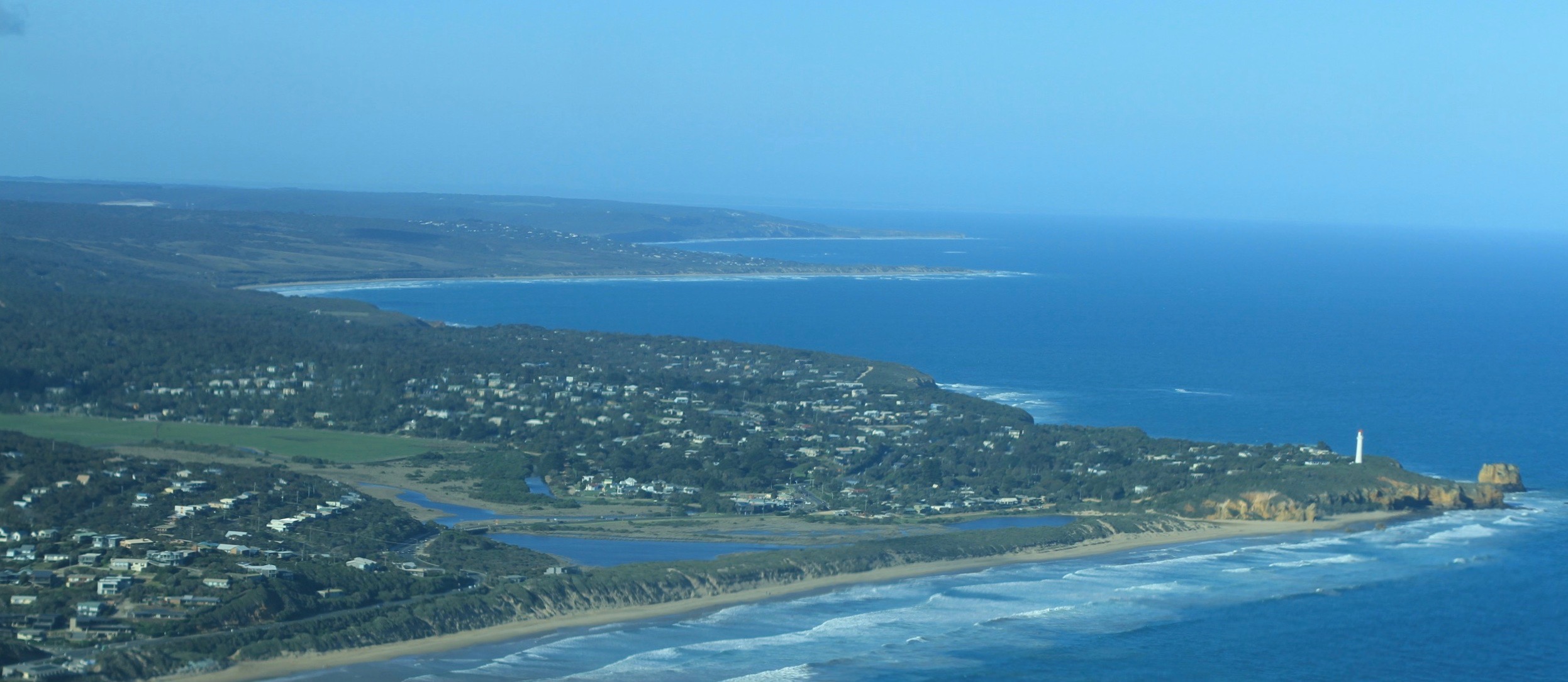
Later in the afternoon I took Henrik for a scenic flight along the coast past Anglesea to Airey’s Inlet, with a few orbits over Anglesea so he could photograph his new house from above.
Henrik’s beach house is the middle one of these threeAirey’s Inlet
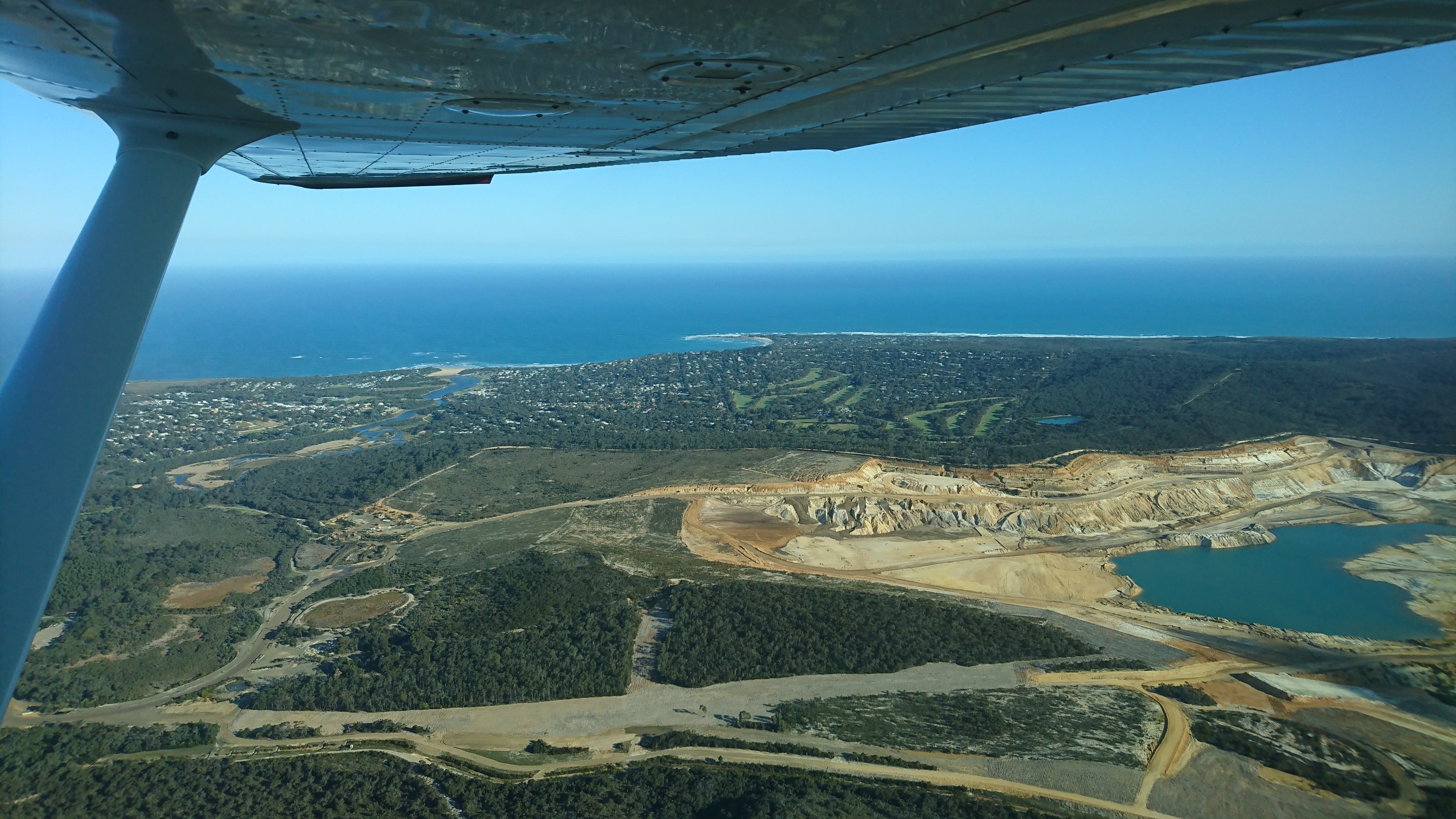
On the way back we flew over the Anglesea coal mine where the power station had recently been demolished.
Coal mine with Anglesea township in background
The old Anglesea coal fired power station had been detonated 2 days before and reduced to a tangle of twisted steel and concrete. It was the second attempt as the first didn’t do much damage. This one seemed to do the job. Apparently the stack will remain as a “tourist attraction”.
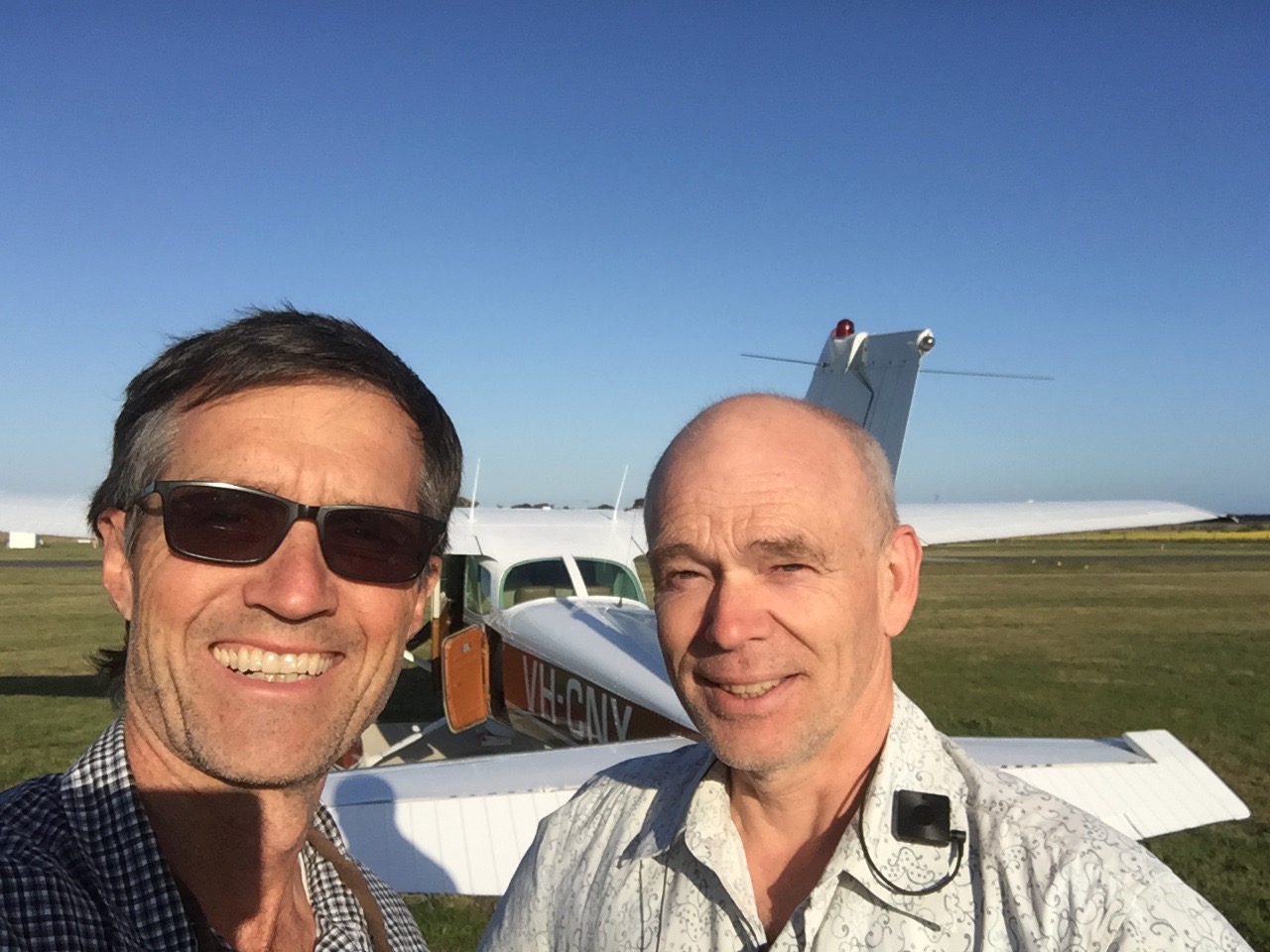
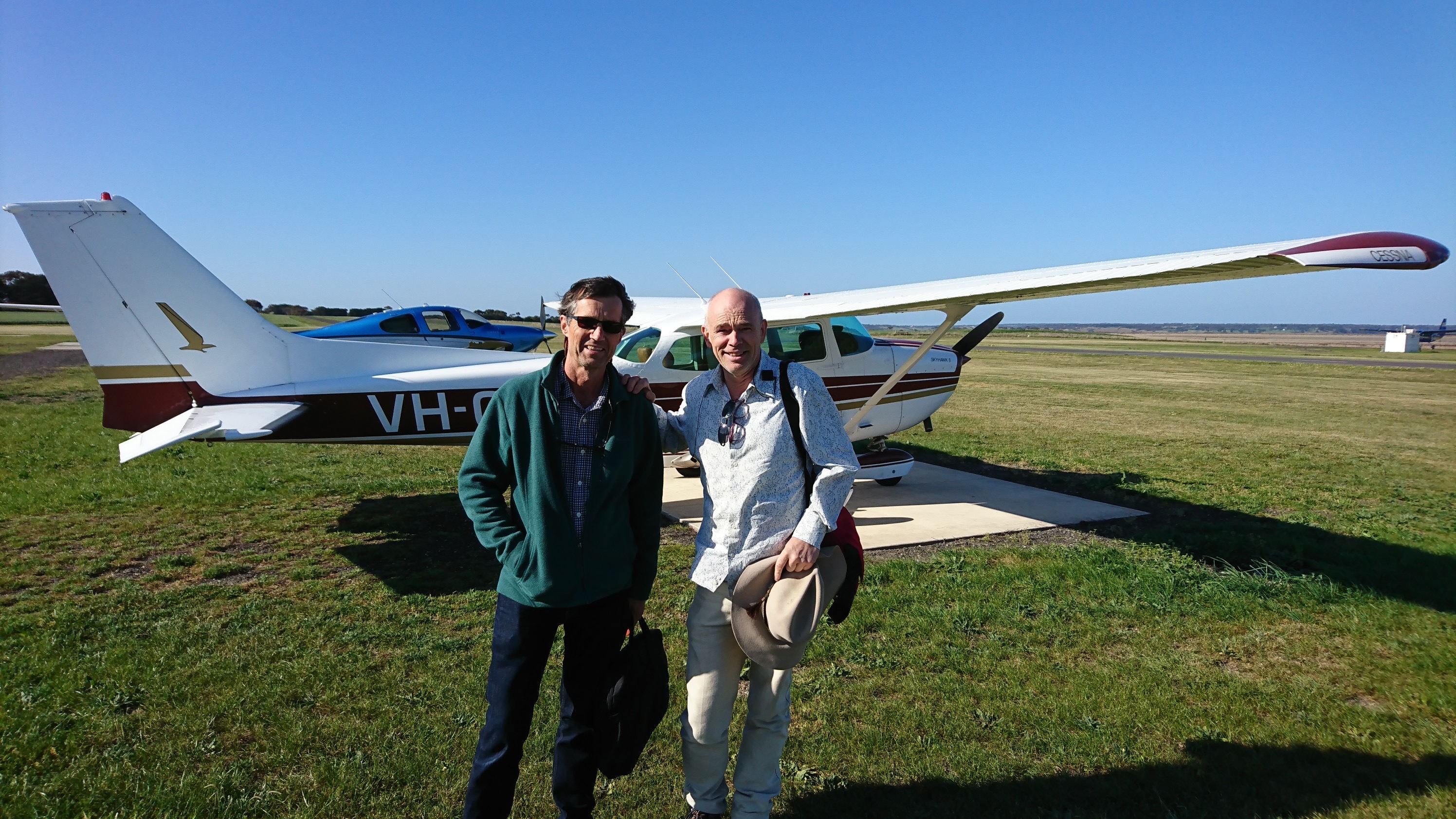
After a smooth landing Henrik told me that it had been his first flight in a light aircraft. Previous smallest was a Dash 8!
Back on the ground
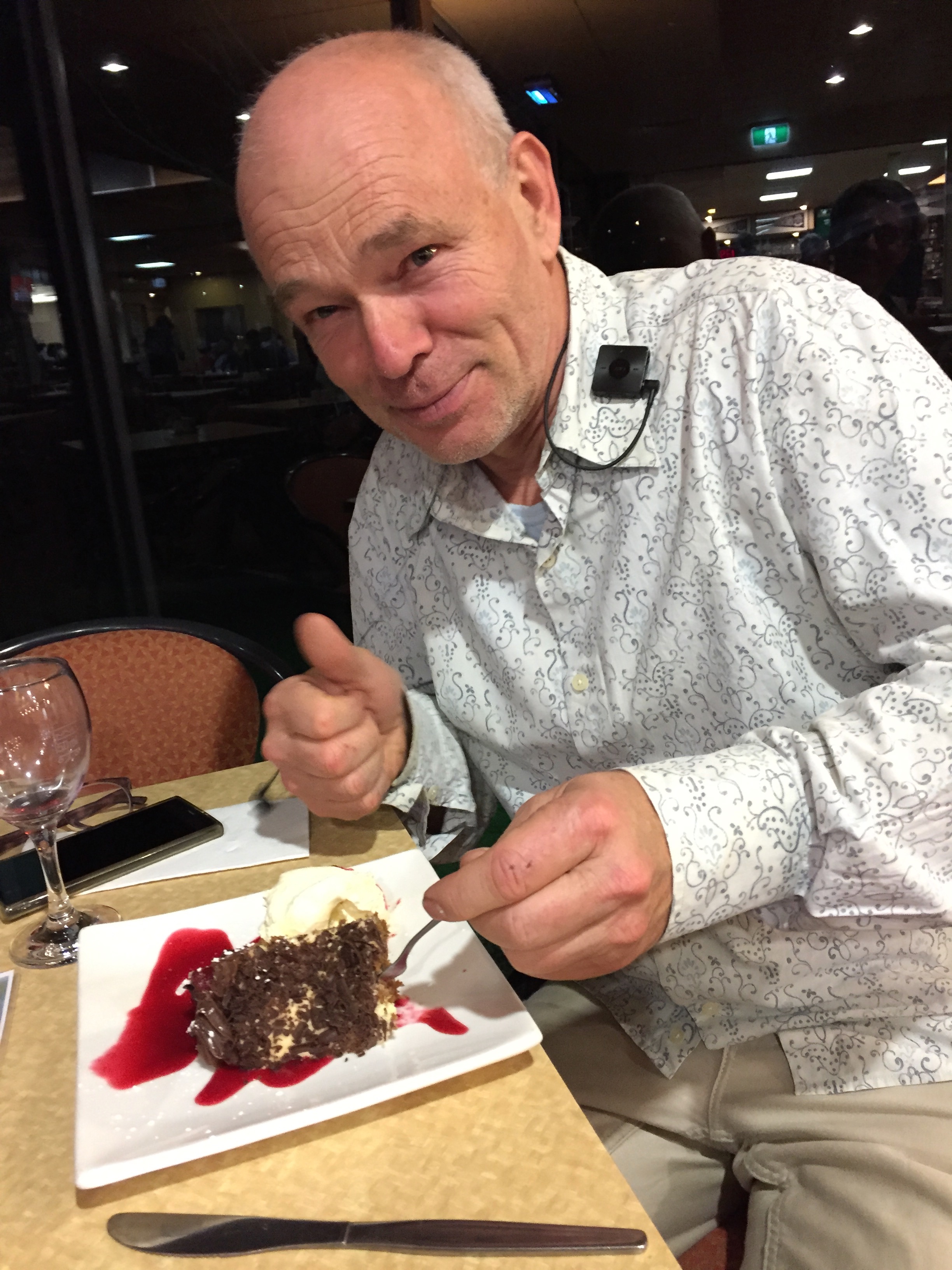
We celebrated with dinner at the Anglesea Golf Club which does a very good steak and probably the best Black Forest Cake I’ve had this side of Austria.
The next day I headed back, taking off once again into the wild blue yonder.
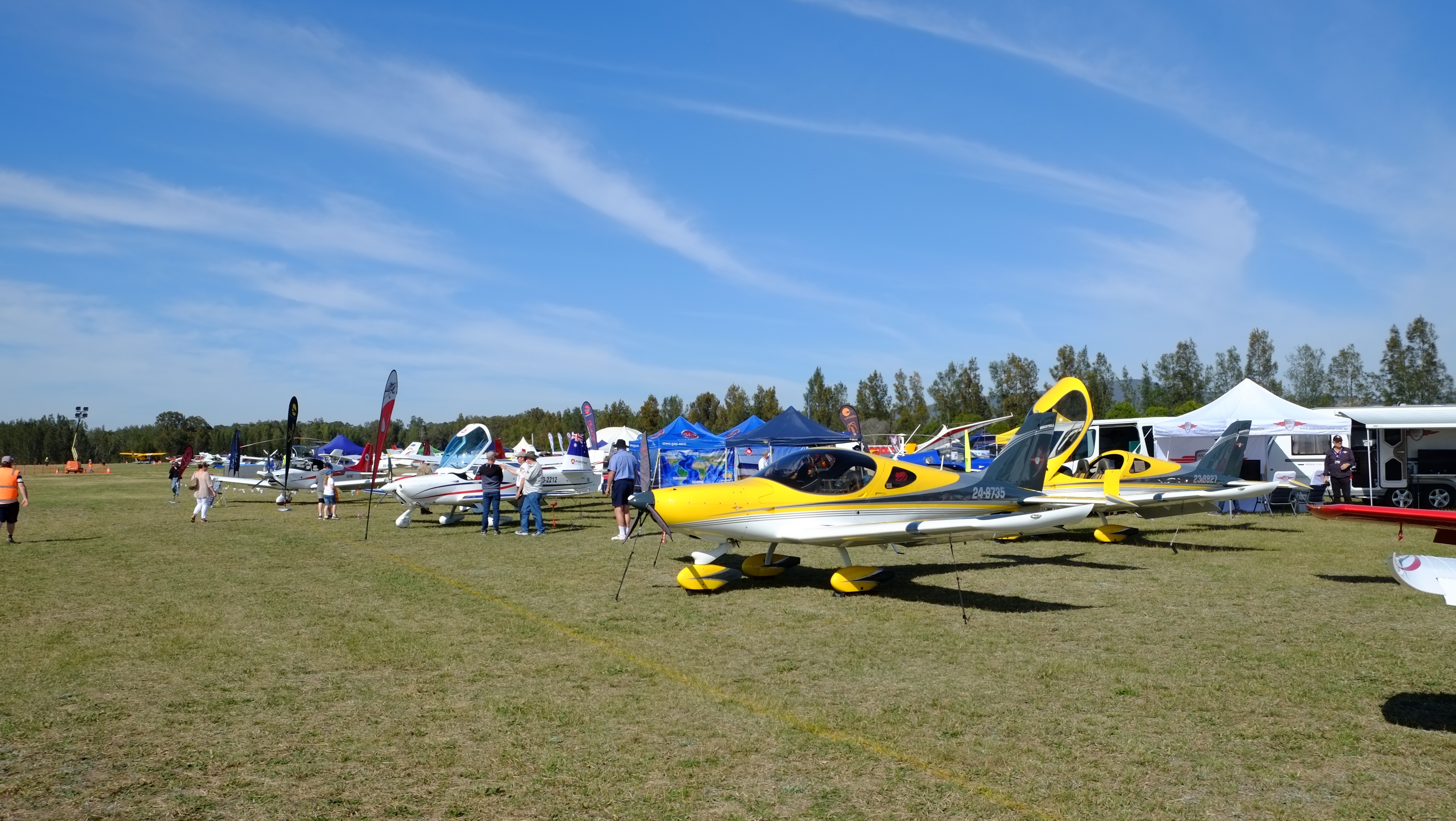
Towards the end of September 2018 Sigi, Mike and I flew down to Cessnock in the Hunter Valley for the AirVenture, a couple of days of exhibitions, seminars and displays promoting general aviation, followed by a series of aerobatic displays. AirVenture had been an annual event for some years. It started as a gathering for sport aircraft enthusiasts but more recently had grown to include all manner of general aviation. The idea was to connect aviation enthusiasts with each other and also with suppliers of aircraft and associated hardware and software who showcase their products. It also included a series of seminars and presentations about a variety of aviation related topics. The presenters were pilots, instructors, salespeople or representatives of organisations who have interests in general aviation. As a result of its success, the event outgrew its original base at Narromine near Dubbo and in 2018 was held at Cessnock Airport in the Hunter Valley.
I had no preconceptions of AirVenture but I’d wanted to fly to Cessnock for some time, and Mike was keen to attend AirVenture, so I agreed to fly down there with him in MSF. I managed to persuade Sigi to come with us by not mentioning the fact that it was in fact an aviation event until she’d already committed to go. She thought it was just a flyaway to the Hunter to do some wine tasting!
Our plan was to fly down on the Thursday morning, attend AirVenture on Friday and Saturday and then return on Sunday. Four seminars ran in parallel all day Friday and on Saturday morning while an air show filled out Saturday afternoon. A gala dinner was held on Saturday evening.
I elected to fly down, with Mike manning the radios and Sigi acting as time keeper. Good division of labour among the crew. The trip down started well, flying IFR in blue skies.
Climbing past The Gap and Enoggera Dam
We were cleared to climb pretty well straight away and were at 9000ft over Amberley, then tracked via Armidale down the western edge of the great divide.
The overall trip was just over 2 hours in the Cirrus and by the time we were about 45 minutes out of Cessnock some cloud was gathering ahead of us. The weather forecast had mentioned showers and low cloud close to Cessnock that was due to clear by 2pm. Although we’d taken our time departing it was still only midday by this time. No worries though, we’re IFR. A bit of IMC (Instrument Meteorological Conditions = in cloud) practice is good. Then Mike received a text from Rebecca Penny, the Cirrus sales rep from Sunny Coast who had flown down the day before that said basically: “Are you still expecting to fly in today? Nil visibility here right now!” There is no RNAV approach into Cessnock so Mike checked the BOM radar while I checked our Plan B: head out west of the Hunter to Scone and land there to wait out the weather that was due to clear to the north east of Cessnock. Scone was CAVOK and we could see that there was no cloud out to our right hand side. All good!
We decided to continue on our flight planned track and enter IMC, checking our lowest safe against the topography before we entered cloud. With just over 30 minutes to run we entered IMC at 9000ft and pretty quickly noticed the temperature drop. Mike asked “Did you check the freezing levels”. I said “Yeeeees! And then remembered that it did say 7500 ft at the southern end of our planned track. “Let’s descend to 7000ft!” I suggested, knowing that LSALT was 6600ft. Mike contacted ATC who confirmed “no IFR traffic” and down we went. As we descended the temperature rose a bit but as we levelled out it started to decrease yet again.
We were still in IMC with occasional breaks in the cloud when the temperature dropped to 2°C and Mike noticed some ice forming on the right wing. Knowing we couldn’t descend any further until we’d passed the Barrington Tops we debated quickly whether to head west out of the IMC as Sigi remained focussed on her knitting in the back seat. Then there were a couple of breaks in the cloud and the temperature rose again. We maintained our track and Mike advised ATC that we’d delay top of descent due to weather. Once we’d passed Brumlow Top (5204ft) and Mt Royal (3885ft) we descended to 5000ft and broke out of the cloud. We could see Singleton ahead and off to our right but low cloud to the left where we knew Cessnock had to be. Being visual we descended to 3000ft so we were below the cloud base. Passing Singleton we headed straight for Cessnock and kept a good lookout for the aerodrome. There were showers around so we dodged a couple as we approached and spotted the runway, joined downwind on RWY35, and landed, just as the weather cleared away to the north east. It had been another good IFR experience – we’d negotiated some tricky IMC but had a Plan B at all times. The lesson of the day was: Take good note of freezing levels in the GAF before you fly!
We tied down the plane and headed off to the Crowne Plaza Hotel, located next to the aerodrome. It’d be home for the next 3 days. The weather cleared away and it was a wonderful fine, albeit chilly, evening.
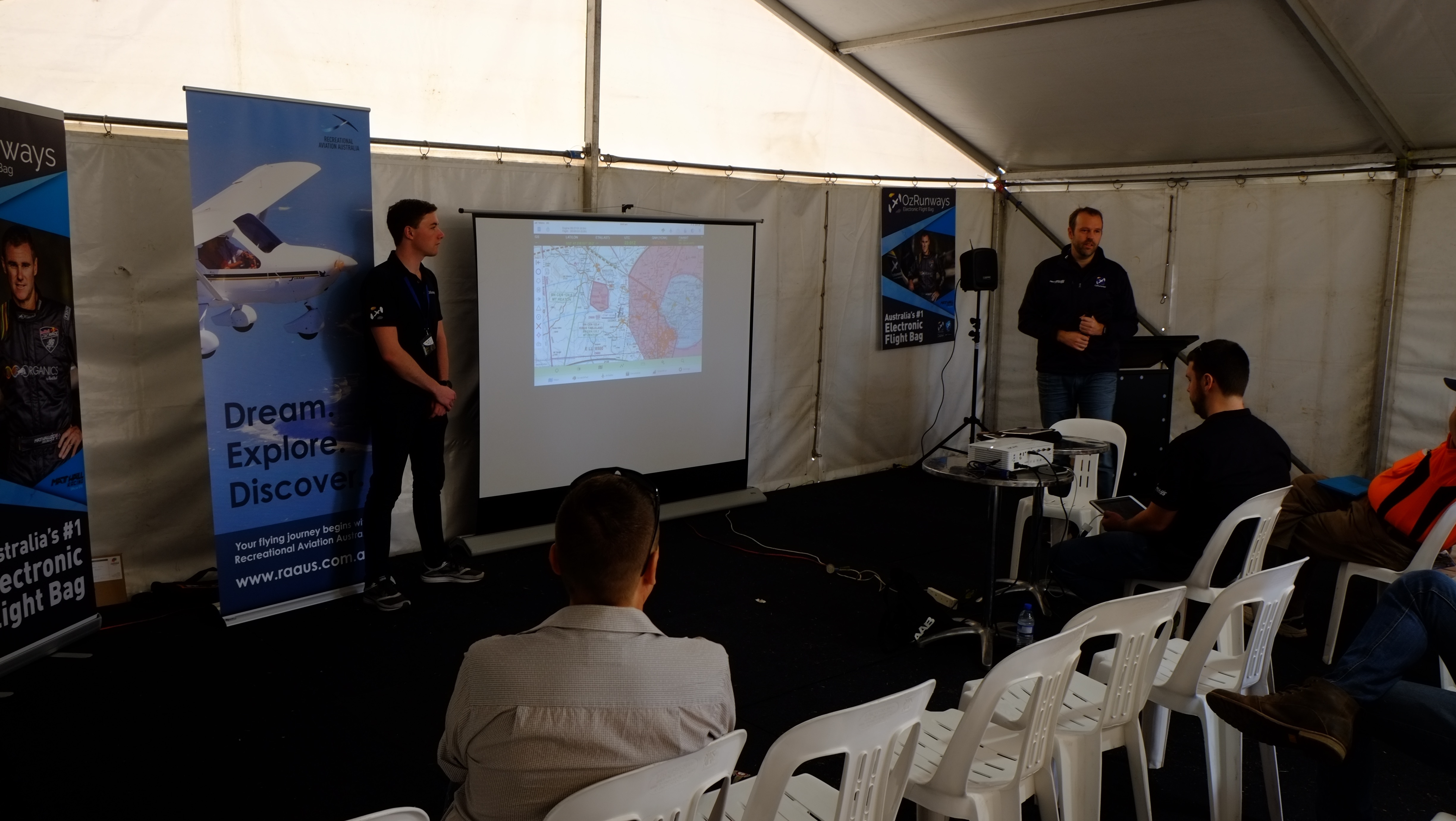
Friday dawned with clear blue skies. We caught a shuttle bus over to the AirVenture site at 8:30 so we could take part in the first seminars at 9am. The range of seminars was impressive. I went to a different one every hour until 4pm. I didn’t have time to check out any of the planes on display or the stands of the suppliers. I even managed to miss out on lunch because there was so much happening. Topics included An Introduction to Angel Flight, GAF Forecasts, What to expect from your BFR, OzRunways Q&A, ATC with confidence, AvPlan Introduction and Emergency Handling. It was a great day with a lot of things to learn.
Friday evening was dinner at one of the many fine restaurants in the Cessnock area.
On Saturday the seminars commenced at 9am with an OzRunways tutorial, a Matt Hall talk on safety, one pilot’s experience of the Outback Air Race, an explanation of the technology behind Dynon glass panels and some history of Spitfires over Normandy in WW2.
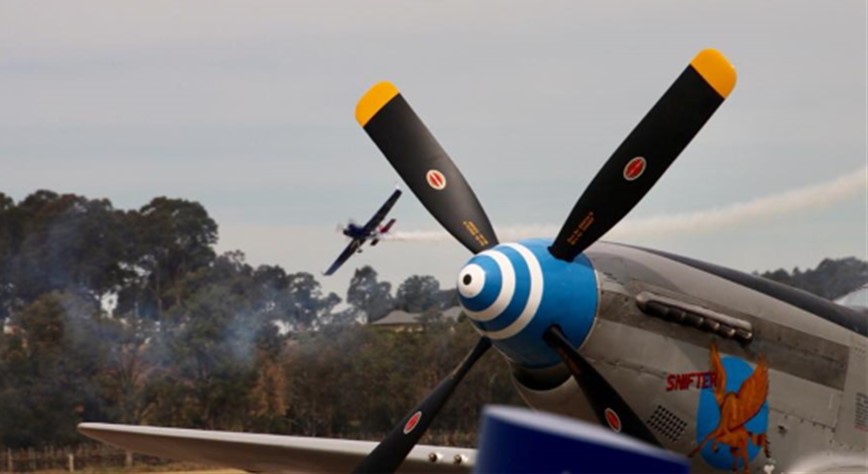
By 1pm we were seminared out and ready for the air show. Matt Hall and his fellow aerobatics aviators didn’t disappoint. It was quite a show. I managed to check out a few of the supplier stalls and some of the range of aircraft on display in between acts and even managed to get some lunch for a change. By 4pm the show was over and the displays were starting to be dismantled and we headed back to the Crowne Plaza to get ready for the gala dinner.
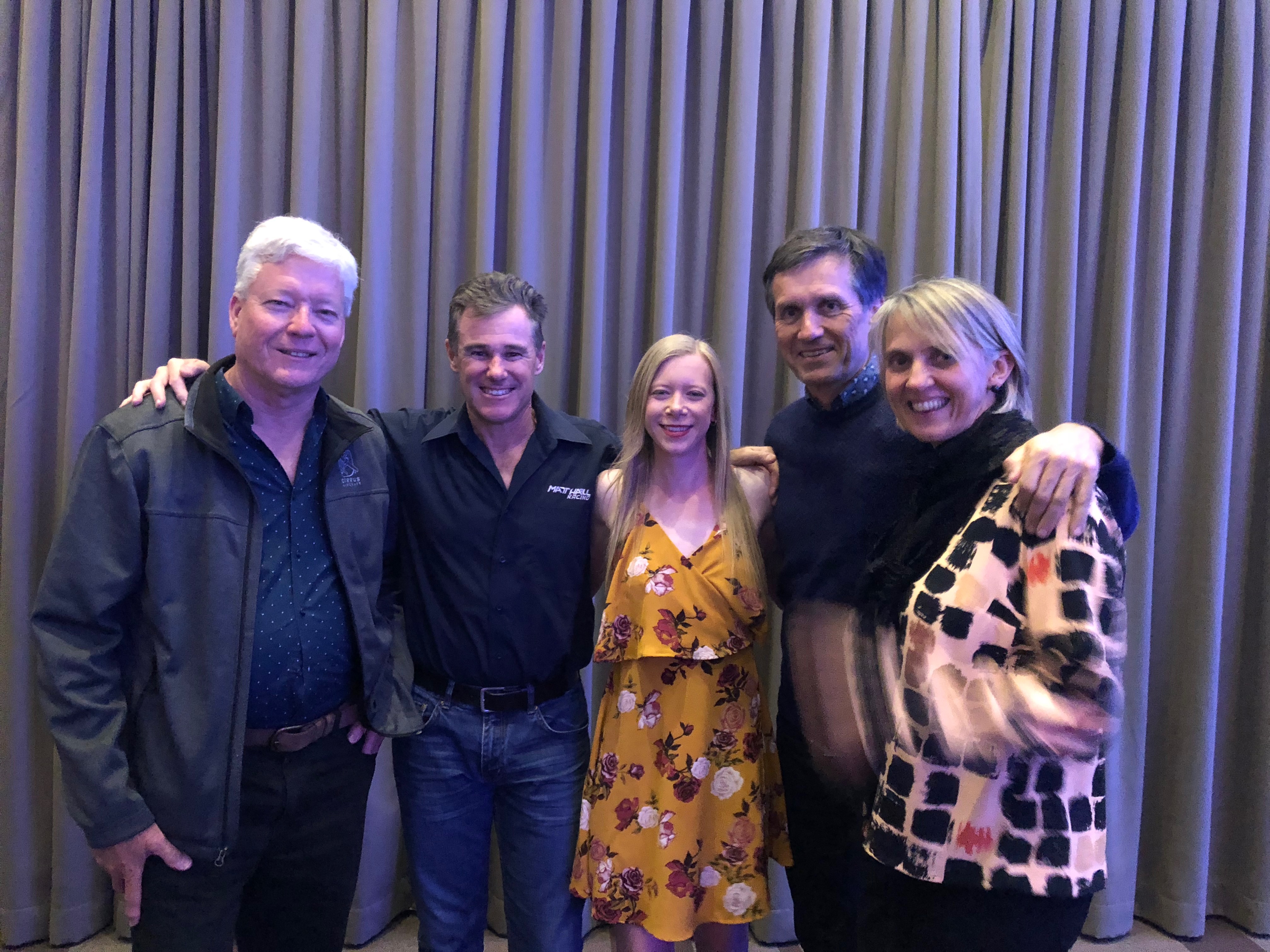
This was a great event with a speech by Matt Hall with excerpts from his life story and how he morphed from teenage glider pilot to sport aviator to RAAF fighter jet pilot and then to Red Bull Race champion. And many of the lessons learned along the way, including how to work in a team and get the most out of yourself and those you work with while remembering the real aim of it all is to arrive home safely to your loved ones at the end of the day. Impressive. Scholarships were presented to a couple of young aviators who admitted they would love to follow in Matt’s footsteps one day. It ended up with some rather late chatter and banter in the hotel bar with new friends.
With Matt Hall
On Sunday morning it was time to up stumps and head home. The weather was picture perfect and forecast to be so all the way back to Redcliffe. We decided to take the coastal route. Mike was PIC and I was radio operator. Sigi was timer again. We said our goodbyes then taxied out and joined the small queue of aircraft waiting to leave. We had a rather slow one in front of us and as he rolled down RWY 17 and an inbound aircraft turned base, we entered and lined up. The plane in front of us climbed painfully slowly and we waited for him to turn, knowing that at the speed the Cirrus climbs we could easily catch him if he didn’t turn first. The incoming aircraft turned final and we waited. And waited. For the plane ahead to turn. The incoming pilot asked whether we could vacate the runway as soon as possible. The departing aircraft turned. Mike applied full power, we rolled and rotated. We were off.
Departing the Hunter Valley on climb to 10,000 ft
We departed to the northwest initially to avoid flying though the restricted airspace around Williamtown airbase. Mike had planned at 9000ft as we were heading north east for most of our route but ATC asked us to choose between nonstandard 8000 or 10,000ft so we chose the latter. The auto pilot turned us over our first way point and we climbed to 10,000ft, tracking via the IFR route north east to Taree, then followed the coast, tracking over Kempsey, Coffs, Evans Head and Ballina.
Our navigator taking a break from her knitting to check we’re still on track with help from OzRunwaysEvans Head
Approaching Ballina a Q-Link Dash 8 was departing and we saw him climb across our path as he headed to GAMBL (the IFR waypoint overhead Casino). Then it was on towards the Gold Coast. ATC vectored us (gave us a heading to fly) out to sea to avoid traffic south of the Gold Coast and then we were vectored over the top of the Gold Coast airport and on into the southern part of Moreton Bay where we reached our top of descent. ATC then vectored us on various headings so that we descended through 6000ft as we passed Brisbane CBD on our left and Brisbane International on our right. How cool was that!
Soon we were approaching the Redcliffe Peninsula but we were too high to do a normal approach so we requested one orbit over water to allow us to descend to circuit height. It was midday on Sunday, a perfect blue sky day and surprisingly no traffic in the circuit at Redcliffe! Criminal but it made life easy for us. Mike joined downwind for RWY 07 and did a great landing. A perfect end to a great trip.
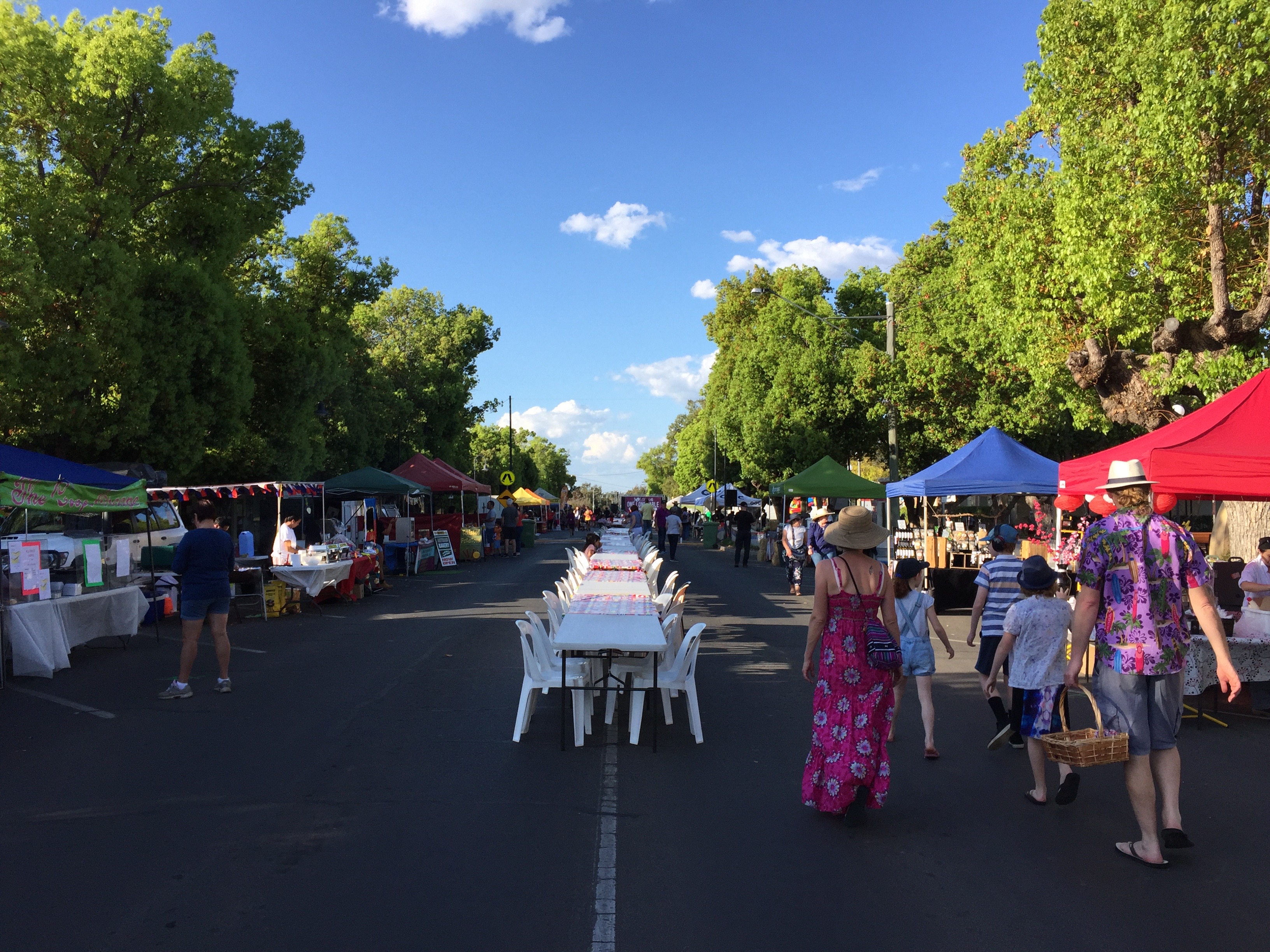
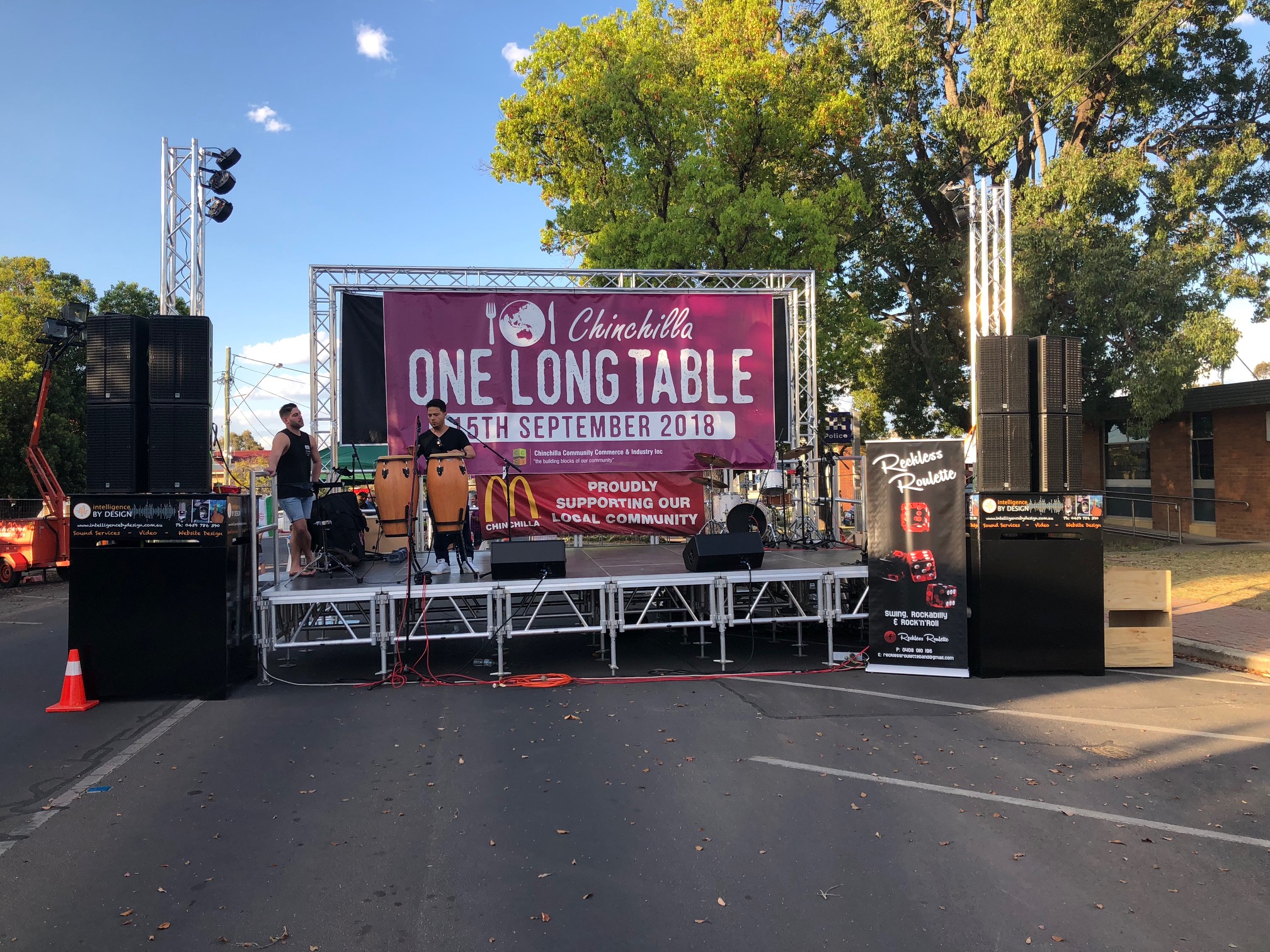
On the weekend 16th September 2018 as an aero club flyaway we had a quick trip out to Chinchilla to the annual One Long Table Festival (and an even quicker trip back). The festival celebrates the multicultural community in this western downs town with a variety of foods from around the world and live music.
We had a leisurely departure from Redcliffe on the Saturday morning with reasonable winds and weather.
Departing from Redcliffe – Upwind on RWY07
The trip was out an hour to an hour and a quarter depending on plane and route. We had seven planes and fourteen people together with a RA plane who joined us. Heading off west from Redcliffe we were soon passing over Lake Samsonvale and the Pine Rivers Dam.
Heading out past Lake Wivenhoe and Somerset Dam we made good speed and were soon on short final into Chinchilla.
On final into Chinchilla
The main street in the town was closed and stalls, food, music and entertainment was provided in booths all around a long table stretching about 200 metres for everyone to share. The idea was to select food and drink and sit at the table while enjoying the atmosphere and entertainment.
We arrived mid afternoon so after a break we headed off to the festival for an enjoyable evening with clear skies and cool weather. The event was interesting and we stayed at the Downtown Motor Inn only 100 metres from the main street.
Sunday morning was windy but fine. The Chinchilla Aero Club put on a BBQ breakfast that we all attended. The club is a group of aviators with their own planes and who have a club house and get together regularly.
By mid morning, the weather was starting to deteriorate and was forecast to get worse. Also, a nasty crosswind developed. We all headed off fairly quickly after the breakfast before the weather became any worse. Luckily the wind was from the west so our trip home was faster than the outbound one, with a good tail wind. We topped 208 knots ground speed on the way back.
Unfortunately the wind also stirred up a bit of a dust storm so we didn’t have good visibility on the way home, even at 9000ft.
The Gap – Mt Coottha – Archerfield – Stradbroke Island – Point Lookout – Moreton Island
On 14th September 2018 I decided to make the most of the dry weather in Brisbane and went for a flight around the bay, starting at Redcliffe and first heading to Archerfield via The Gap. After a short break we took off again flew east to the southern end of North Stradbroke Island, then followed the east coast to Point Lookout and on to Moreton Island then back over the bay to Bribie Island and Redcliffe. Harpur came along as official photographer and took these great shots.
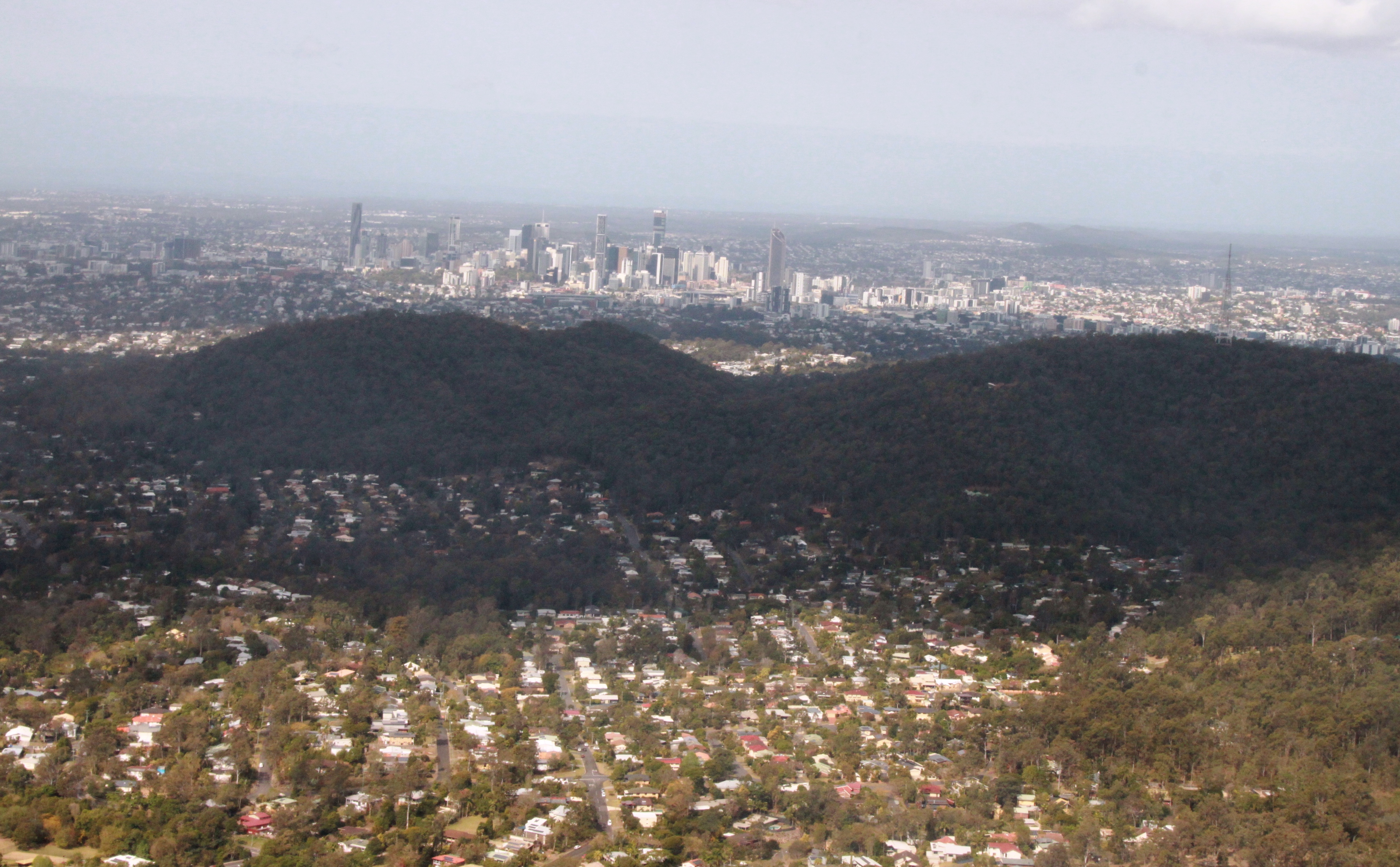
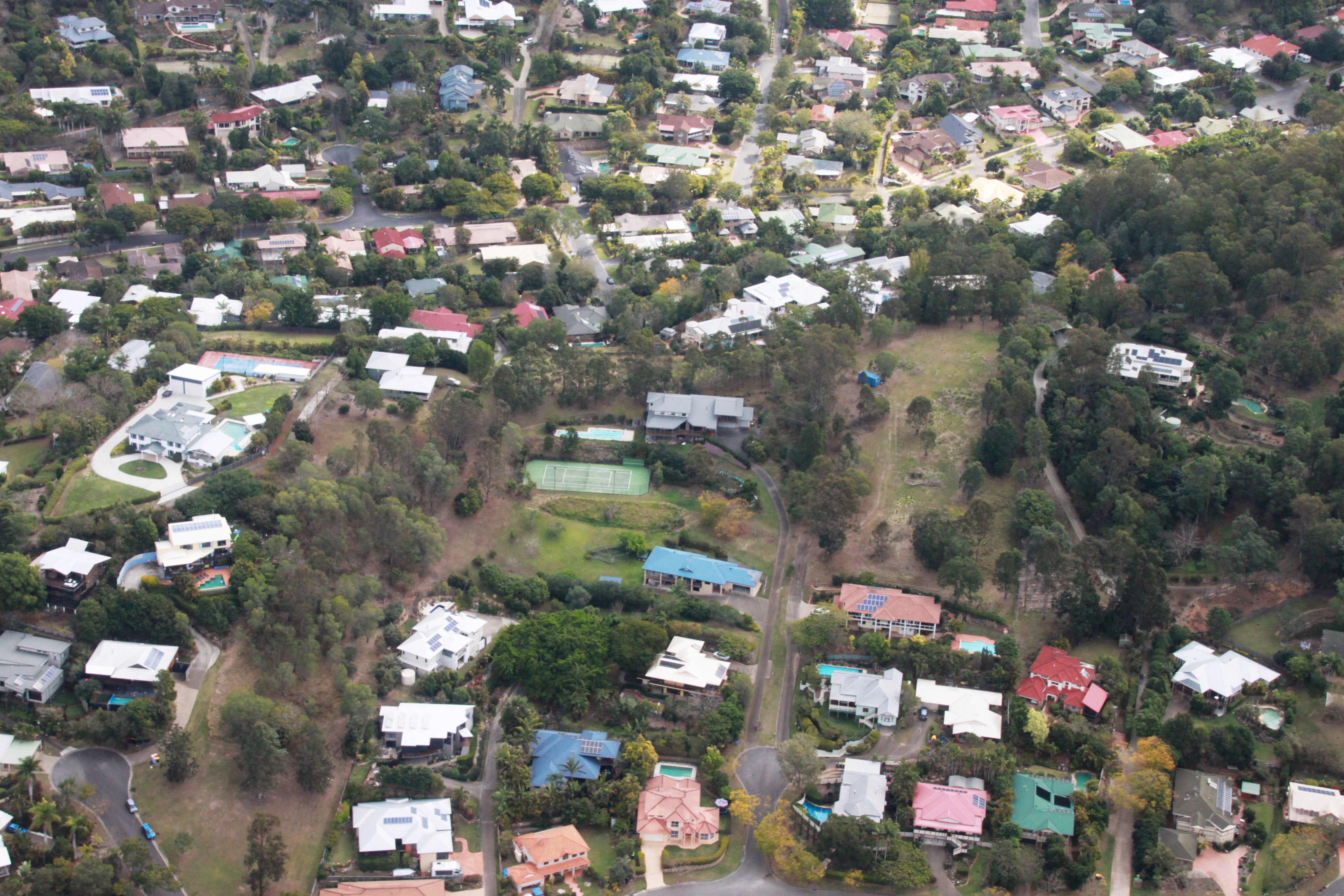
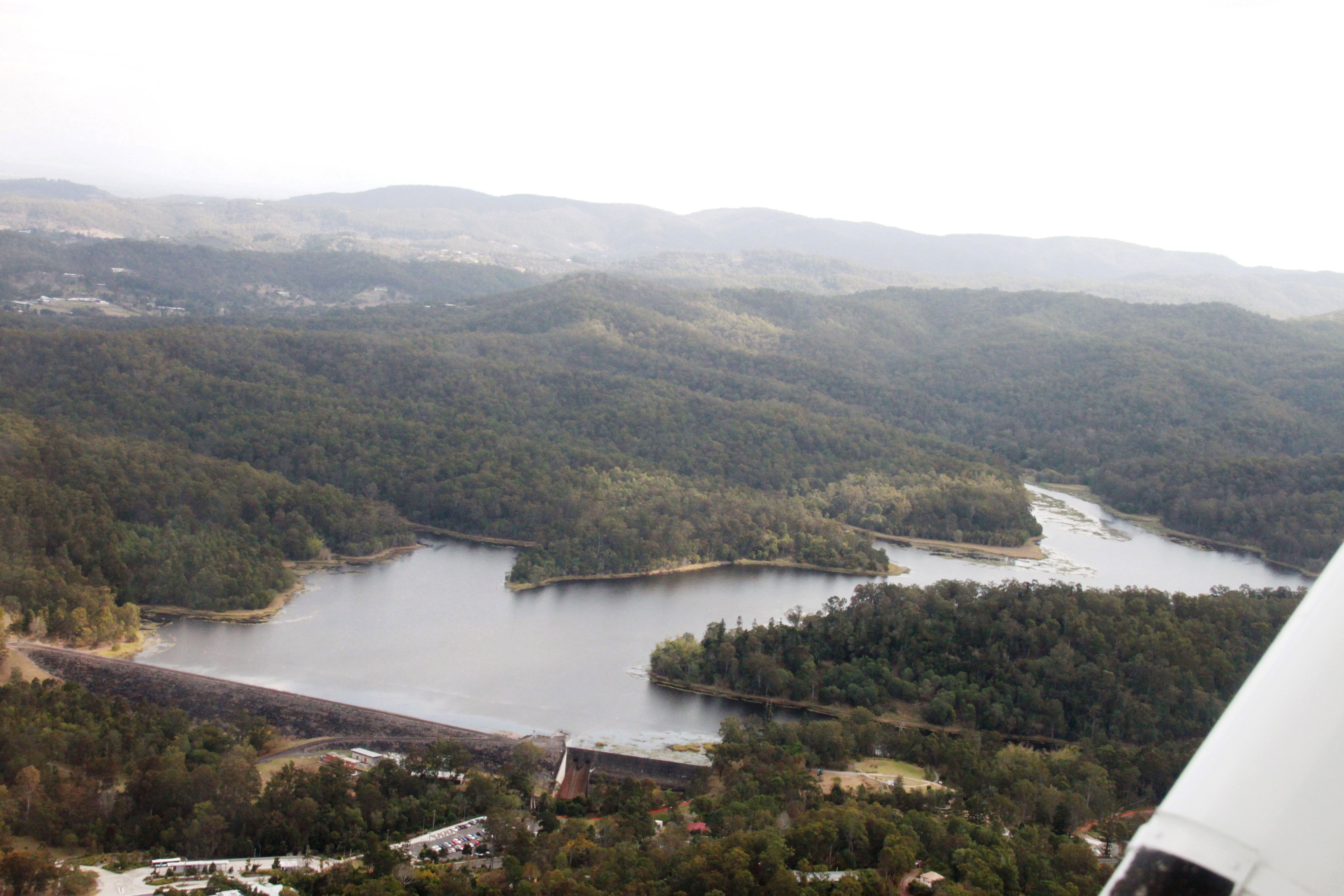
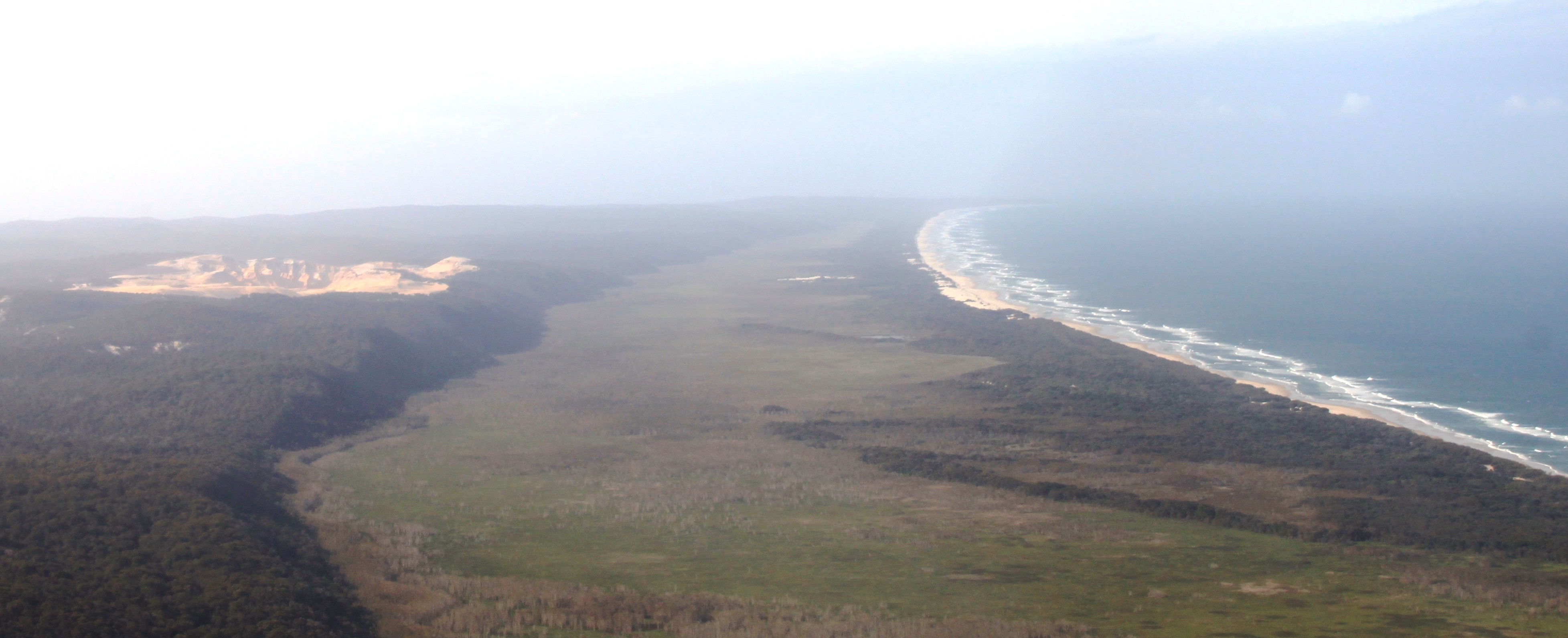
Ferny Hills looking towards The GapUpper Kedron housing developmentThe Gap, Mt Coot-tha and the CBD Enoggera DamAbeam the TV TowersFinal RWY 10L ArcherfieldThe strait between North and South Stradbroke IslandsEast coast of North Stradbroke IslandFresh water perched lake on StraddieApproaching Point Lookout from the southPoint LookoutMoreton Island
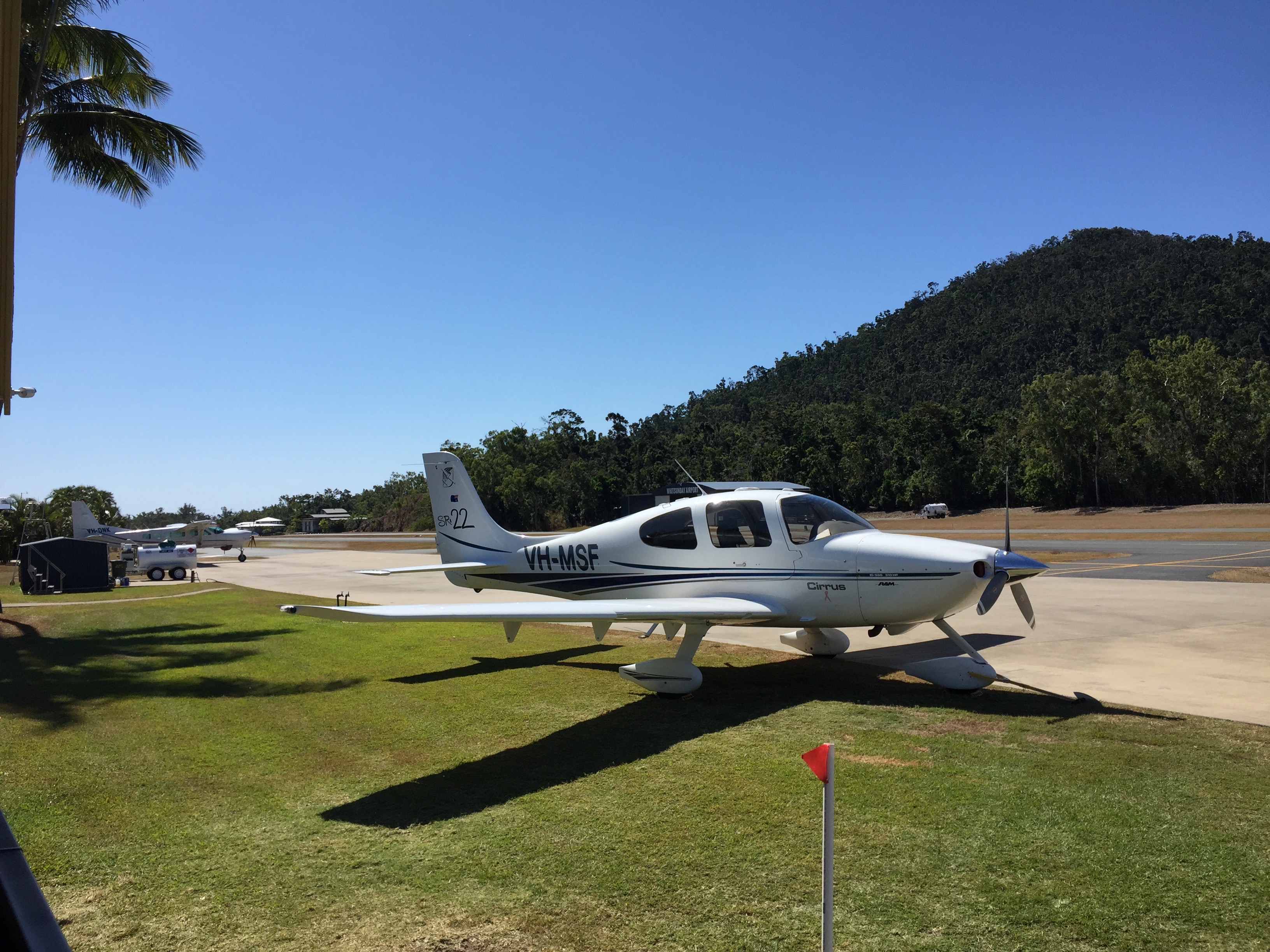
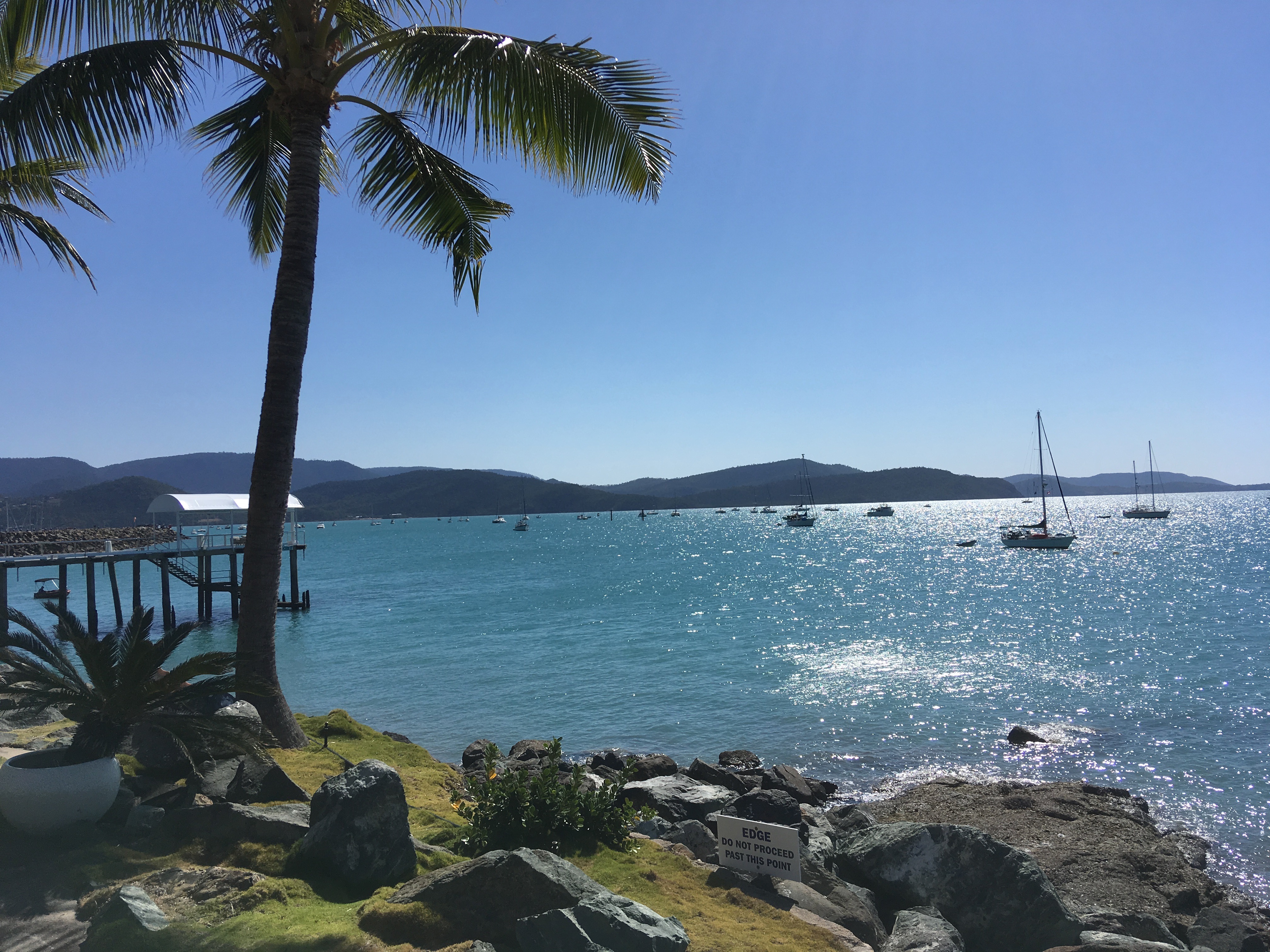
In August 2018 Sigi and I flew up to the Whitsundays for a few days to enjoy the winter sunshine. Mike Cahill came with us as far as Mackay so he could visit his mum. I flew the first leg from Redcliffe to our lunch stop in Gladstone and Mike took over for the flight to Mackay.
Departing Gladstone
On the way we passed over Rockhampton and Shoalwater Bay military training area that was nonactive. Mike’s brother picked us up at the airport and took us to our hotel for the night.
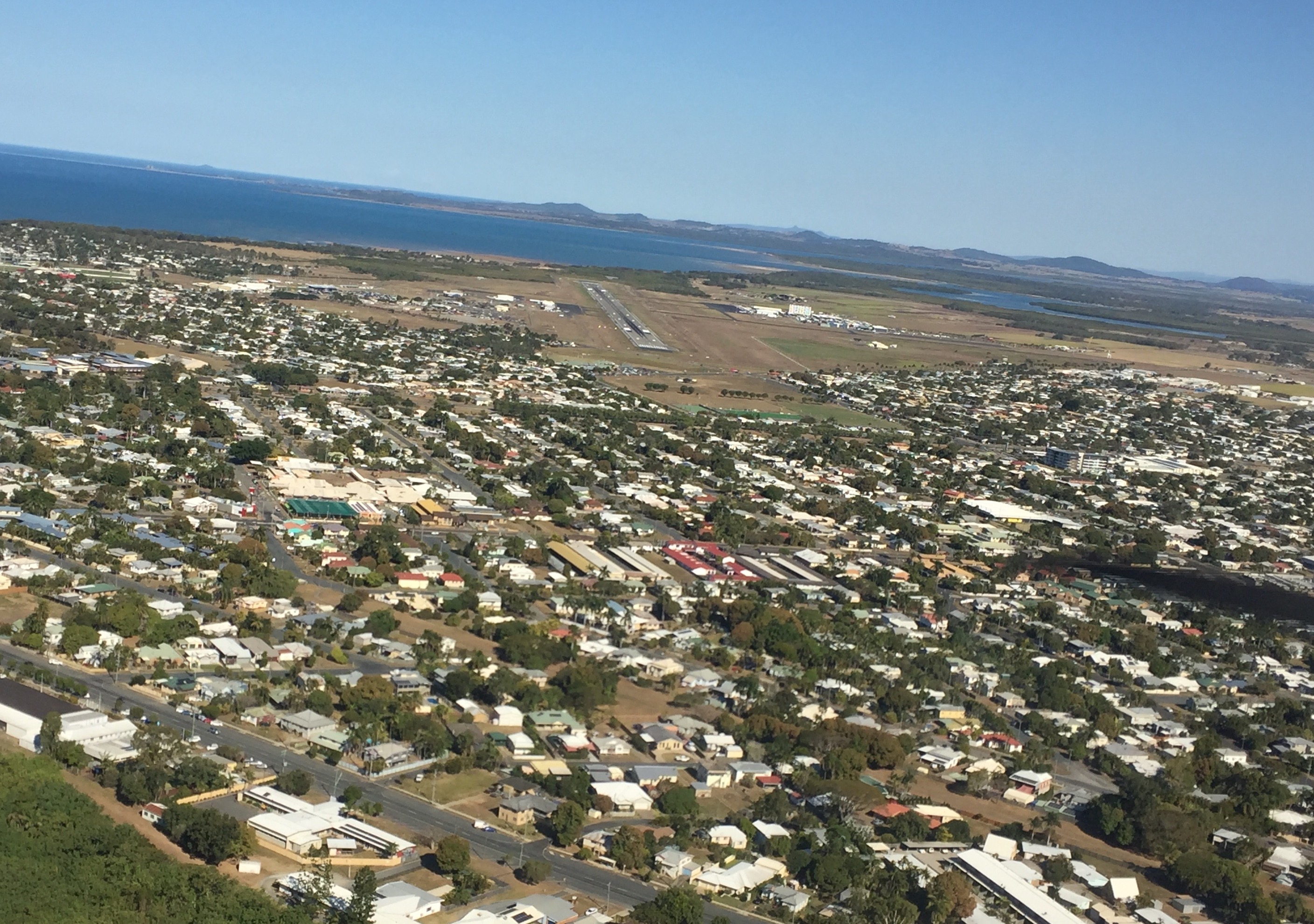
Rockhampton from 8000ftNorth of RockhamptonShoalwater Bay with the military runwayApproaching MackayOn base RWY 14 in Mackay
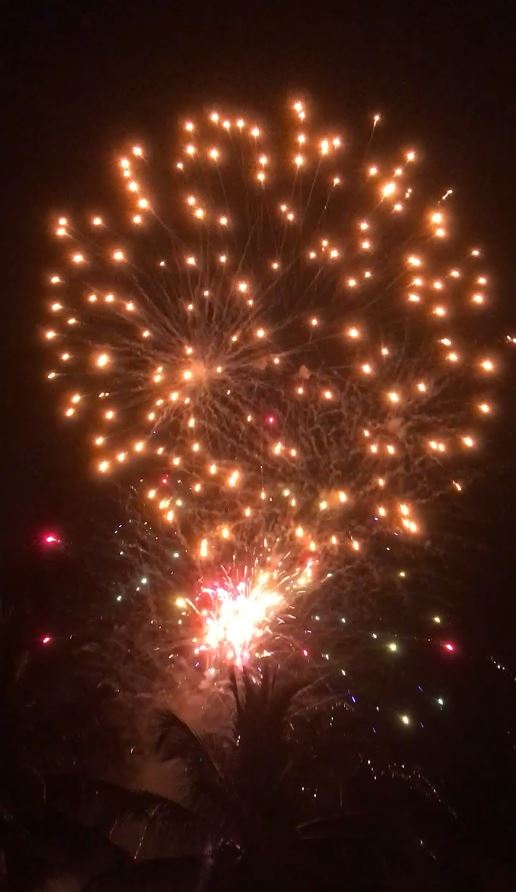
That night we were treated to a fireworks display over the beach. It seemed someone was celebrating a wedding at the hotel.
The next day we had a walk on the beach at sunrise and later Mike took us for a tour of Mackay before heading out to the airport for our departure to Bowen.
Mackay beach
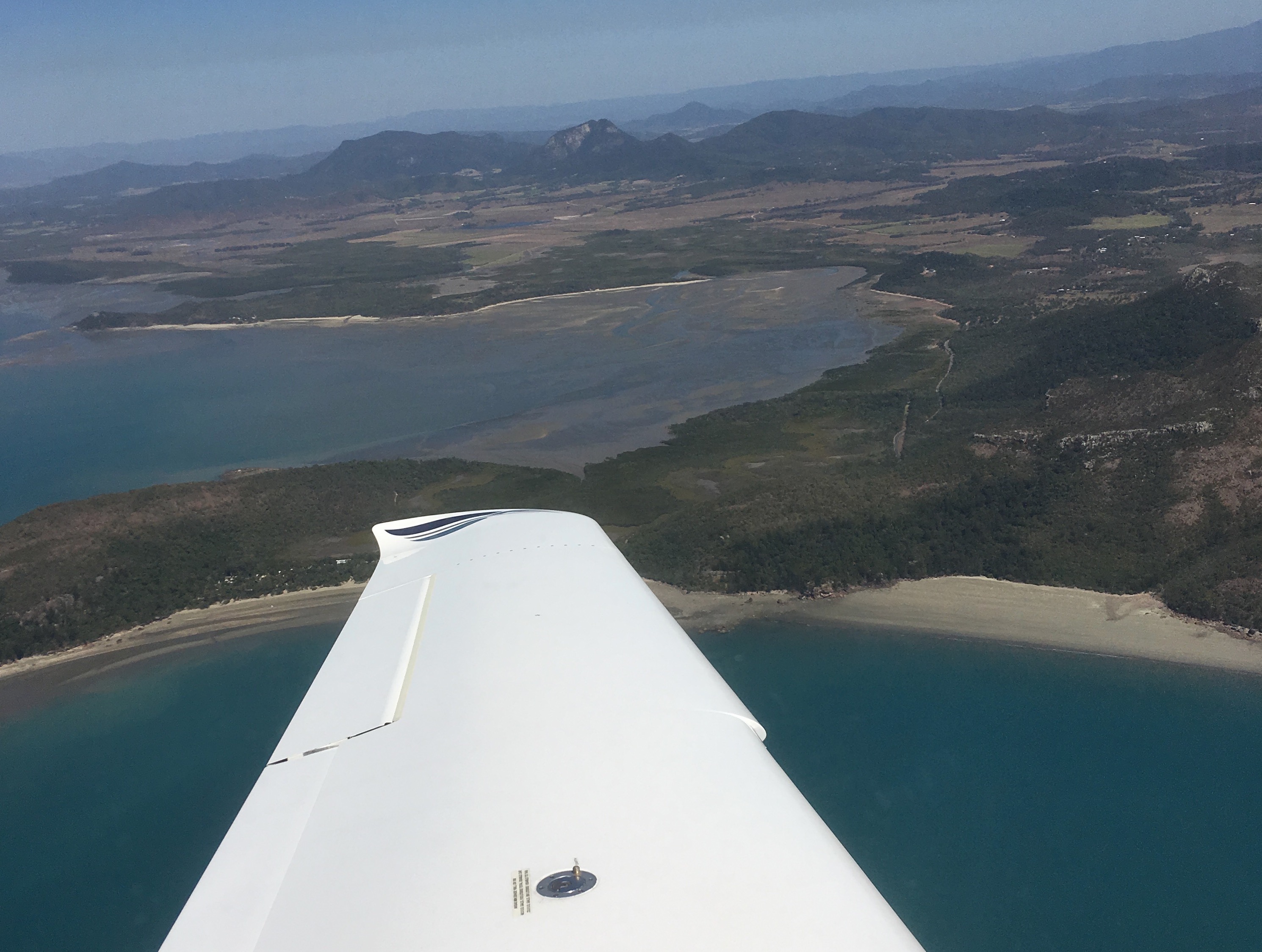
We followed the coast, orbiting over Cape Hillsborough.
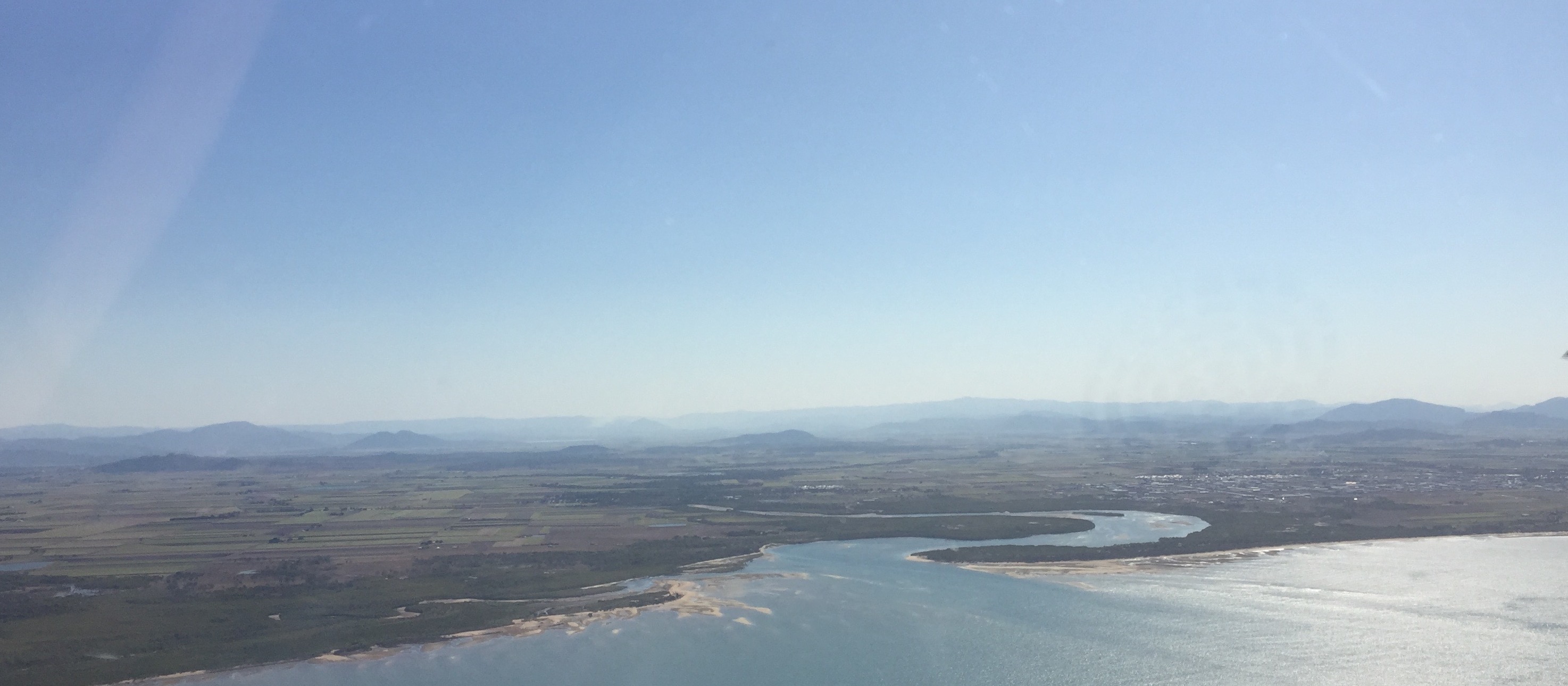
From there we flew on over the bay to the Whitsundays, over Airlie Beach and on into Bowen on the Don River that flows underground most of the time. Water appears when it’s in flood apparently. It’s a great bit of coastline. Lots of beaches and the water is warm. We got a taxi to our cabin at Horseshoe Bay, a lovely area just to the northeast of Bowen itself.
Whitsunday IslandDon River at BowenHorseshoe Bay, Bowen
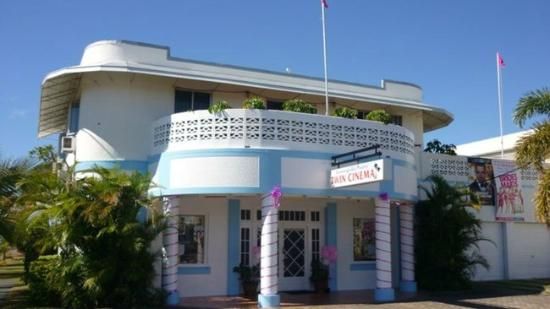
We had interesting visit to the local cinema that evening: Mission Impossible was followed by our taxi not turning up and being given a lift home by the cinema’s owner. Ben was one of the many volunteers who helped with creation of Baz Luhrmann’s film “Australia” ten years ago. He runs a very modern cinema within a heritage listed building.
Bowen cinema
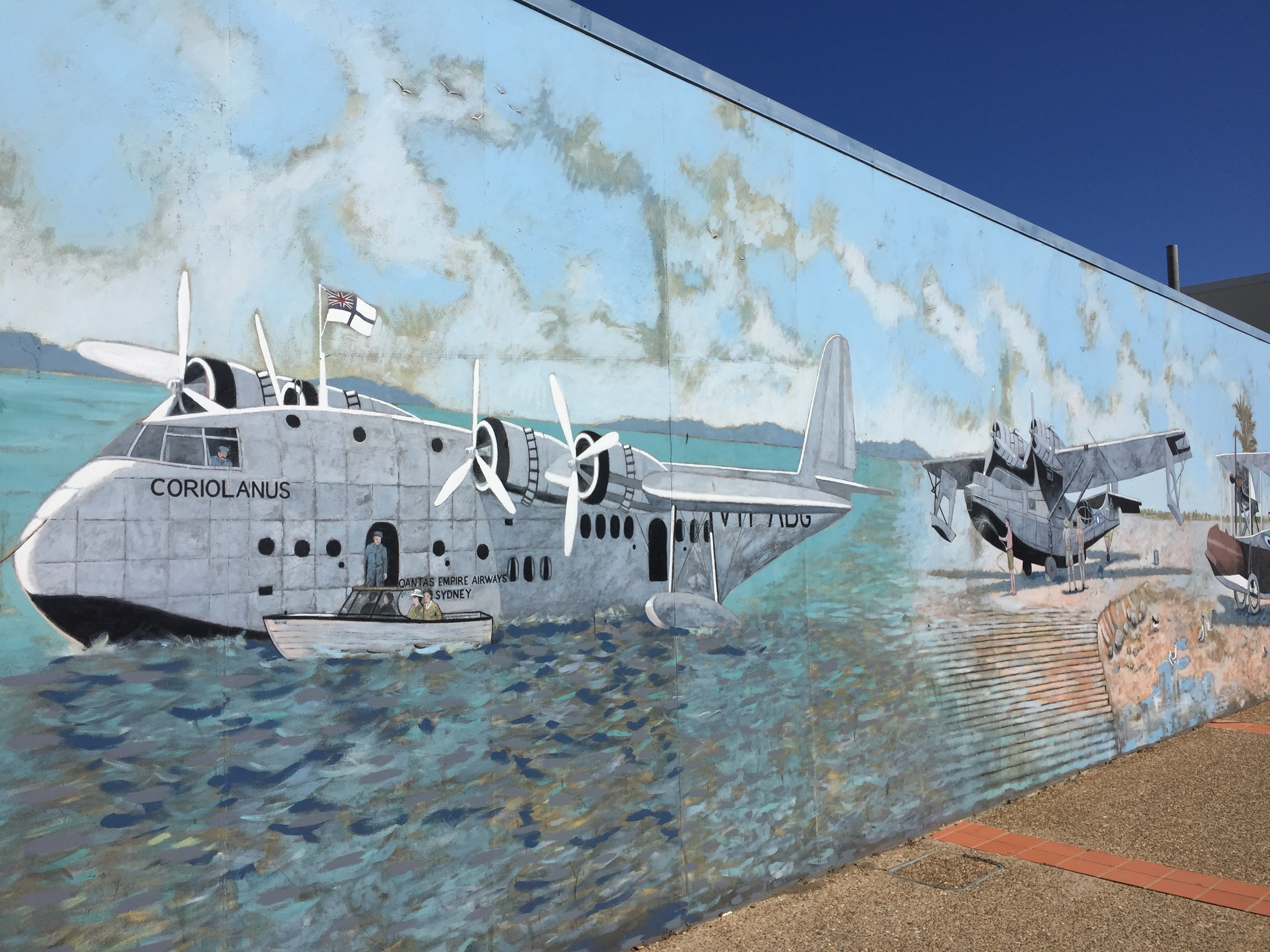
The next day was a non-flying day – a time to relax. We caught the bus downtown to the Bowen “CBD”. Our tour started along the foreshore where Bowen’s role as home to the Catalina flying boats during WWII is commemorated. This is the “hard dock” where the Catalina flying boats were brought out of the water for servicing. Note the 10-12 knot sea breeze!
There a many many murals around Bowen. This one celebrates the role of flying boats around the second world war.
The foreshore is also where the film “Australia” was filmed in part with the town being recreated as Darwin in the 1940s for a few months in 2007. The Grand View Hotel nearby was one real building that was used in the film and is still in use today. The locals seem to think it’s over priced and over rated. We thought it was pretty good.
The Grand View Hotel
After a look in the local museum we had lunch there. Then it was back to Horseshoe Bay and a 2 hour walk around the headland of massive granite boulders with views up and down the coastline. This really is a great part of the country.
The next day was a good day for a flight over the islands. We invited our new friend Ben “the movie man” to come with us. He flew in the past and was eager to see what a Cirrus is like. He knows the area really well so made a perfect navigator to help us avoid controlled airspace around Hamilton Island. We took off from Bowen and passed over his cinema in Queens Beach then tracked over Horseshoe Bay and climbed to 3500ft for the flight over the bay to Gloucester Island.
Departing Bowen, looking along Queens Beach towards Horseshoe BayGloucester Island
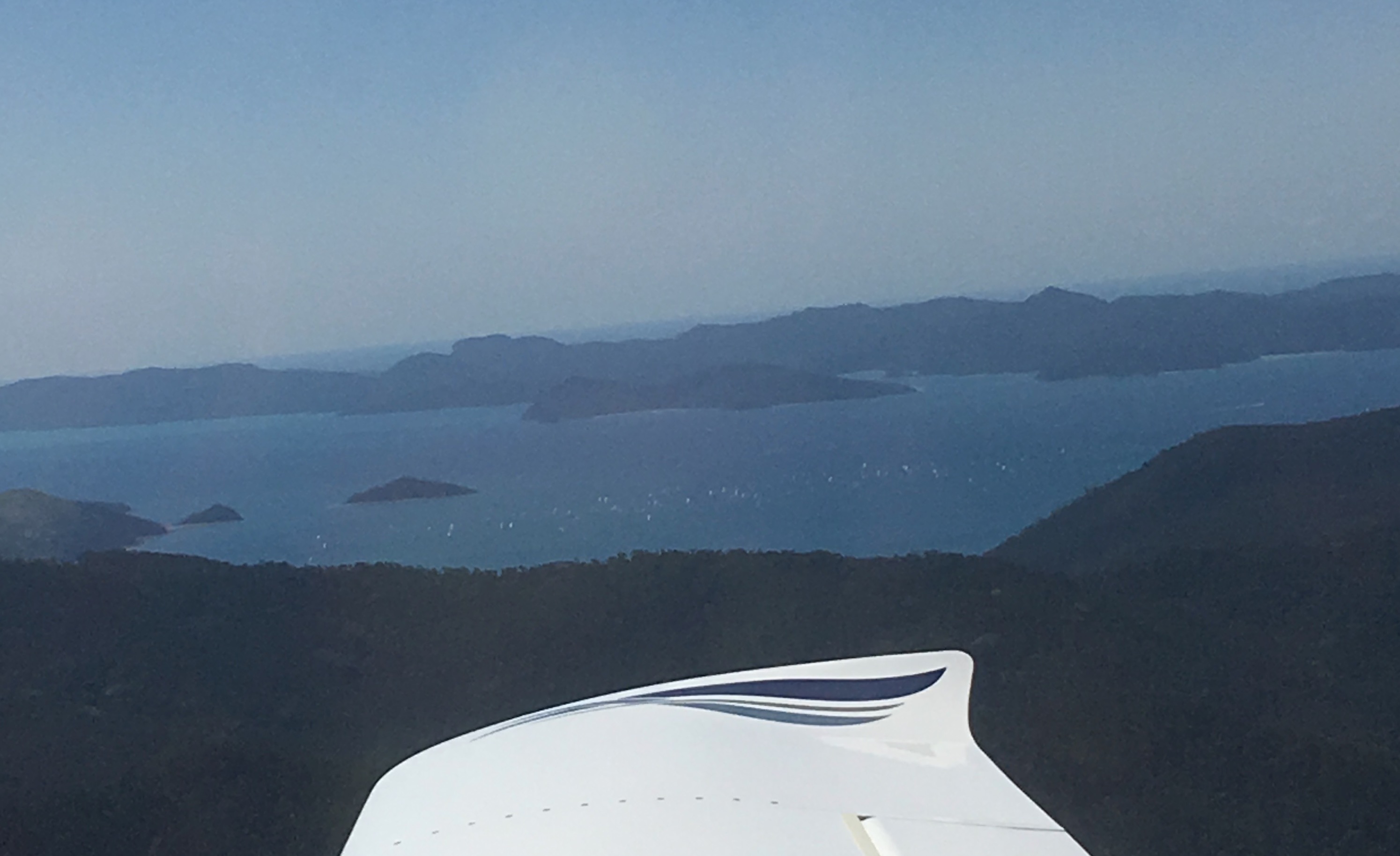
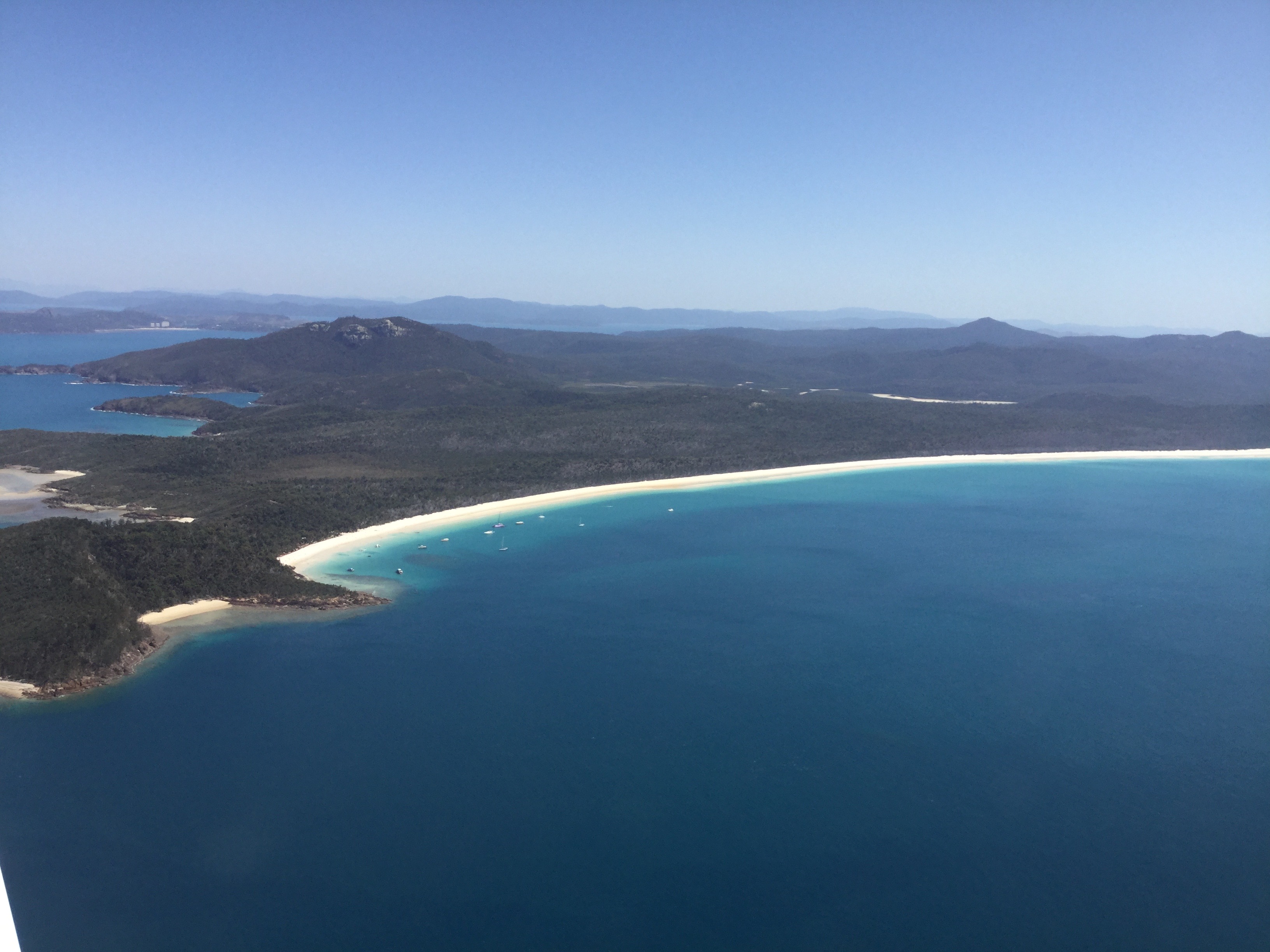
From there we followed the coast, descending to 1500ft and at Airlie Beach tracked over water to Hook Island and up the coast to Hayman Island then down the east coast of Hook and on down Whitsunday Island to Whitehaven Beach, seeing the fault line that the pure white sand comes out of to replenish Whitehaven Beach.
Whitehaven Beach, with Hamilton Island left backgroundWhitehaven Beach showing sand trench
Turning 180 degrees we headed back up the eastern coast of Whitsunday Island then tracked back to Airlie Beach, joined right base for Runway 14 into Shute Harbour Airport.
It’s a fancy sealed strip with Airpark. Base for scenic flights and sky divers. I did a “greaser” of a landing much to the delight of Ben.
Turning final on RWY14 Shute Harbour
Ben treated us to a lazy lunch at one of the resorts in Airlie Beach.
The view at lunch
Later it was back to the airport, a quick preflight and we were ready for the flight back to Bowen.
All aboard!
We took off over Shute Harbour itself, swung a left and passed by Airlie Beach again on our way back to Bowen.
Airlie Beach
Back at Bowen we caught a taxi to Horseshoe Bay and went for a swim and watched the sun set.
The next day it was time to head home. We flew the quick hop to Mackay where we refuelled MSF and met Mike who had brought his mum out to show her the plane. He offered her a flight but she refused. Likes to stay firmly grounded it appears. Then it was time to take off and head back to Redcliffe passing the coal loading terminal on the climb out.
Following a few night VFR lessons by 1st August 2018 the time had come for me to do a biennial flight review for my instrument rating so I decided to incorporate a night instrument endorsement at the same time. I did this with Adam Starr at Archerfield in another Cirrus SR22 with callsign FOJ. It was similar to MSF but newer and with more sophisticated avionics and glass cockpit.
We had a practice flight a few days before, taking off just after last light and carrying out a couple of instrument approaches at Kingaroy so Adam could check out I was ready for the test. It went well so I booked him for my test.
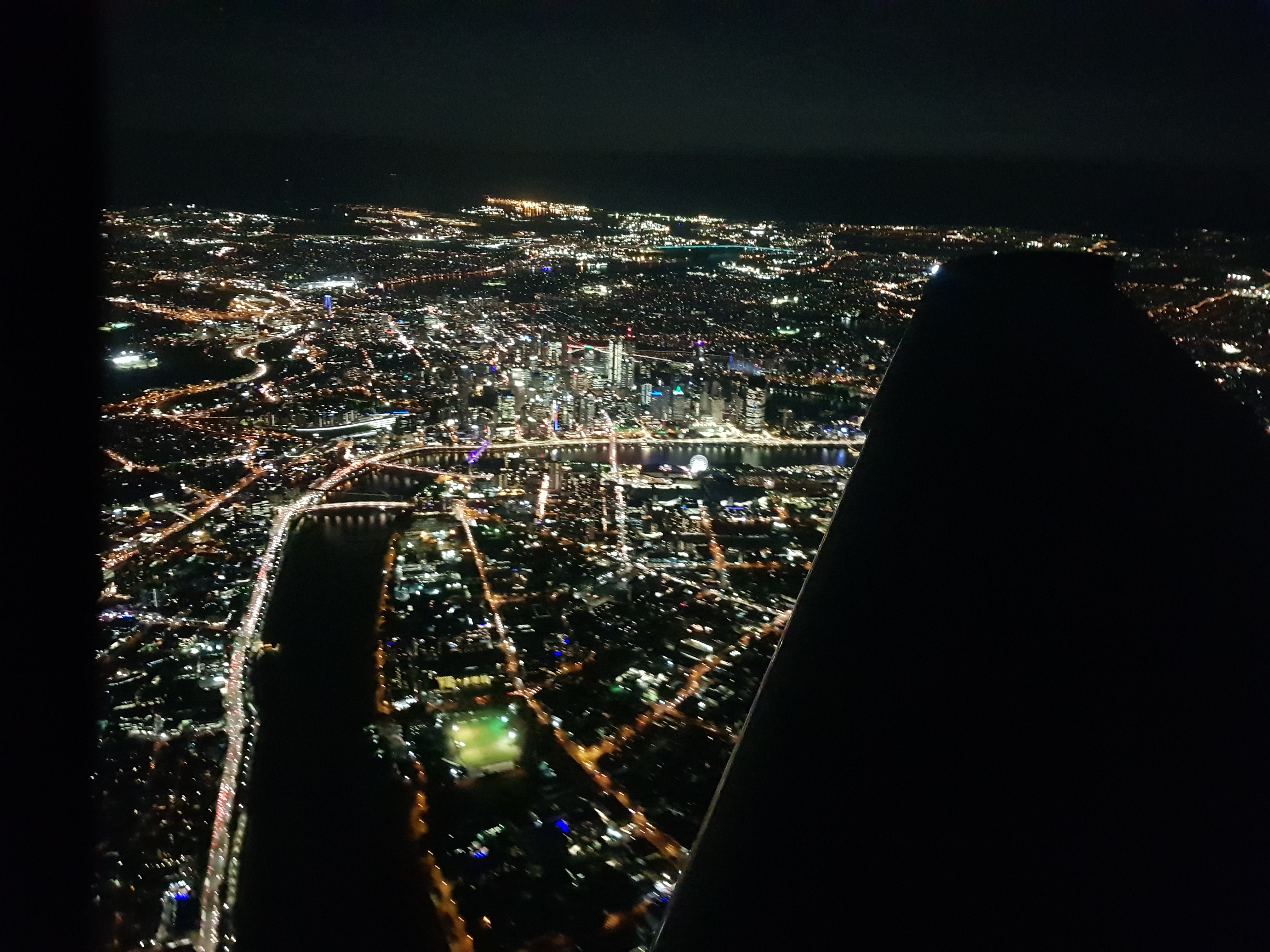
Once again we took off just after last light and climbed to 1500, orbiting over Archerfield while waiting for a clearance as the jets passed overhead on their final approach into Brisbane International. After a couple of orbits Brisbane Approach cleared us to climb to 4000ft (above our lowest safe altitude) and vectored us (ATC providing headings to fly on) over Brisbane, with a wonderful view of the CBD on the right hand side.
Toowong Reach of the Brisbane River and the CBD
We flew to Redcliffe in about 10 minutes, left our lowest safe altitude above the aerodrome and circled down to runway 07, did a touch and go landing, then headed off for Sunshine Coast airport. We passed over the airport at 5000ft and headed for the instrument approach waypoint over Noosa Head. The instrument approach went well, followed by a circling approach over water and another touch and go landing on runway 36. And it was back to Archerfield via a couple of waypoints out to the west of Dayboro, staying clear of the regional flights coming in from the north west. ATC allocated us the RNAV instrument approach into Archerfield. The RNAV is more precise than a visual approach and allowed ATC to separate us better from the Brisbane International arrivals. RNAVZ RWY10L is the most complex instrument approach I’ve done so far with a large number of step heights that you mustn’t fly below but also one that you mustn’t fly above (to remain clear of the Brisbane traffic). With the help of the very capable auto pilot it all went well however. I had to slow down a bit for another plane on the runway ahead of us but he got away in time and we touched down gently and taxied back to the hangar. Test passed for another 2 years and now with night IFR privileges as a bonus!
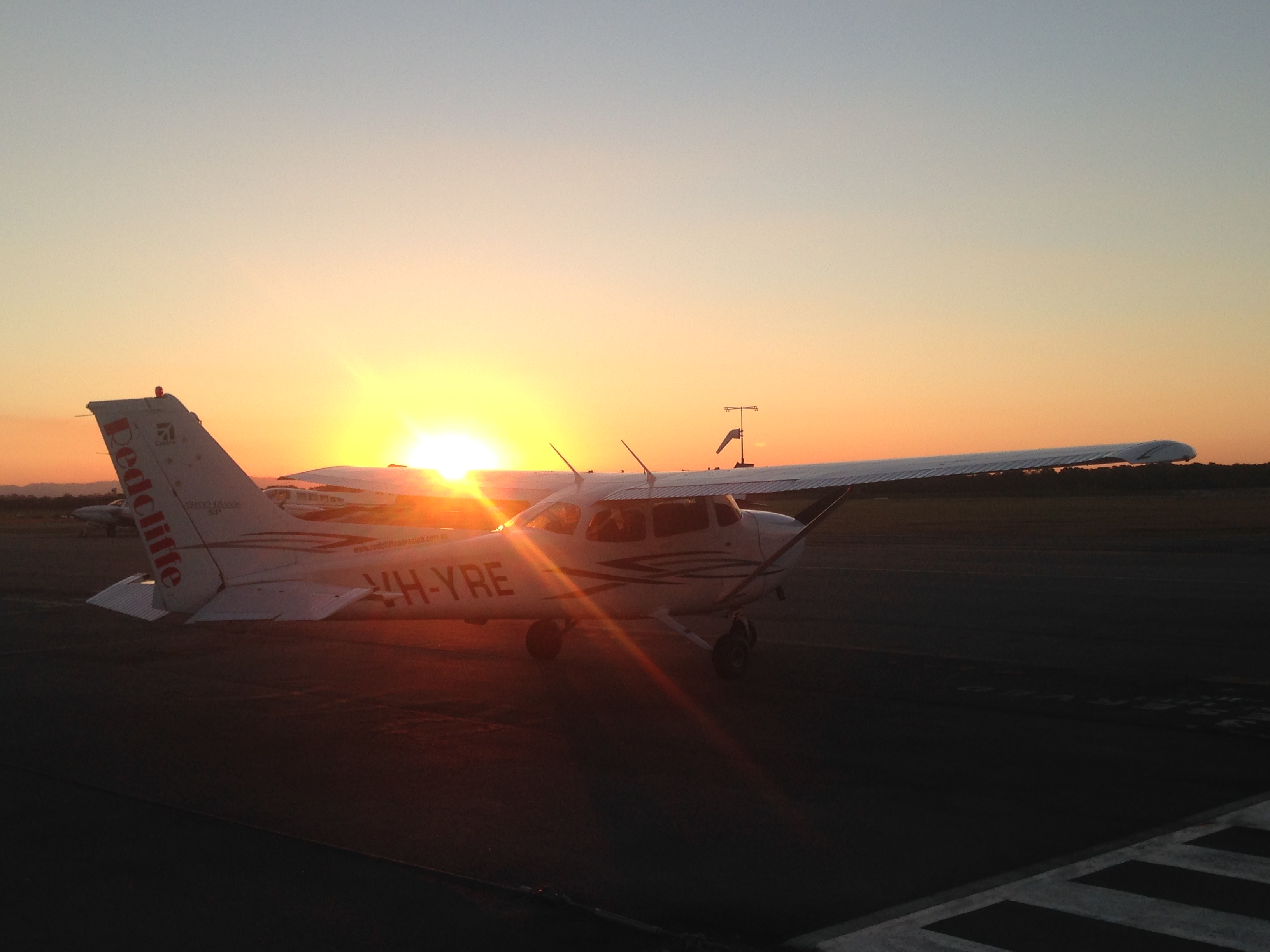
July 19th 2018 was night circuits in Cessna 172 VH-YRE. After a few circuits with instructor Stephen White he left me to myself and I completed my first solo night circuits. Another step closer to night flying. Woo hoo!
Longreach – Alice Springs – Uluru – Arkaroola – Broken Hill – Dubbo
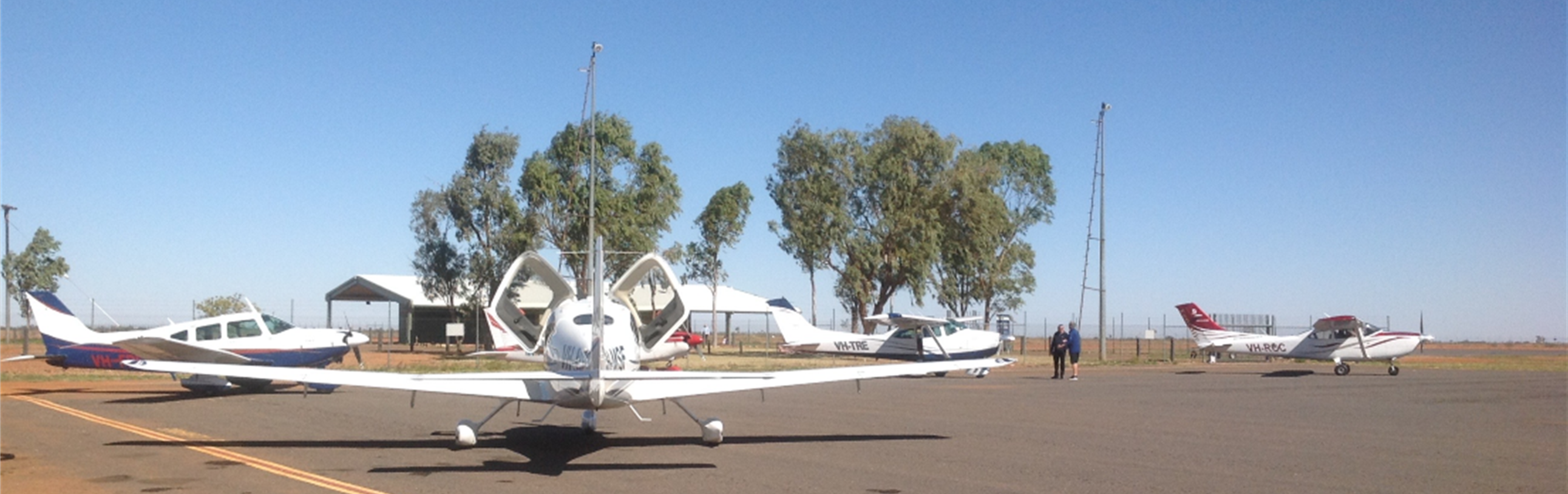
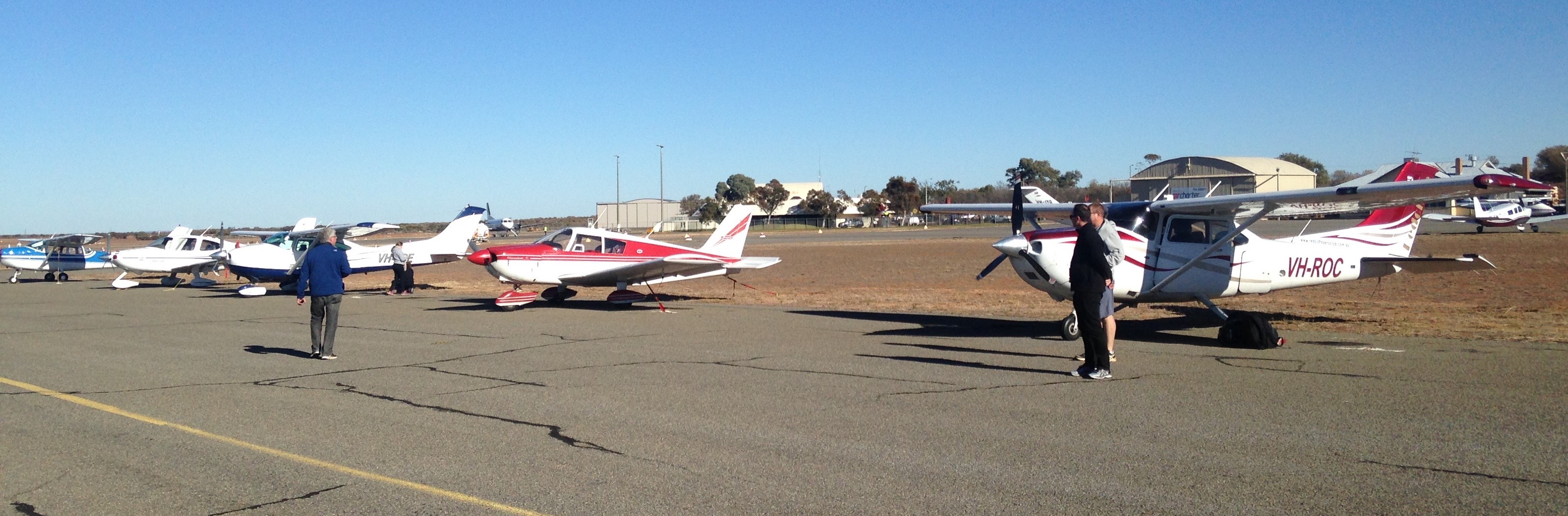
In July 2018 I took part in the biggest aero club flyaway to date. It was to be the “trip of a lifetime”. From Redcliffe to Ayers Rock via overnight stops at Longreach and Alice Springs. Five aircraft containing 13 very fortunate individuals embarked on an odyssey to central Australia. After three nights at Yulara resort to explore Uluru and the Olgas we returned via overnight stops at Arkaroola in South Australia’s Flinders Ranges, Broken Hill and Dubbo. Branded “the Rockers”, the whole group had a great time with each having a different view of the nine day adventure. Mike Cahill flew his Cirrus MSF with me as co-pilot. Stephen White piloted his C182 TRE with 1st officer Maureen and 2nd officer Madeline. Sam Keenan was in command of his Piper BHN supported ably by Tania, and their two girls Ava and Georgie, while Andrew Pearson and Mick Gardner shared pilot duties in ROC and Ashleigh Hodge flew FRF with Margot Logan as navigator. This post is lifted from the September 2018 AirChat magazine, in which we compiled an article composed of contributions from various members of the contingent describing what for them were highlights of the trip.
Desperados
Redcliffe to Alice Springs: Ashleigh Hodge – FRF
It was an intense first couple of days on our fly away to Uluru for Margot and me in the club’s Piper Archer VH-FRF. Day 1 was a Saturday and our plan was to fly initially from Redcliffe to Roma, where we would refuel, and then head to Longreach for the night. The departure morning was not ideal. We were caught by significant cloud cover and, after making an attempt to get through to Roma, spent 4 hours on the ground in Kingaroy waiting for it to clear. Eventually the weather improved and we made it to Roma, by which time the other four aircraft had long departed and it was too late to continue to Longreach. So we decided to stay the night in Roma. On arrival in Roma we were fortunate enough to meet Col, a local instructor and motel owner, who helped find us a room for the night and gave us a lift into town. We kept the rest of the group, who all managed to make it to Longreach that day, up to date by Messenger, a handy little app for such situations.
We planned to leave at first light the next day to meet up with everyone in Longreach and then continue onto Boulia to refuel before flying the next leg to Alice Springs to spend the night. We were up at the crack of dawn and headed out to the airport. Unfortunately we couldn’t get the plane started in the cold wee hours of the morning and ended up needing to jump start the battery. Thankfully our new friend Col from the previous day came to our assistance. I gave him a call to see if he could help us start the engine. To our delight he was shortly out at the airfield helping us get the plane started.
Longreach
We eventually got up in the air and headed for Longreach, where we made a quick stop to refuel. Mike and Phil were waiting for us in MSF, having used our delay to check out the Qantas museum. We then headed on to meet up with the rest of the Rockers at Boulia where we had another refuelling stop.
Approaching Boulia
From there flew on to Alice Springs, our destination for the night. It had been a long day. After over 7 hours of flying it was safe to say I was knackered by the end of it all. But it had been a great learning experience.
Boulia
Being a Sunday night there were only a few restaurants open in the Alice and a lot of visitors looking for somewhere to eat. Luckily we were tipped off about a BYO Italian place over the other side of the Todd River. After a stop for a predinner drink at a pub on the way we had a great Italian meal there before getting an early night so we’d be fit for the flight to Ayers Rock.
Alice Springs
Alice Springs to Ayers Rock: Sam Keenan – BHN
On the Monday morning we convened for breakfast in the heart of Alice Springs, and with the excitement of our trip still building, everyone was in great spirits.
After returning to the hotel to collect our bags and ordering two taxis to the airport, most of the group loaded into the first maxi taxi, whilst Tania, Ava, Georgie and I awaited the second taxi which never came.
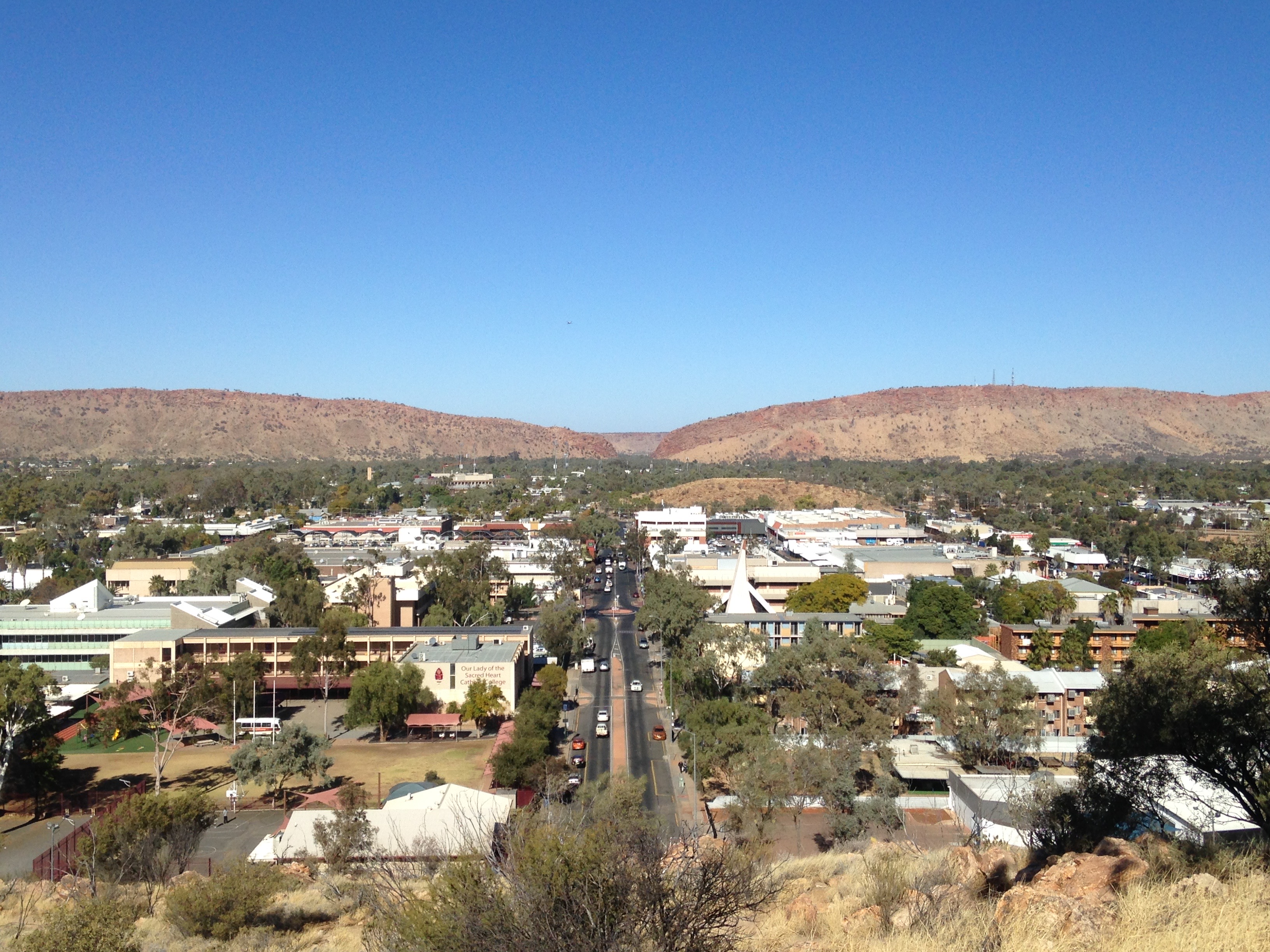
The view from Anzac Hill
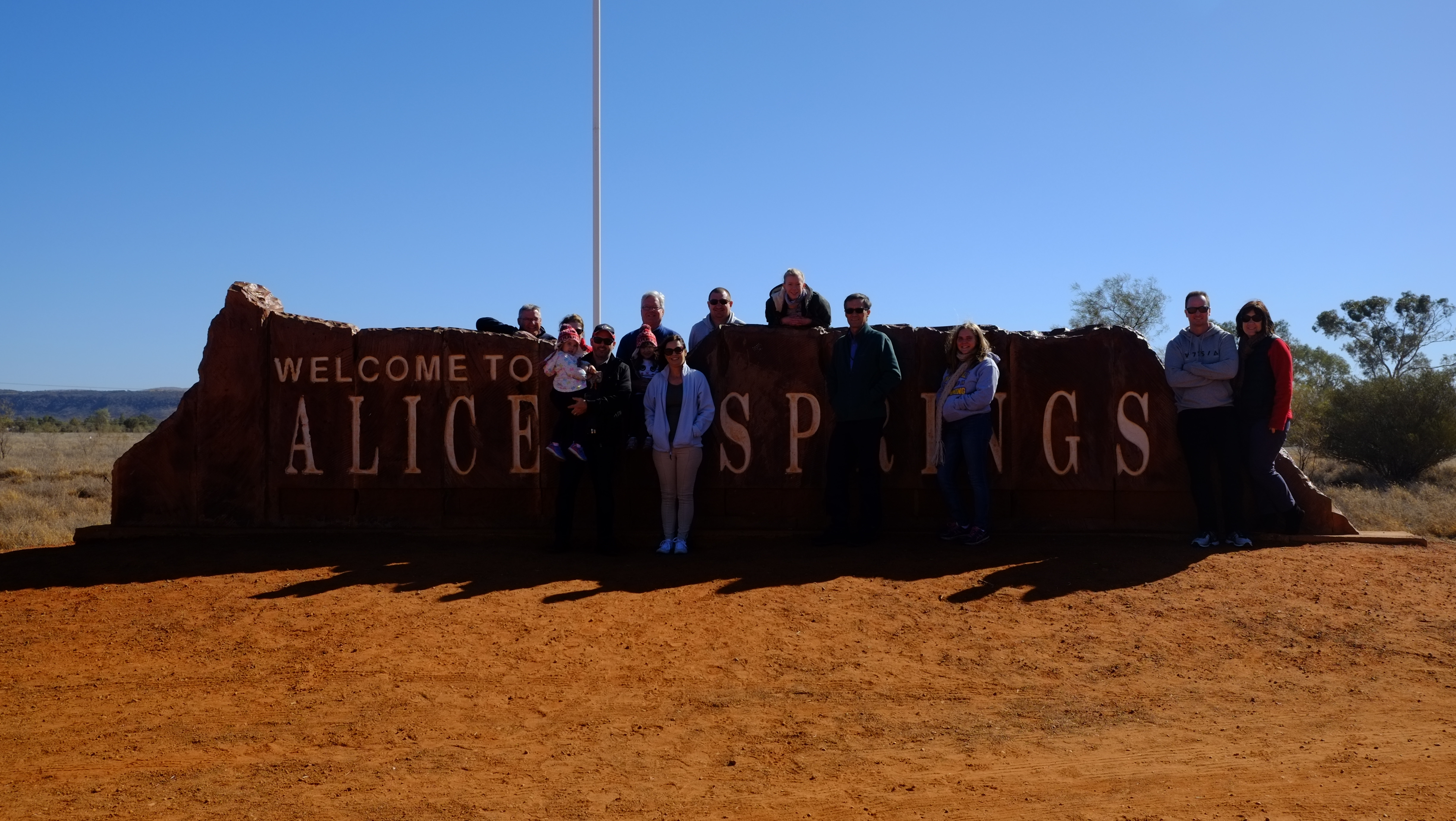
Unfortunately we missed out on a drive up to Anzac Hill for a view over the city, which we were quite looking forward to. By the time a taxi on a fresh booking finally arrived, we rushed to catch up with the others at the Alice Springs sign on the way to the airport for a group photo.
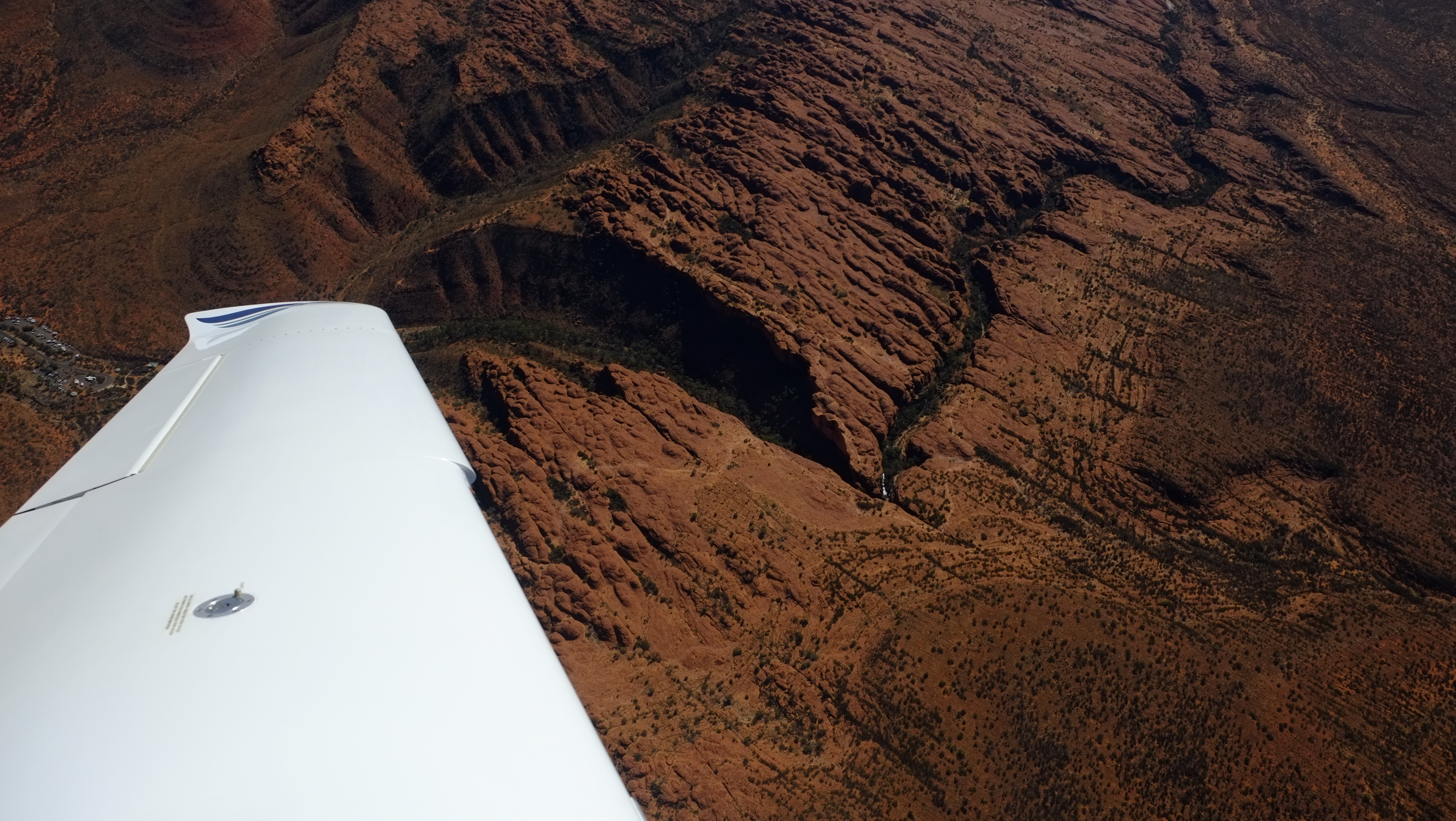
At the airport, the flying conditions were again looking perfect (CAVOK, CAVOK, CAVOK…), and we scurried around releasing tie downs, checking fluids and loading bags. Following a short taxi, we shot into the crisp air for The Rock. Some flew via Kings Canyon and some direct. Fortunately, we all avoided Pine Gap (the highly secretive US/Australian joint military facility and prohibited area).
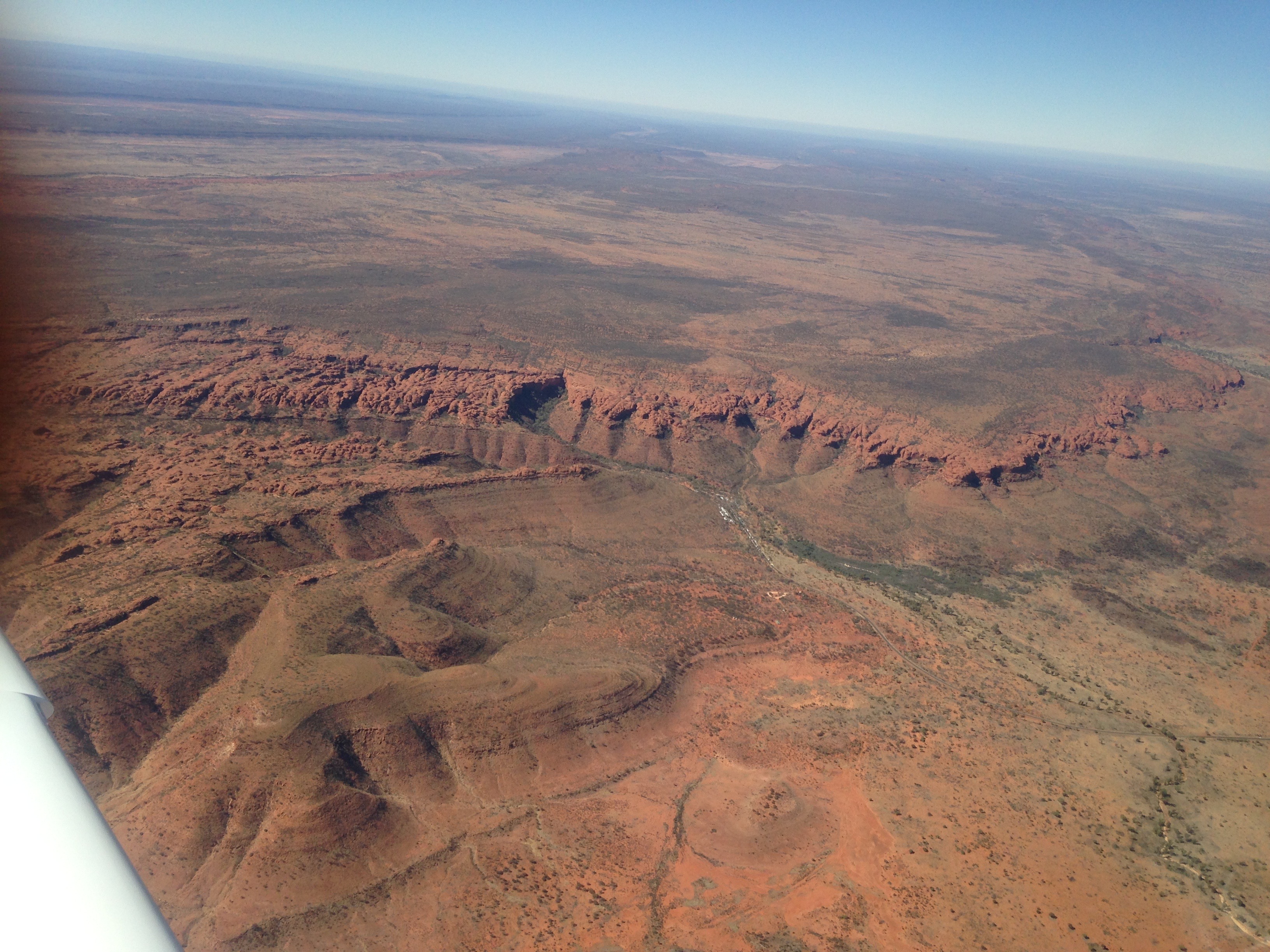
Kings Canyon
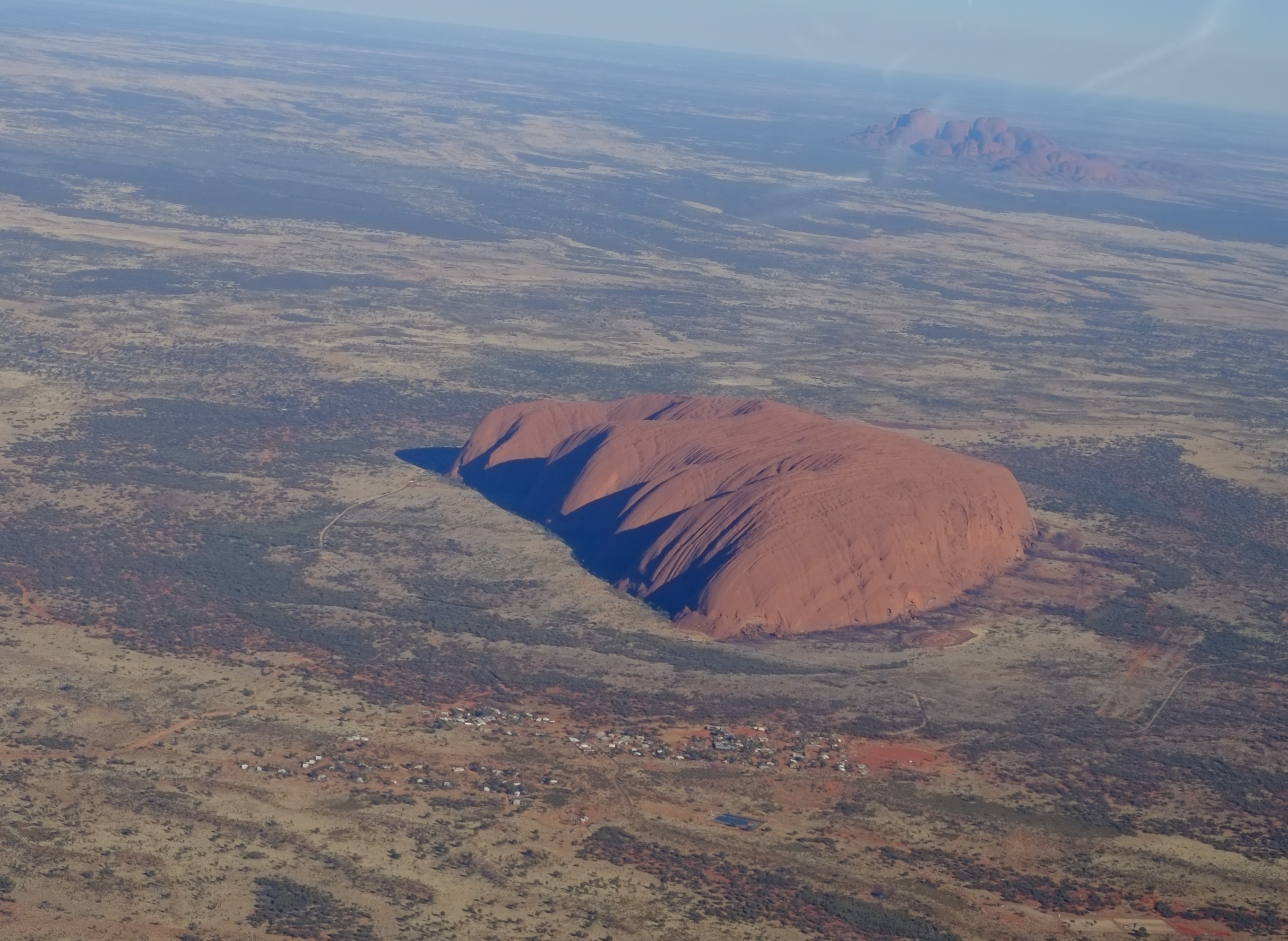
After a (relatively) short flight, we were able to spot Uluru on the horizon. It really was impressive, and I suppose it is also a pretty reliable positive fix? Semi-convenient free coaches run between the airport and the township, and we jumped aboard, ready for a few days of relaxing!
Ayers Rock: Mike Cahill – MSF
We arrived at the red centre early afternoon after a pleasant flight. On our way out of Alice Phil flew us over Simpson’s Gap, and then set course on a flight route that took us over the old Lutheran mission at Hermannsburg and Kings Canyon, where we carried out an orbit to gain a good view of this amazing formation. We spotted Uluru and Kata Tjuta (the Olgas) on the horizon soon after leaving Kings Canyon. As we passed over Lake Amadeus we were cleared inbound by Ayers Rock Radio. All aircraft were secured and we took the bus to our accommodation for the next few days, The Lost Camel. It was school holidays and Yulara village was packed to the rafters with people.
Several of us walked around the rock on Tuesday. It was a 10km walk that put the size of Uluru into perspective.
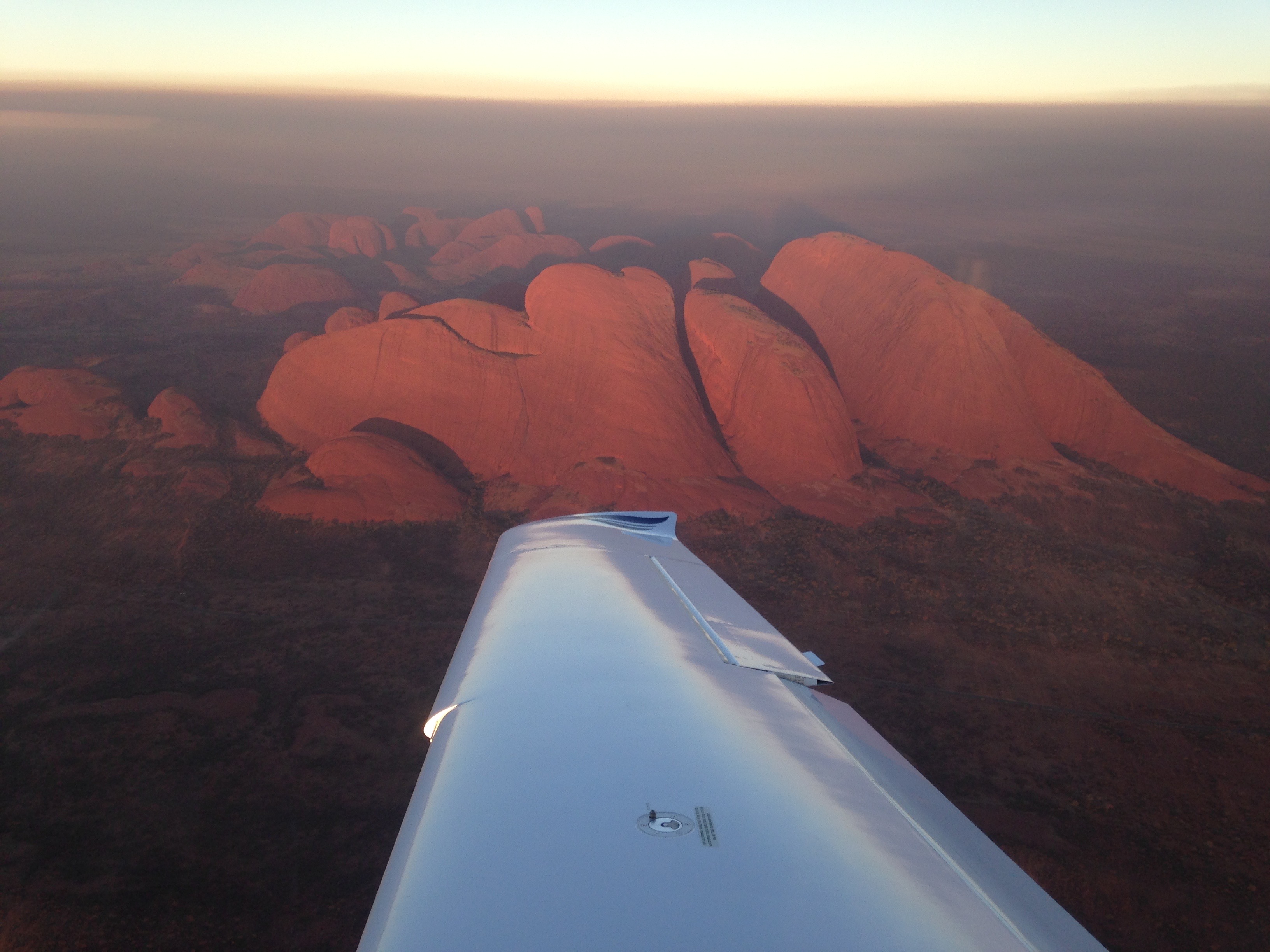
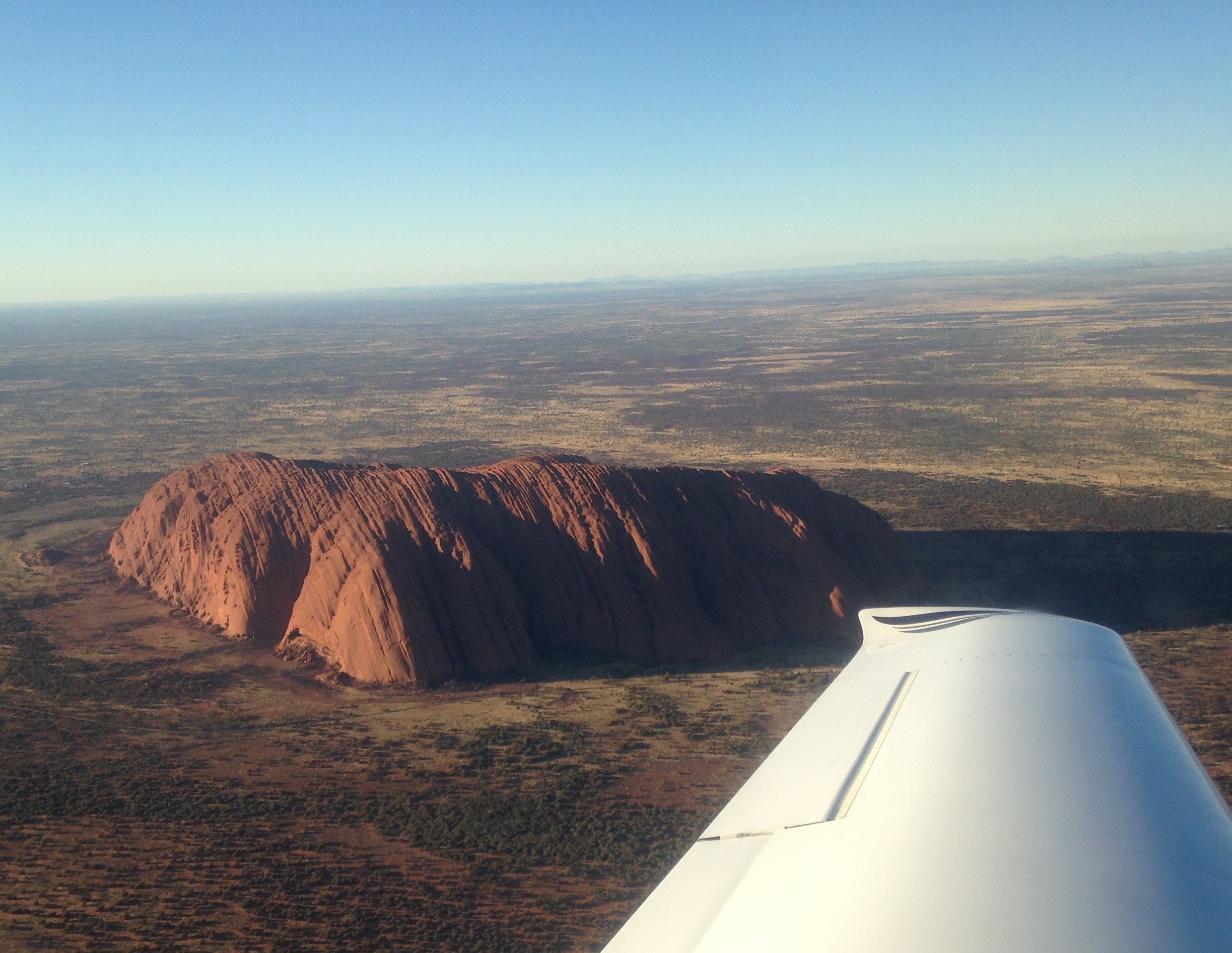
Unfortunately, the rock climb was closed due to high winds at the summit so those who were eager to climb it were disappointed. We decided to fly a dusk scenic around Uluru and Kata Tjuta. There was a burn off out to the east that evening and the resultant smoke made visibility pretty poor so that we couldn’t get any good photos of the rock. We decided to do a sunrise scenic the next morning and luckily the smoke was gone by then. After scraping some ice off the wings we flew the second scenic with great results.
Olgas
Wednesday was spent in different ways with some people doing camel rides and other activities while others chilled out, did the laundry or caught up on some work. We all enjoyed the activities at Uluru and the down time.
Arkaroola: Tania Keenan – BHN
By Thursday our time at the Red Centre had come to an end and we headed south, passing Uluru on our way to Coober Pedy where we refuelled.
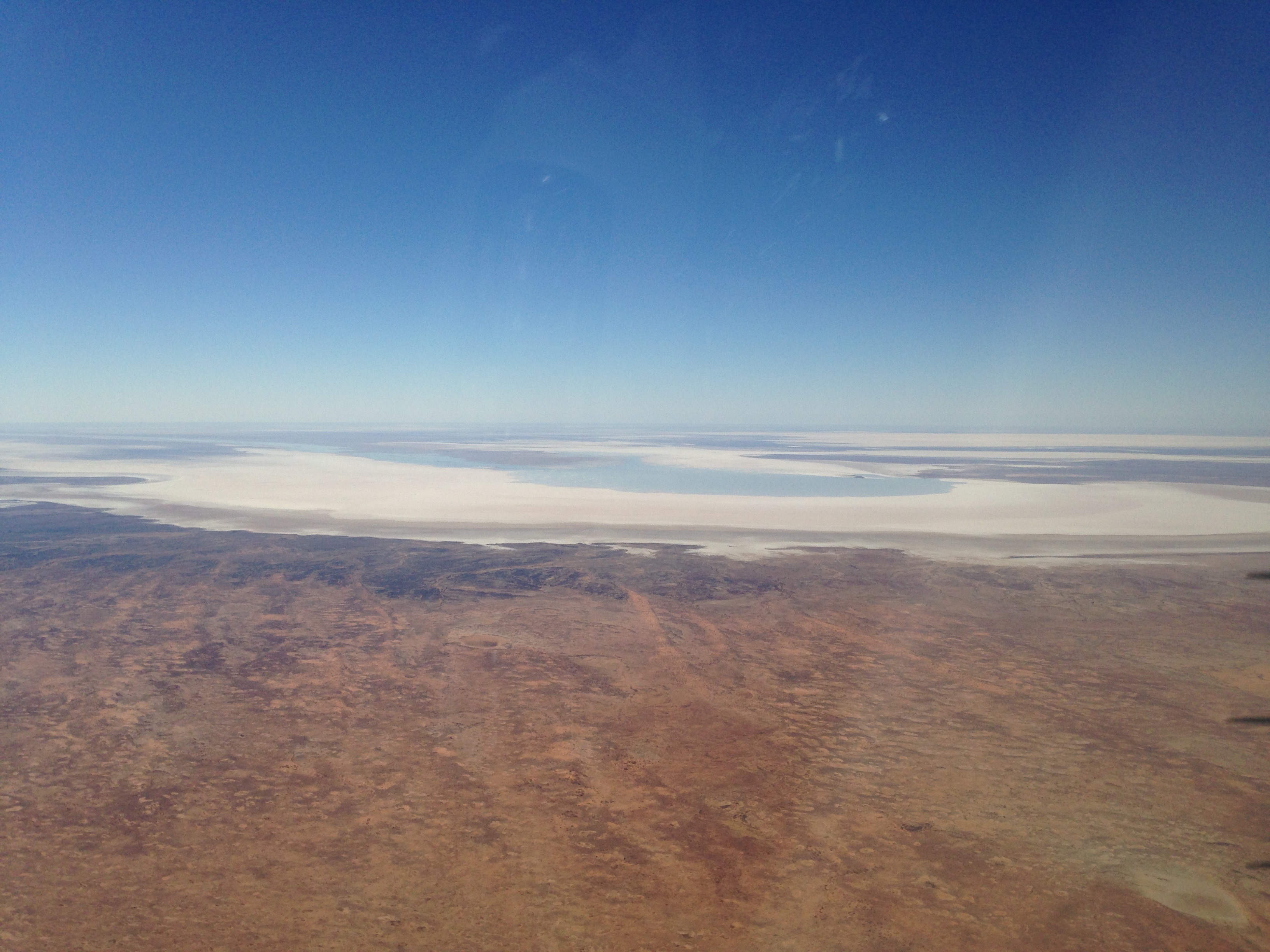
From there we tracked to the southern end of Lake Eyre.
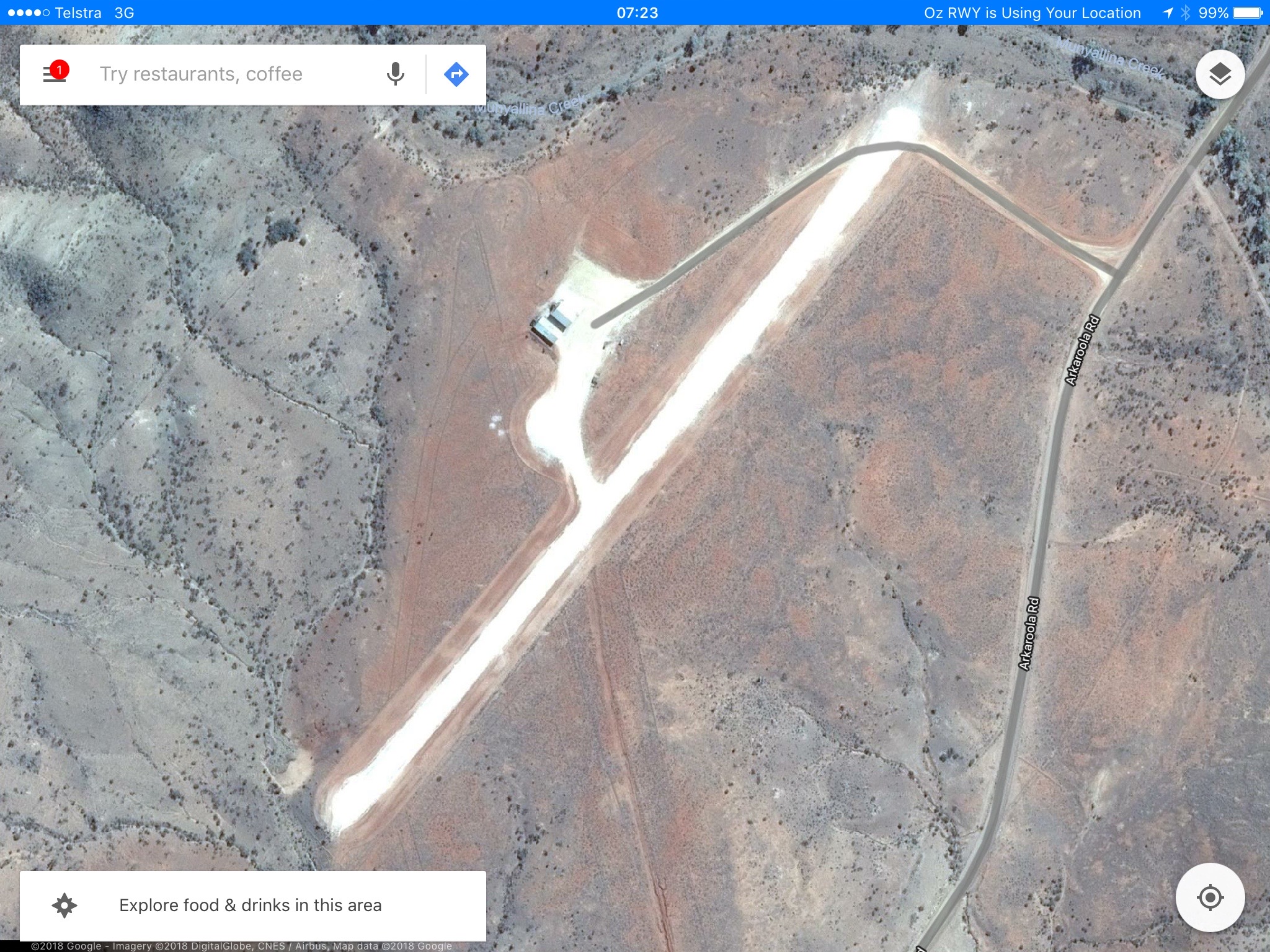
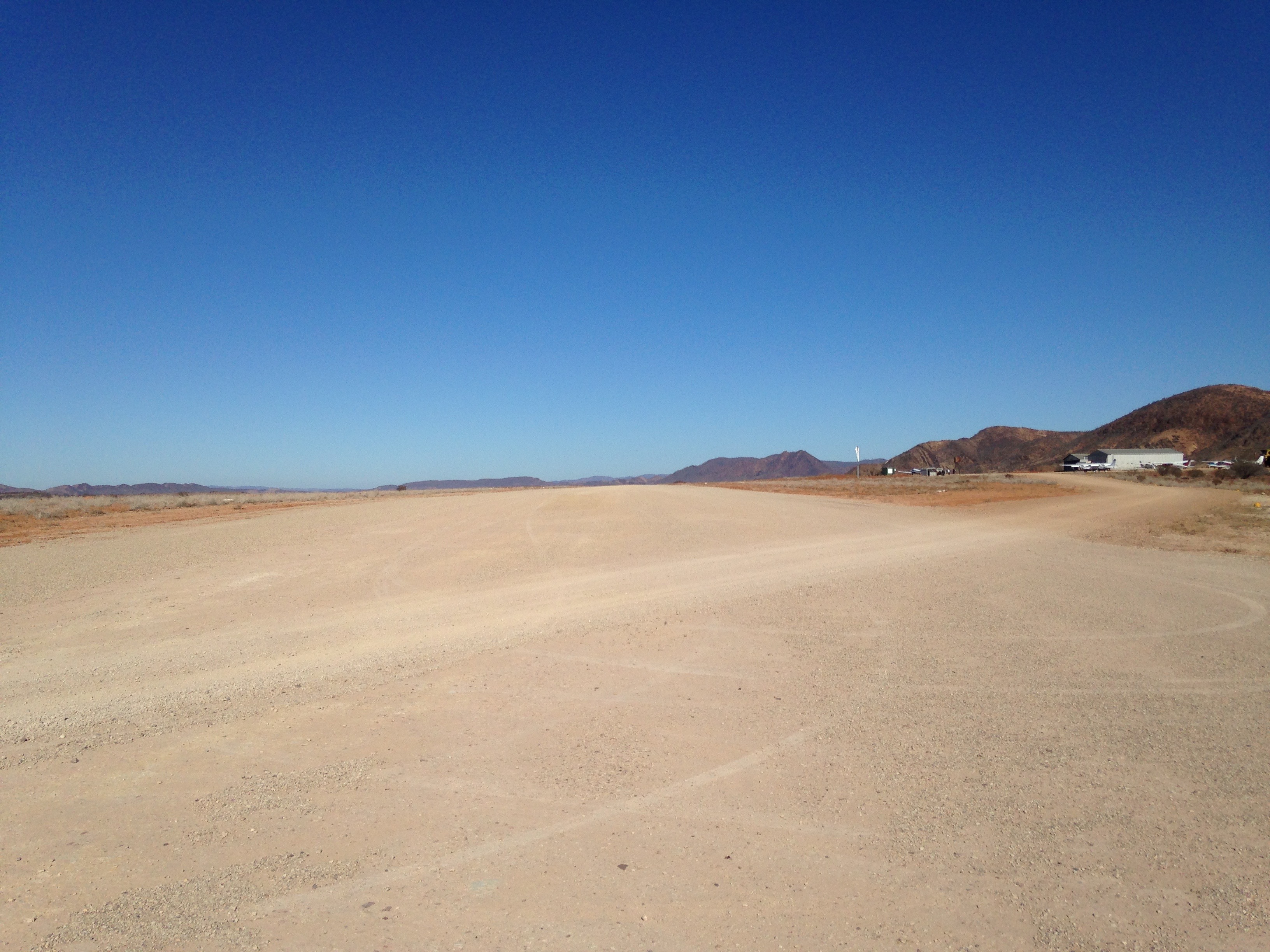
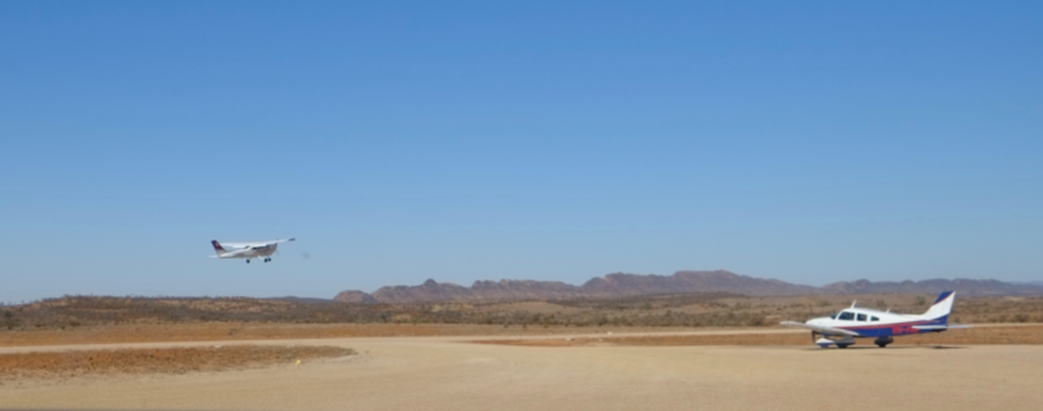
We were on our way to Arkaroola, a hidden gem in the Flinders Ranges of South Australia. The Arkaroola airstrip is a little hard to spot.
We descended over some breathtaking rocky scenery until it suddenly popped into view as we passed over a ridge at 1500 feet only 1 mile out. The gravel runway is 750 metres in length, with a creek either end, and a rise at the southern end, followed by a gradual decline towards the creek at the northern end. Needless to say, the landing required focus. The aptly named “international airport” was dry, flat and desolate. You could easily think you were standing in a crater on Mars; unlike Mars however it would be quite hot in summer! Compared with the tourist hot spot of Uluru, we felt like we were really staying in the outback this time.
Arkaroola airstrip from Google Earth
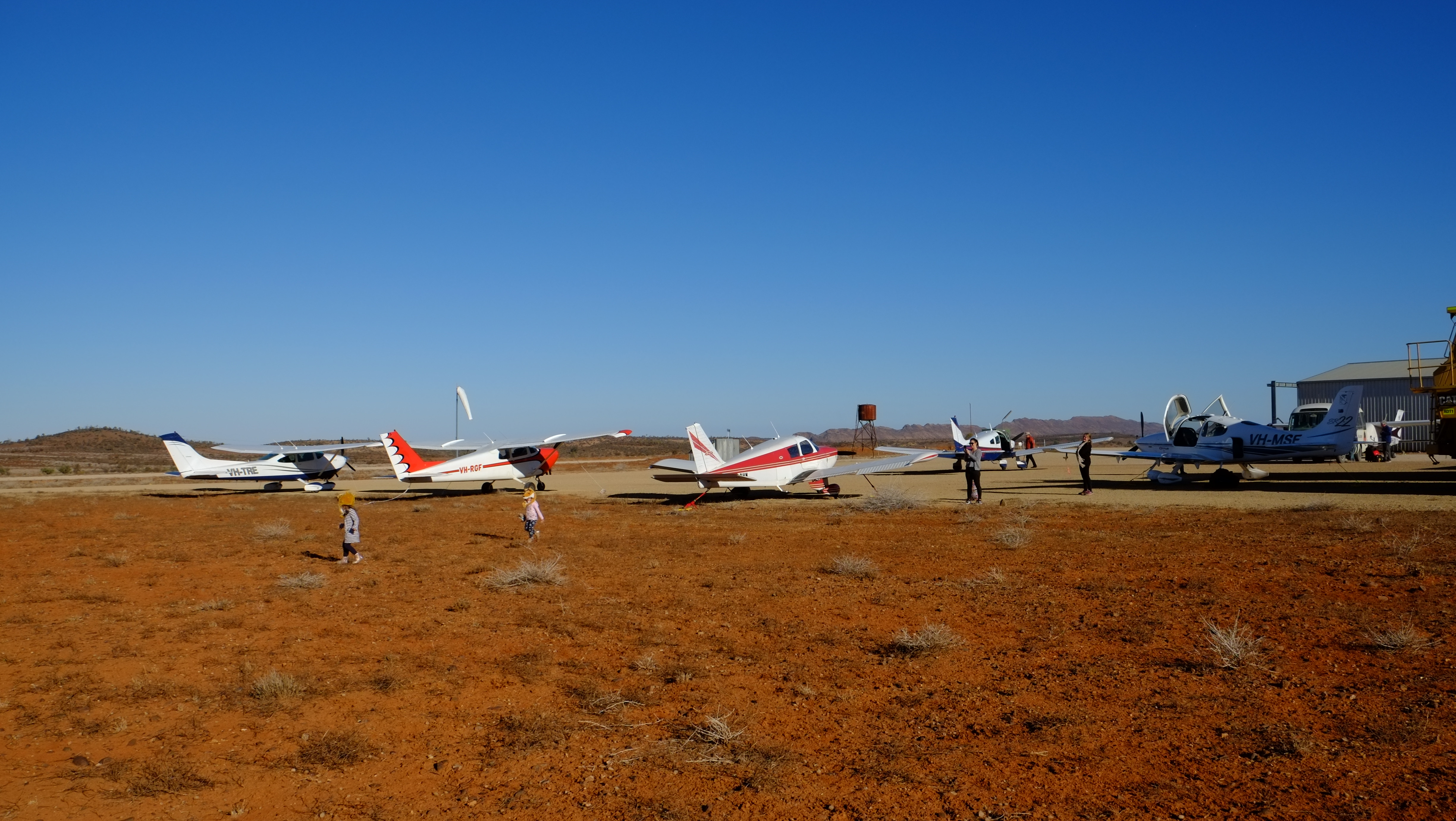
Our host Doug was expecting us, having been listening on his VHF hand held radio. While we waited for him to arrive we unloaded and poked around the couple of planes on site while keeping a close look out for local wild animals.
Arkaroola airstrip
We loaded our gear into Doug’s bus and he drove us from the airstrip to the Arkaroola Village (a motel, restaurant, shop and camping area) along a gravel road that wound through the surrounding hills. As he did he provided a running commentary of the nature reserve he has called home for over 40 years. Doug pointed out and named the flora and fauna and pointed to caves, animals and a former bat “guano” mine as well as numerous historical points of interest. I realised we had been oblivious to how special this place is and its historical significance.
Doug’s family, “The Spriggs” were pioneers of the geological history of Australia. It was Doug’s father Reg who discovered fossils from the Ediacaran period! And geologists travel from all over the world just to study there. Reg and his wife fought long and hard to lease and then purchase the land from the South Australian government, and to protect it from uranium mining. It has been a wilderness sanctuary run by the family since the 1970s.
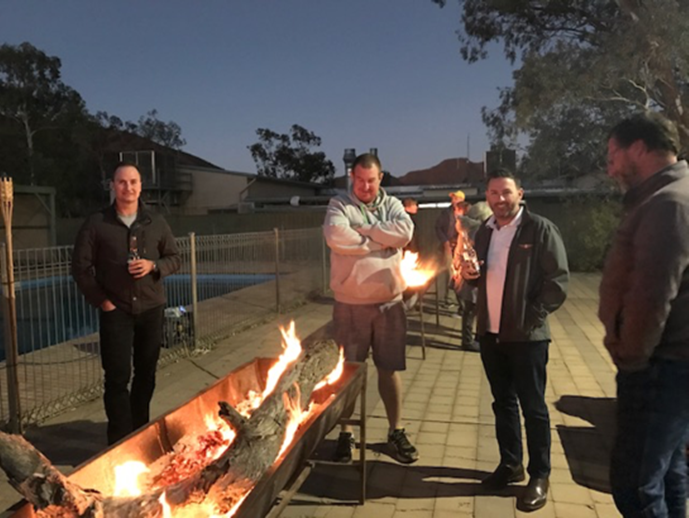
The evening was ‘BBQ night’ with open fires, great food and the opportunity to meet other campers, pilots and guests.
At 8pm we were driven up to the Dodwell Observatory to do some stargazing with our host Joe. Joe arrived in Arkaroola back in the late 70’s to deliver a parcel and never left. Although it was a really cold night the star gazing was really informative. We saw Mars, Jupiter, twin stars, a dying cluster of stars, new baby stars and many more. We could have stayed there all night if it hadn’t been for the imminent threat of frostbite!
Friday dawned clear and crisp. Breakfast was relaxed and hearty, with a bit of flight planning mixed in.
We headed out to the strip and after a quick pack and the standard pre-flight we were up in the air for another CAVOK flight to Broken Hill.
Departing Arkaroola
Broken Hill: Maureen Hollyoak – TRE
Leaving Arkaroola we were off to the east heading across Lake Frome, a large salt lake, towards the New South Wales border. The dry, parched land that had been a very constant feature since we had left Brisbane continued as we flew towards Broken Hill.
Silverton
The big feature of Broken Hill, the mullock heap, appeared on the horizon after about an hour.
In 1844 explorer Charles Sturt identified a broken hill in the otherwise fairly flat country and gave the place its name. In 1883 a boundary rider named Charles Rasp noted mineral deposits that he thought was tin. He and six mates formed the Broken Hill Proprietary Company (BHP) to raise capital to start mining. The ore deposit formed 1,800 million years ago and is the world’s largest silver, lead and zinc mine – hence the nickname Silver City. More than 800 men have lost their lives in the mine over the last century and the miners’ memorial is a solemn reminder perched on top of the mullock heap. The town always had a strong union movement. The so-called Barrier Industrial Council was formed to protect the workers’ welfare rather than the company profits. There are still environmental issues related to heavy metals in the dust with many children in the town still having higher lead levels than is considered acceptable by health authorities.
Our local tour guide met us at the airport and took us for a 6 hour tour around the town. After a quick lunch the first stop was the mine area itself. There are currently two mines operating on the lease with 2 million tonnes being taken out annually. The huge timber beams used in the old shafts are Canadian oregon that was imported over a century ago. They apparently still look as good today as when they were laid. Can you imagine the enormous task of importing these timbers all that way? Apparently this oregon is the strongest timber that exists. Based on the number of rings much of this timber looks to be over 1000 years old.
No longer just a mining town, Broken Hill is home to the world’s largest acrylic painting. The 12m high x 100m long canvas was painted by local artist Ando. The “Big Picture” details a wide variety of local scenes around Broken Hill and is a great achievement for the artist and the community.
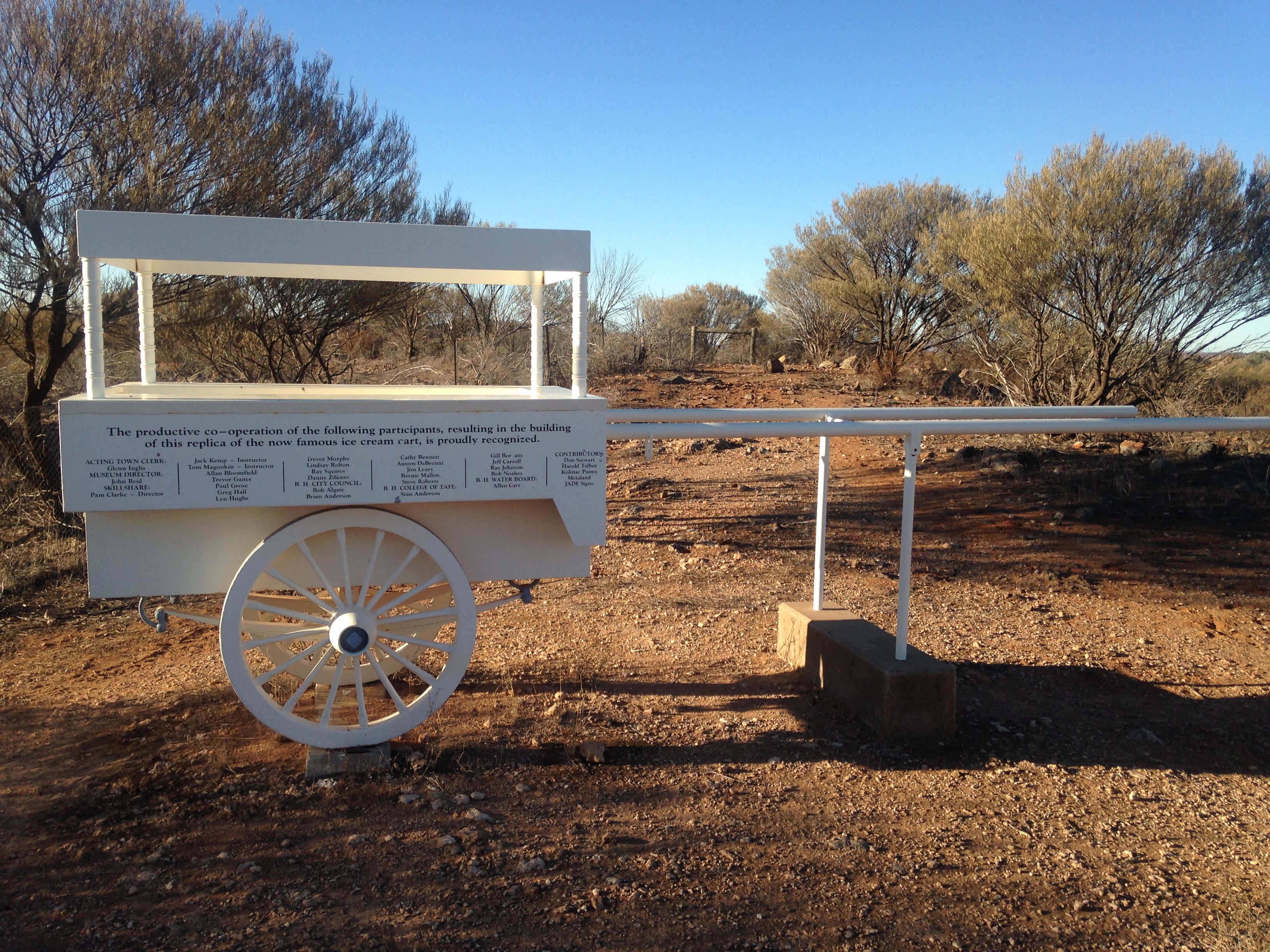
Broken Hill has a great history, including the only shots fired in anger on Australian soil during World War 1. The Battle of Broken Hill was a fatal incident which took place in 1915. Two men shot dead four people and wounded seven more who were heading to a New Year’s Day picnic on a special train to nearby Silverton, before being killed by police and military officers. We were shown where the battle took place and the two men were defeated. There is a replica of the ice cream cart used in the attack on the picnic train.
It seemed a good spot for the obligatory group photo.
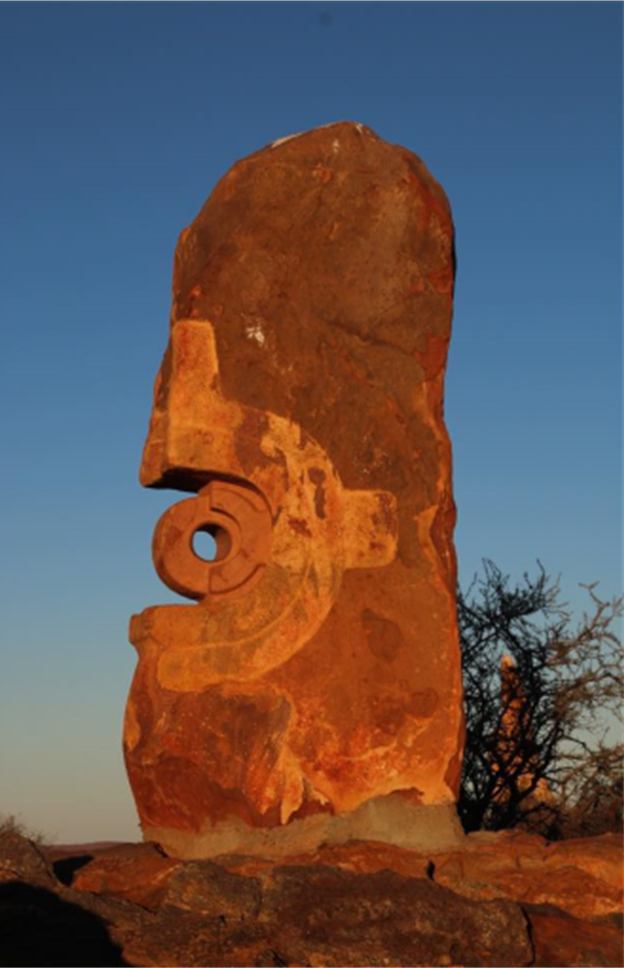
Another artistic feature of “the Hill” is the “Living Desert Sculptures”, our last stop for the day. Some local councillors managed to arrange for 12 sculptors from all over the world to descend on the town to chisel 12 sandstone blocks into interesting sculptures. We viewed them from the top of a hill overlooking town as the sun sank in the west.
Our tour over, we all descended on the Palace Hotel, our accommodation for the night and we were in for a real treat. The hotel was built in 1889 with a vision of providing fine dining and coffee to the community. By 1892 the owners realised that fine dining and coffee didn’t provide enough income to keep them in business, so they joined the scores of other licensed hotels selling alcoholic beverages.
Palace Hotel
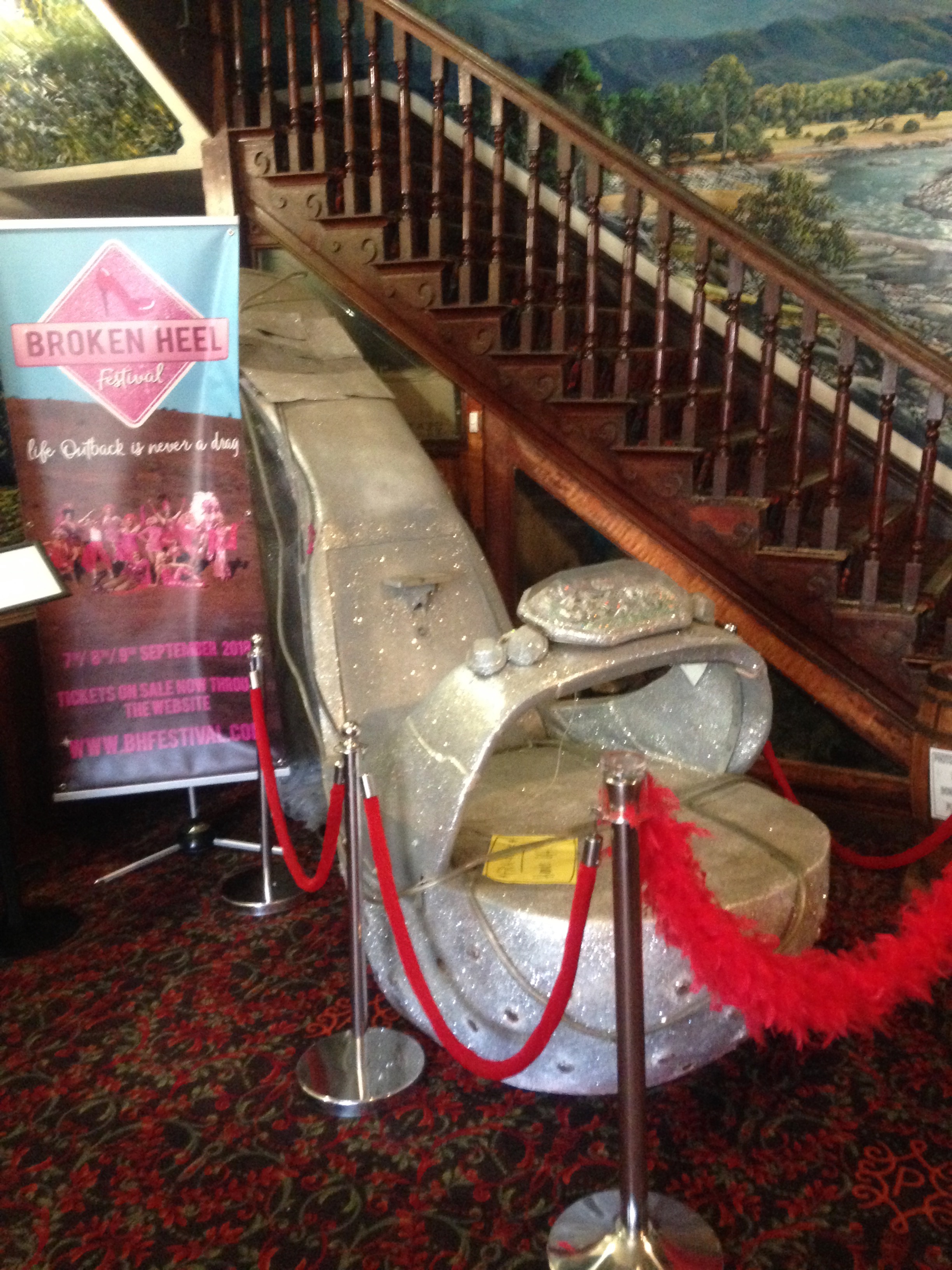
The hotel gained new popularity and notoriety when the cast and crew of the film Priscilla Queen of the Desert came to town in 1994 and filmed scenes in and around the hotel and the town. Many of the characters stayed at the hotel and it is still possible to visit (and even stay in) the Priscilla Room – which is gorgeous. The Palace has been associated with the film ever since and still contains some of the props used including an enormous high heel shoe. It’s the reason why the town celebrates a “Broken Heel Festival” in September each year, with performances from the nation’s best cultural personalities plus showgirls, Bio Queens, Drag Queens & Drag Kings. It’s a far cry from the mining culture that originally made the town wealthy.
To top it off, the day we were in town was Friday 13th July, so all the waiters were dressed up appropriately, adding to the great atmosphere of the place which was certainly the centre of town that night and I suspect every weekend.
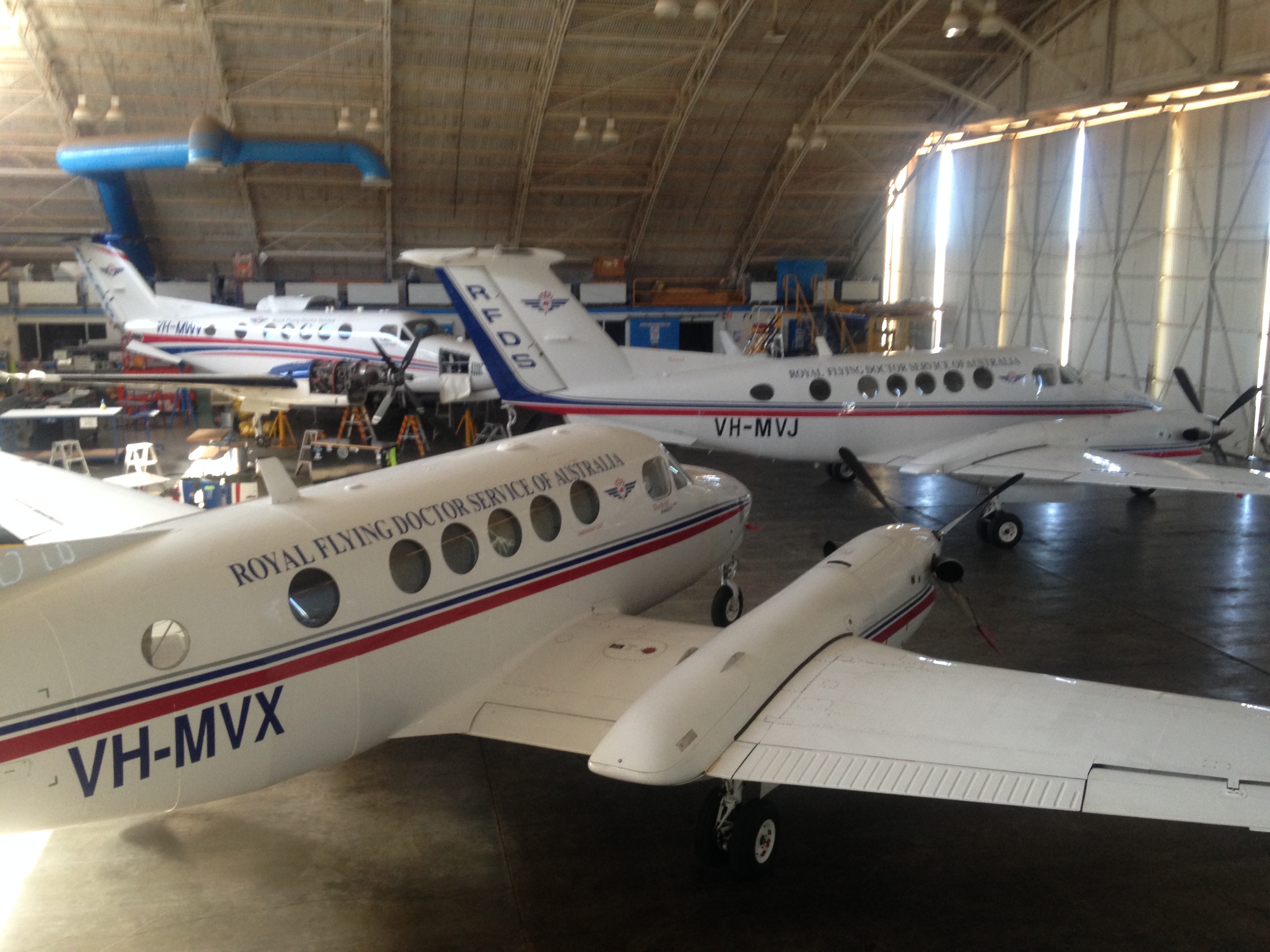
After a great sleep in our palatial rooms of basic (some might say retro) hotel style we were up ready for the next adventure. After breakfast we were off to the Royal Flying Doctor Service base.
We were shown though the centre and gained an understanding of how the work comes and goes. The Broken Hill base covers a “mere” 640,000km2 area. They have four Beechcraft King Airs worth $12,000,000 each. One was on a retrieval while we were there. It was clear how the costs mount up with just one retrieval over the minimal retrieval distance costing $10,000. The government provides significant funding however a large proportion is still raised from mums and dads fundraising all over the country.
It’s a humble reminder how all of us might need their service one day. We all need to think how we can contribute to this amazing service. They are always looking for pilots so anyone who is sick of their day job and has a commercial license could go join them for a rewarding and adventurous time. I had to keep reminding Biggles (Stephen White aka CEO) that he had an important job to do presently and not to put his hand up quite yet.
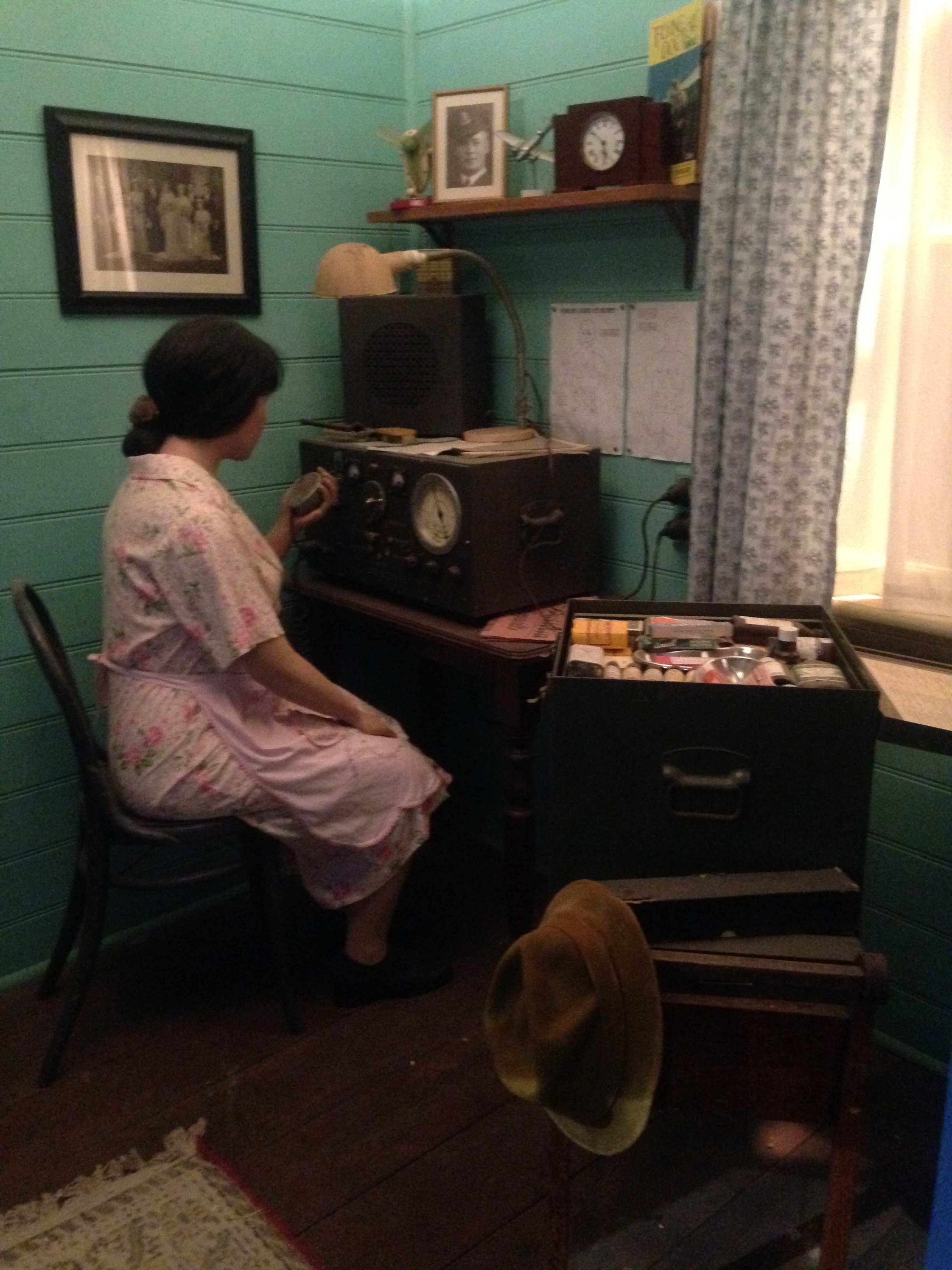
Medical chest with numbered medicines that doctors could prescribe to patients over the airThe original MSF
With the RFDS behind us it was off to the refuelled planes ready for our next air adventure enroute to Dubbo over more dry, parched country – a stark reminder that 90% of New South Wales is in drought.
Dubbo to Redcliffe: Mick Gardner – ROC
We spent a chilly night in Dubbo prior to our final leg home to Redcliffe. Sunday morning started off freezing cold at -5 degrees, so we knew we didn’t have to hurry out to the airport. The planes would be hard to start if we got there too early. We walked two blocks to a cafe only to find out they were fully booked. We found another cafe around the corner that was also full but they at least offered us seats outside. Outside? Did we hear right? In sub zero temperatures? But by this stage we were hungry and desperate for coffees so we sat outside under some gas heaters that sort of worked for a while which wasn’t too bad. Andrew asked the waitress for the biggest coffee they had and to all our surprise they didn’t disappoint. A few minutes later the waitress walked out with a “Bucket of Coffee” (supersize mug) so the morning started off with a few laughs and nice food.
After packing our bags most of us headed off to Dubbo airport in a Maxi Taxi while Sam, Tania and the girls stayed in Dubbo to visit the Western Plains Zoo.
With clear blue skies we were eager to get home but decided to stop in Tamworth to stretch our legs and have a toilet break. TRE was the first to depart followed by ROC, FRF and MSF. With only a 60 minute flight time we arrived in Tamworth, home to the Australian Defence Force flight school. It’s a D Class aerodrome so we had the tower to contend with.
Heading to Tamworth from Dubbo
Ready for our next coffee we discovered that the Tamworth Airport Terminal is being upgraded so the coffee shop was closed. The pop up café that’s meant to be its replacement during the upgrade was also closed for the weekend so we were out of luck. TRE didn’t muck around and departed pretty well straight away while the rest of us had a chat deciding what was the best way to plan into Redcliffe as we had Brisbane airspace to consider.
Departing Tamworth
After a while we also headed back to the planes and departed on Runway 30R as Tamworth has parallel runways. It was about a 2 hour leg over some high terrain and we noticed a few bushfires along the way.
Between Tamworth and Inverell
Our track took us over the top of Amberley RAAF base which was not active and from there we requested clearance through Brisbane airspace which we were granted, much to our surprise.
Passing over the NSW/Qld border and the Scenic Rim
One by one we all arrived safely back at Redcliffe. After unpacking the planes we ended up debriefing over a drink or two at the club on what really was a trip of a lifetime.
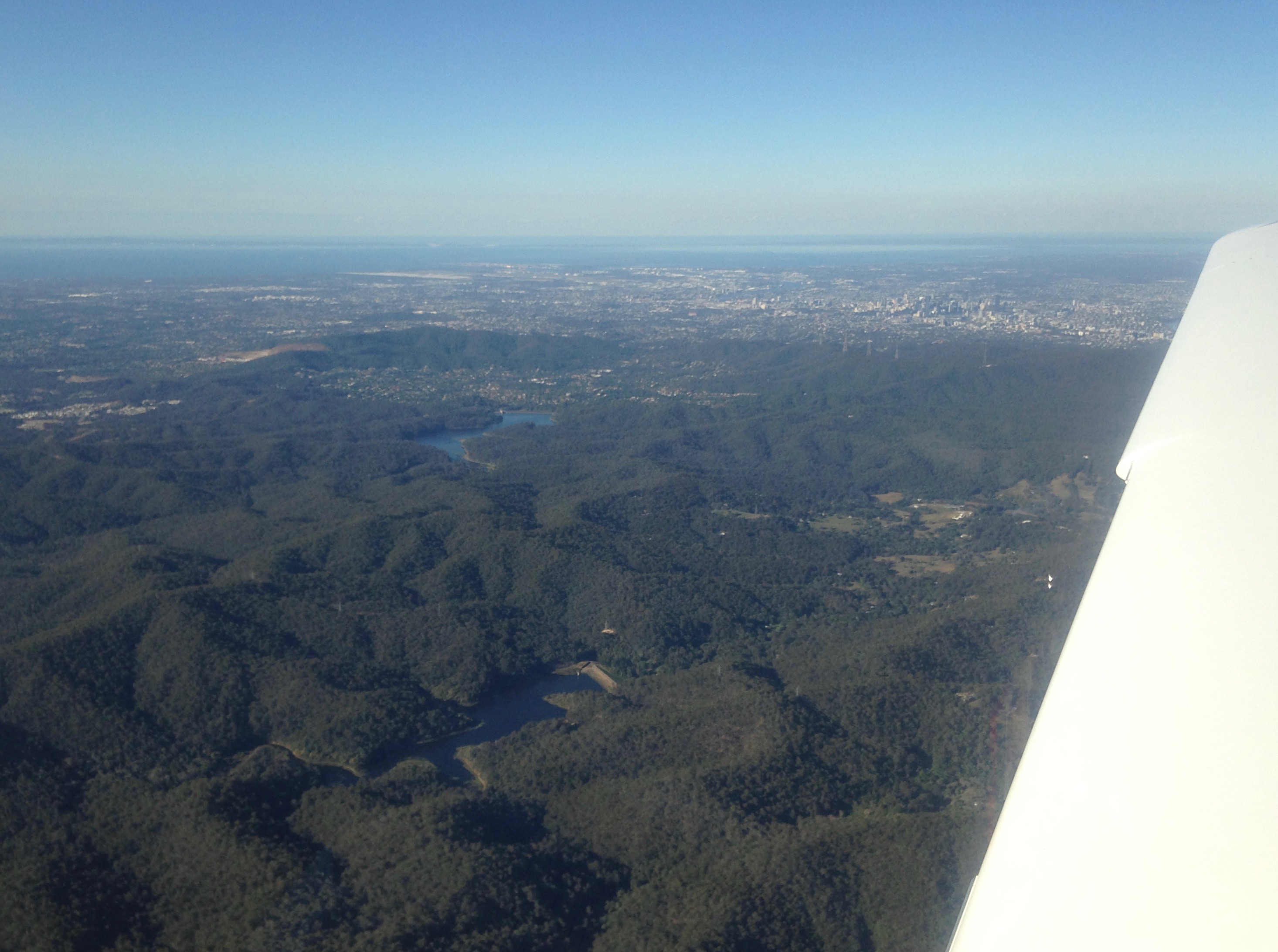
On descent past Gold Creek Dam, Enoggera Dam and The Gap
All of us would like to thank Sam Keenan for the work he put into arranging the trip. It was a very professional effort and all went smoothly because of it. The camaraderie that built over the trip was exceptional and it was great to share a week of fun and adventure with such a great group of people. We all learned a lot along the way but mostly shared some great times and places in a way that not many people have the opportunity to do. It highlights how fortunate we are to be members of such a great club that promotes trips like this, allowing less experienced aviators to mix with, and learn from, those who’ve been around and flying for longer.
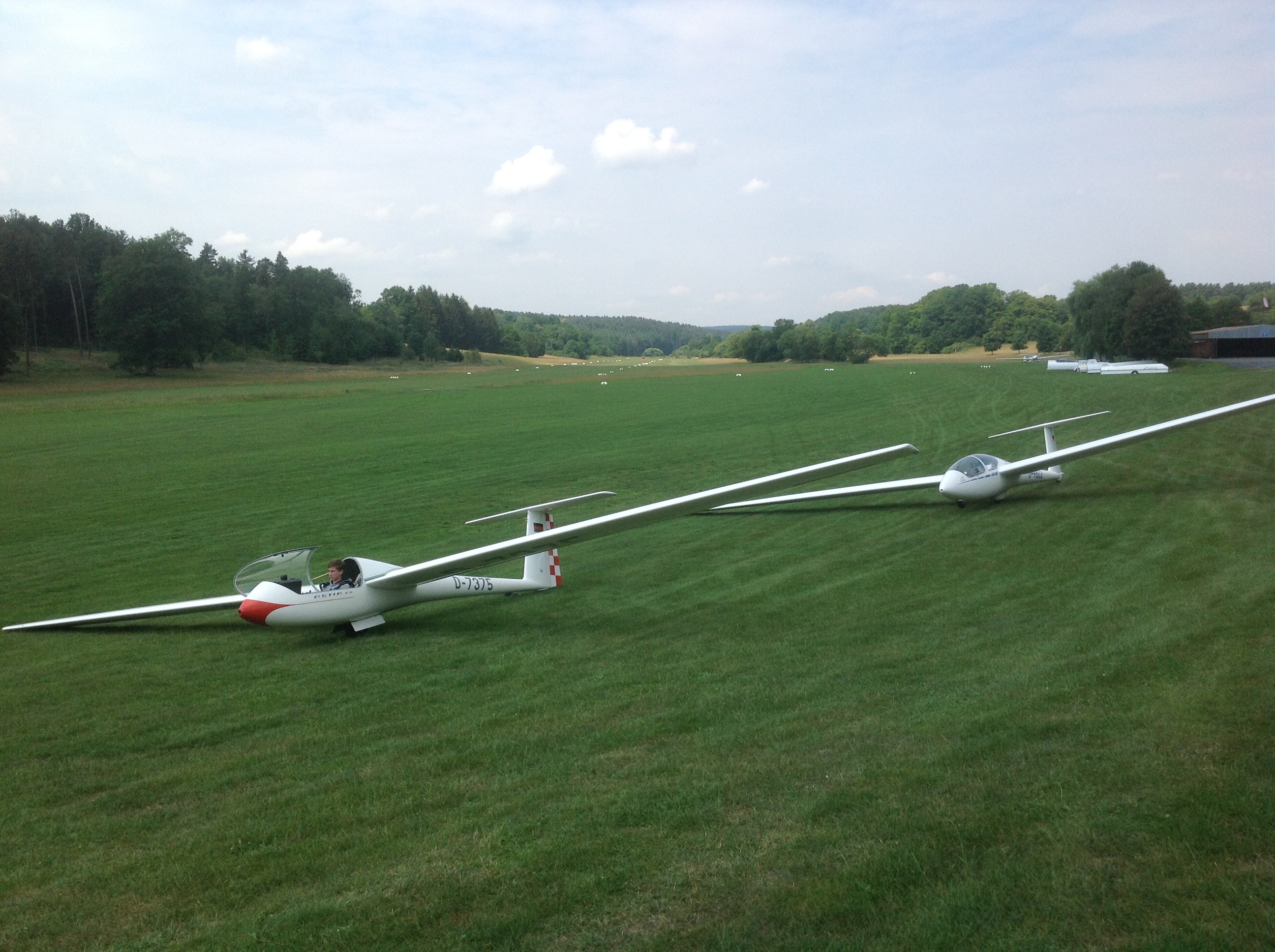
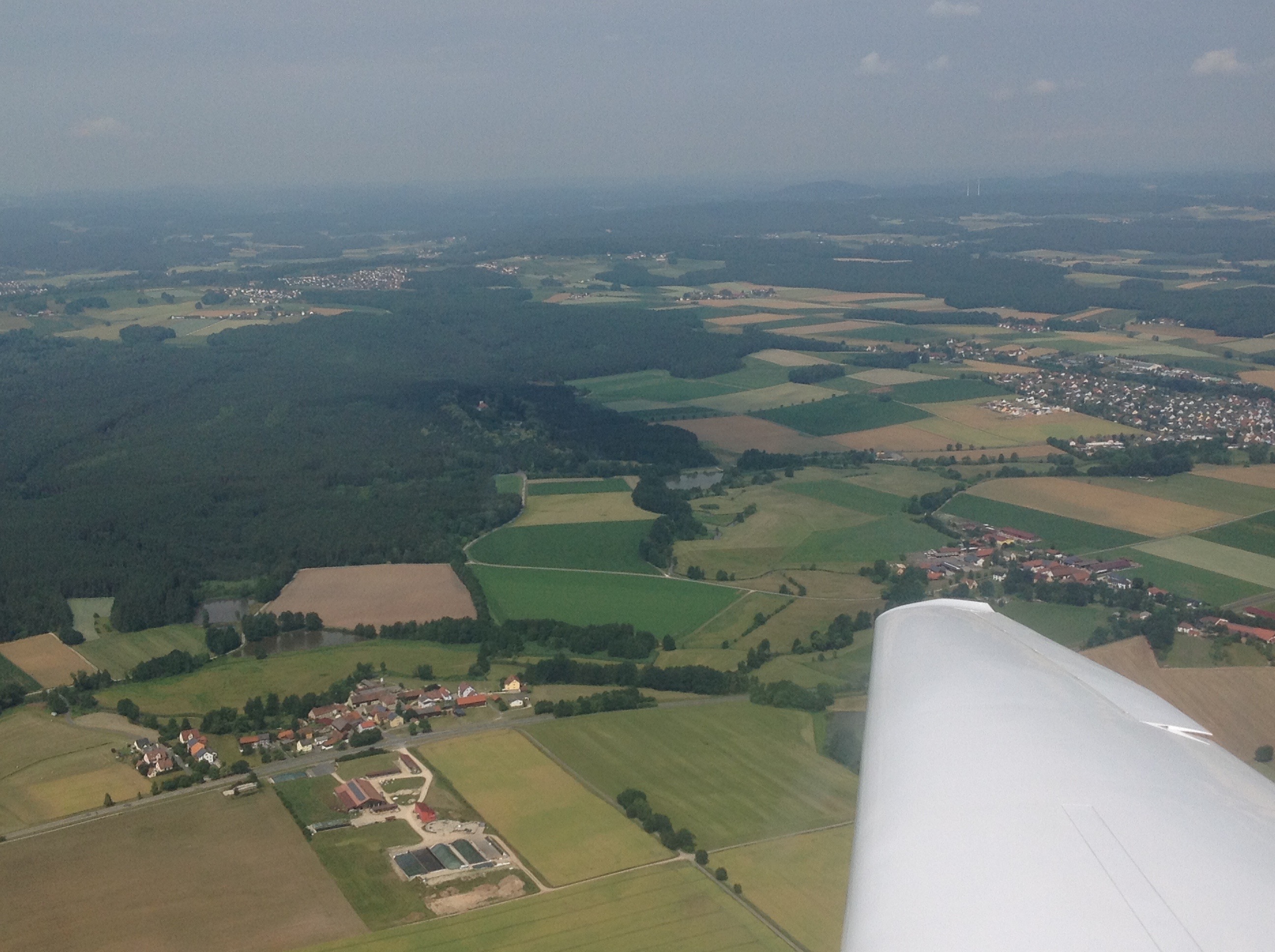
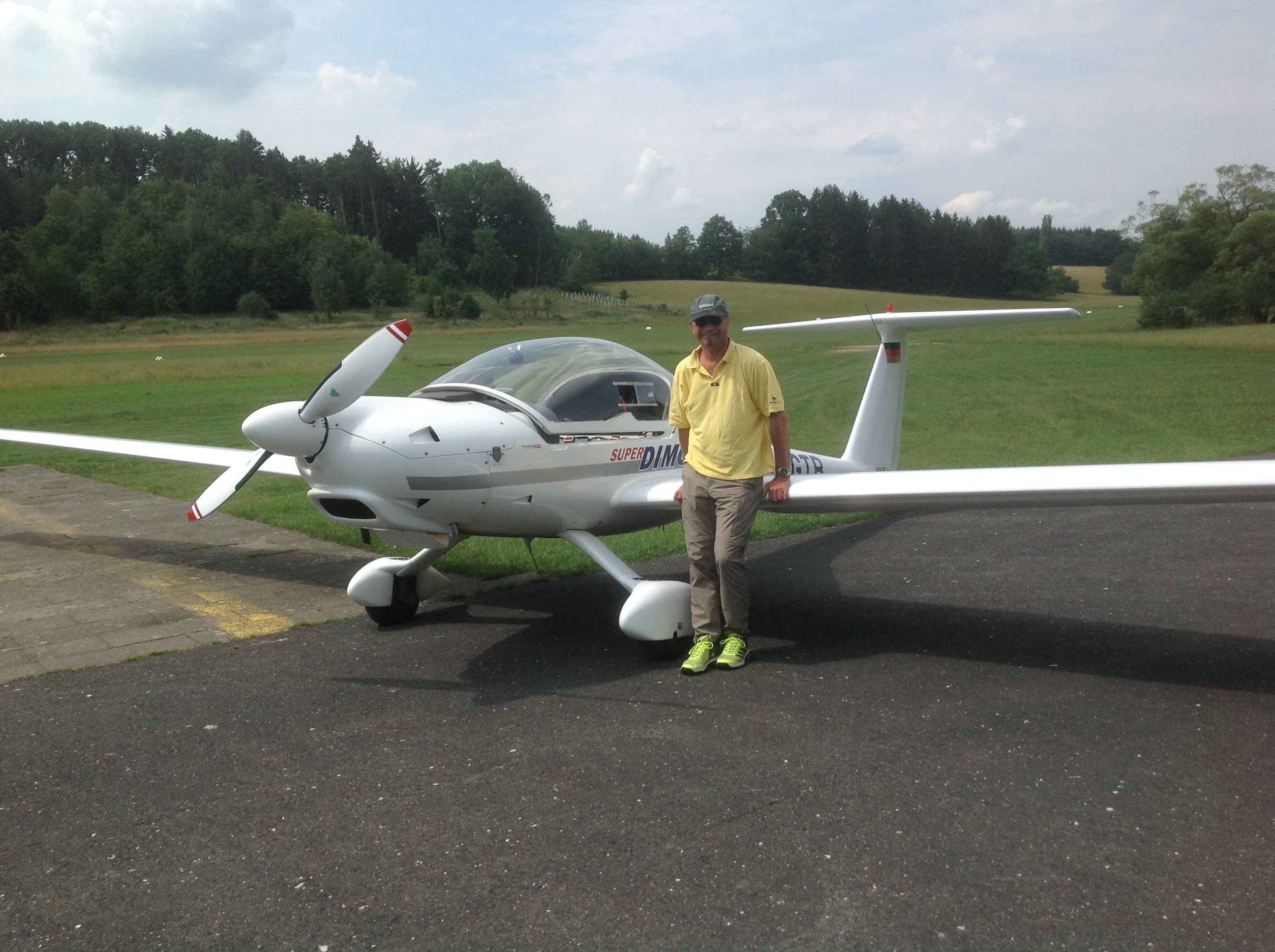
I’d been wanting to fly around Amberg, Sigi and Sonja’s birthplace and my home for 5 years in the late 80s, for a while and finally managed it in June 2018. There’s a gliding club with a field just outside town and they take guest passengers up for a very reasonable fee. I chose the Diamond Super Dimona motorised glider to ensure we had a good look around. My pilot was Joerg, who’d been flying there since 1984. It was a smooth ride at 500-1000ft above ground level and pretty good visibility despite some thunder clouds developing not too far away.
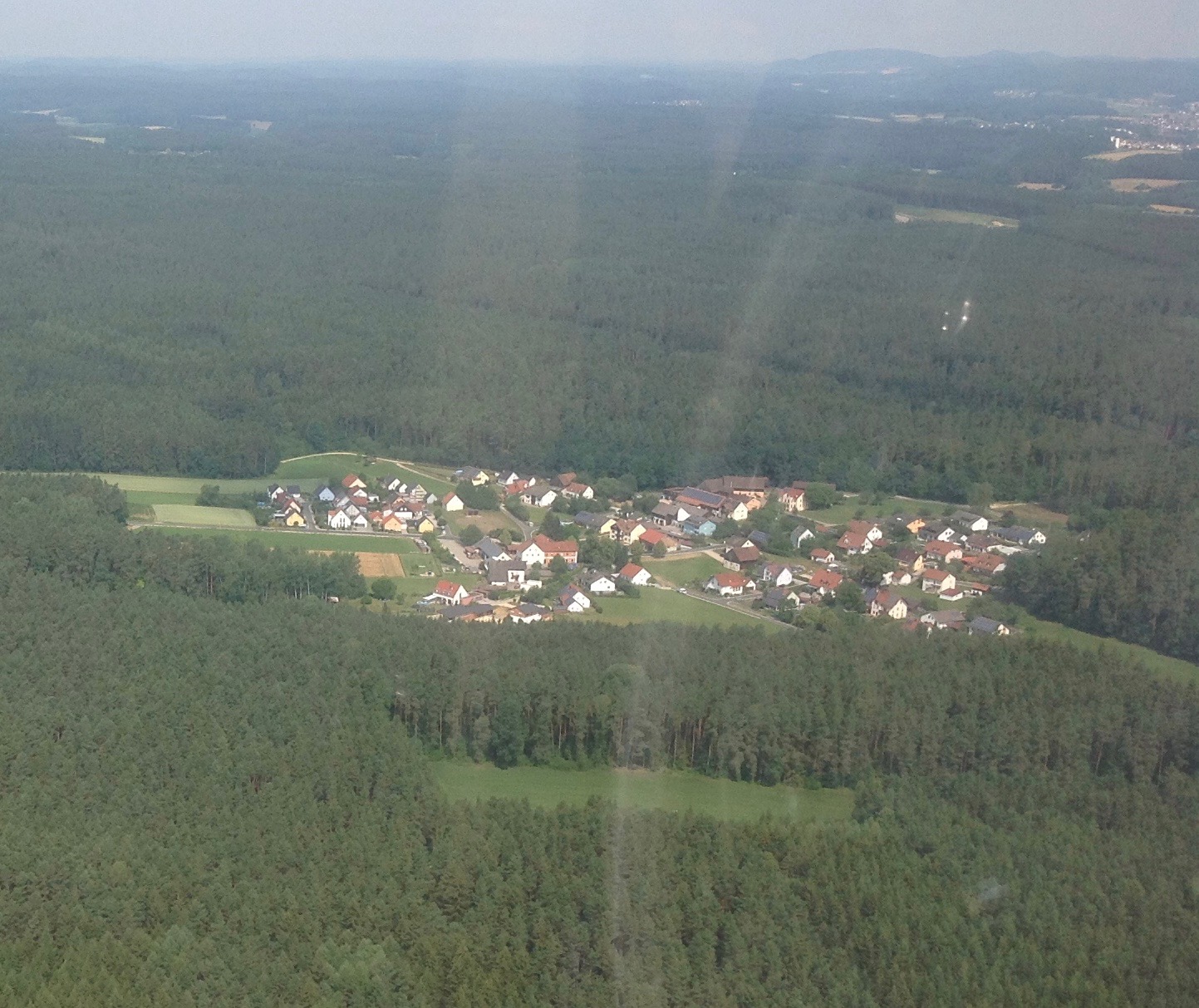
Fichtenhof
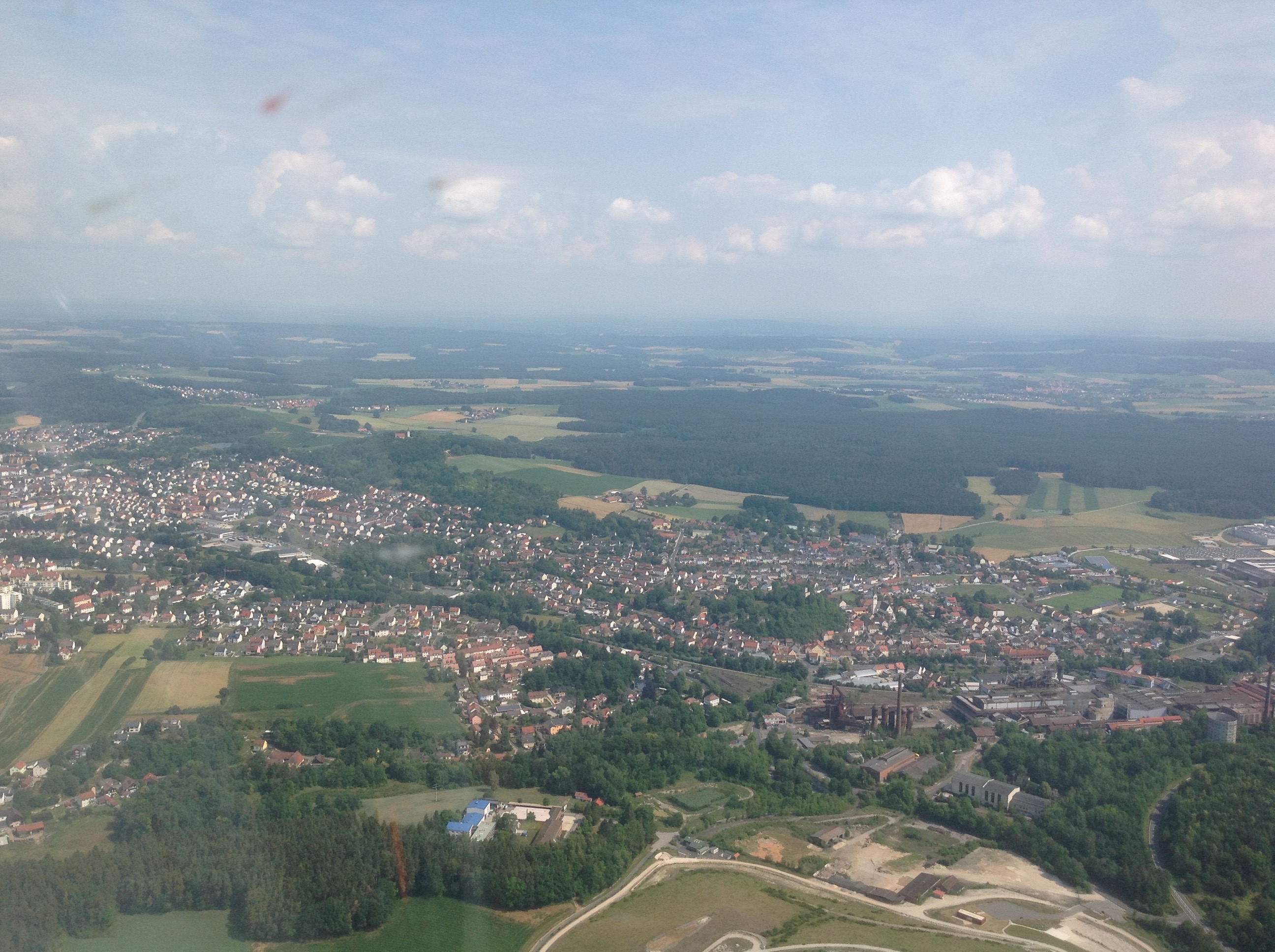
We took off from Amberg, and flew over Fichtenhof to Rosenberg, where the steelworks was where I worked from 1985 to 1990. It closed down about 20 years ago, no longer able to compete with imported steel.
RosenbergThe defunct Maxhuette steelworks
From Rosenberg it was a short hop to Koetzersricht, Sigi’s village where she grew up, along with nearby Frohnberg and Hahnbach.
Koetzersricht in foreground with Frohnberg above and Hahnbach on the rightKoetzersricht
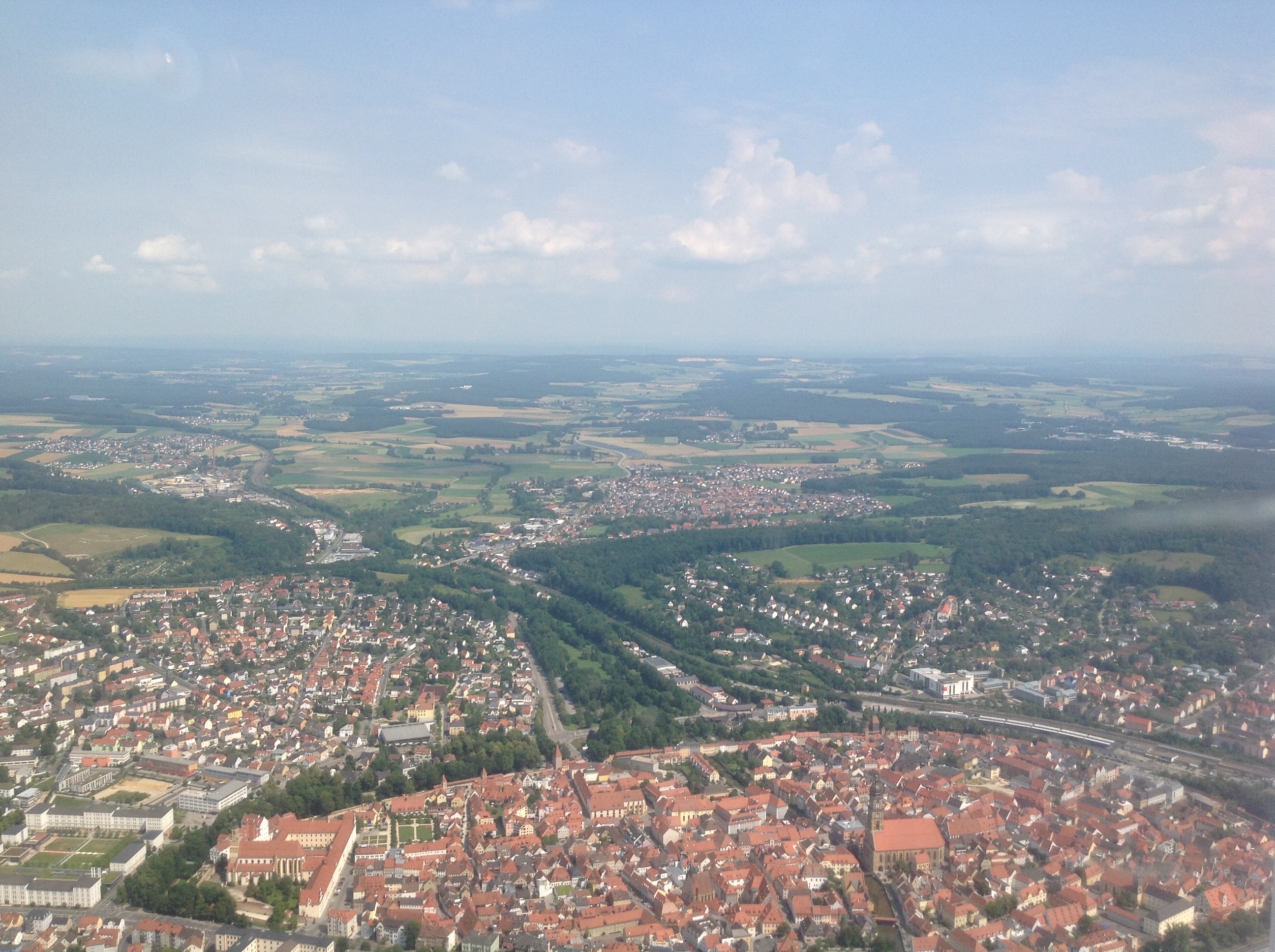
After an orbit over Koetzersricht we headed back to Amberg and flew over the city on our way back into the gliding field. It was a great way to get a bird’s eye view of the area at a comfortable speed.
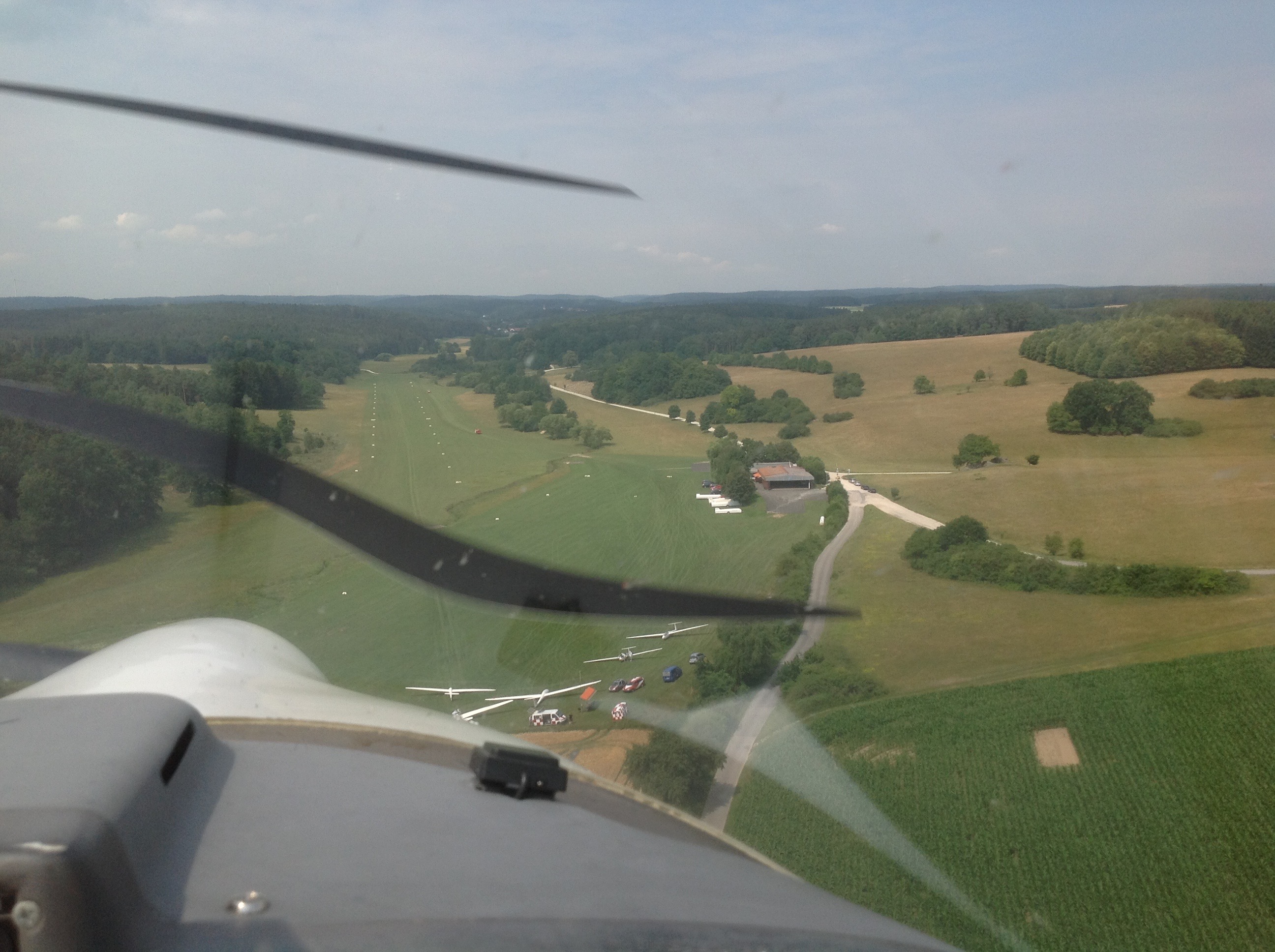
Amberg with Mariahilfberg church at lower leftAmberg old town with Martins church lower right, looking along the Vils valley towards KoetzersrichtShort final
Highly recommended to anyone who goes there. 30 Euros for 30 minutes.
We had an early start on April 25th 2018 for the Anzac Day Dawn Patrol. The Redcliffe Aero Club has held this event for a few years. Prior to the dawn service, in the dark, I prepared VH-ROC for the … Continue reading →
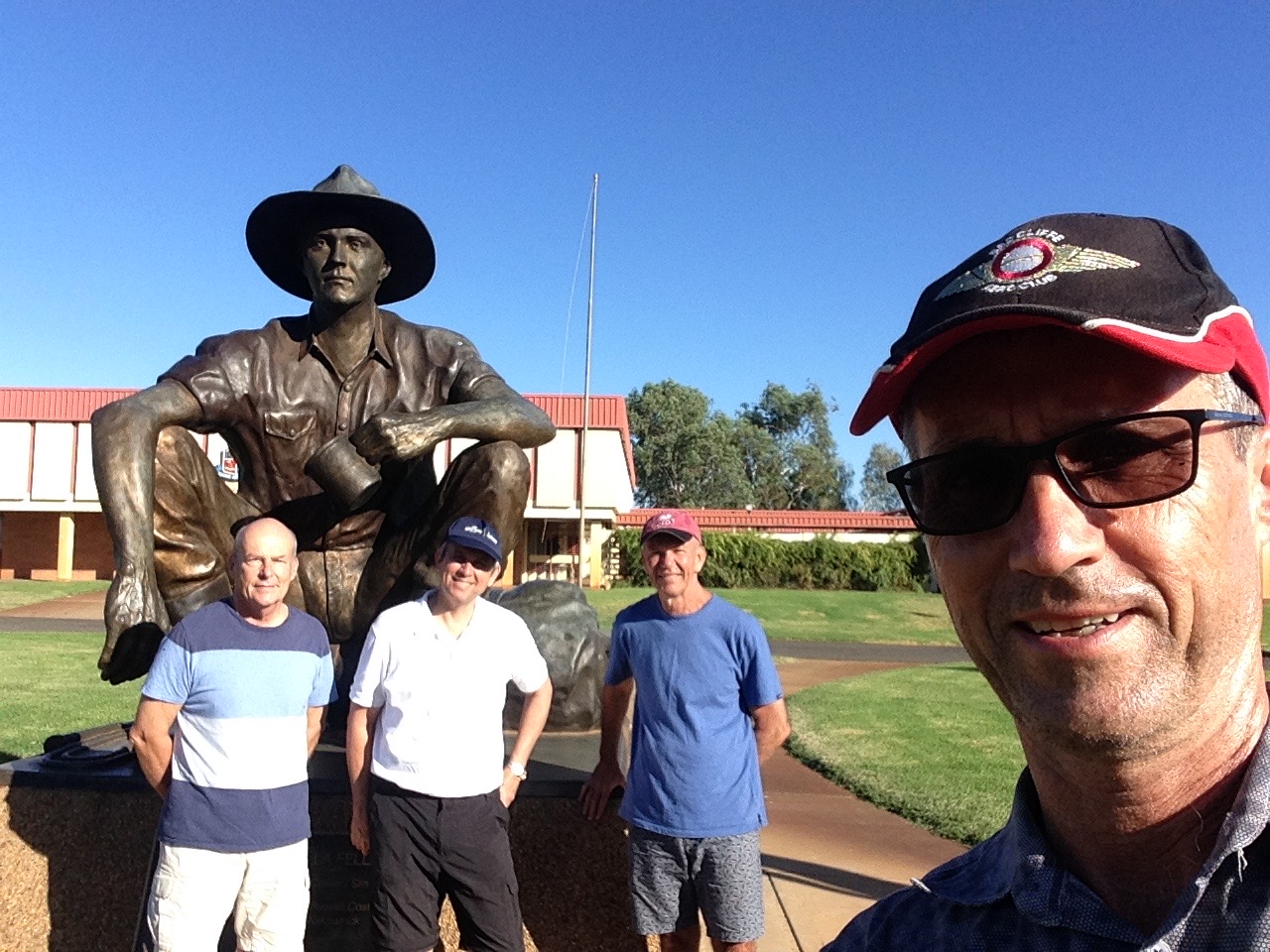
In early April 2018 Harpur Michell, Peter Bradley, Mark Cuskelly and I headed off to the Wild West of Queensland for a weekend in the outback.
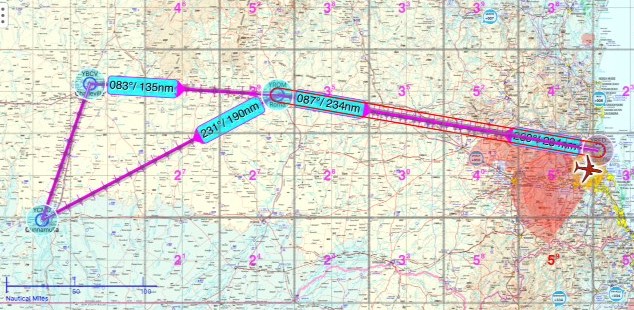
After a refuelling stop in Roma we headed to Cunnamulla for our first night.
With the “Cunnamulla Fella”
We stayed with Ken and Barbie who are Peter’s aunt and uncle. It’s an interesting little town with plenty of characters.
Babs with Peter
Barbie and Ken organised a barbie for us (fitting) and invited a couple of friends around for the evening. Their granddaughter Hannah joined us later in the evening.
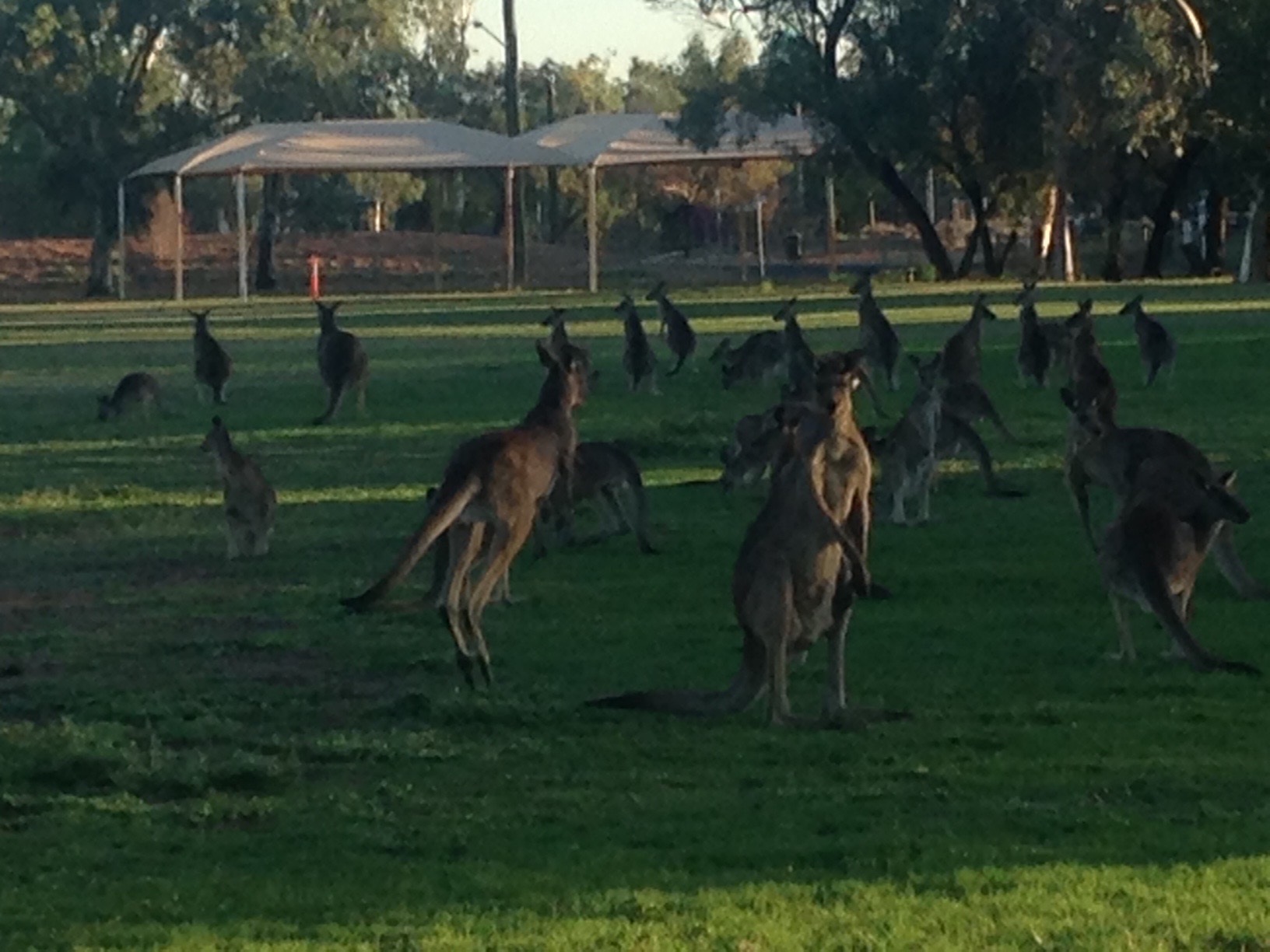
Roos galore on the school oval
Following our evening in Cunnamulla Harpur, Peter, Mark and I woke up to clear blues skies. After a coffee at a trendy “downtown” cafe (yes there is one and it’s for sale!) and a great breakfast of omelettes cooked by Babs, her granddaughter Hannah drove us out to the airport, dodging suicidal kangaroos as we went. Hannah is a jillaroo and used to catching wild pigs around the property she works on so kangaroos are nothing for her.
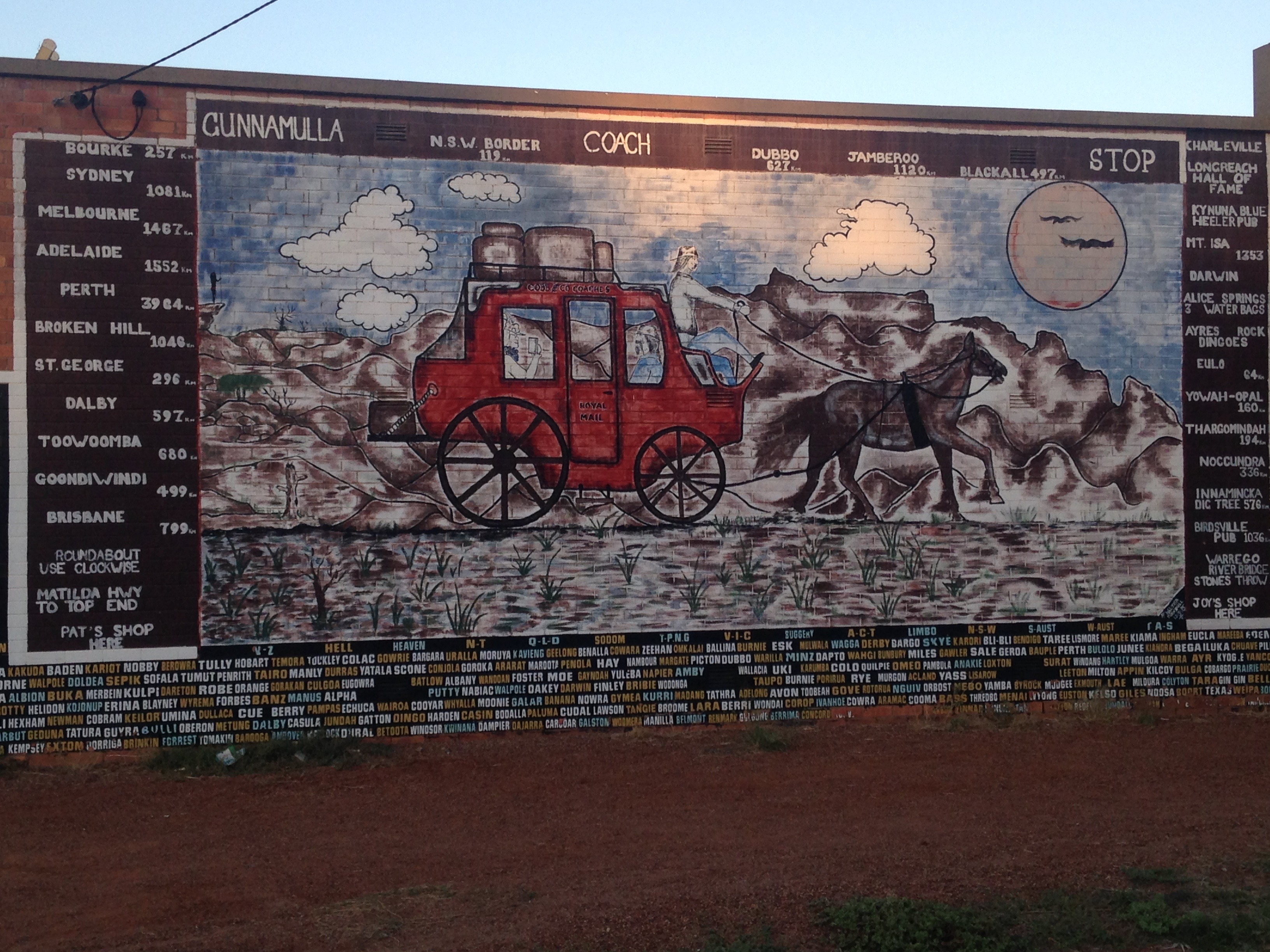
Cunnamulla was a stopover for the Cobb and Co coaches in the 1800s
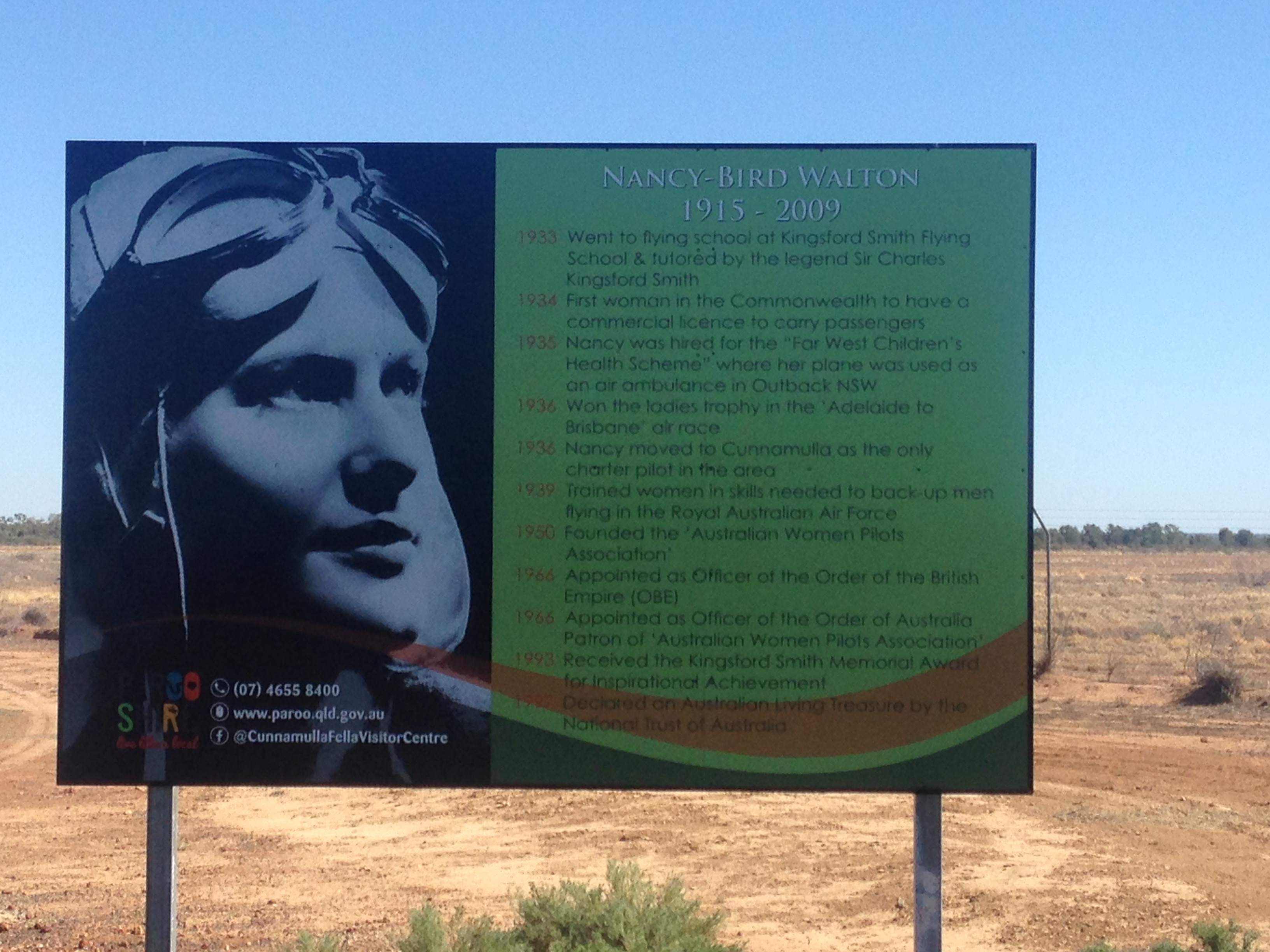
At the airport we noticed a large billboard that described the life of Nancy Bird Walton, one of Australia’s pioneer aviators. She worked in Cunnamulla as a charter pilot for a while and founded the Australian Women Pilots Association.
We loaded up and headed off for Charleville, about 40 minutes away. On departure we orbited over Cunnamulla at 2000 ft to wave to the locals and take a few photos then followed the road and the Warrego River northwards.
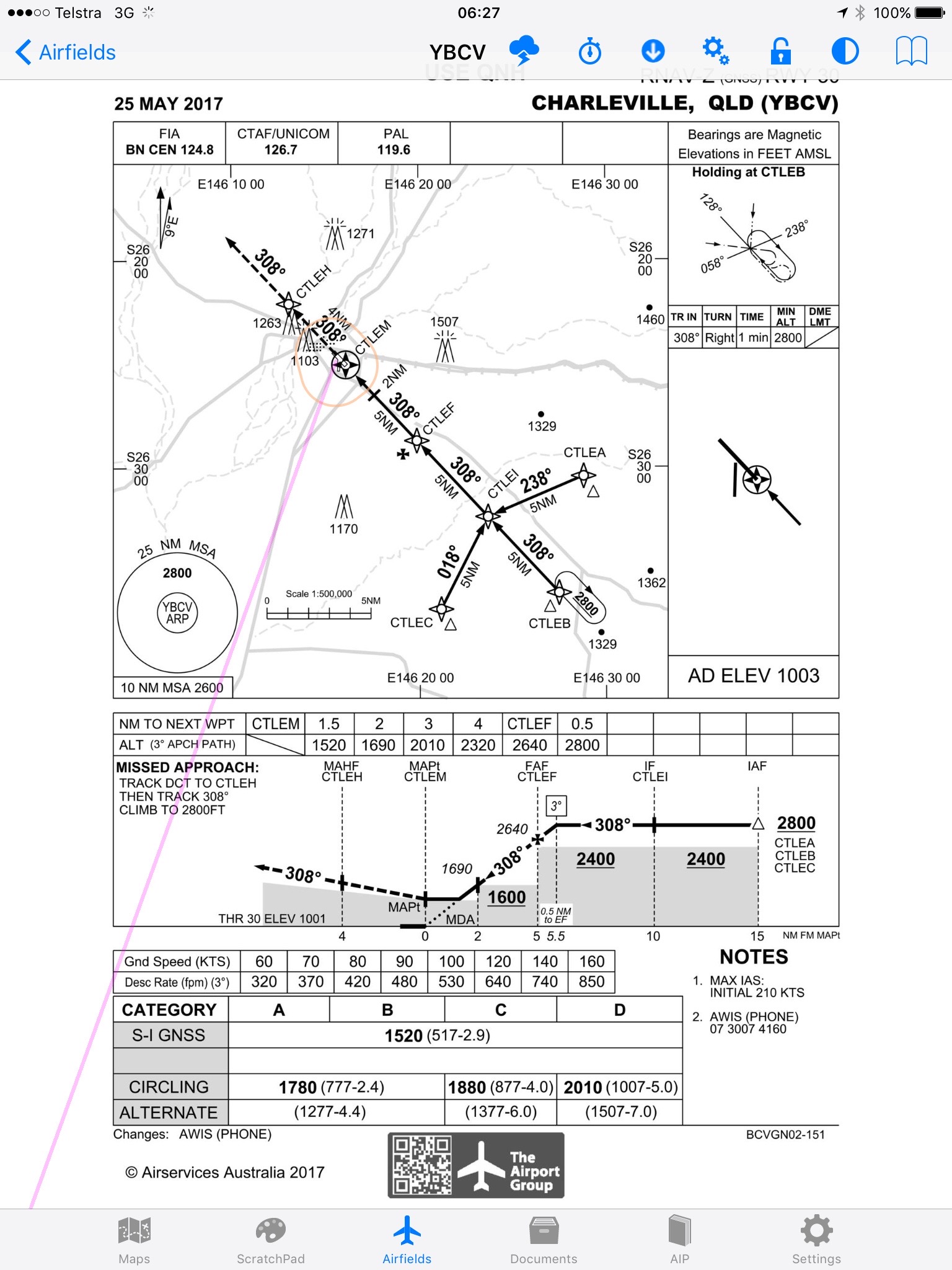
Although there wasn’t a cloud in the sky I wanted to practise an instrument approach as this is something a private IFR pilot must practise at least once every 6 months and more frequently if possible. It helps you prepare for a real one in cloud when required. So I prepared to fly via the RWY31 RNAV. This meant diverting northeast when we were 25 miles out from Charleville and descending to 2800ft for the initial waypoint. I used the autopilot on the Cirrus to hold us at 2800 while using the heading mode to manually fly a holding pattern at EB. We then continued past waypoint EB and EI to EF, where we started descending at 500ft/min until we were about 3 miles from the threshold. I then broke off from the straight in approach and did a circling approach and landed into the wind on RWY 13.
Instrument approach for Charleville
On arrival we refuelled the aircraft then walked over to the Royal Flying Doctor Visitor Centre nearby. It’s a static display of the history of the RFDS where Charleville played a major role in the past.
We caught a taxi into town and checked into the Corones Hotel. I found this place on Trip Advisor and it was special. Built in the 1920s by a Greek immigrant and entrepreneur it saw some pretty amazing times between the wars. Lots of historic photos line the walls. It has some really finely crafted woodwork, mainly of silky oak, like the main staircase, and stained glass windows and sculpted ceilings. We had a drink and a meat pie (what else?) in the massive bar and made a plan for the evening.
At the Corones Hotel barCorones Hotel Stairs
Dad had asked me to look up whether any of the Herriman family still live in Charleville. John Herriman was dad’s pilot in the bomber command mosquito squadron and had grown up there. I checked out the white pages and sure enough there was one Herriman listed. I called up but no answer. But the address was less than 1km away so we headed around there to check it out. I went up the front steps of the old Queenslander and rang the bell. Along came an elderly gent with a shock of white hair and a great bushy beard. “I’m looking for someone who might have known John Herriman” I said. “That’s me” he answered. “I’m Harry, his baby brother!” Bingo!! So we had a chat about John growing up in Charleville and how he’d moved to Brisbane to study electrical engineering at UQ then went to fight in the war. I mentioned that John was a good pilot according to dad but I’d heard that he never flew after the war and found it strange. “Well you see, I don’t think John ever liked flying” said Harry. “He just did it as a job during the war and when he got back he had no interest in it any more.” It was good to meet up with the brother of the guy that dad entrusted his life to during those many missions in the 1940s.
Corones Hotel deck
We had to get to the Cosmos Centre at 7:15pm so arranged dinner at 6pm in the beer (and steak) garden. The taxi picked us up on time and we headed out for a couple of hours of star gazing. The Cosmos Centre has about 5 or 6 large telescopes. Astronomers set them up using a GPS system beforehand and then guide the visitors through the process of star gazing while explaining the various nebulas and clusters. Charleville has a reputation for clear skies and it didn’t disappoint us. Unfortunately there were no planets in the sky at that time but we saw plenty of different star groups. We saw Capella that’s 47 light years away, the Great Orion Nebula that is 1600-1900 light years away, the Jewel Box that’s 7,700 light years away and Omega Centauri Global Cluster. This is the largest globular cluster in the Milky Way. It’s 17,000 light years away, contains up to 10 million stars and looks like shards of broken glass – quite strange. By the time we arrived back at the hotel at 10pm the bar was shut as was the rest of town (it was Sunday) so we retired for a well earned rest!
Downtown Charleville
Monday dawned with clear blue skies. After a short stroll around the Charleville “CBD” we headed off for breakfast at one of the cafes that opened at 7:30. With some good coffee and a good breakfast we chatted away aimlessly until someone noticed it was almost 10am and we had to check out of the hotel. We caught a taxi out to the airport and loaded up once again. I preflighted the plane and submitted an IFR flight plan to Roma. A Rex plane arrived and parked at the terminal. MSF roared into life and taxied out to runway 13 and departed to the east, climbing to 9000ft. It was lovely and smooth up there, above the turbulence.
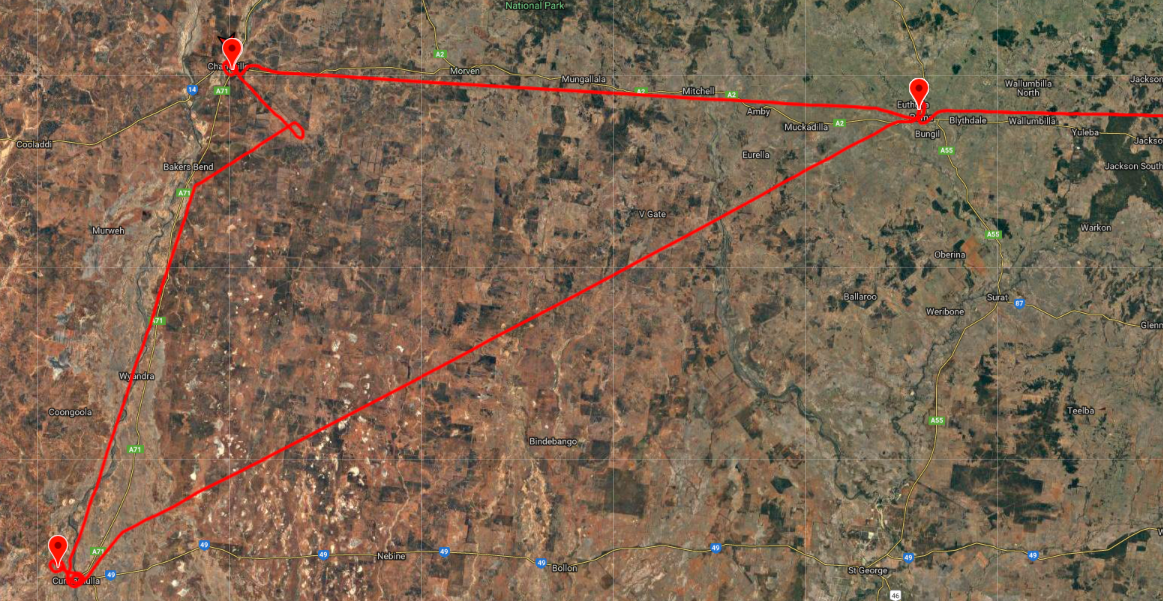
The route from Roma to Cunnamulla to Charleville and back to Roma
After 45 minutes it was time to descend again. It was a smooth touchdown in Roma and while refuelling we had a chat to Gavin the ARO who we’d met on the way out to Cunnamulla on Saturday. I think he must have been impressed that I’d told him we’d be back on Monday at midday and sure enough, there we were, right on time. I submitted a new IFR flight plan on the Ipad and after a bite to eat we all climbed aboard again and taxied out, took off and headed east again. For this leg I’d elected to fly at 7000 ft, knowing that we’d have to avoid the special Commonwealth Games Air Defence Identification Zone around the Gold Coast above 8500ft. Unfortunately it was a wee bit turbulent at 7000 so after putting up with the bumps for about 20 minutes I requested a climb to 9000 ft which ATC approved without delay. We’d have to descend before we reached the ADIZ anyway. Lovely and smooth yet again! We just so happened to have a band of cloud at that level which meant popping in and out of clouds as we went along.
There were a few bumps passing through them but it was fun to pass in and out. That’s what IFR is all about! Passing over Kingaroy the autopilot turned us gently for home and MSF was soon descending over Lake Somerset and Kilcoy for Redcliffe.
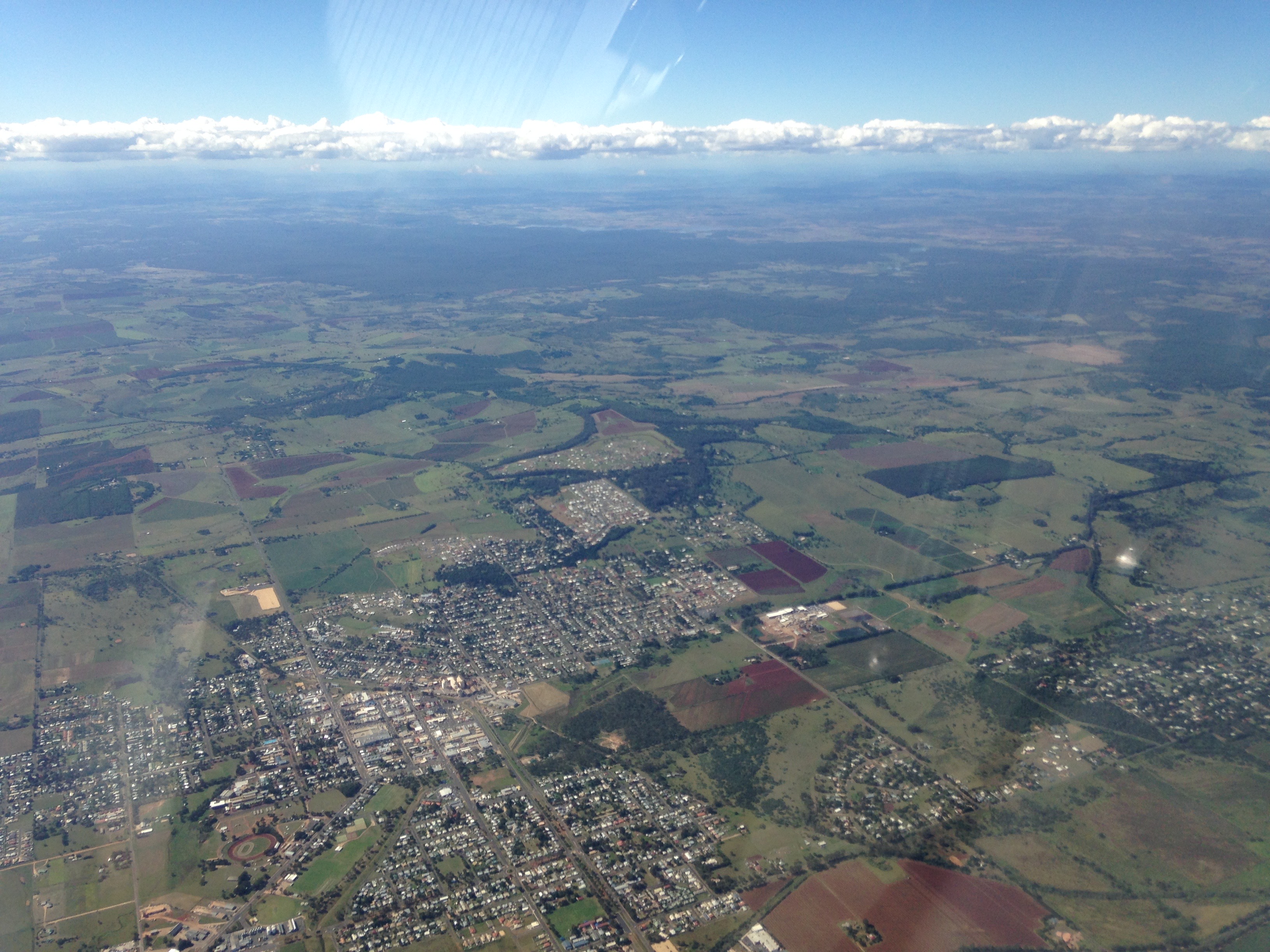
Kingaroy from 9000ft
We were visual as we descended, picking some gaps between the few clouds in our way, allowing the air traffic controllers to focus on guiding more significant aircraft. It was a pretty normal join to the circuit at Redcliffe and a smooth touchdown. Home again from our “wild west” weekend.












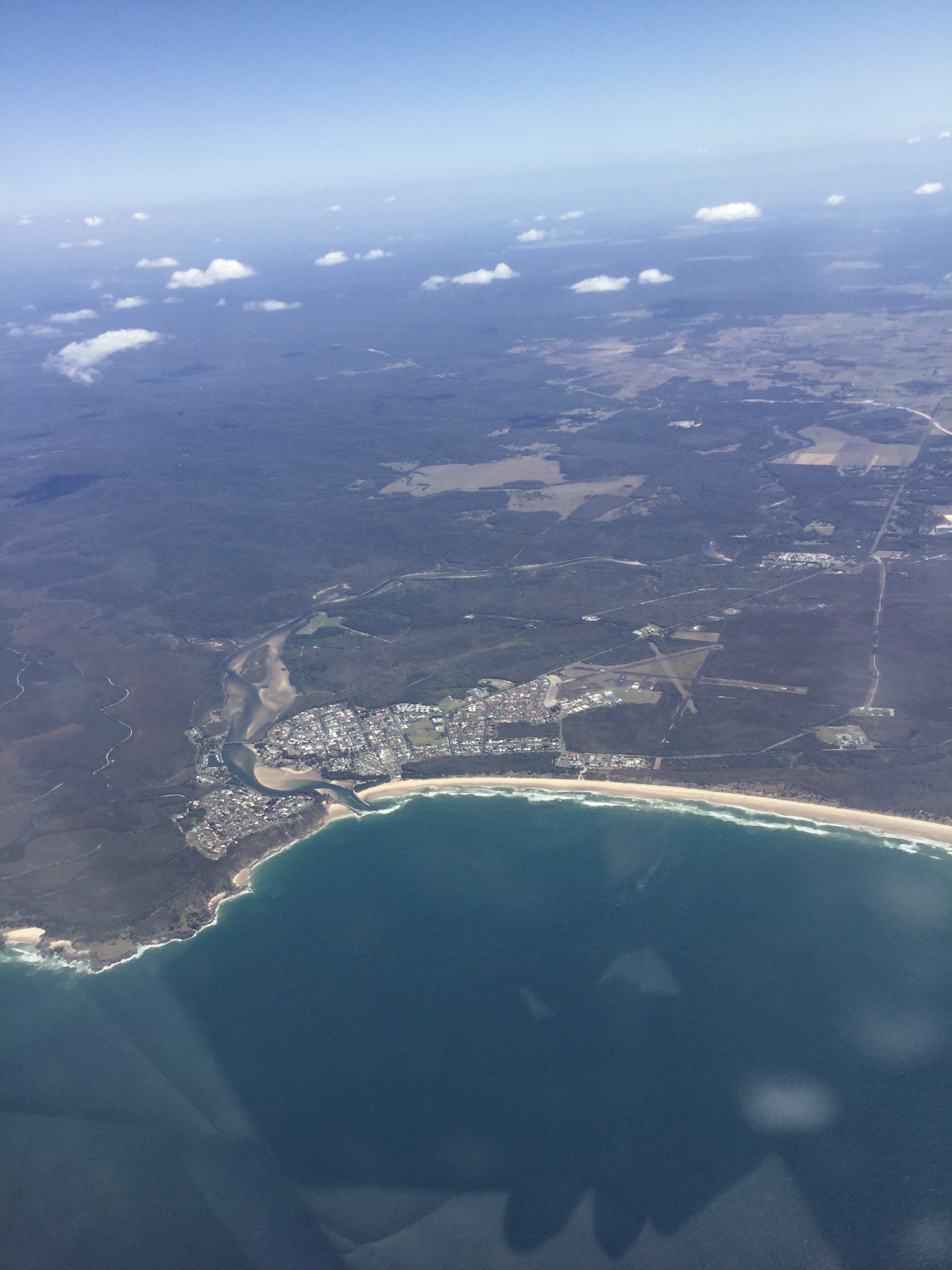
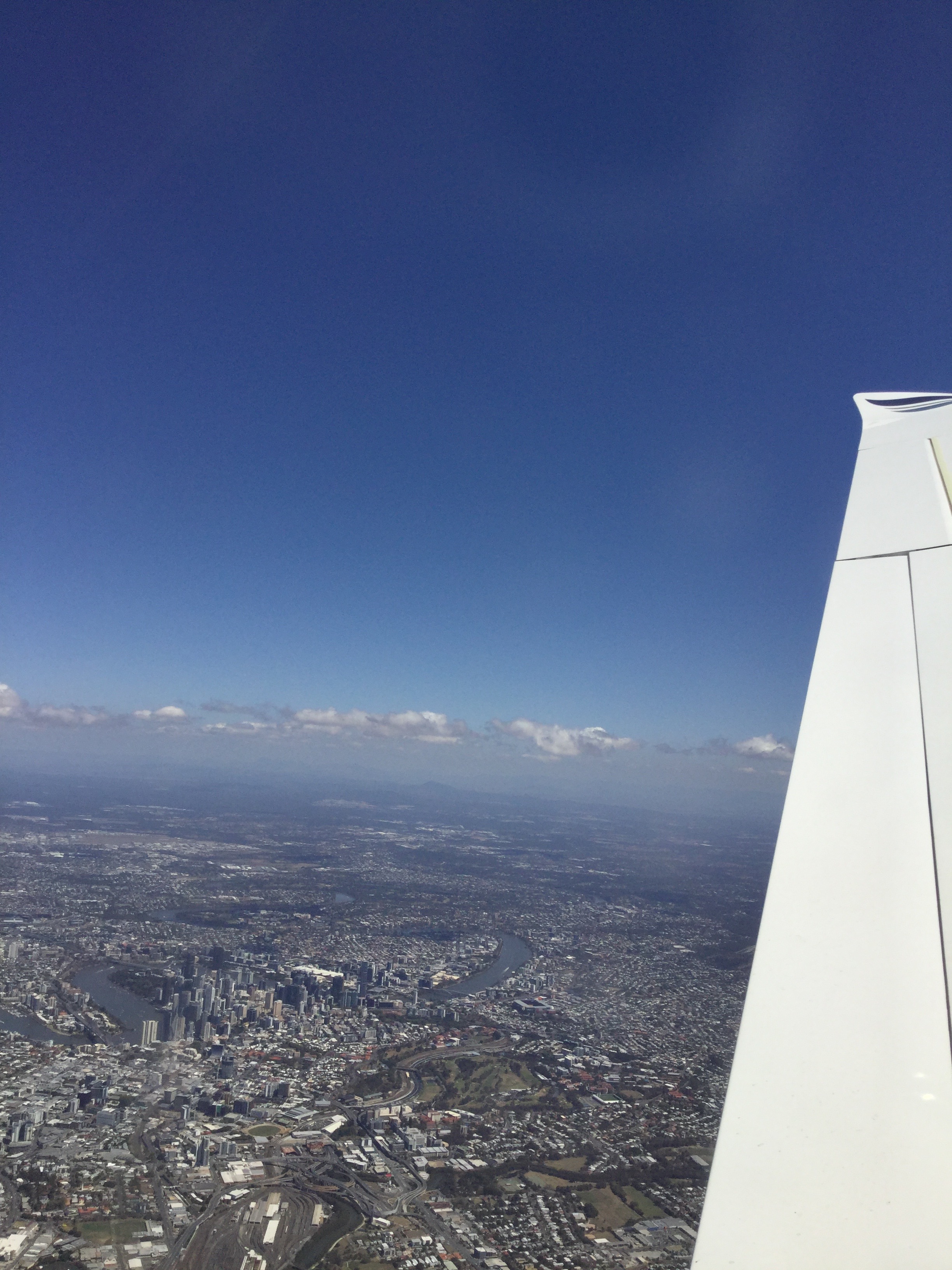
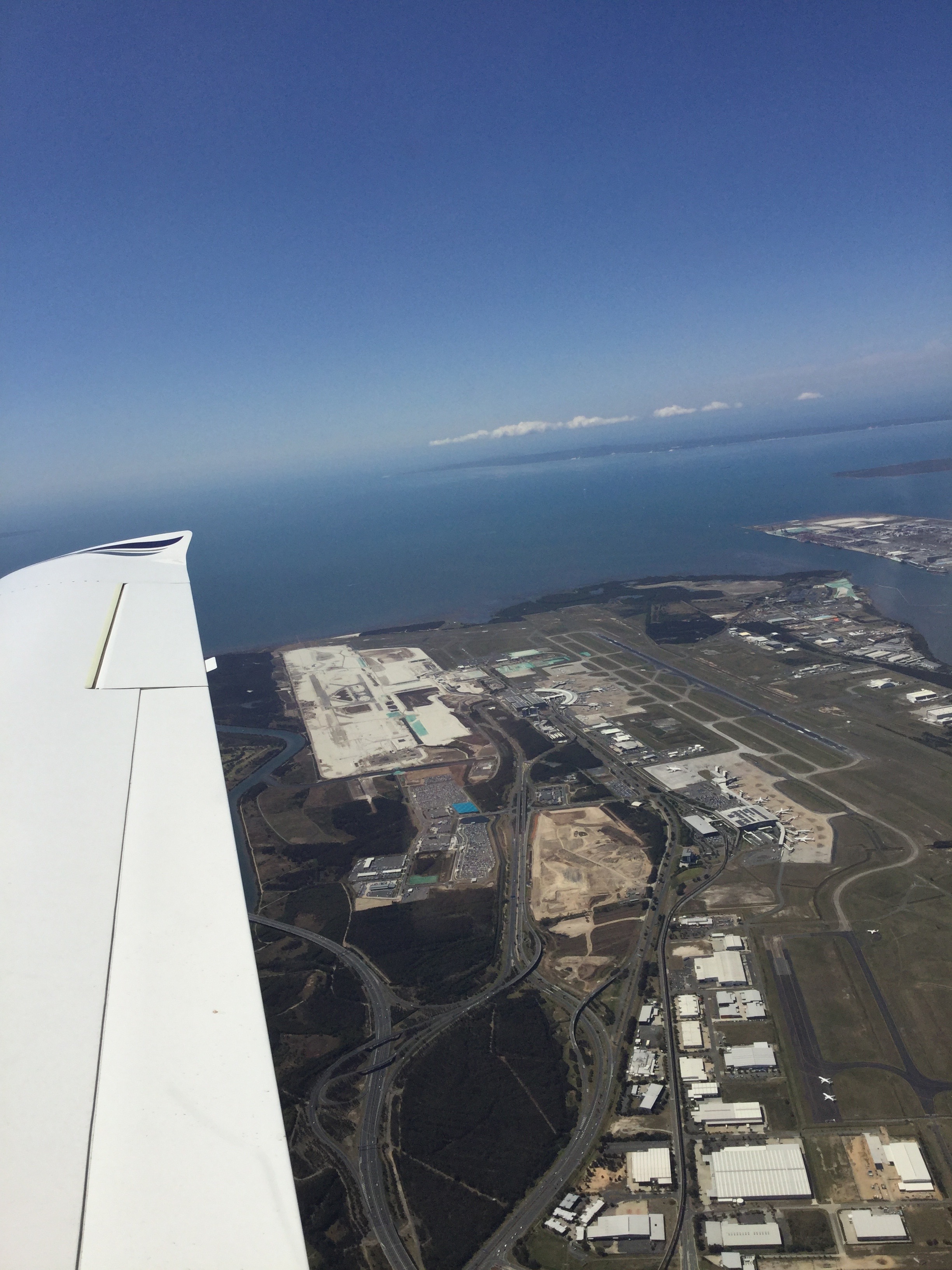


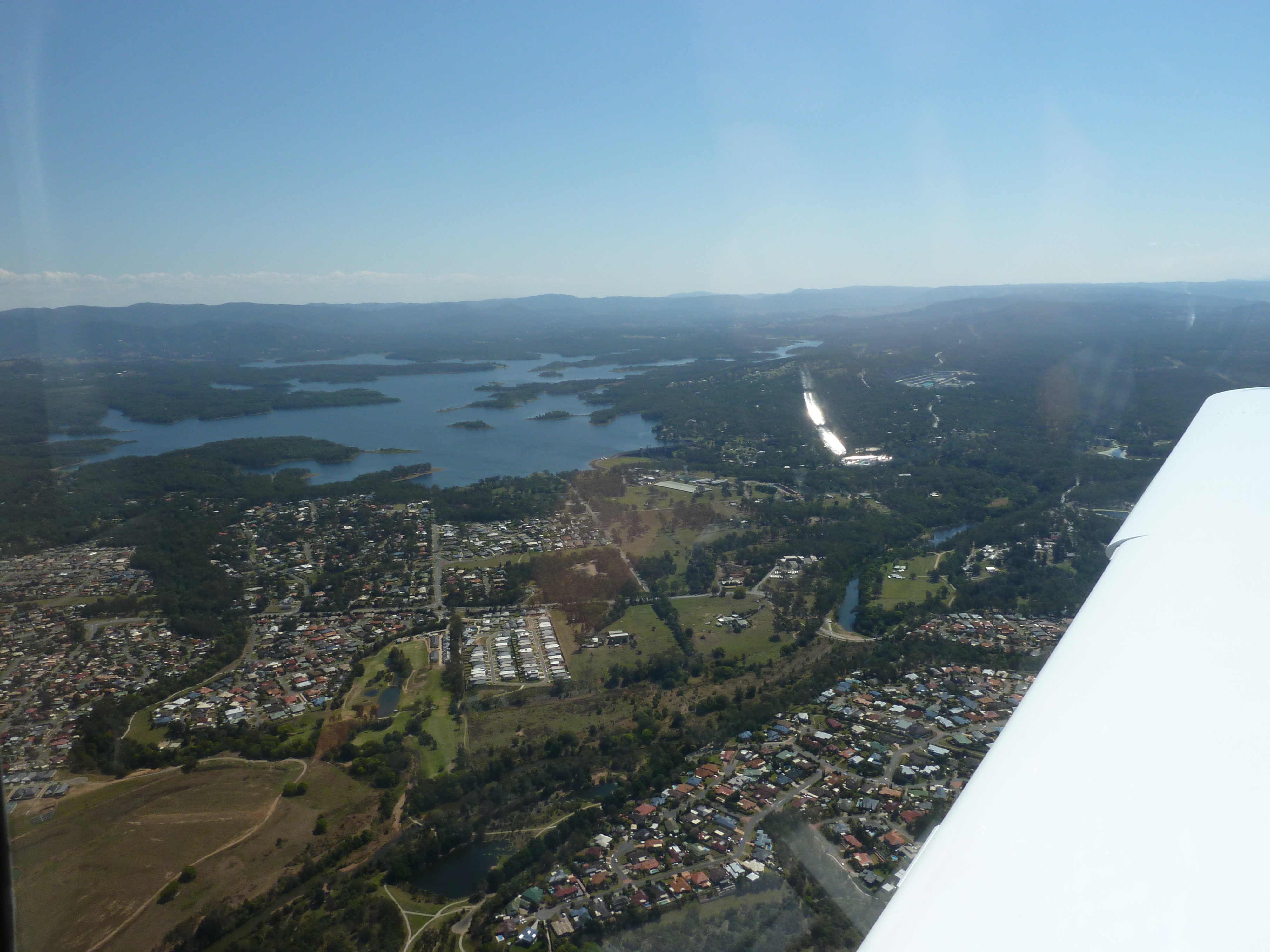










































 PrivatierAir