
In the aftermath of MSF’s crash I realised I’d need to hire a Cirrus from someone else as, at least for the forseeable future, Mike wouldn’t have a plane. MSF had been a “Generation 1” SR22 with fairly basic avionics so to build up my confidence in flying again while acquainting myself with the more sophisticated avionics in the more recent model SR22s that are available for hire, I decided to do some “refresher” training with Adam Starr out of Archerfield. By 30th October 2023 I hadn’t flown with him for over a year so it was high time to do an IFR refresher anyway with the aim of it making me feeling comfortable with private hiring one of the SR22s that he has access to or one from Team Aviation next door.
Adam had recently taken delivery of a new Generation 6 SR22 that belongs to a guy he’s known for many years. This was VH8AS, with only 20 hours on the tacho. It was still being run in and hadn’t had its first oil change yet. It didn’t have deicing equipment or oxygen but it had the whizz bang Garmin Perspective Plus avionics which is a bit more highly featured than the system in MSF was.
After a bit of a chat about my recent flying experiences and how I prepare for a flight each time, we headed out to the apron and I preflighted 8AS. The wing was noticeably higher than MSF, giving it a bit more clearance for the prop. It also featured remote locking/unlocking and door handles that were easy to use. All in all, a very nice plane and one that would be good to hire in the future if it’s available.
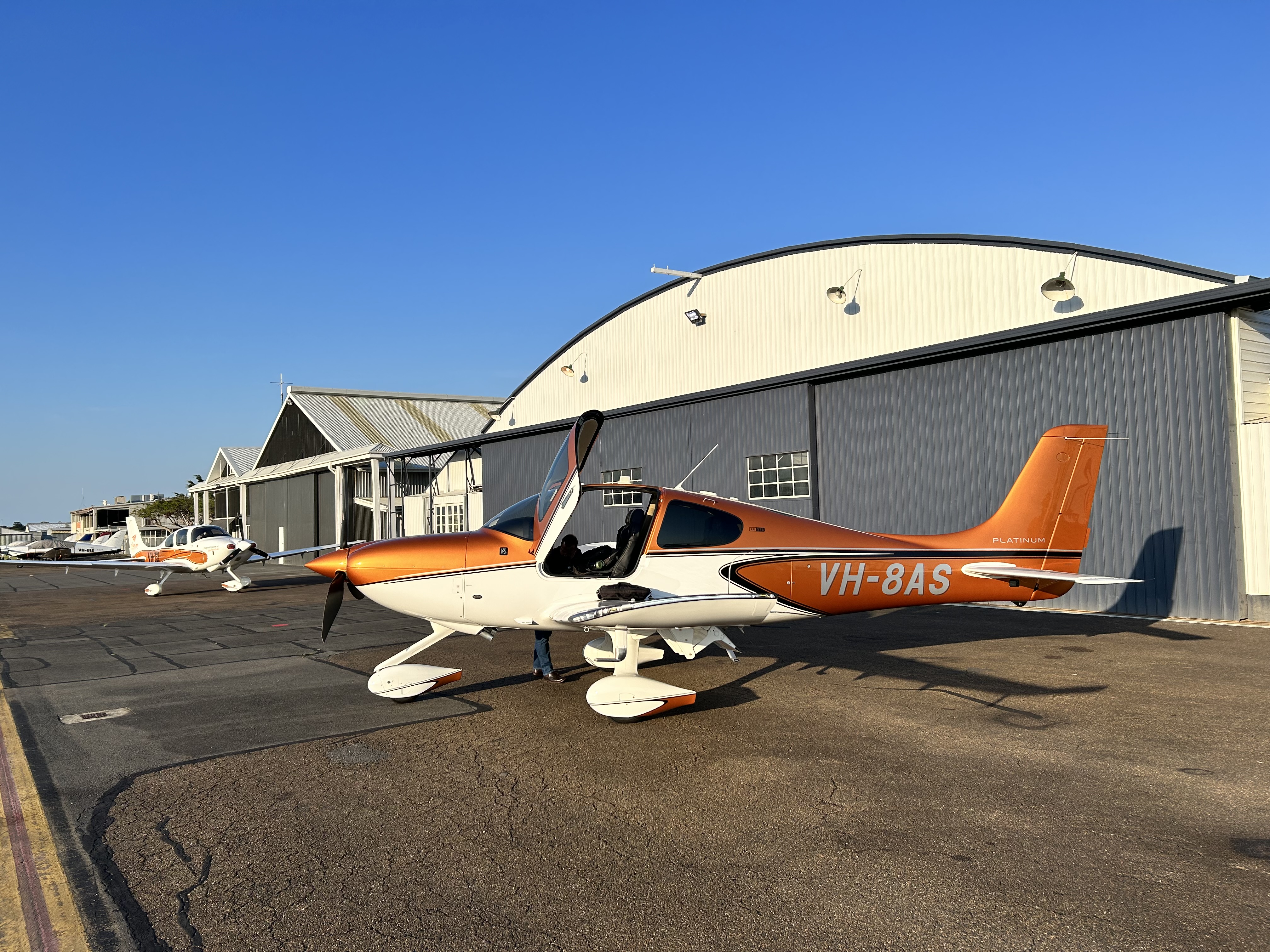
I’d planned a flight to Warwick to do a couple of instrument approaches and to practice some night landings. As a result, we departed YBAF around 5:30 so we’d arrive at Warwick just before last light. Adam suggested I change my planned route to fly via waypoint Huugo to make sure I avoided Amberley airspace on the way out.
It was good VMC weather so we did a VFR departure with the switch to IFR once we were airborne. We’d stay low as we headed away from the circuit, staying well below the jets coming into Brisbane from the south west. That’d meant we wouldn’t have to hold and wait for a gap in the jet traffic. The Archer tower had closed at 5pm so it was pretty much like departing Redcliffe on a CTAF and then being identified by Brisbane Centre once we were at circuit level.
Departing YBAF was straight forward, turning onto a heading of 135M at 1000ft until we reached an industrial estate just south of the Logan Motorway. We were switched from Brisbane Centre to Brisbane Approach who gave us a clearance to Huugo with a climb to 7000ft. Although we could have flown at 6000ft and 7000 wasn’t the standard altitude for a westerly flight Adam said it was smarter to fly higher. I’d just told him that I didn’t like to fly higher than 7000ft without oxygen so that’s why we hadn’t chosen 8000ft. We climbed using the FLC (flight level control) mode of the autopilot, something that MSF didn’t have either. It’s a safer way to climb on autopilot, where you set an airspeed rather than a rate of climb, avoiding the potential of airspeed reducing to unacceptably low levels as you climb.
On the way out to Huugo Adam handed me the “hood” and as we turned towards Warwick he told me to disengage the autopilot and fly by hand. He also turned off the main AHRS (attitude and heading and reference system) so I’d have to refer to the secondary instruments for hand flying. This increased my workload considerably, especially as I was still becoming familiar with the different layout of the Perspective Plus system. As a result, my approach into Warwick was less than average and Adam took over about 3 miles out as I was too low on the glide path. I continued with a missed approach and then climbed back out to the initial approach point to carry out a hold. I flew that on autopilot so it went ok and then it was time to head back to Amberley with full instruments.
It was dark by this time so we flew direct, being handed over to Amberley approach as we went. They cleared us to the initial waypoint for the RNP approach into YBAF. This started ok but I forgot the 10 mile call and didn’t descend as quickly as I should have and as a result, when I somewhat belatedly turned on the runway lights with the PAL system, I saw that I was way too high to land. The ATIS had indicated a 25 knot north wind that was basically all cross wind on RWY10L so it was a pretty easy decision to go around – the 25 knot crosswind wouldn’t make the landing particularly easy. After a fairly standard circuit I was on final for RWY10L with a rather stiff crosswind. I was tired and it would not have been smart to fly further night circuits in those conditions so I aborted the plan of further night circuits and did a full stop landing. The touchdown was not ideal. I didn’t kick it around to have the nose lined up with the runway exactly and there were some sideway forces on touchdown. Not pretty. However Adam did explain that a couple of hangars on the northern side of the runway that we’d passed just before touchdown result in wind shear in those conditions and he would usually land a bit further down the runway so he’d stay above the hangars and avoid the wind shear effect. So I hadn’t coped too badly.
As we taxied back to the hangar we agreed that another lesson was required before I’d hire the plane. Next time it’ll be to Kingaroy to give me a bit more time to plan the approaches.

 PrivatierAir