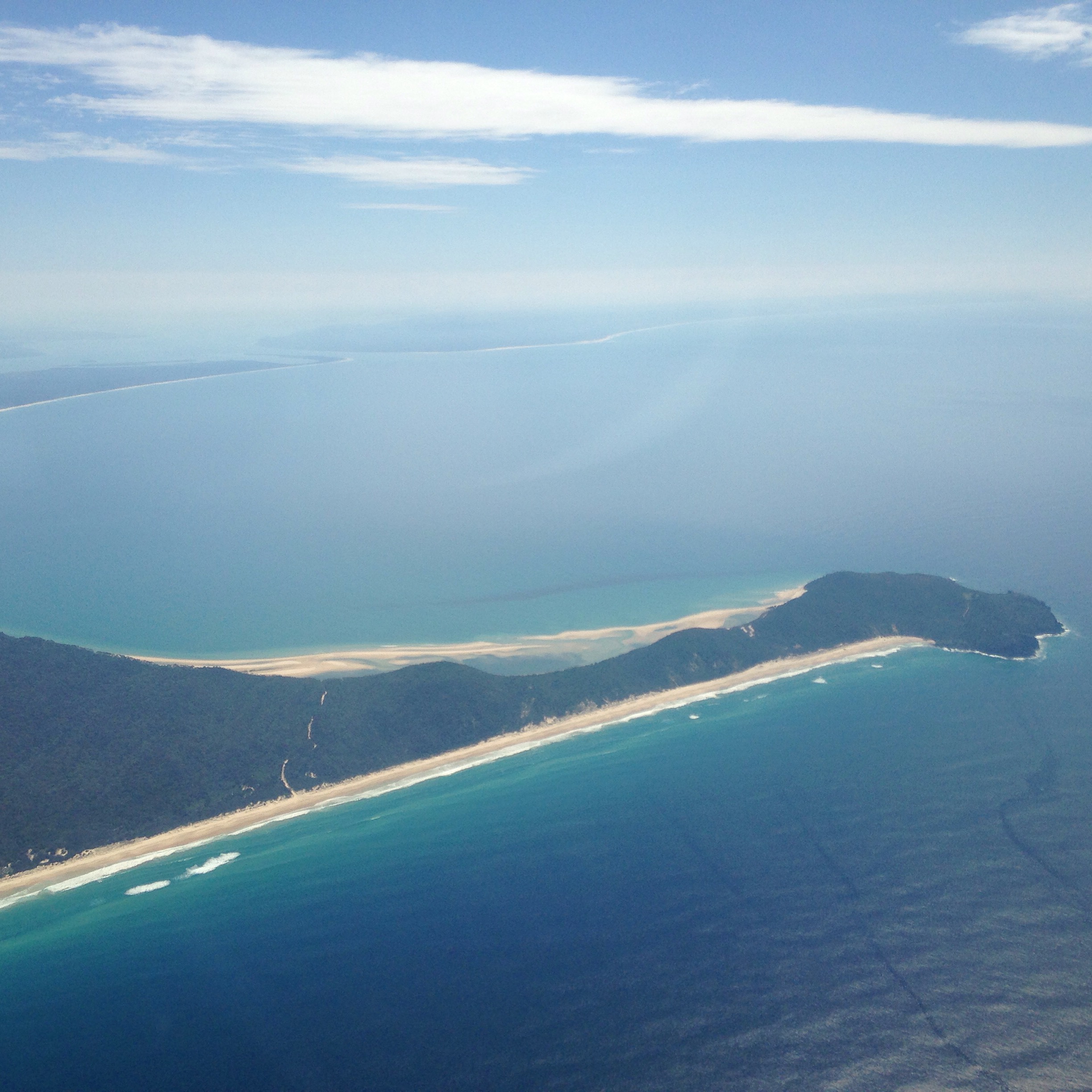
RNAV practice at Kingaroy

Instrument approach – Kingaroy – Wondai

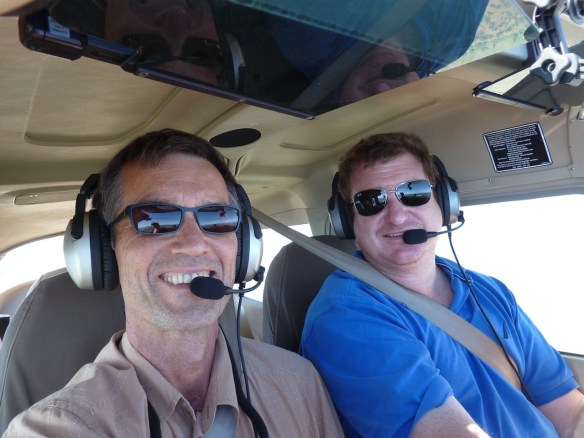
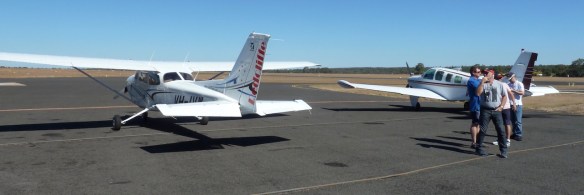
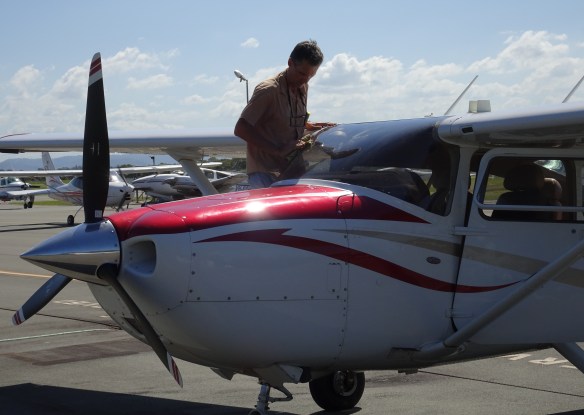
By March 2016 I’m most of the way through my Instrument Rating training. I’ve flown by instruments with an instructor by day and night and made instrument approaches into Sunshine Coast, Toowoomba, Bundaberg and Kingaroy. I’ve also had training and gone solo on the simulator at the aeroclub, practising the same approaches and departures and others such as Brisbane, Coffs Harbour and Mount Gambier. Now it’s a matter of practising what I’ve been taught  in the plane. So on Friday 18th March I took my friend Ted Surka along on an expedition in the “ROC” – Cessna 182 VH-ROC.

DSC02907

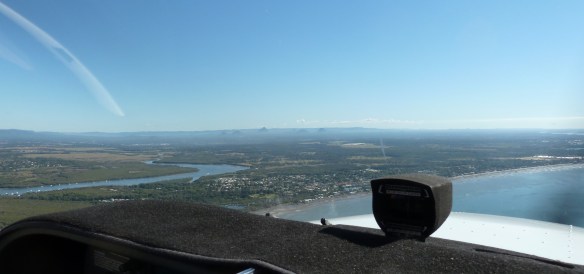
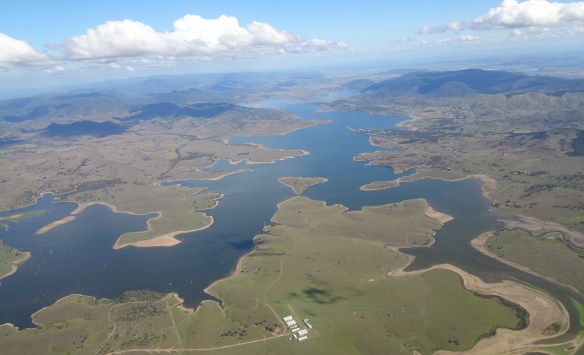
We flew from Redcliffe to Kingaroy via Kilcoy and Lake Somerset. It was a perfect day.

DSC02911

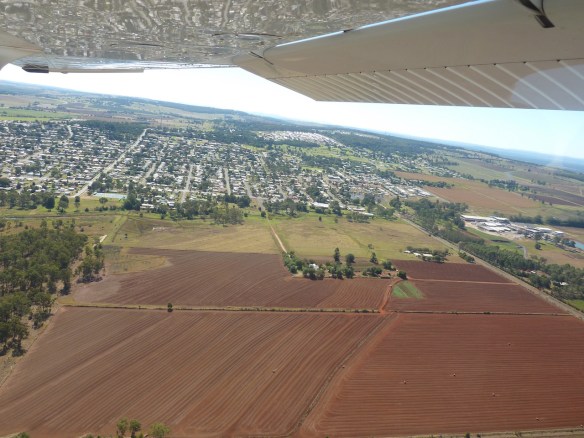
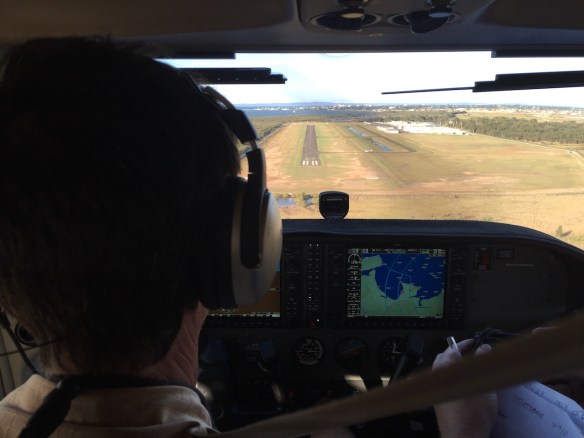
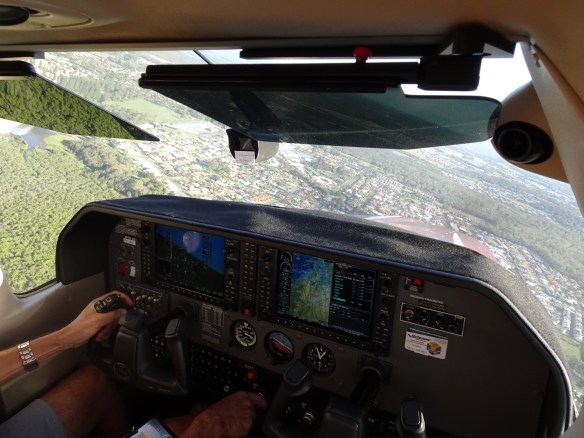
About 30 miles before reaching Kingaroy we tracked to the west to enter the southern RNAV (area navigation) instrument approach for runway 34. I wanted to practise what would normally be done in cloud but in this case it was on a fine day with good visibility. The RNAV approach involves using the GPS system to fly at an area lowest safe altitude (LSALT) to one of three entry way points, fly at least one orbit in a standard holding pattern, then enter the approach and descend on a 3 degree glide path to a minimum descent altitude (MDA) about 500 feet above ground level a mile or so in front of the runway. Under real life conditions all this would occur without any visibility of the ground until you emerge from the clouds. The aim is to fly down to emerge from the clouds prior to reaching the MDA and then land visually. If you don’t have visibility of the runway by the time you reach the MDA you have to abort the landing and climb back up to Lowest Safe Altitude. As it happens the holding pattern in this case was located about 3000 ft above Tarong coal mine and power station, so we orbited up there a couple of times and Ted got a good view of the mine and power station while I concentrated on keeping the plane within tolerance.

DSC02912

DSC02921

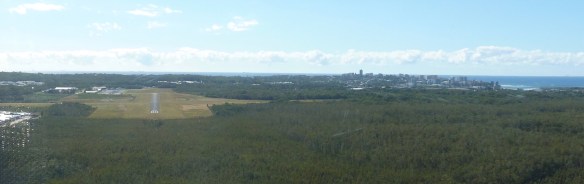
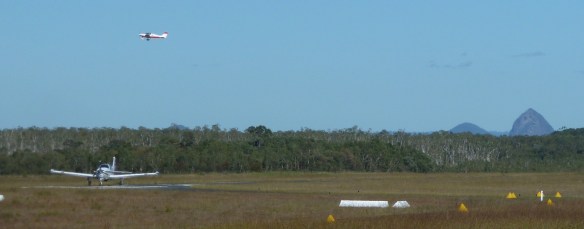
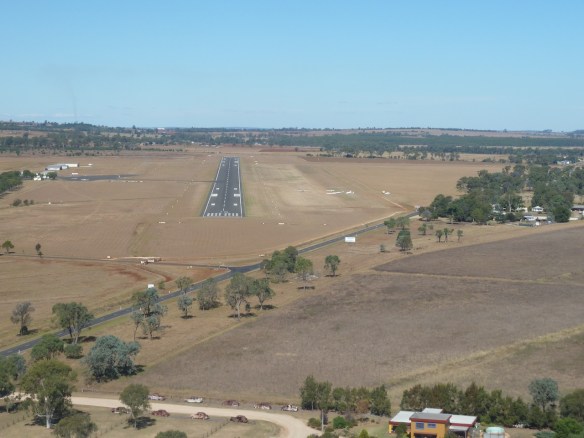
There was a fair bit of gliding happening at Kingaroy and they were using a tug plane on the cross runway to launch, directly across Runway 34 where we wanted to land, so I decided to abort the RNAV exercise about 5 miles out and do a normal visual fly over the field and then enter the circuit on the downwind leg for runway 34. This gave plenty of time to ensure there would be no “misunderstandings”. We had a good view of Kingaroy as we made our circuit. On the final approach the glider tug pilot was kind enough to allow us to do a touch and go between glider launches.

DSC02924

We had a very smooth landing and I immediately applied power and took off again, and headed to Wondai, a small town with a very well kept grass strip about 30 miles north. We did a circuit and a visual approach followed by a go around on short final. We then climbed out and away and headed back to Redcliffe via the Bjelke Peterson Dam and the Brisbane River valley.

DSC02933

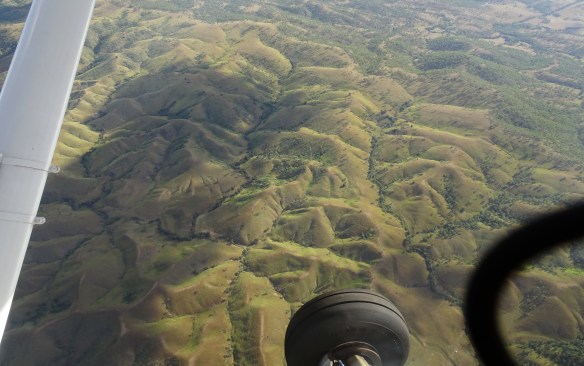
There was some really scenic country along the way.

DSC02932

We flew over Mt Mee and past Caboolture into the Redcliffe area. The amount of new housing around the North Lakes area was a surprise to Ted, as it is to most people who haven’t seen it from the air before.

DSC02937

Above is the view towards Brisbane over the Hornibrook Viaduct, with North Lakes in the foreground.  Below is a new very uniform housing development built next to the new Redcliffe railway line.

DSC02940

We flew into Redcliffe at about 4:30. It was very quiet and we had the place pretty much to ourselves. Another smooth landing completed a really great Friday afternoon.

DSC02942

Thanks to Ted for all the great photos.

Fraser Island by VOR Navigation

In November 2015, having passed the instrument flying exam, I thought it was time to test my new found knowledge on Navaids while building up some more experience on the Cessna 182. One of the navigational aids used is the VOR (VHF Omnidirectional Radar). It allows you to fly along a radial towards and away from a beacon located at some particular location (usually high up on a hill). This allows you to follow a particular track very precisely. Important if you’re flying in cloud. Another is the GPS unit, which allows you to put in a flight plan with various way points before departure and follow them as you go. I waited for a day with not too much cloud (not ready to fly in cloud just yet) and asked a friend along to provide some moral support.

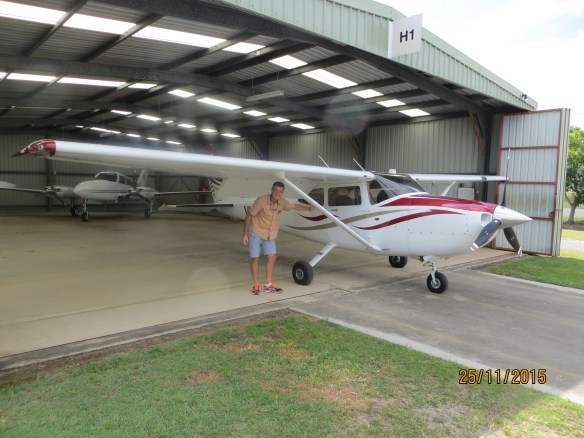
IMG_3447.JPG

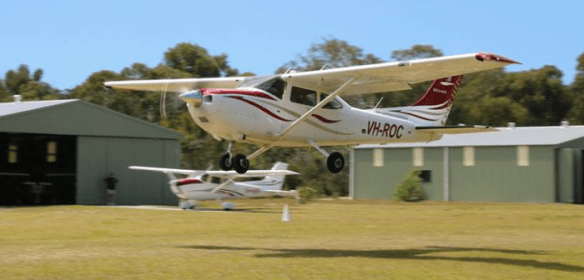
We headed off in the “ROC”, one of the better equipped 182s at the aero club, tracking the coast from Redcliffe over Beachmere to Bribie Island.

ROC taking off

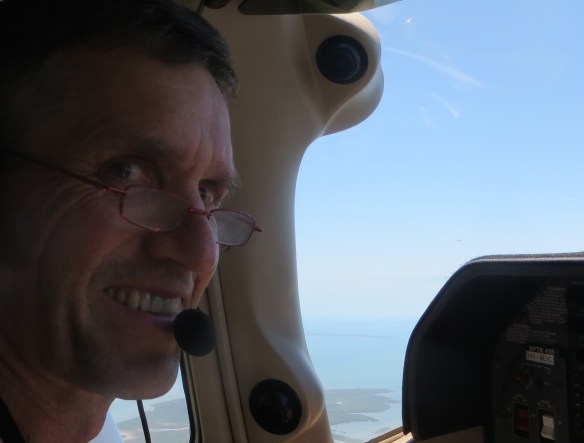
Meanwhile I tuned in the VOR to the Maleny beacon, identified that it was the right aid by listening to the morse code signal it was transmitting, then tracked to Maleny using the instruments to guide us. We passed over the Glasshouse Mountains on the way.

The Twins

The Twins – Glasshouse Mountains

We successfully found our way to the Maleny beacon and flew right over the top, then headed out on a different radial to the north, tracking for Maryborough. We had the GPS on the screen as a backup, confirming that we were on track. Now one of the things we have to avoid up around that area is the Wide Bay military training area so it was very useful being able to track well clear of it using the VOR. We arrived over Maryborough bang on time and then headed east for Fraser Island.

IMG_3451

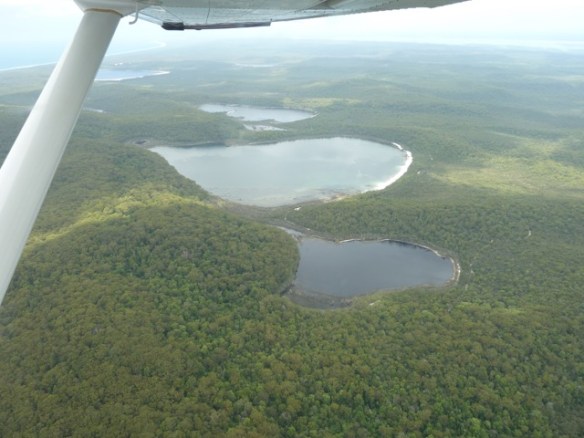
There was no VOR at Maryborough so we used the GPS to check we were on track. We crossed the channel and passed over Lake McKenzie before heading south along the east coast of the island.

Lakes on Fraser

Fraser Island Lakes

It was a smooth flying day and no other traffic nearby so very pleasant. At the southern end of Fraser we passed over Rainbow Beach and to the west of Double Island Point.

Double Island Point

Double Island Point

We then tracked back on a third radial to the Maleny VOR before heading back to Redcliffe via the Glass House Mountains and Caboolture. It was just over 2 hours in all and a great flight. To make things even better the wind was straight down the runway on landing so managed a very smooth touchdown.

FullSizeRender

IFR Theory

Bob Tait theory school – IREX exam – private instrument rating

Having completed my Private Pilot Licence in May 2015 based on the Visual Flight Rules (VFR) I’m allowed to fly all round Australia but only during daylight hours and clear of cloud. I must be able to see the ground at all times so that I can navigate by visual references. For the future, though, I want to be more flexible when travelling away from home. If we’re out somewhere and the weather turns bad or the sky is overcast, I’d like to have the option to fly through the cloud to escape to better weather up above and head off somewhere else. I’d also like the option to be able to land after nightfall just in case we’re delayed and the flight takes a bit longer than planned. So I enrolled in an Instrument Flight Rules (IFR) theory course at Bob Tait’s Aviation School at Redcliffe.

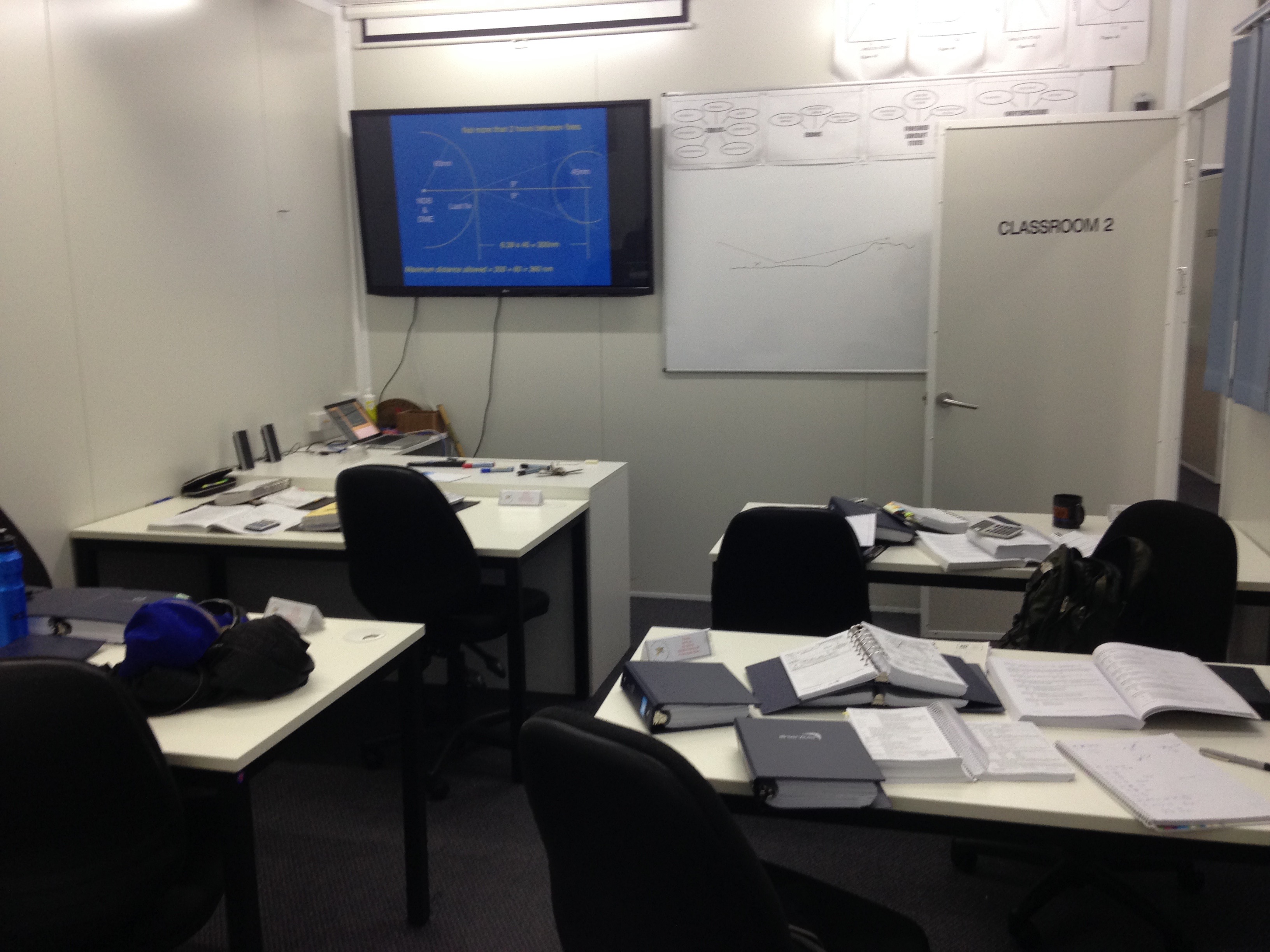
Bob Tait Classroom

Bob Tait Classroom

Bob is a veteran pilot and originally a science teacher who set up his own flying school decades ago and has taught thousands of budding pilots the theory of flying. This course was a two week one aimed at learning what is required to pass the CASA “IREX” theory exam.  It was a good course covering lots of different aspects of flying by instruments. The theory was largely covered in the first week while the second week was used to work through lots of questions and calculations to make sure the understanding was really there. I decided to do the exam at Archerfield the following Monday 23/11 so that it  would all be fresh in my brain. The strategy worked. I passed with 90%. Now I can start the practical training for the IFR that will lead to my obtaining a Private IFR rating (PIFR). That will happen in Redcliffe again, at the Aero Club.

IMG_1517

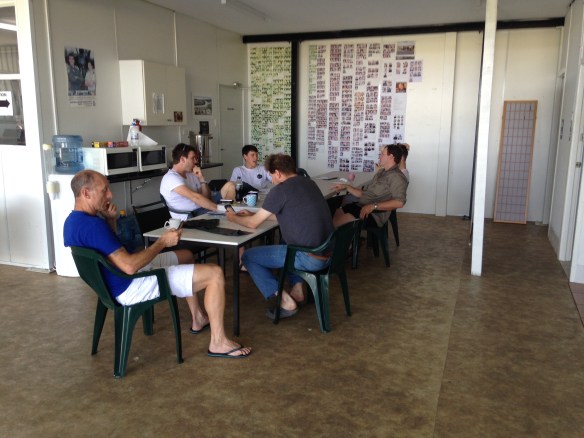
Break out area next to Bob’s Piper Pacer. His pride and joy.

IMG_1514

GPS approach into Mount Gambier airport

IMG_1516

Lunchtime. Mug shots of former students on the wall. I did my PPL theory here as well so now have two shots.

Breakfast at Dunwich on North Stradbroke Island

North Stradbroke Island (or “Straddie” to the locals) is located off the coast from Brisbane and is a bit of a local secret as a place to escape to for old style beach holidays. The largest town, Dunwich, has a small aerodrome with a grass and gravel strip. The local aeroclub likes to attract air tourists with a breakfast “fly in” held on the third Saturday morning of each month. The Redcliffe Aeroclub encourages members to take part in these breakfasts, especially newbies like I was in October 2015, to experience the flight over Moreton Bay and the exercise of landing and taking off from an unsealed strip with its own set of challenges. The strip is 250ft above sea level and nestled between some hills. The runway runs almost north south (15/33) and it’s common to have a sea breeze from the east that can cause some cross wind challenges for landing. The hills and vegetation can also cause wind shear, adding to the difficulties. So it’s a good opportunity to try out some skills not too far from home and with support from others. I elected to take one of the 182s (VH-ROC) and also one of the instructors from Redcliffe to provide some additional real time coaching on the approach, landing and take off. I took my son Tim too, so that he could experience the wonders of a morning flight across Moreton Bay to breakfast.
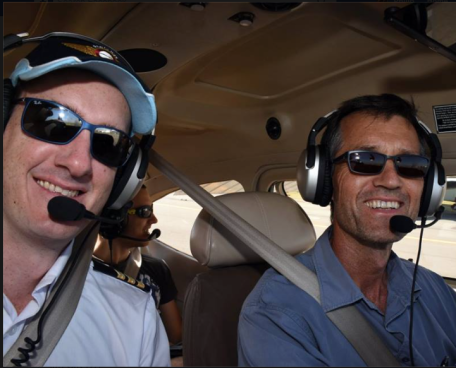
With Jarrad and Tim enroute to Straddie

With Jarrad and Tim enroute to Straddie

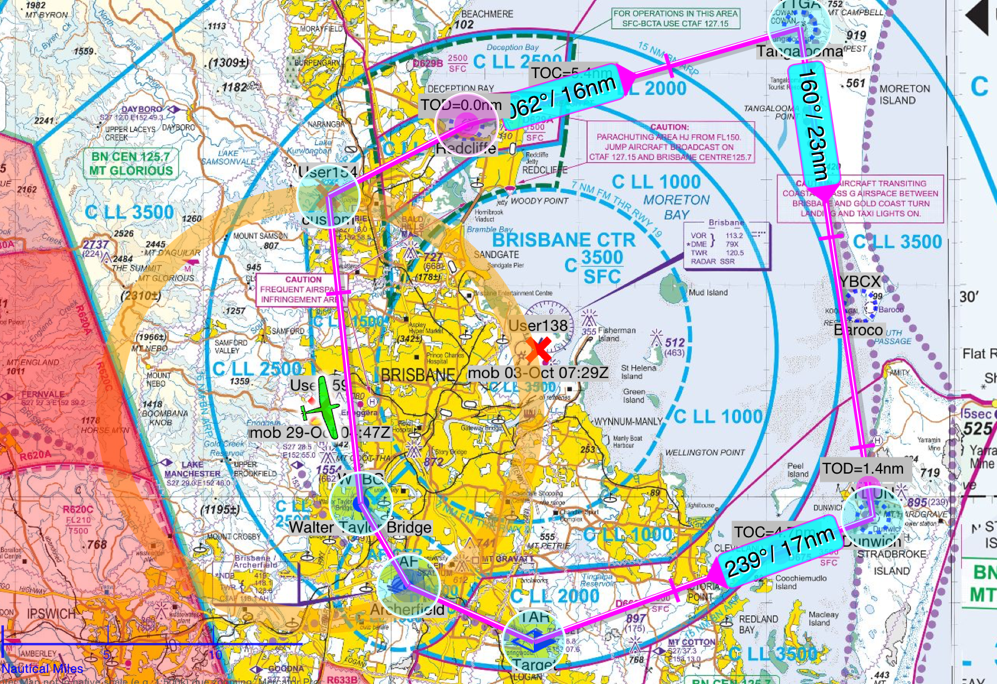
We headed off about 8am, the last of about 6 planes leaving from Redcliffe, and flew straight across the bay to Moreton Island, passing over Tangalooma Resort, then flew down the west coast of Moreton to stay clear of the Brisbane traffic control zone. The waters of Moreton Bay were amazingly clear as we kept an eye out for whales and dugongs.

Moreton Bay blues

Hues of blue in Moreton Bay

Crossing the small strait between Moreton and Straddie, we descended to about 1250ft , passed over the town of Dunwich with its ferry terminals and joined mid field cross wind for runway 15. There were a couple of planes ahead of us in the circuit so I completed a longer downwind than normal to allow them time to land. Coming in on short final I had expected some gusts but it was very calm, almost no wind at all.

Dunwich township

Dunwich township

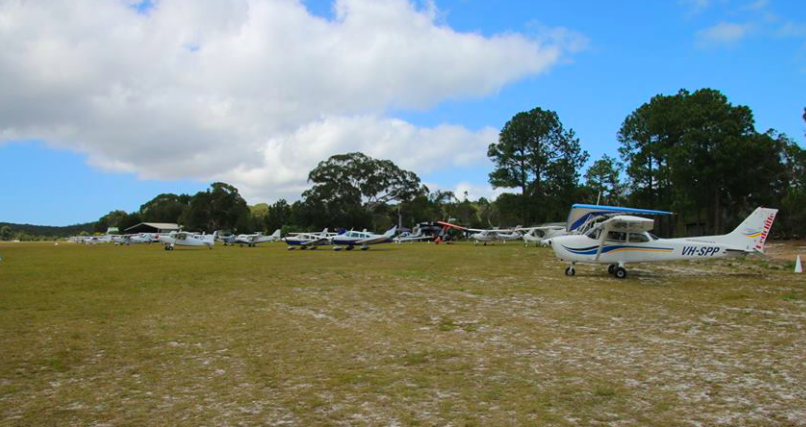
We had a smooth landing and taxied to join about 30 other planes that had already arrived. There was a selection from single occupancy ultralights to twin engine Cessna 310s.
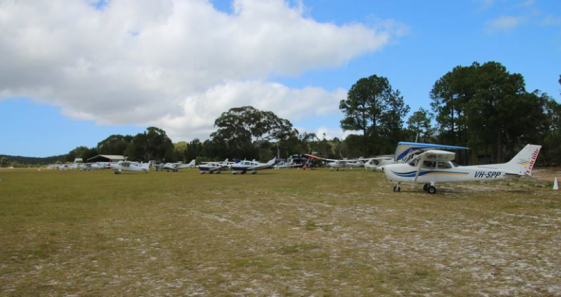
Planes assembled on the side of the strip

Planes assembled on the side of the strip

The aeroclub had put on a great hot breakfast that we enjoyed while chatting with the other 60 or so people at the tables set up outside the club house. People had flown in from Archerfield, Toowoomba, the Gold Coast, the Sunshine Coast and other aerodromes around the region. Some said they fly in to Dunwich almost every month and have done for years.

After about an hour the planes started to leave one by one, practising soft field takeoffs from runway 17. Jarrad gave me a bit of refresher on the technique in ROC, accelerating to rotate a bit early, lifting off and then pushing the nose down to stay just above the surface in ground effect while the plane accelerated to “climb out speed”.

In ground effect picking up speed

In ground effect picking up speed

Then I pulled the nose up and we climbed out above the surrounding hills. We headed west over towards Archerfield and did a transit through the D Class controlled airspace there and headed north past Mt Coottha to the Gap. We did an orbit over the Gap to give Tim a good view of the place he grew up. Then it was off to Redcliffe via Lake Samsonvale. All in all a very enjoyable morning.

Straddie route

To Evans Head in a Cirrus

RAAF base – beach resort – IFR – instrument flying – SR20

It was October 2015. I’d been wanting to fly into Evans Head for a while. It’s a small beach resort where our friends Anne and Harpur had a beach house and it has a great little airport on the town’s outskirts that was a major RAAF base during WWII. They have a very interesting museum that contains among other things an F1-11 that used to be based at Amberley. So I organised a training flight down there with instructor Adam Starr in a Flight One Cirrus SR20. It was great weather again and we flew down through the Gold Coast controlled airspace (CTA). We’d intended to fly over the top of the Gold Coast airport but there was some military activity so we were routed at 1,500ft around the western edge of the Gold Coast just to the east of the hinterland hills. We spotted a couple of F18 jets flying up the coast as we headed south.

After leaving the controlled air space we continued on over the border into New South Wales and past Byron Bay and eventually to Evans Head. It was about 45 minutes flying time from Archerfield. Evans Head is located just to the north of an RAAF training area and there is controlled air space above the airport itself so it meant descending to 1,000ft to stay under the CTA. We noted that the smoke from a sugar refinery was blowing to the south so knew we’d have to land towards the north. This was not the best as it meant doing a tight turn to avoid the CTA to the south but it was still ok. On short final we noticed a few kangaroos!! on the runway. Luckily they cleared off so we didn’t have to go around. We pulled up at the parking area and paid the $7.25 landing fee in the honesty box (you have to love these country airfields).

Evans Head

Evans Head Memorial Airport

After a short break we headed west and flew over to Cherrabah Station out towards Stanthorpe. There was a bit of puffy cumulus cloud around and as Adam knew I was planning to do my private instrument rating he said “how about we upgrade to IFR and fly through the cloud rather than around it?” “Can we do that?” I asked. “Sure, we just have to request it from ATC”. So he got on the radio and soon we were upgraded to IFR and began climbing to 7,000 ft through the clouds. It was amazing as we burst out of a cloud and had the vista of the rolling green hills and cumulus clouds in front of us. A bit of autopilot training followed as we headed  in and out of the clouds back to Archerfield.

Evans head route

Double Island Point

Sunshine Coast – Glasshouse Mountains

Double Island Point route

In 2015, after completing my PPL, I started doing solo cross country flights. One of the first was from Redcliffe, where the aeroclub is based, up to Double Island Point north of the Sunshine Coast. It was a perfect blue sky day with minimal cloud and ideal for flying. Passing over the Sunshine Coast Airport at Maroochydore at 1,500 ft was fun, as was the flight up the Mooloola Coast to Double Island Point. With Fraser Island in the background the view took my breath away. I headed back over Lake Cootharabah to Maleny using it as a dead reckoning exercise to get me there. It all worked well with very little in the way of adjustments required. I made it back to Redcliffe via the Glasshouse Mountains and Caboolture.

double island point