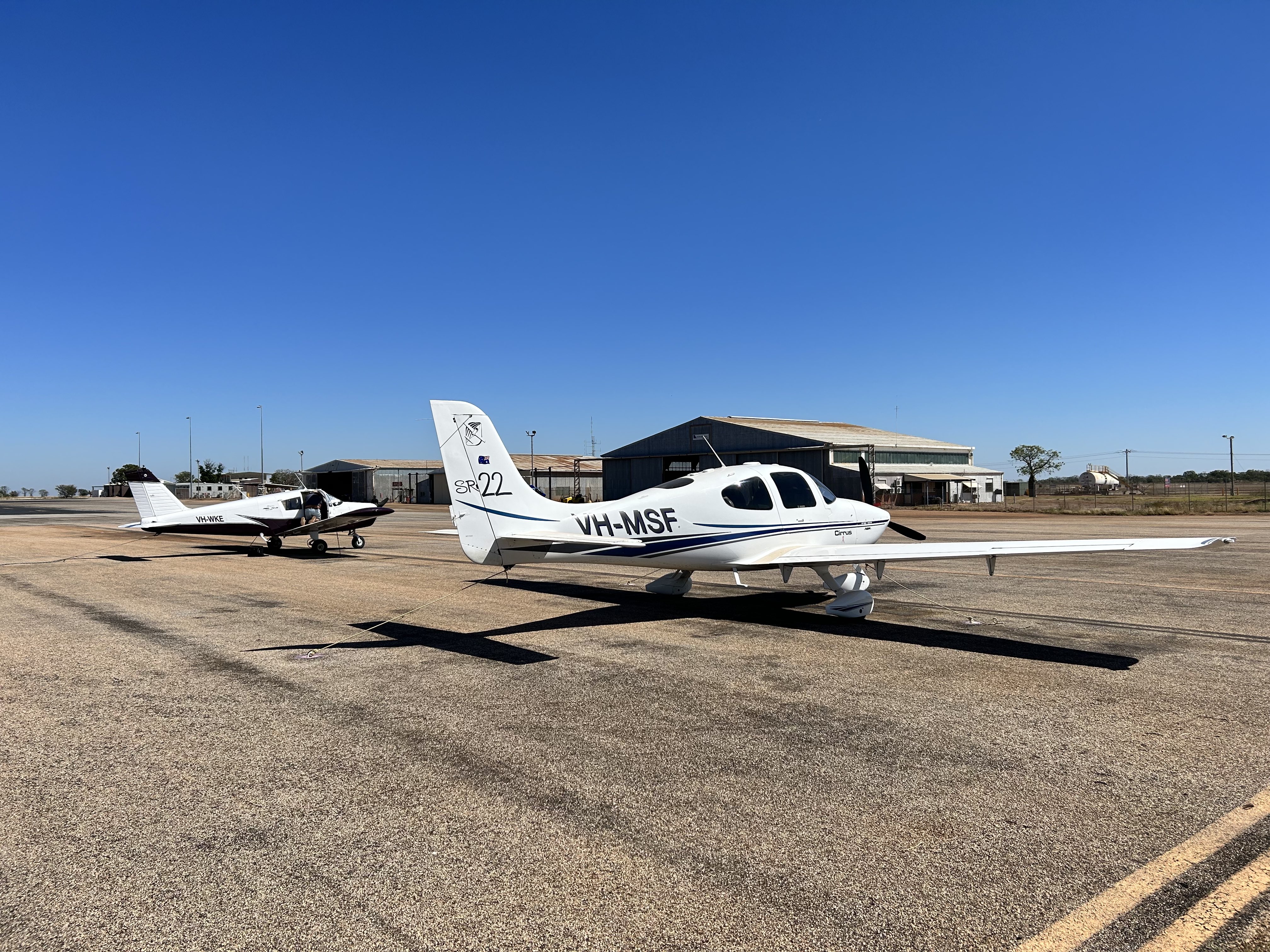
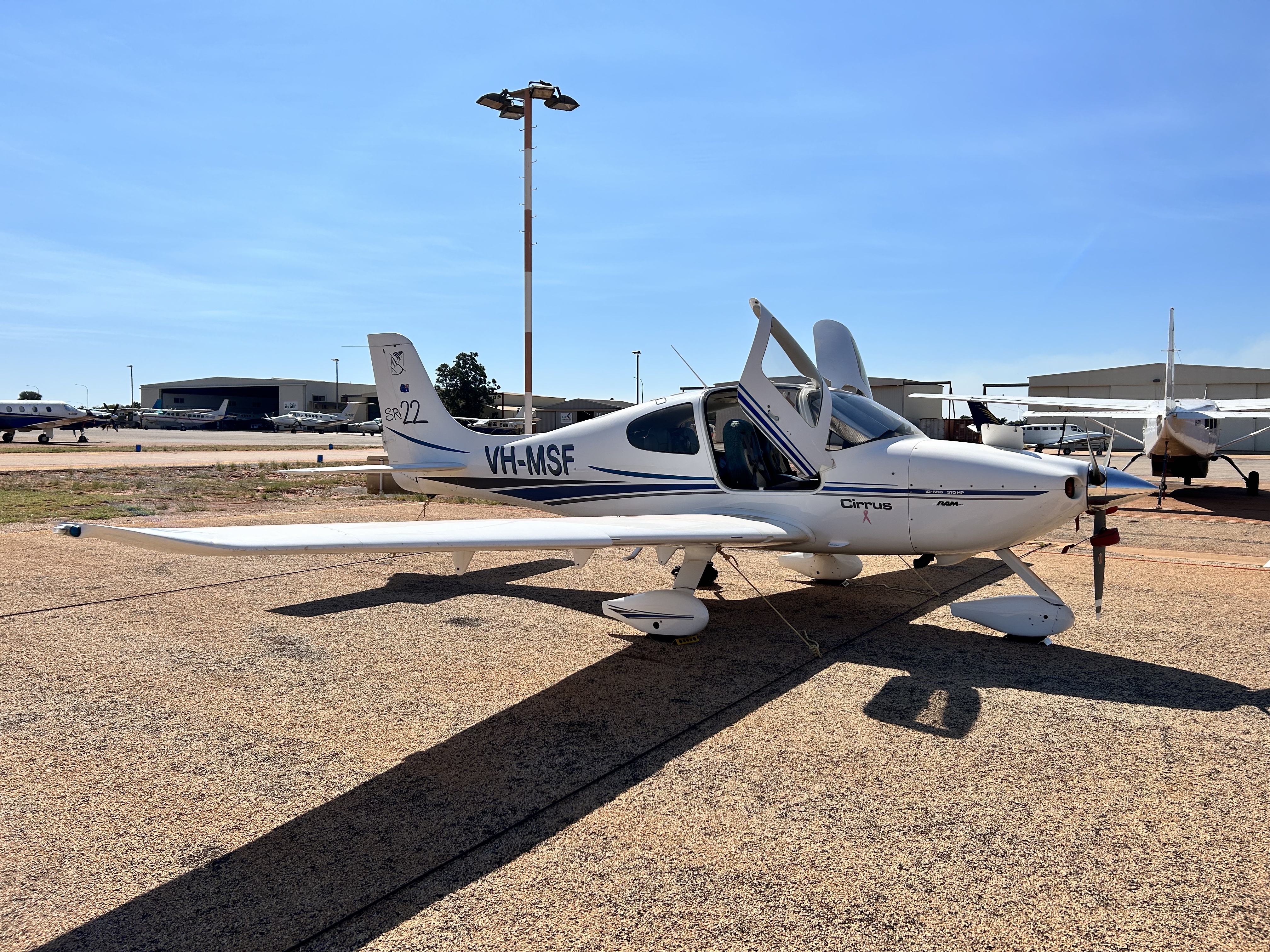
Every two years (except during Covid times) Cirrus Australia put on an “event” for Cirrus owners and pilots. It’s supposed to be a chance for people to network and for Cirrus sales people to talk people into buying or upgrading a plane. There’s also few lectures thrown in but they are more light weight than in the COPA weekends that are held in the alternate years. In the past Cirrus Life has been held in Hamilton Island, Uluru and Hobart. In 2023 it was in Adelaide. The idea is that as many people as possible fly there in their own Cirrus. That was our plan (Mike, Brett and I to fly in MSF) until MSF was destroyed in a crash in early October. So without a readily available aircraft we flew down on Friday 17th November with Qantas/Alliance. Sigi, Sharon and Erica came too, as this is definitely designed as a “with partners” event.
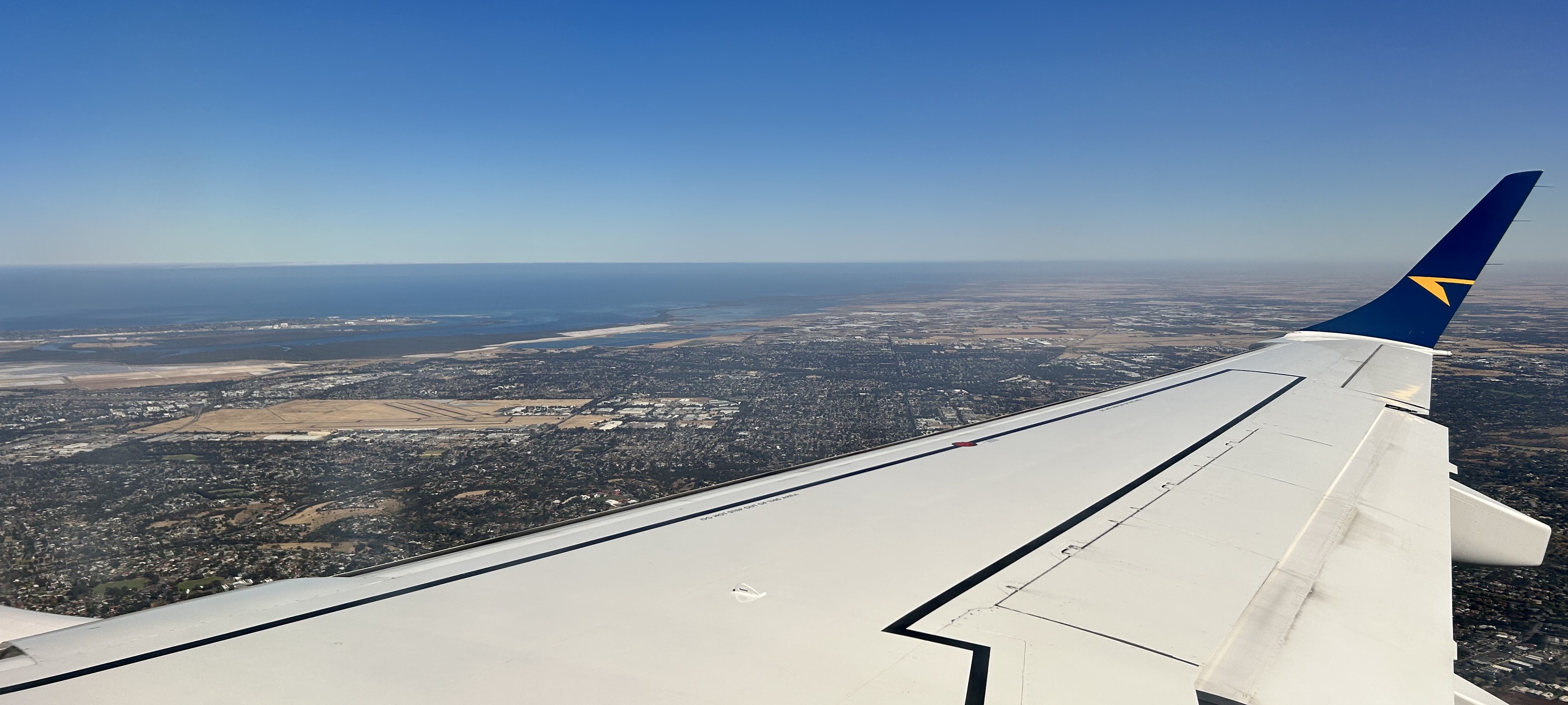
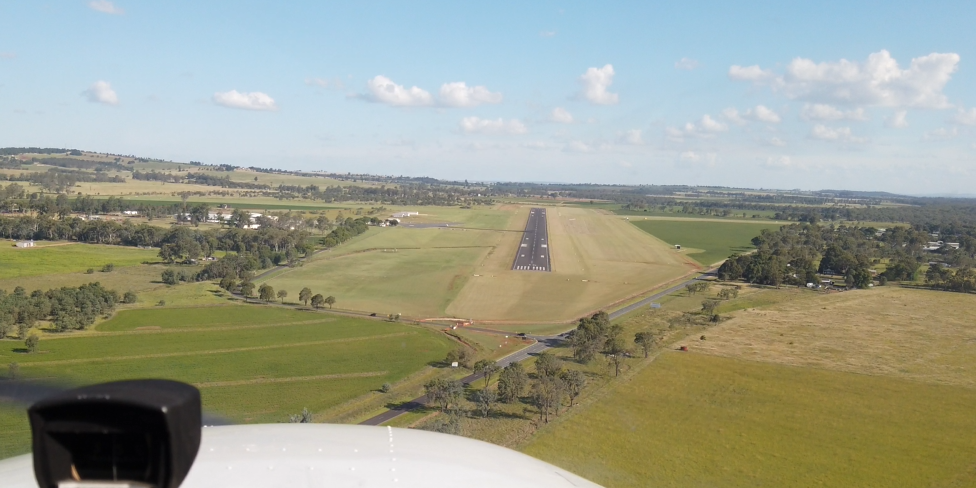
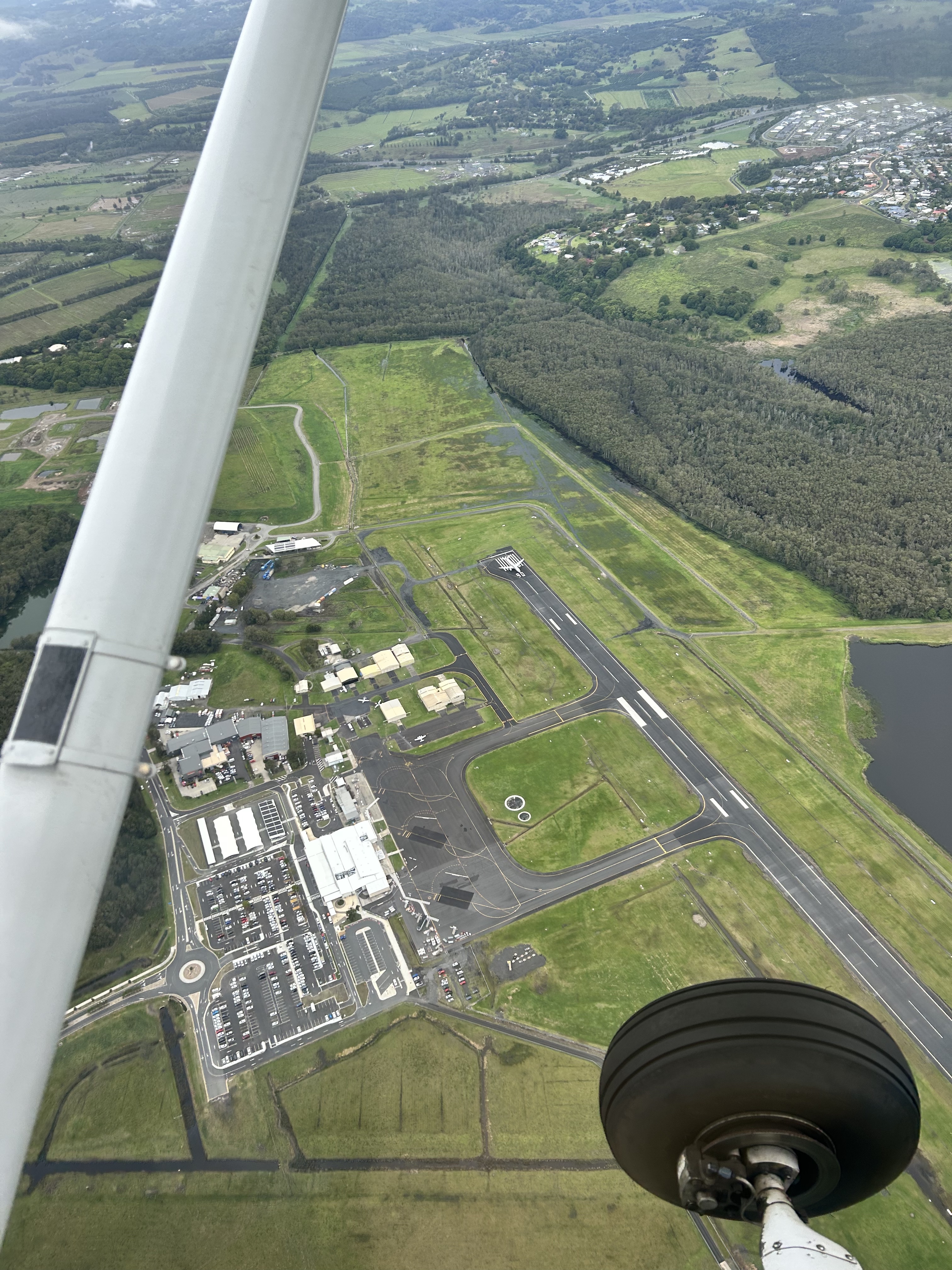
Long final into Adelaide with a view of Parafield Airport
Adelaide was a great venue, with beautiful architecture in the city, the rolling hills around its perimeter and added into the mix was a little bit of history related to Australian cricket.
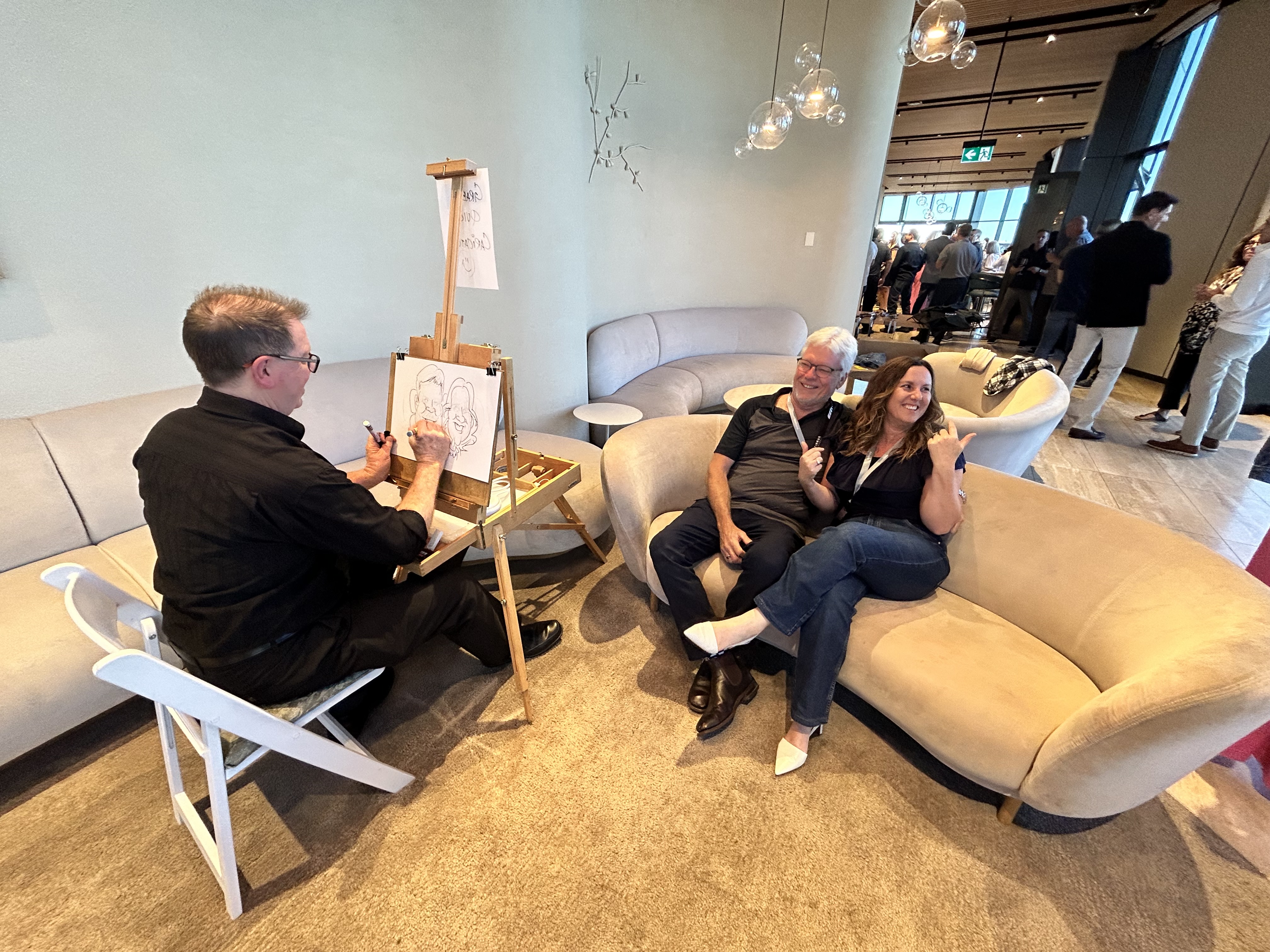
Touching down in Adelaide around 10am we were met by the Cirrus team who transported us to the Eos by SkyCity Hotel in North Terrace, just next to the Casino and across the river from Adelaide Oval. The event kick off was the Friday evening cocktail party. Approximately 150 people filled the rooftop terrace of the Eos by SkyCity Hotel. This venue gave everyone the opportunity to view the city of Adelaide and the Adelaide Oval from a high vantage point and to mix and mingle with old friends. An artist who did instant caricature sketches added a bit of fun.
Mike and Erica have their sketch done
Saturday morning saw the start of the conference while the partners took the opportunity to visit the German town of Hahndorf in the Adelaide Hills and the McLaren Vale wine area.
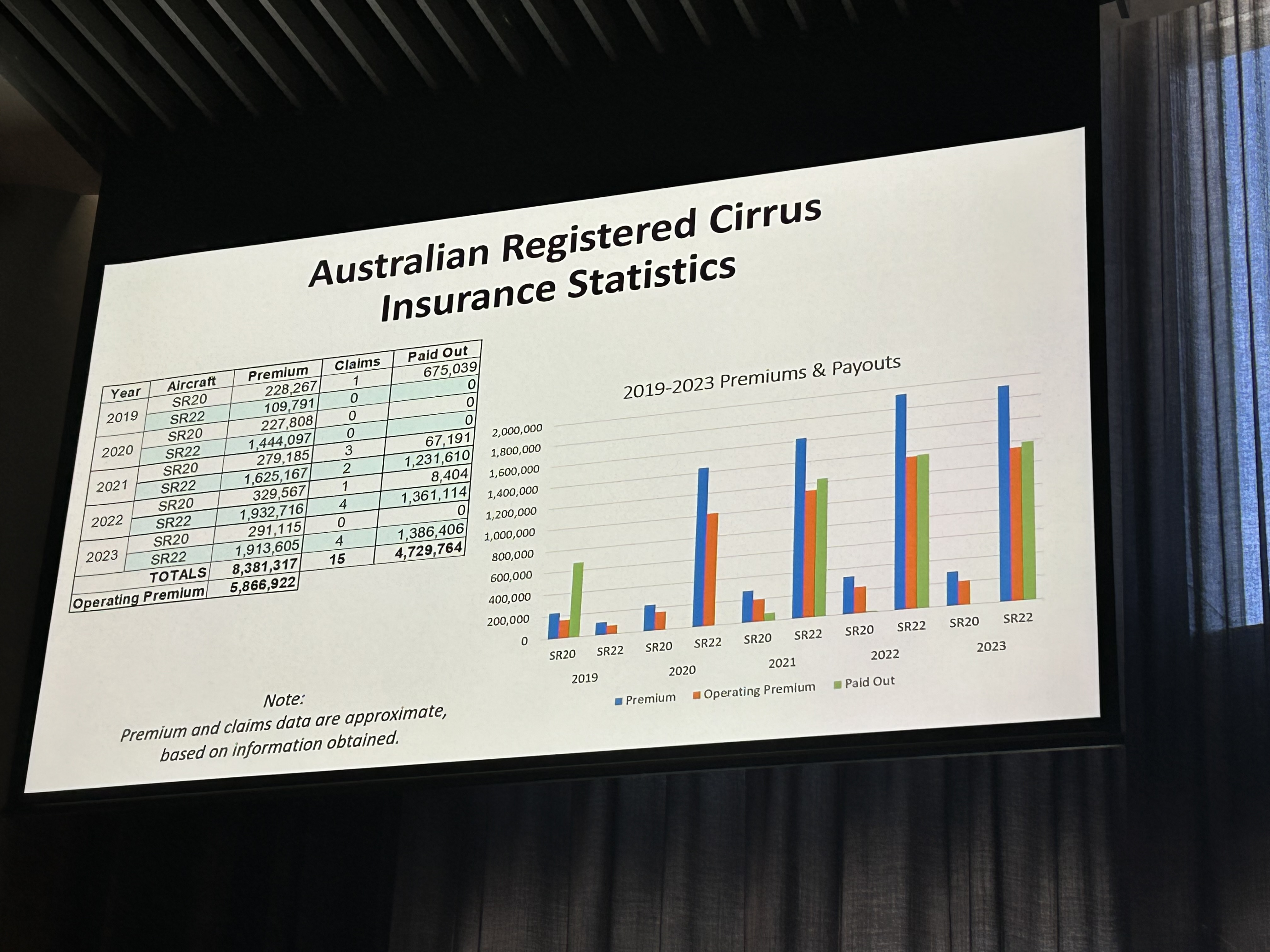
There were several guest speakers from Cirrus USA touching on topics of interest ranging from how to clean your aircraft and what’s the best way to do a go around, to an examination of Cirrus incidents over the past 10 years. Garmin did a segment on their avionics platform, followed by BMG Insurance who discussed the contentious issue of increasing insurance premiums for light aircraft.
Saturday lunch was held at the Adelaide Oval, a short walk away across the river. There was plenty of history in the wings here, not only for cricket fans but for AFL too.
Adelaide Oval
Cirrus invited Queensland and Australian test cricketer, Greg Ritchie, as guest speaker and he kept the audience captivated for about 60 minutes. Excessive laughter continued throughout his entire presentation. He brought back many memories of The Footy Show on Channel 9 when Ritchie, as the very popular ‘Mahatma Cote’, ran riot with skits that you probably wouldn’t get away with today. What an amazing guest speaker! The lunch was followed by a guided tour of the recently reconstructed Adelaide Oval, including a look inside the heritage listed scoreboard.
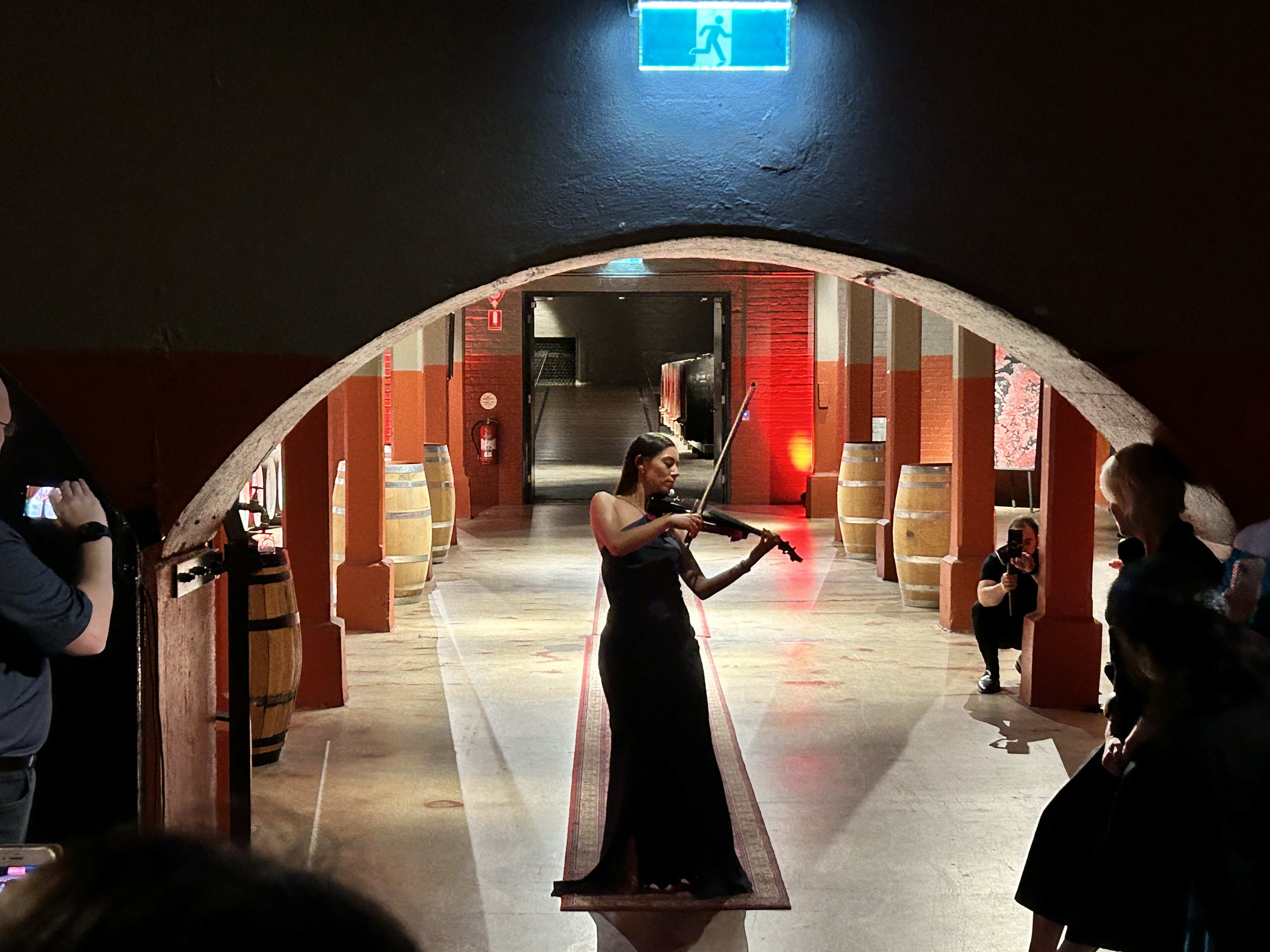
Saturday evening we were bussed to Penfold’s Magill winery, home of the famous Grange. Back in the day the winery was on the outskirts of Adelaide. Today it’s surrounded by several suburbs that extend right up to the start of the hills district. Christopher and Mary Penfold started the winery back in 1844 at the Magill Estate and today that estate is in pristine condition. After a tour of the cellars we enjoyed some wine tasting with canapés while being treated to some great music by the very talented solo violinist Cardinia, who manages to merge classical and pop with a touch of electronic.
Full to the brim we were bussed back to the city.
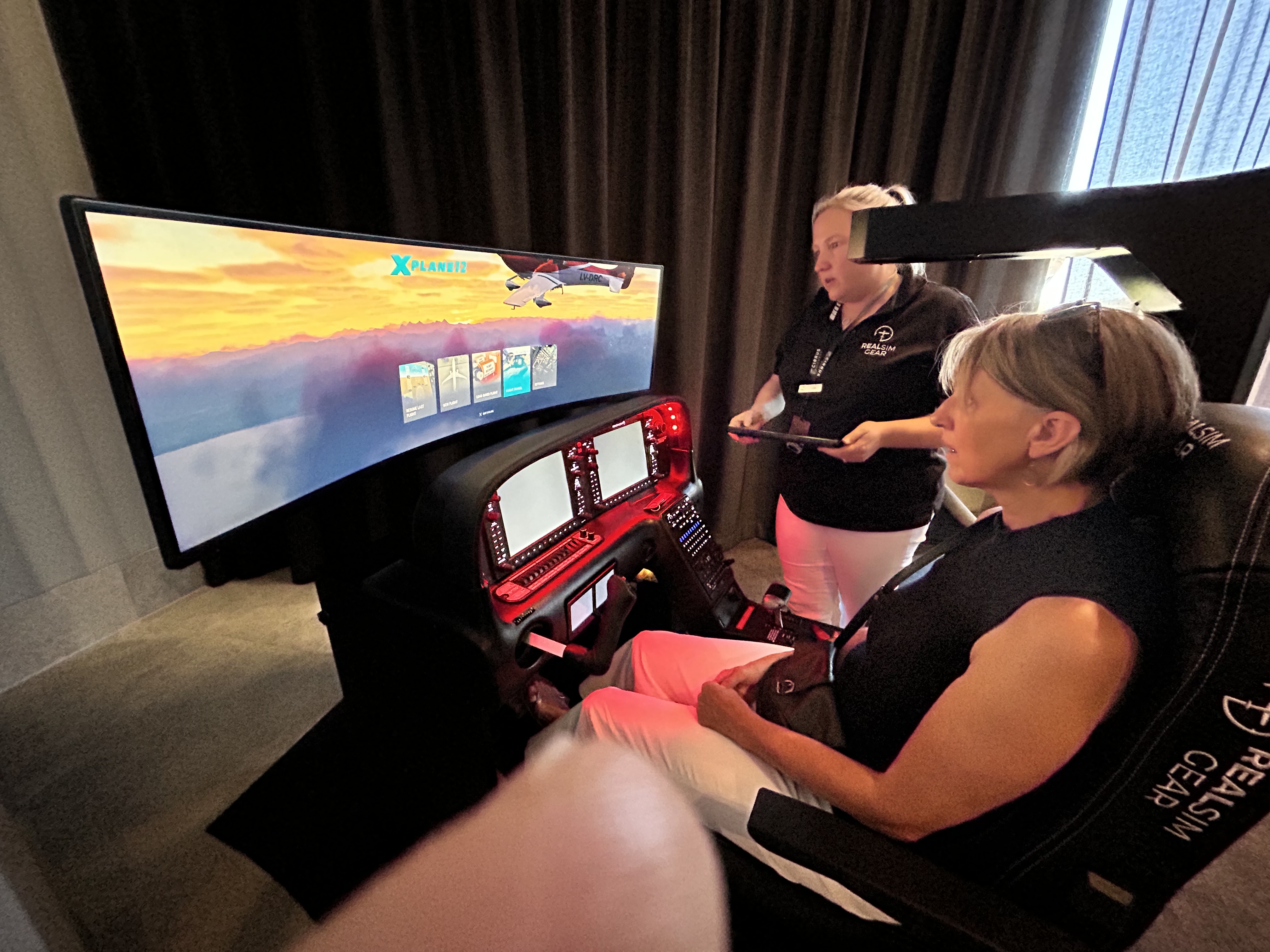
Sunday there was more Cirrus stuff to consume in lectures and the opportunity to fly a simulator, including being able to pull the ‘CAPS’ handle and deploy the parachute overhead Adelaide.
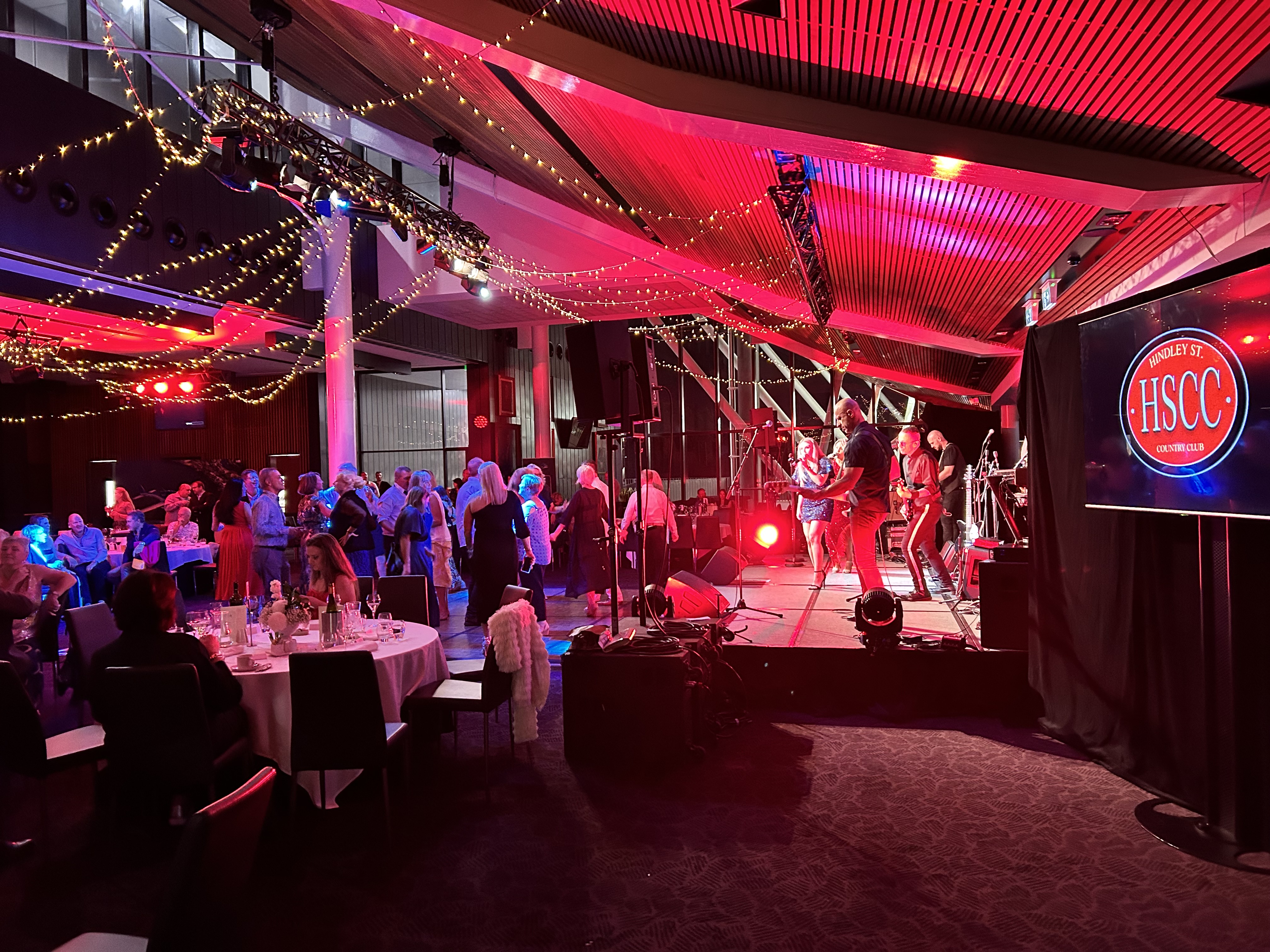
The finale was a gala dinner at the Oval. Cirrus organised a 12 piece band called the Hindley Street Country Club who were on stage for almost three hours, playing non stop a variety of music that got almost everyone up on the dance floor till the end, including a couple of encores.
Monday came and we all headed back home wondering what Cirrus will think up in two years’ time when they host the next ‘Cirrus Life Event’.
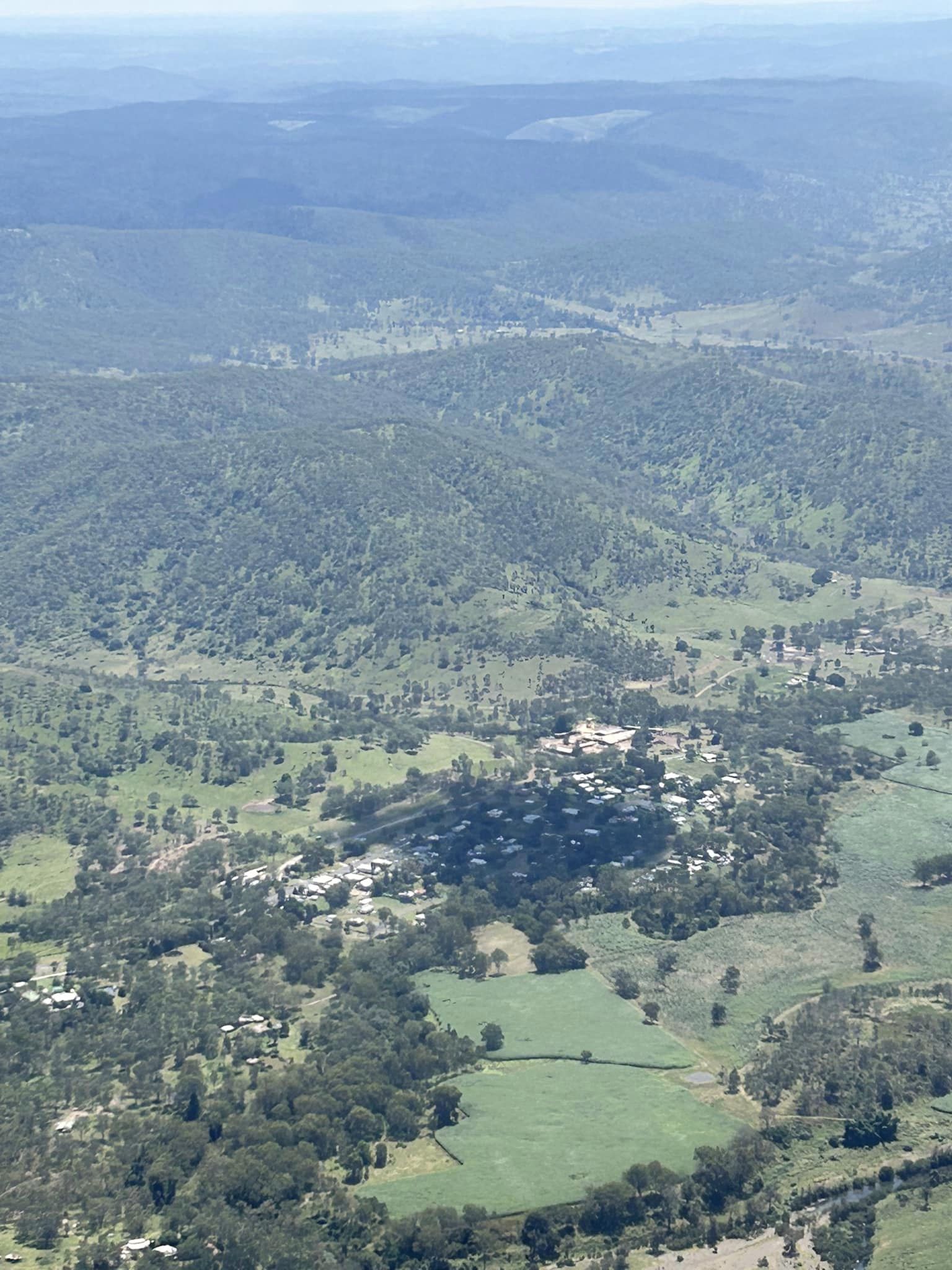
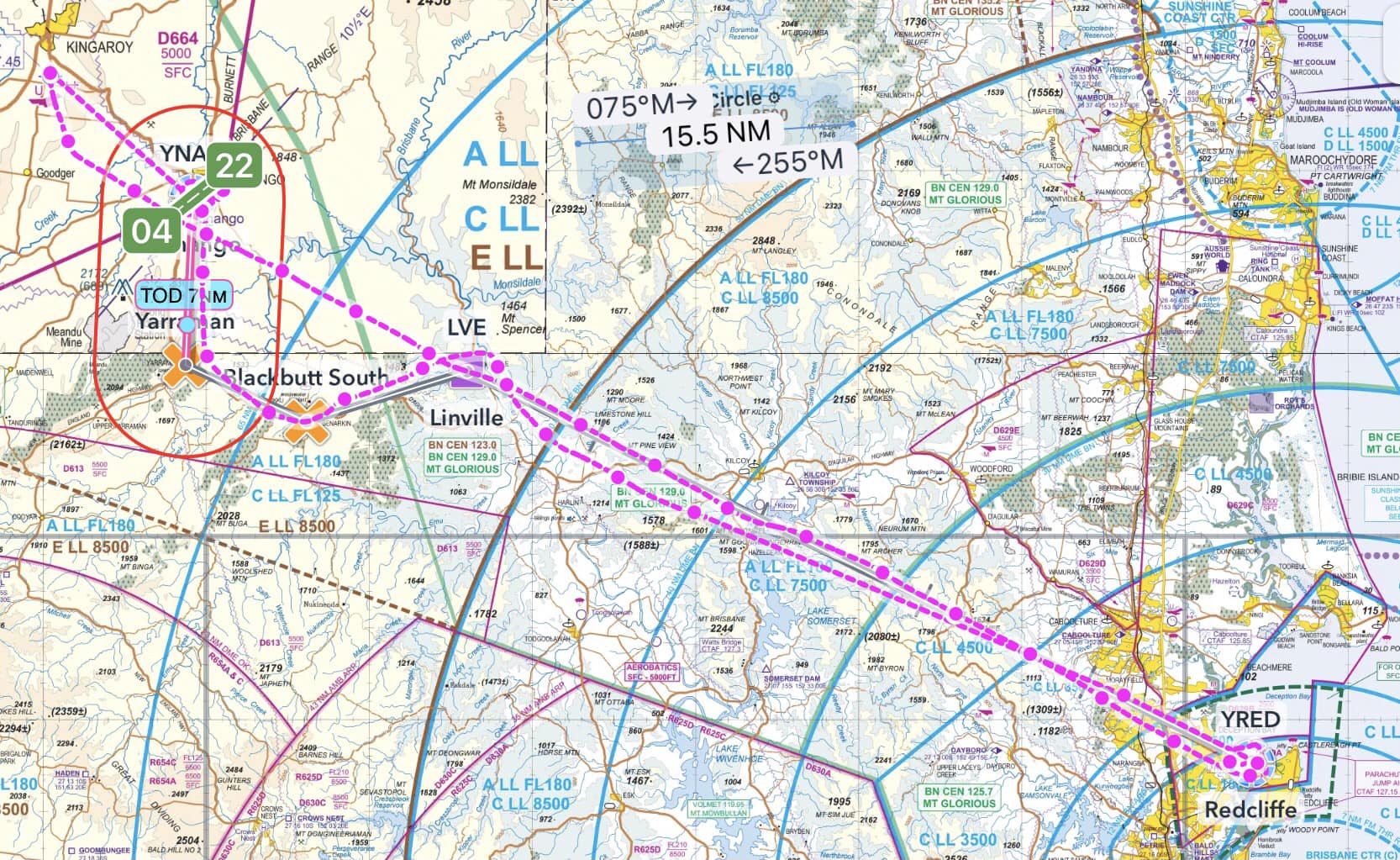
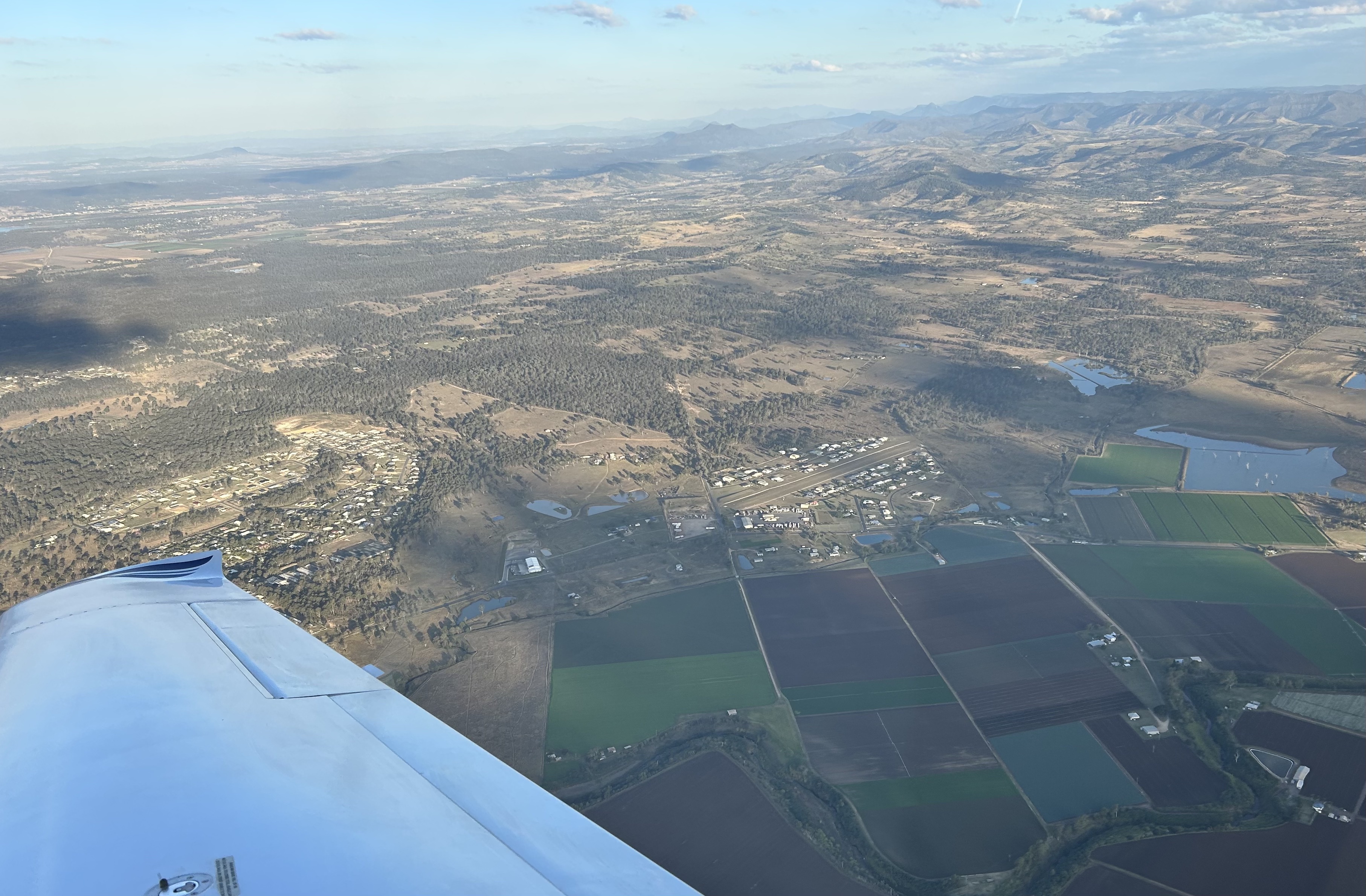
On Friday 1st March 2024 Garry Ayre and I flew to Nanango and Kingaroy, following the Brisbane Valley Rail Trail from Moore to Yarraman on the way.
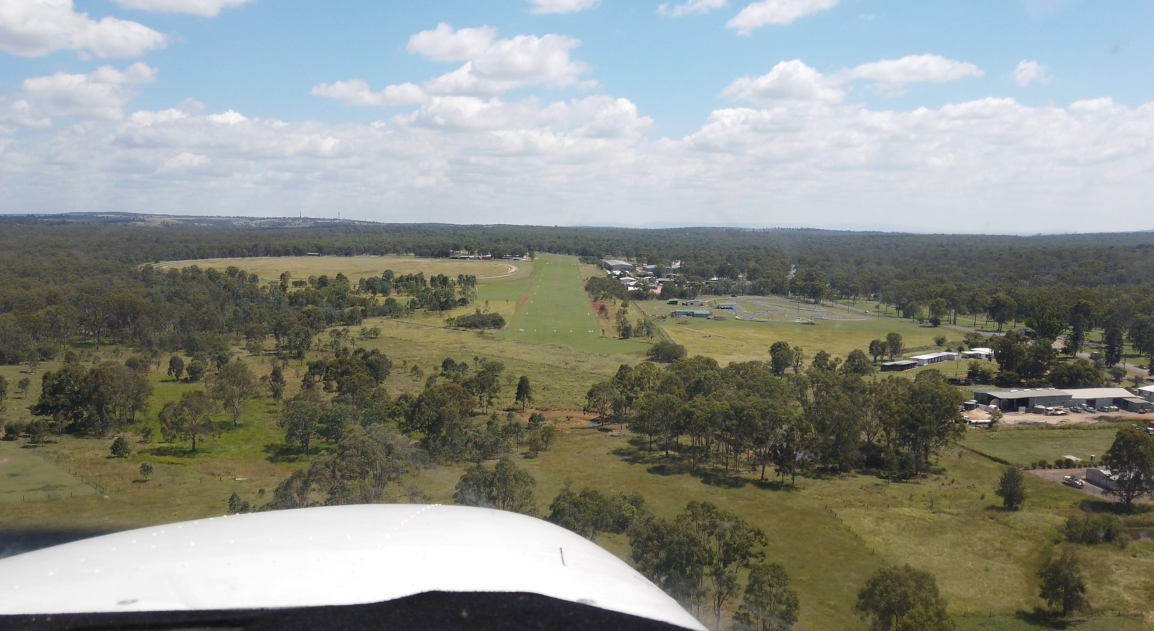
It was my first landing at Nanango where there’s a well maintained 850m long grass strip.
It took about 30 minutes to walk into town where I left Garry in the RSL while I did a quick recce of the town in readiness for our cycle trip in April.
I decided the RSL was the best place for lunch so we settled in there for a BLT and a coffee. After lunch we caught a taxi back out to the airstrip, started up and took off, climbing to 3000ft for the 5 minute hop over to Kingaroy where Garry moved into the left seat for the return journey.
An RFDS King Air arrived with a patient while we were preparing for departure.
Taking off to the south east we passed by the Tarong Power Station and then retraced our tracks via Linnville to Kilcoy.
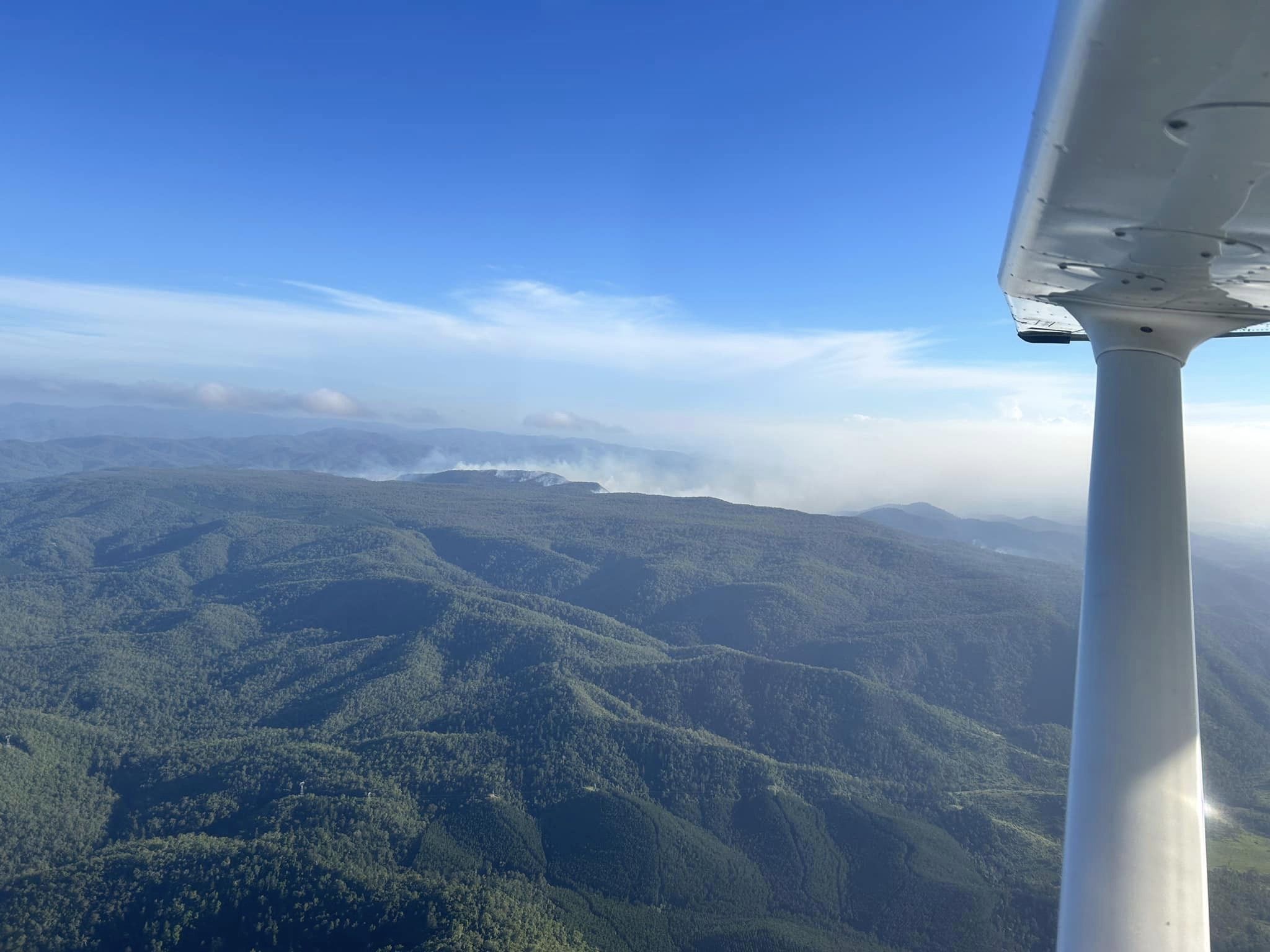
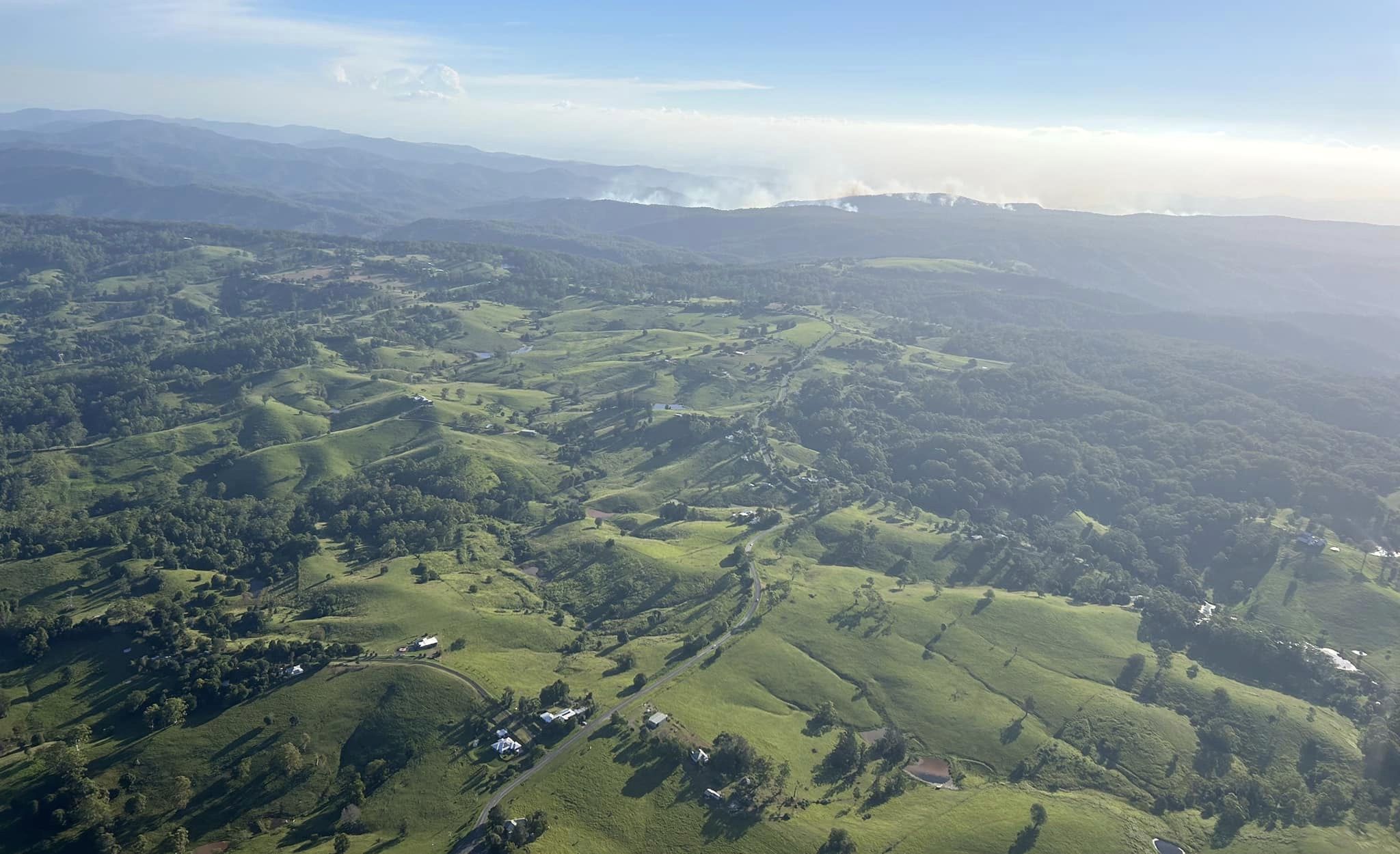
There was a head wind and it was very hazy west of Kilcoy on the way back due to a whole bunch of fires in the hills west of Dayboro. Nevertheless the surrounding country was still vivid green.
With Swiss timing precision that QANTAS can only dream of we landed at Redcliffe just in time for the monthly aeroclub barbecue!
Palmers Island is a privately owned grass airstrip just inland from Yamba. It is owned by the MacIntyre family, local sugar cane growers. Bob MacIntyre was a mad keen aviator who established the airstrip on his property back in the 1970s. The family has been happily hosting GA visitors every since. Unfortunately Bob died suddenly in September 2023. Apparently he’d been out on his ride on mower ensuring the strip was in perfect condition the day before he died and just “didn’t wake up in the morning”. His sudden death was a shock to his family and all his friends and there was some concern the airstrip may close but his sons and daughter have announced they will continue to run the airstrip and maintain it to Bob’s high standard into the future.
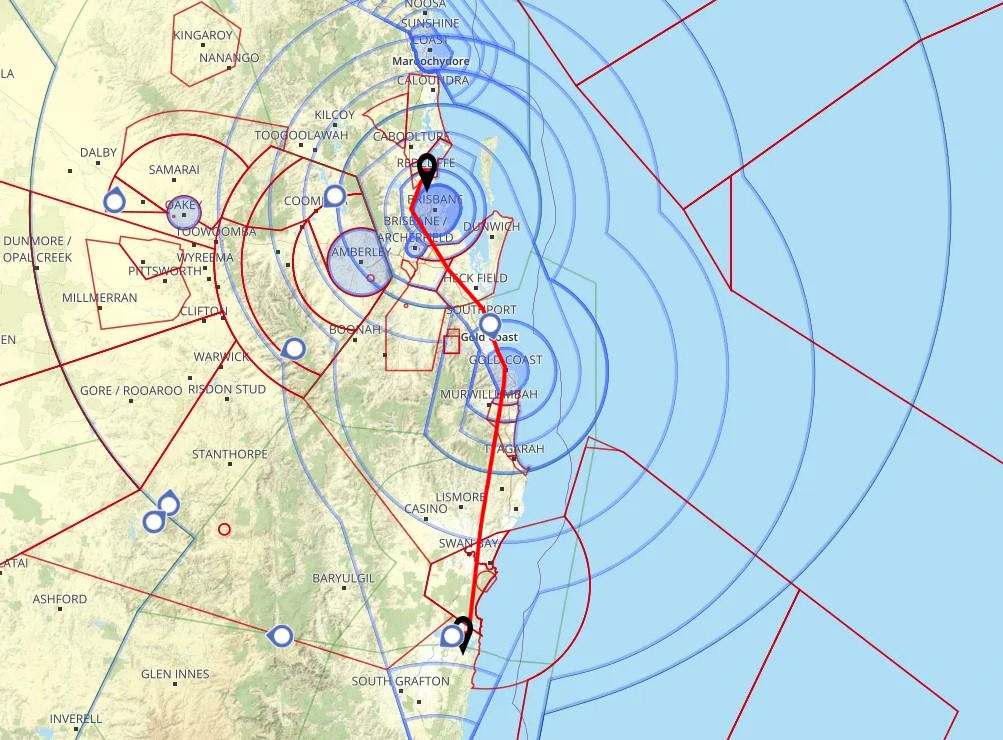
So, after a couple of failed attempts prior to Covid, on November 11th 2023 the Redcliffe Aero Club held a flyaway to Palmers Island and Yamba. It’s about 1.5 hours south of Brisbane in a 172 so a good distance to go for lunch with plenty of beautiful coastal and hinterland scenery along the way.
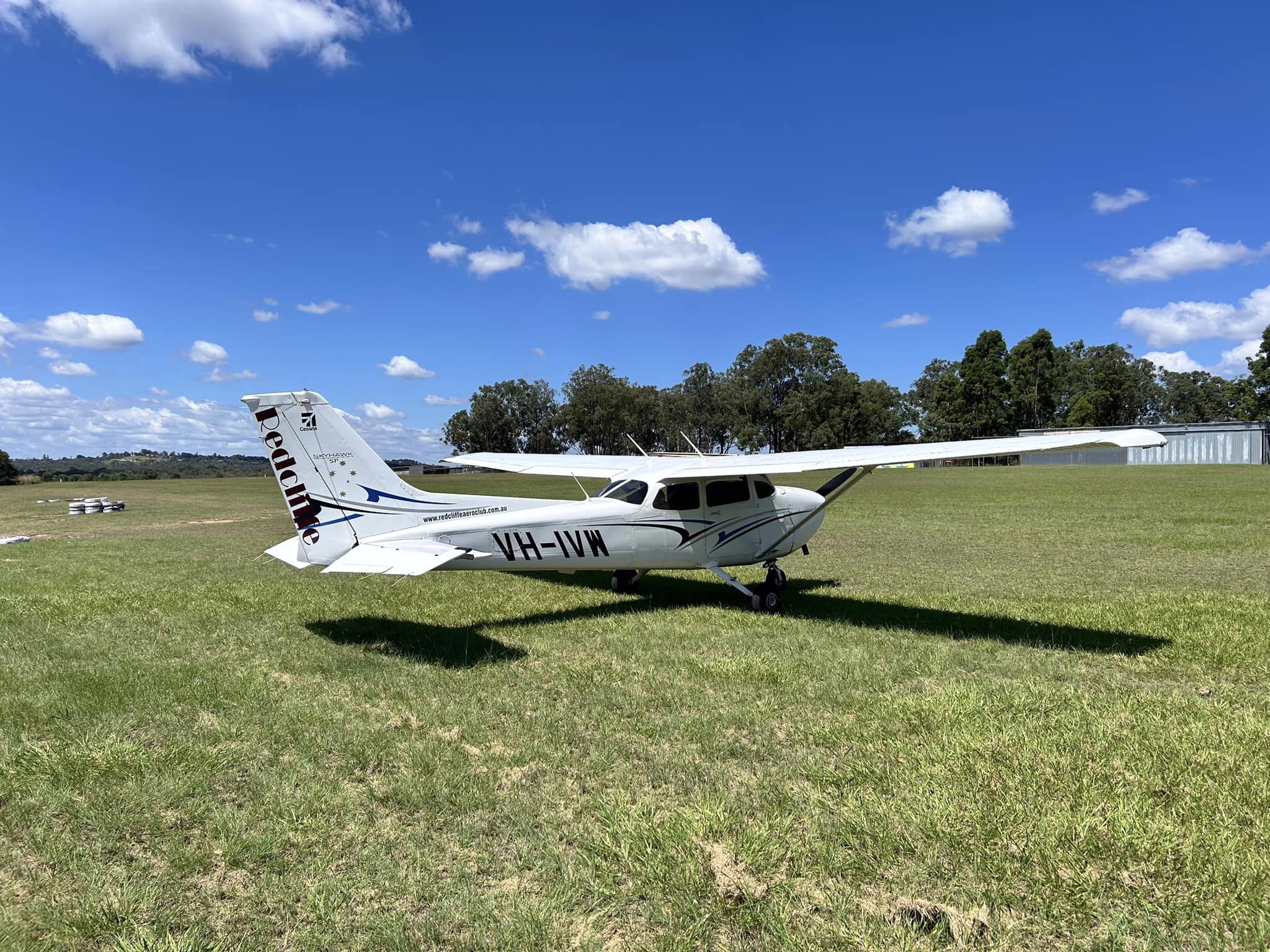
I decided to take one of the club 172s, IVW, which has a G1000 glass cockpit and is IFR, even though it doesn’t have an autopilot. But hey, it was only a short flight so who needs autopilot anyway? Garry Ayre had just completed his PPL a week before so we decided to fly together. It’d be good experience for Garry as he starts to spread his wings into the world. I was to be his first “passenger” along with Justin Webb, a young guy who would like to learn to fly. We agreed that Garry should fly the outward leg over the islands and along the coast VFR. It would give him some practice passing through the Gold Coast controlled airspace and down the coast and spotting the somewhat hard to find airstrip at Palmers Island. I’d fly home IFR to give both Garry and Justin an idea of how we fly under the instrument flight rules and so we’d have a different perspective, flying directly over the top of Brisbane.
The day started off looking fairly unpromising. Low cloud and showers of rain. But it was forecast to improve during the morning and clear in the afternoon so we delayed our departure time a bit and took off from Redcliffe around 9:30, passing over Moreton Island and Straddy on our way to the Gold Coast. I volunteered to do the radios to give Garry more time to enjoy the flying and the views.
South Stradbroke Island looking south towards the Gold Coast
Approaching the Gold Coast I called up Brisbane Centre and obtained a squawk code, and we were identified, told to remain OCTA and to contact Gold Coast Tower abeam Q1. There were a few other aircraft around as we headed south and we were asked by Gold Coast to head inland to Robina Town Centre and follow the inland VFR route due to traffic. Nevertheless this gave us a great view of the coast and the hills to the west, and we were soon over the Tweed River and out of the controlled airspace.
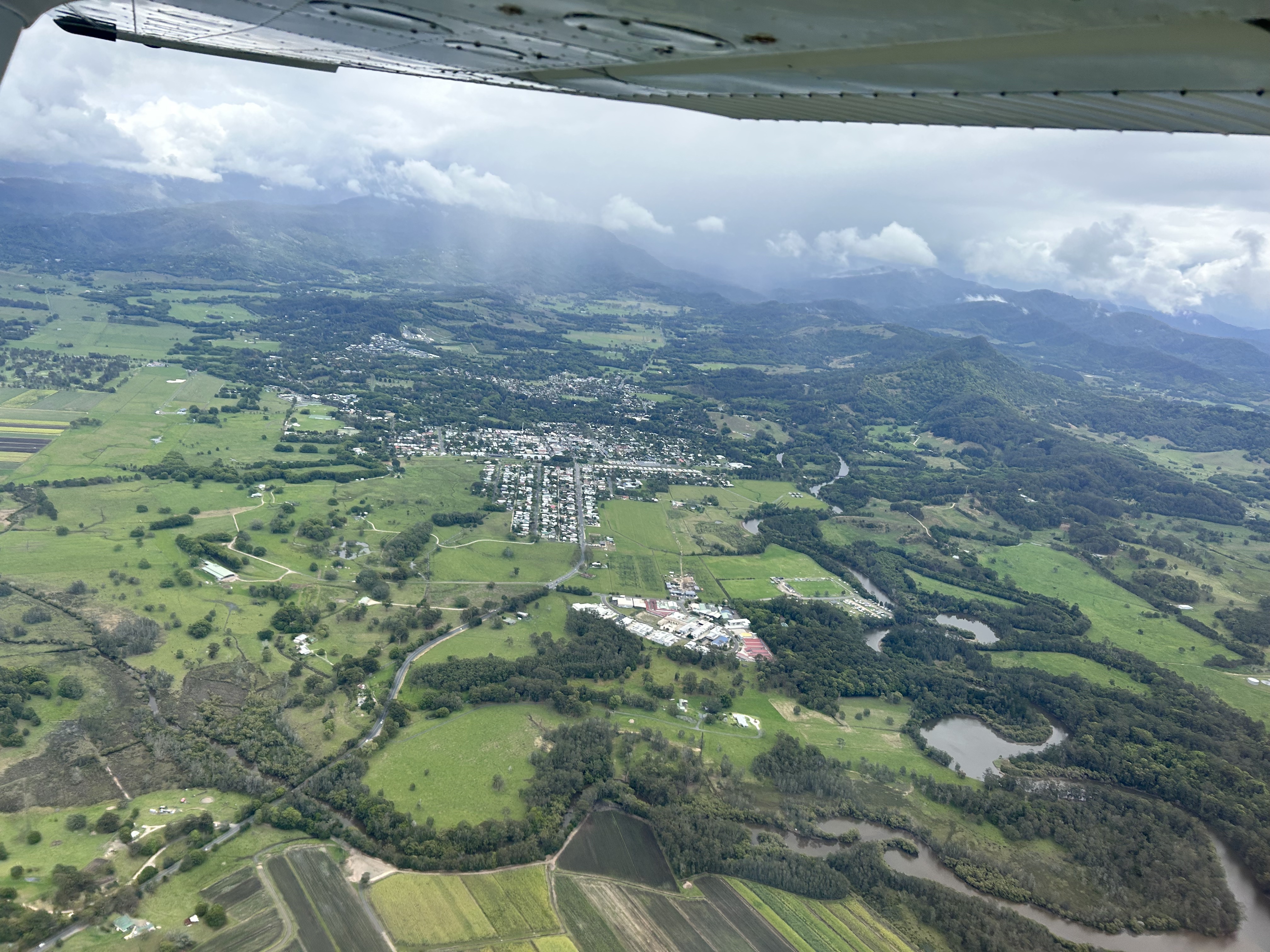
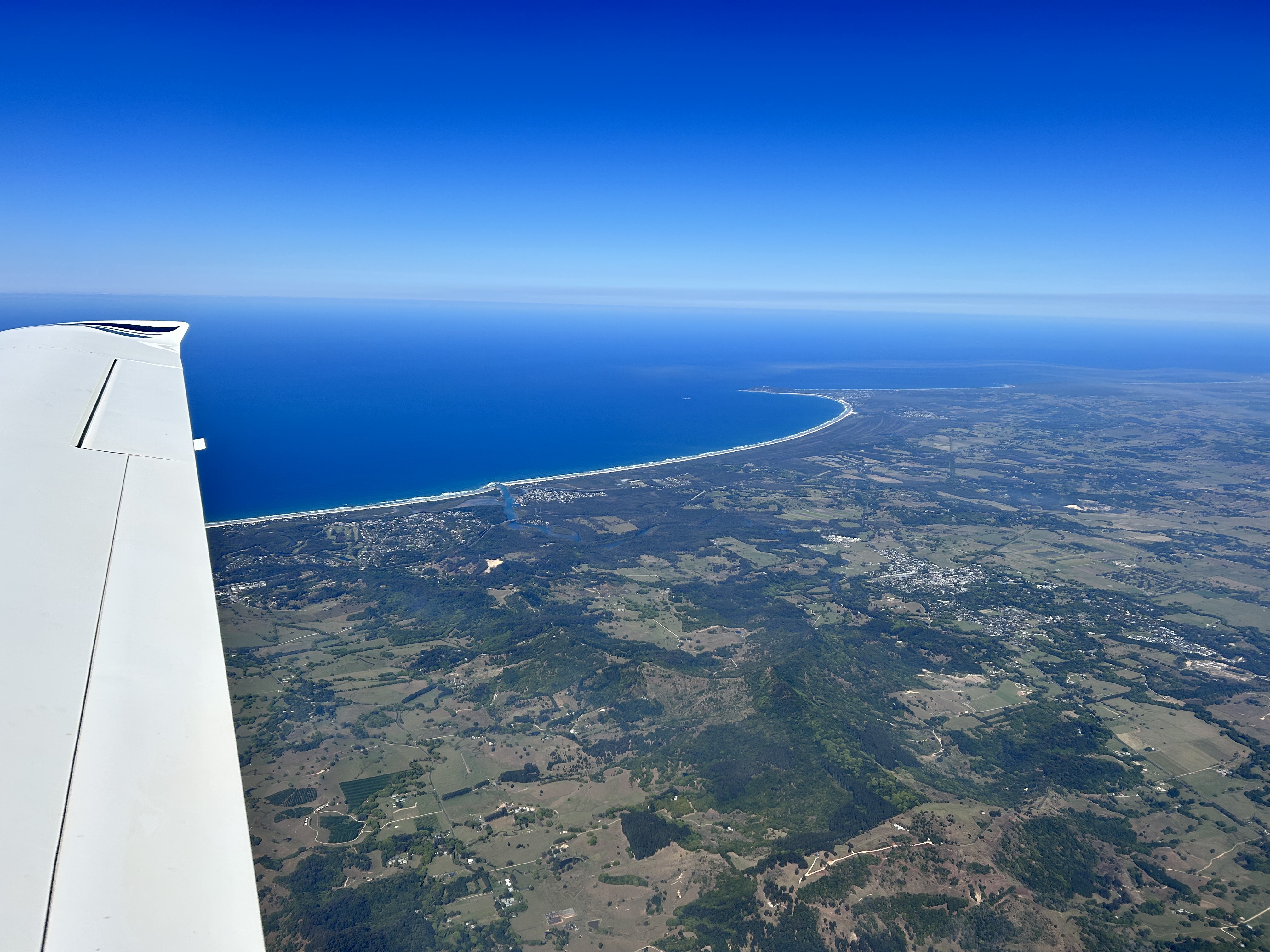
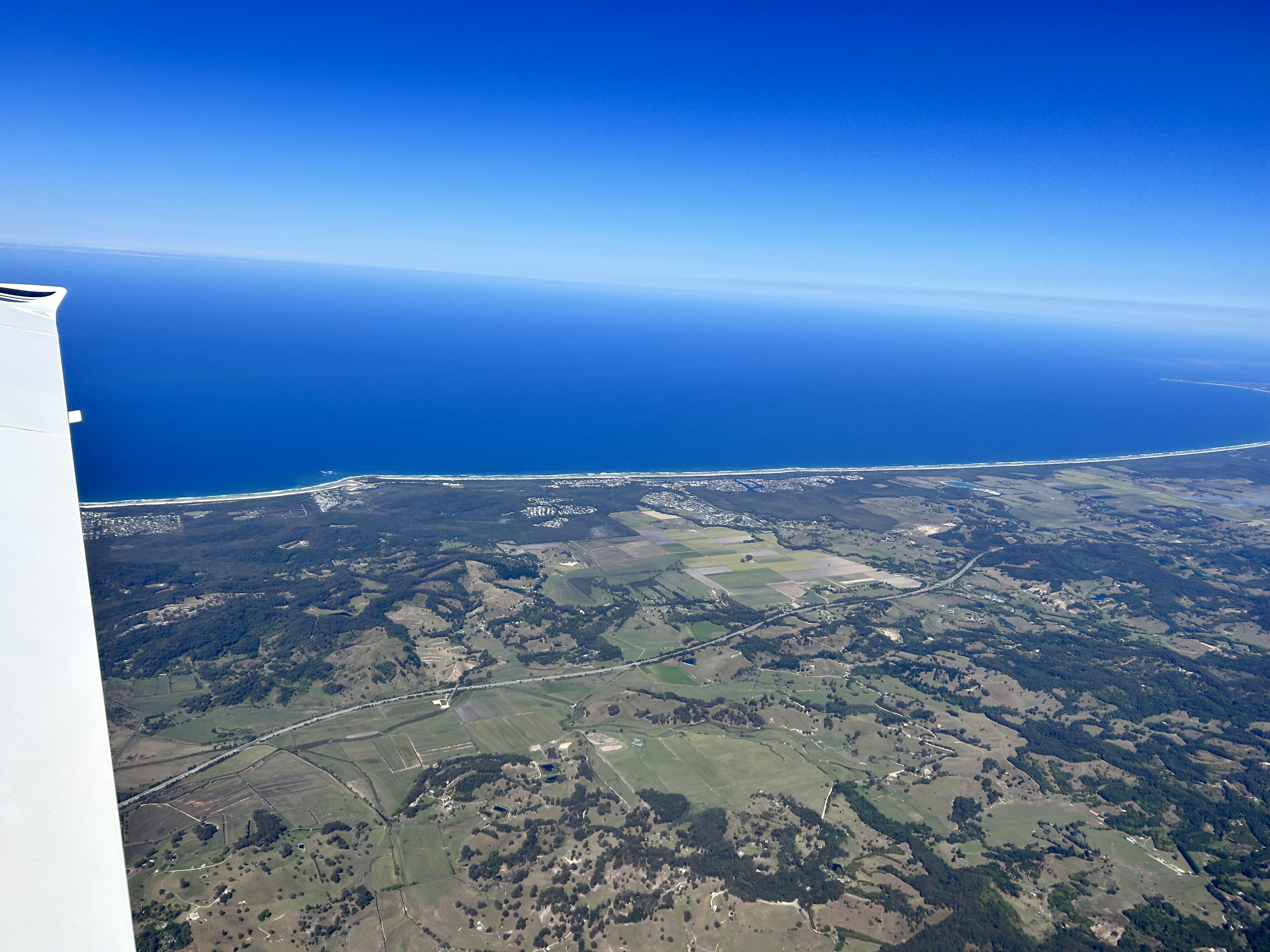
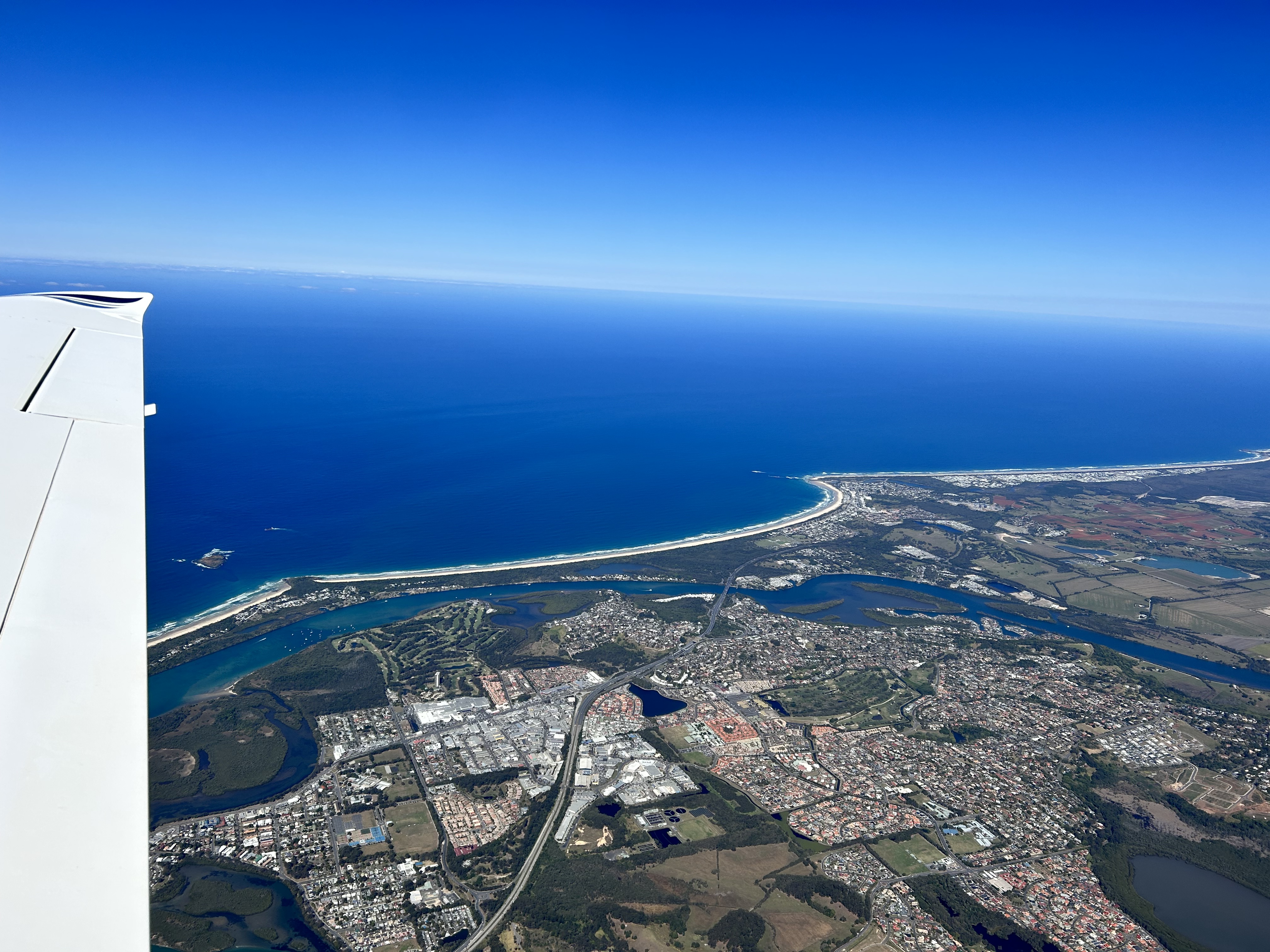
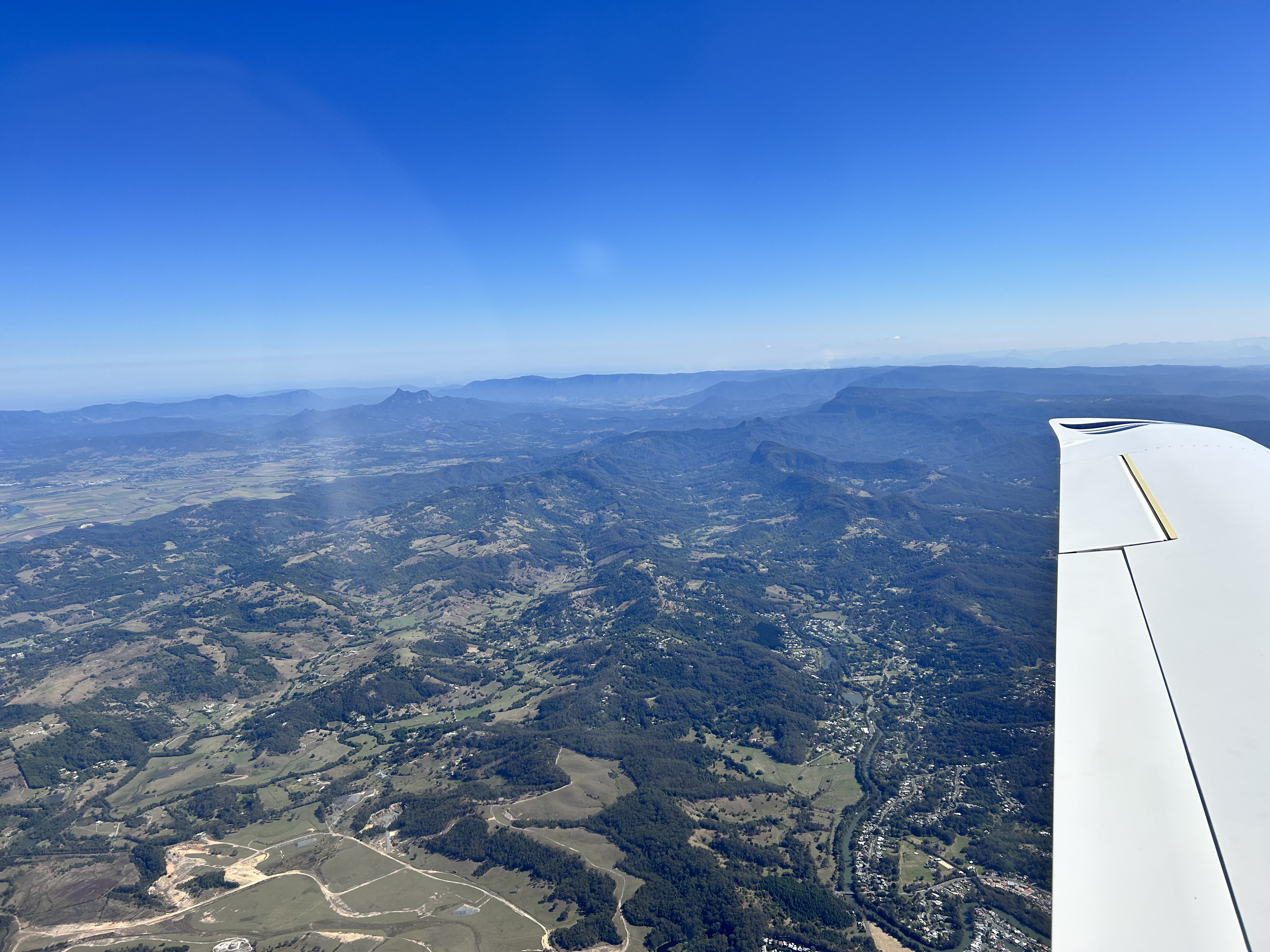
Passing familiar territory along the coast I could identify all the towns from Fingal Point down to Pottsville and on the right hand side we passed Mullumbimby.
Mullumbimby
CASA had implemented an air traffic service in Ballina earlier in 2023 due to a few close calls involving GA aircraft and jets so I was required to call them up as we entered their zone and tell them that we were planning to overfly the airport and track south to Yamba. There was a Jetstar plane about to depart and he called us up and asked our location when we were about 5 miles to the north. When I told him he said he’d wait for us to pass overhead before he took off. The air traffic controller told him it wasn’t necessary to wait as she had us on radar but he said he’d rather wait until he had us clearly sighted.
Ballina Airport
As we passed overhead he started to roll and took off to the east over the coast, turning left to avoid us as we headed further south.
We were about to pass over the Evans Head restricted airspace so we’d checked on the NOTAMS prior to departure to check it wasn’t operating. Just to be sure I called up Brisbane Centre and they confirmed it was inactive. Passing over the bombing run we tried to spot evidence of recent activity but there was none to see. The weather was really fining up by the time we were approaching Palmers Island. The Northern Rivers region really is spectacular country.
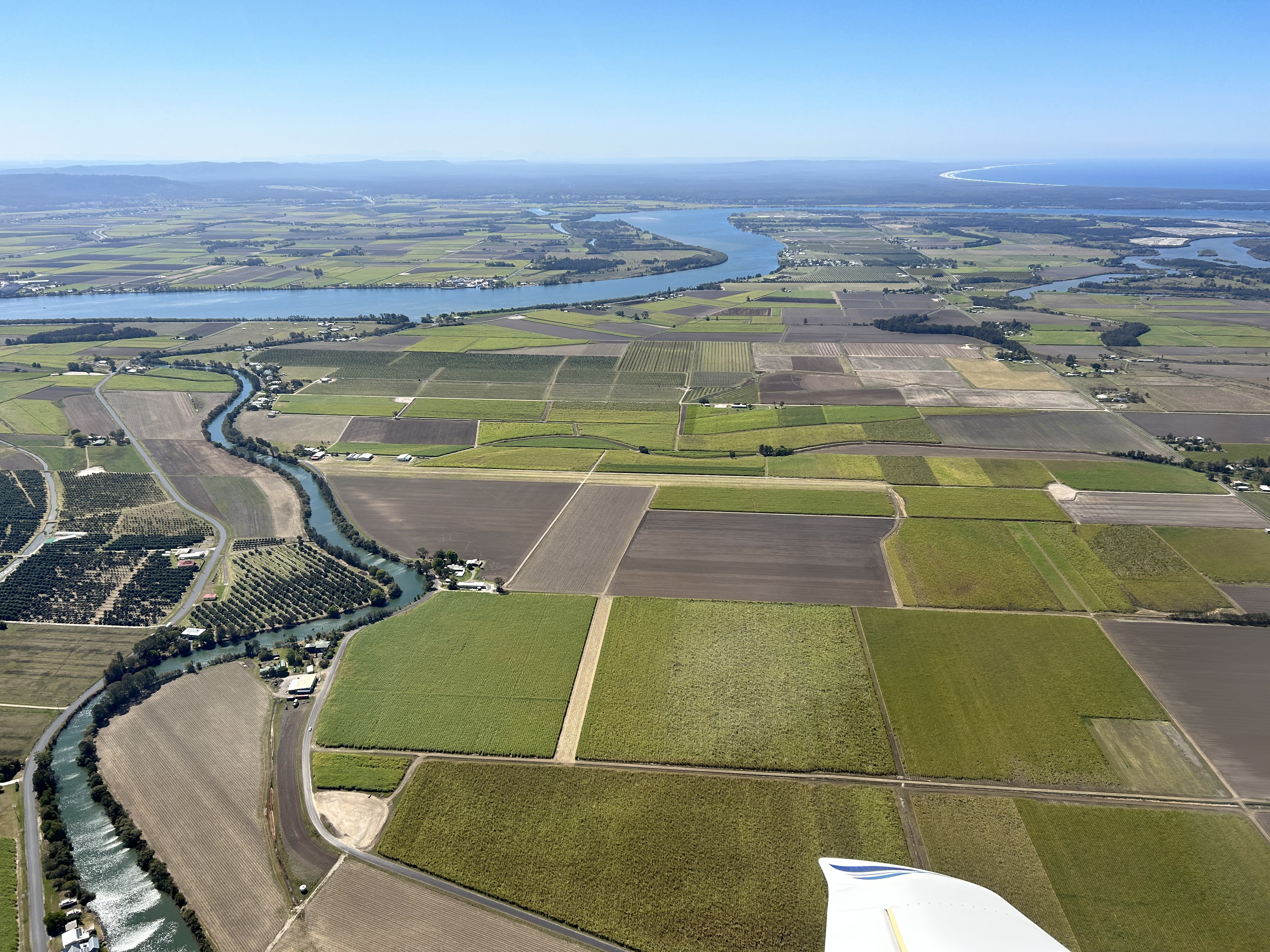
Having flown into Palmers Island before I knew where the airstrip is located so was able to guide Garry towards it (we had the GPS locked on it as well but we were trying to find it visually). I managed to spot it when we were about 5 miles out but Garry and Justin didn’t have a chance. It reminded me of when Mike, Brett and I flew in there a few weeks before and didn’t spot the strip until we were right over the top of it. A green grass strip surrounded by green cane fields is not easy to spot. Anyway, when we were over the top Garry did make it out and, after checking the windsock to see there was a slight easterly blowing, we joined midfield crosswind for RWY 09 and landed on the recently mowed grass.
We were four planes in all from Redcliffe and the others had arrived a bit earlier so they’d already taken one of the two loan cars (organised earlier) into town. We said hello to the Macintyre family who run the airstrip and then climbed into the second car to follow them into town. We joined them at the Pacific Hotel for great panorama out to sea and a couple of very juicy steaks.
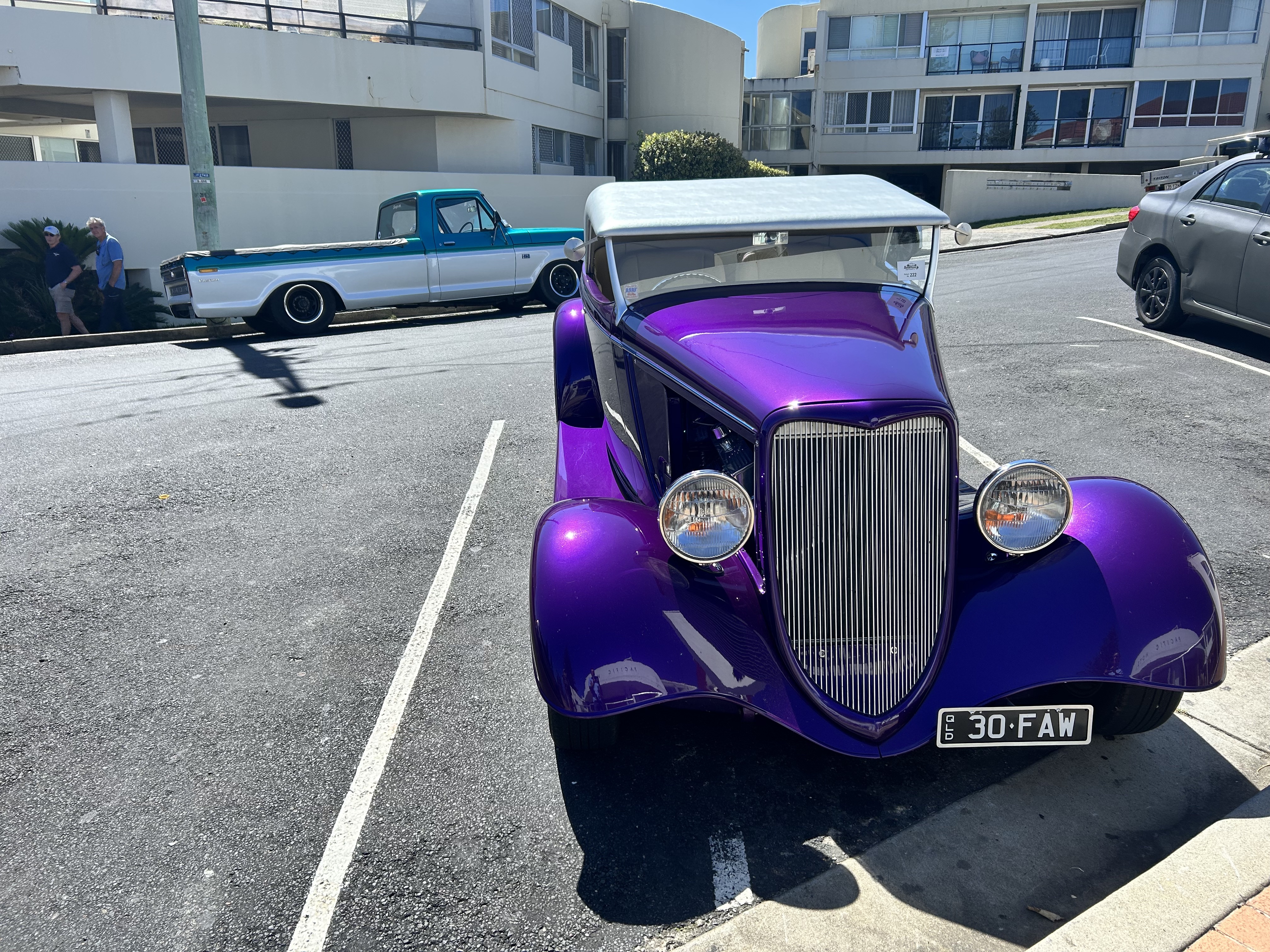
After lunch we stretched out legs with a short walk to the lighthouse and a view of the beach. It was a “hot rod” weekend in Yamba so there are few fancy cars around.
Back at Palmers Island we had a chat to a couple of the other guys, one of whom hangared his plane there. It was an Arion Lightning Classic kit plane that he’d built himself. One of our members, Neil, had flown his own Lightning Classic down from Boonah that day and the two of them knew each other.
I’d submitted my IFR flight plan back in town so as soon as the others had taken off we were ready to go. We climbed out to 6000ft and tracked direct for the Gold Coast. It was pretty much clear of cloud by this time so we had great views along the way. Around Ballina ATC asked me to fly direct to a waypoint over Heck Field so this gave us a great view of the Gold Coast out the right hand side.
Gold Coast from 6000ft
As we were approaching the south of Brisbane we were vectored slightly west of the Brisbane Airport so passed directly over the CBD.
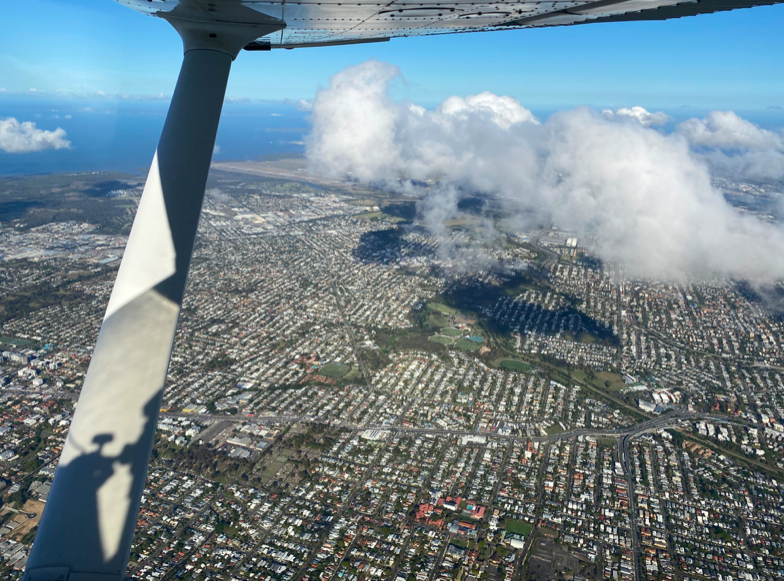
Looking over Kedron towards the Brisbane Airport
We passed through one solitary cloud as we descended into Redcliffe. One more soft touch down and we were back home again.
Scone, Mudgee, Temora flyaway – Don’t run your fuel tanks dry – Flying without instruments – One looooong table – Stanthorpe wineries – White out conditions – It’s the Law – Kimberley cruising – Flying coach
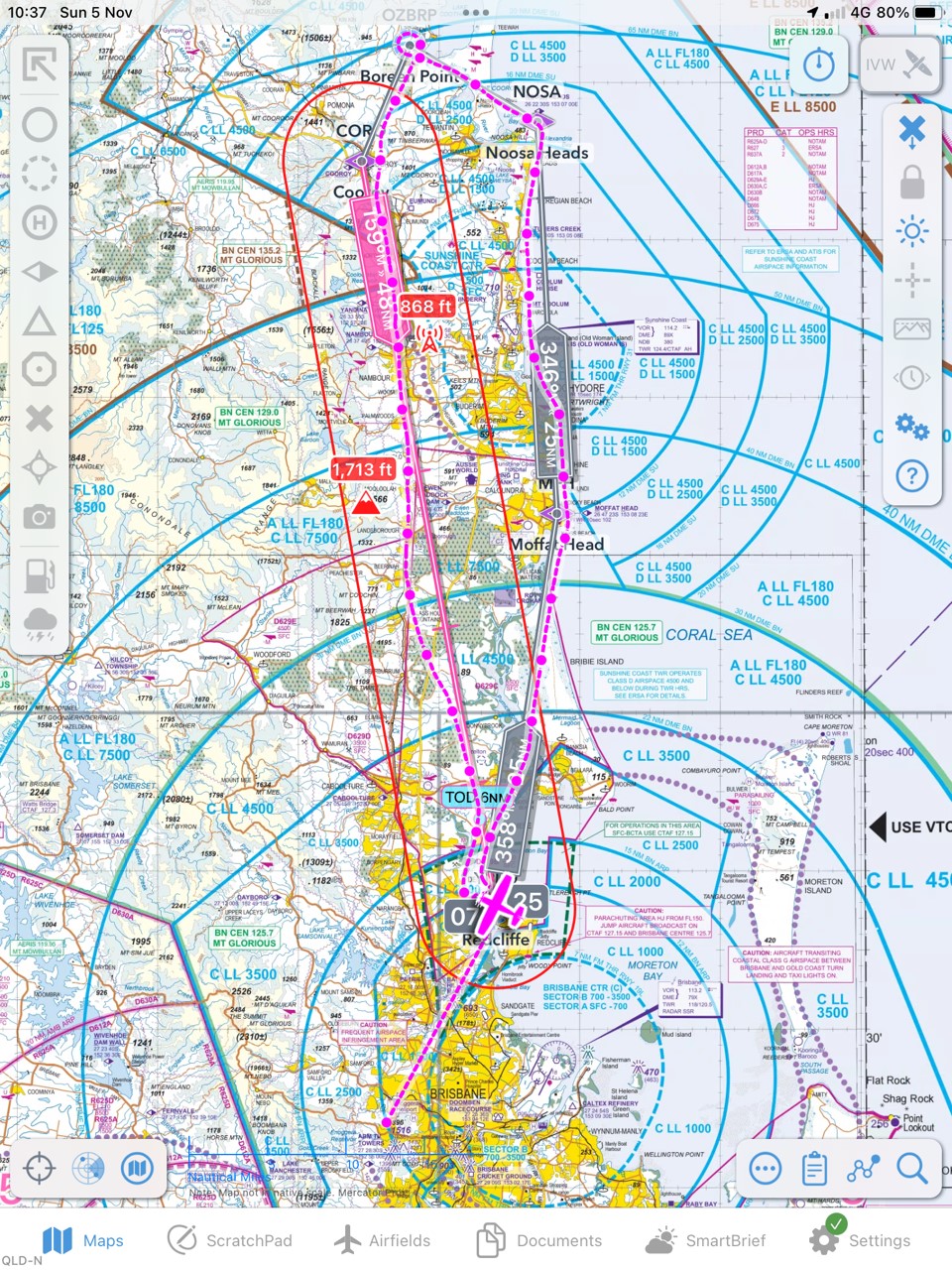
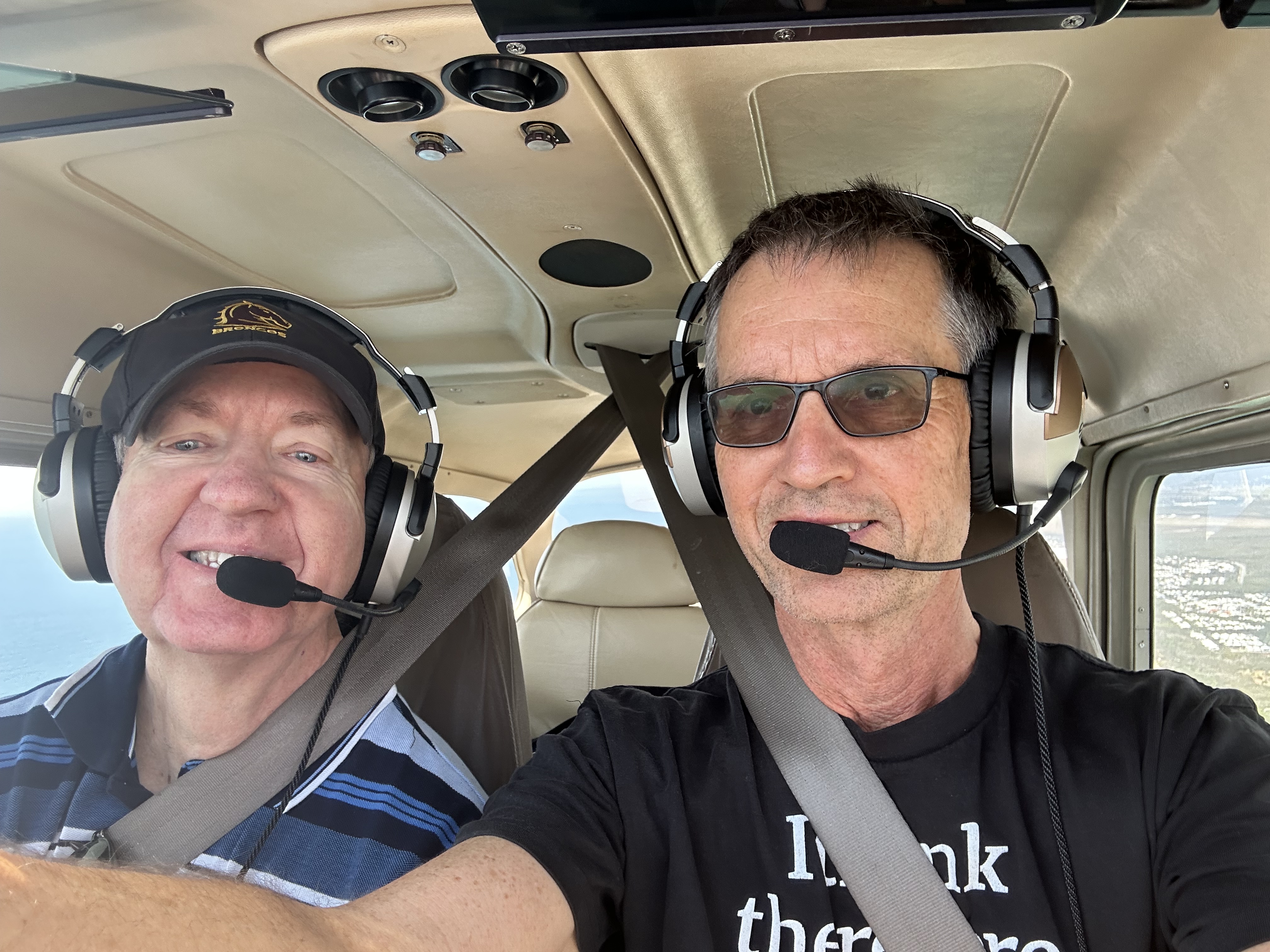
As part of my plan to reacquaint myself with the Cessna 172s at the aero club, following the destruction of MSF, I decided to go for a short flight with Garry Ayre on Sunday 5th November 2023. I hired IVW, my preferred aircraft as it’s IFR rated and has a G1000 glass cockpit very similar to the Perspective in the late model SR22s. Garry had recently passed his PPL licence so I thought it’d be good to share some of my experiences with him and he would make a good copilot. I wasn’t sure where to fly at first but when I heard the Noosa triathlon was on that day I decided we’d fly up to Noosa, my favourite bit of coastline.
Originally we’d planned to meet at 10am at Redcliffe but when I check the TAF for YBSU on Saturday evening it suggested that there’d be showers from midday so we agreed to meet at 8am instead, so we’d get to fly in the best part of the day. It was gloomy as I headed out of the Gap on my way to Redcliffe but fined up as I approached the coast.
We preflighted IVW and agreed that our original plan for a touch and go at YBSU wasn’t a good idea as a 20 knot crosswind was forecast on the runway. I still put YBSU as an alternate on the flight plan knowing that we could land there if need be if YRED was rained out later. The weather seemed to be remaining further south, with the strong north easterly wind keeping it there. We judged we’d be pretty safe and stay dry for at least the next hour although there were a few spots of rain as we taxied out to RWY07.
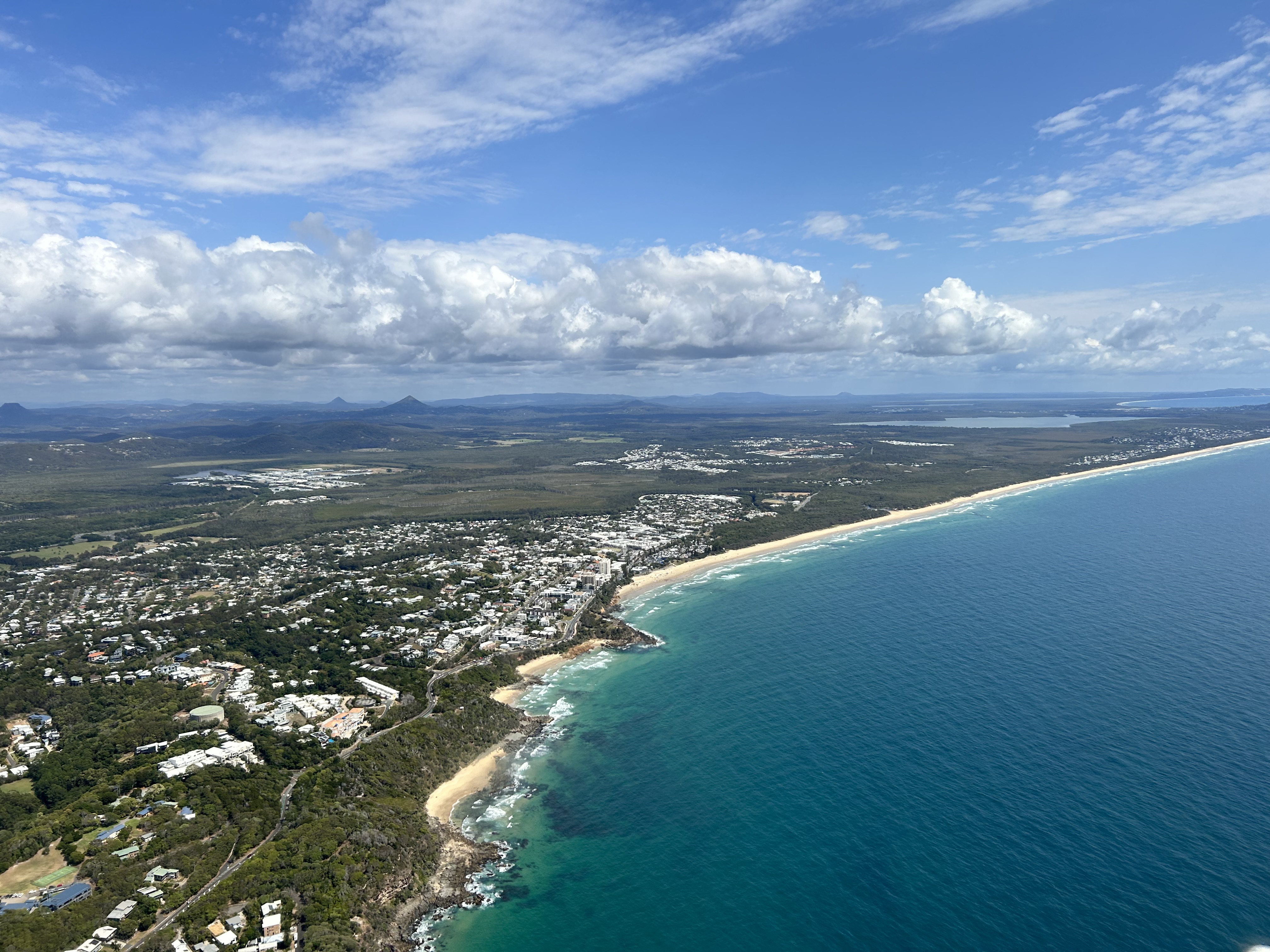
Taking off it was scattered cloud at about 3000ft over Bribie Island. We obtained a clearance to fly through the YBSU controlled airspace over water and were soon passing Mt Coolum with a great view to the north. At that point I realised that one advantage of flying in a 172 compared to a SR22 is that it goes much slower (115knots compared with 165knots) so you can take in the scenery much better. A bit like I discovered flying the Piper Cub a couple of years ago. Garry took over for a while so I could take some photos.
As I was planning to visit Coolum for a couple of days of golf a few days later it was great to see some of the golf courses from the air, and Coolum as well.
Coolum Beach
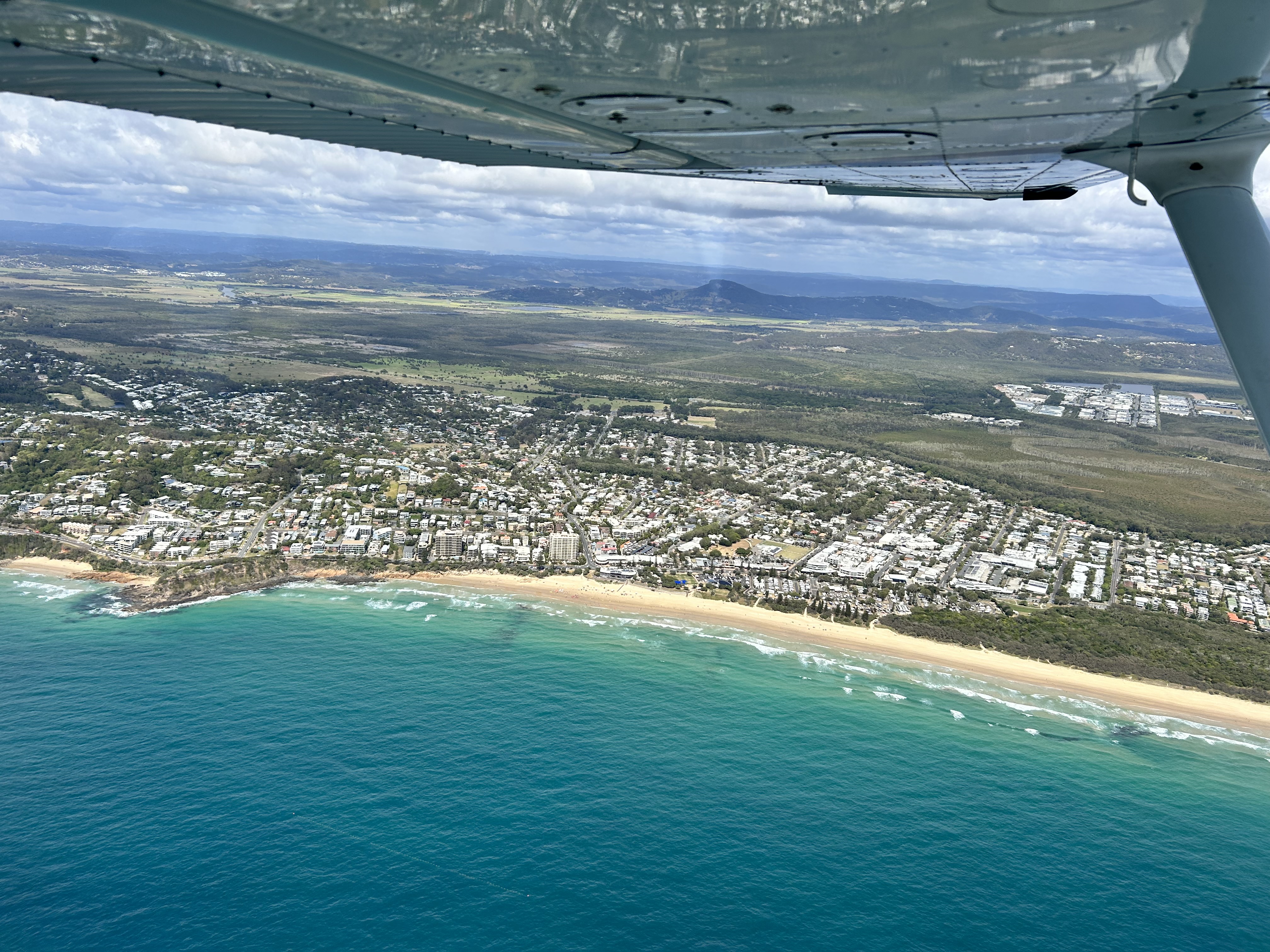
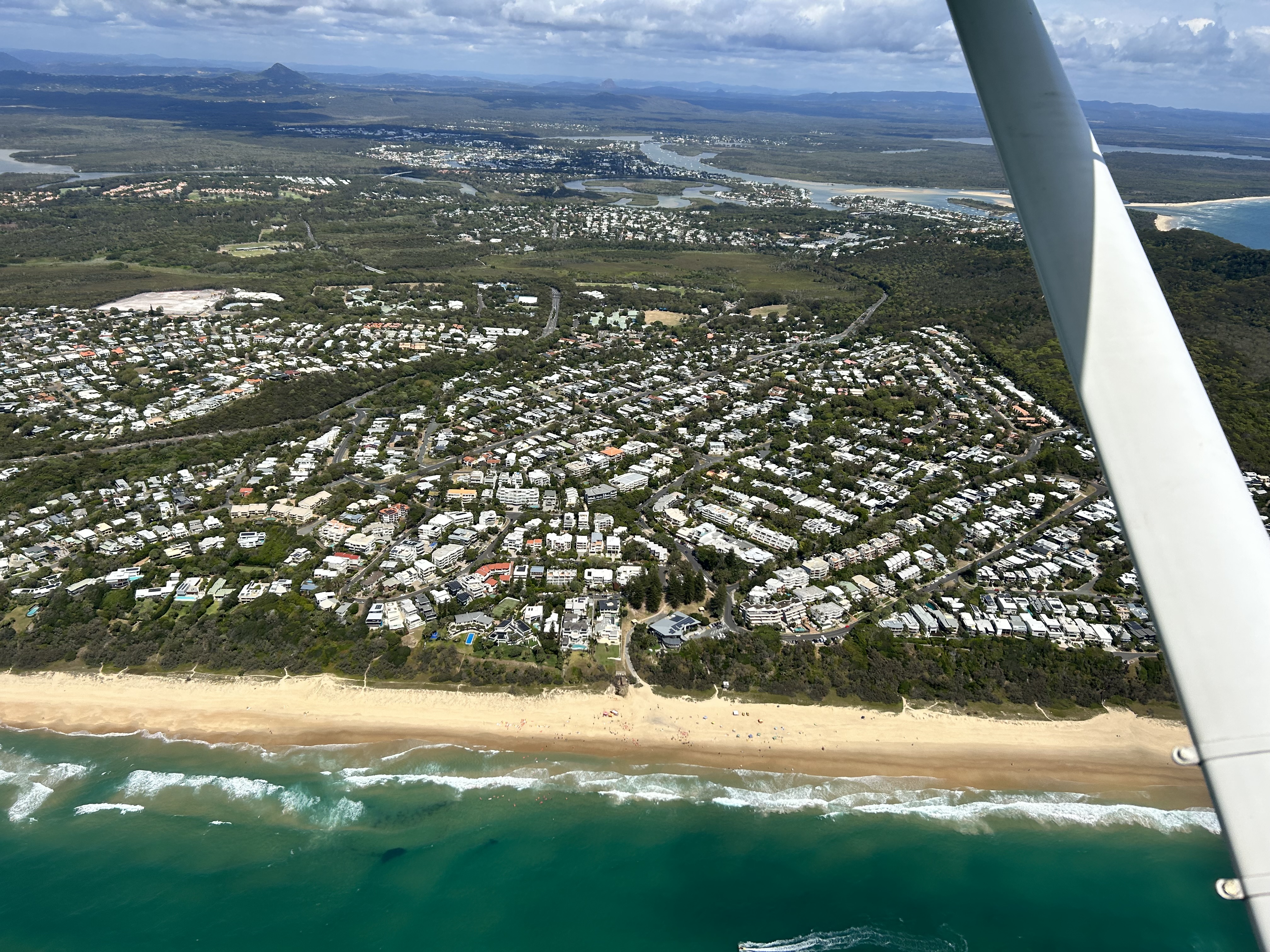
Leaving controlled airspace at Lake Weyba we caught a glimpse of the Noosa airstrip and then passed Sunshine Beach.
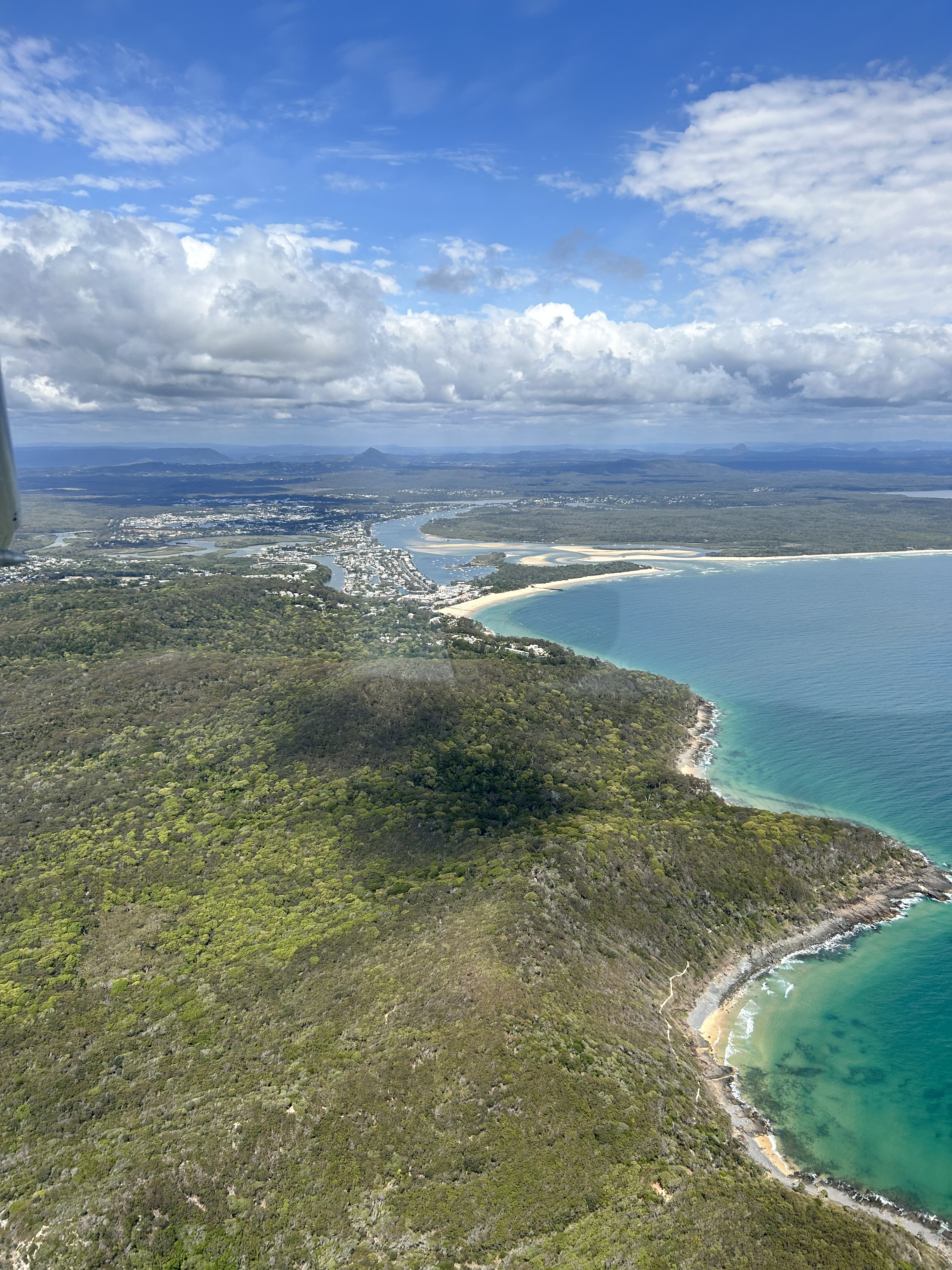
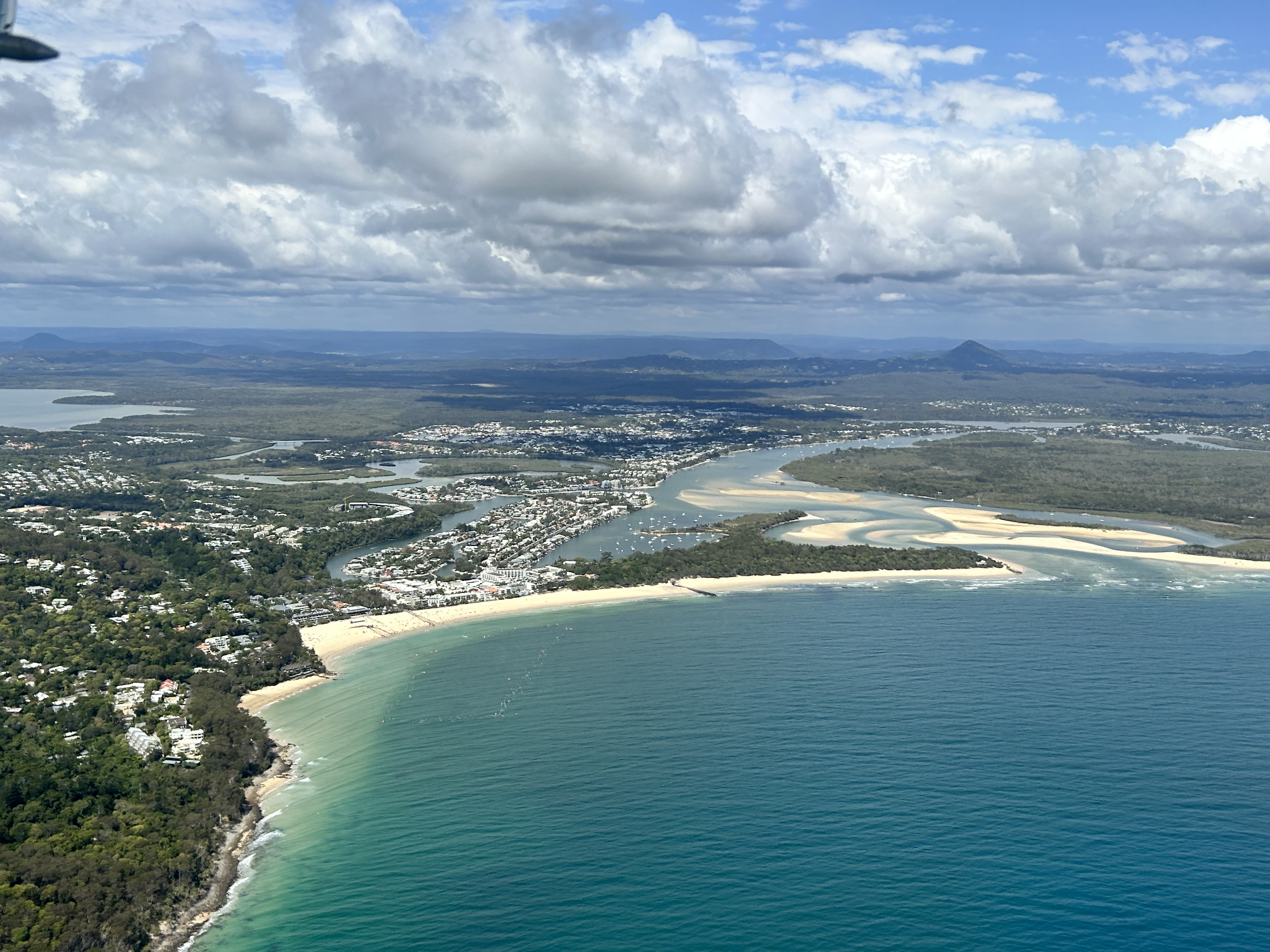
Rounding the corner over Noosa National Park we headed for the river mouth and Noosa’s main beach.
Rounding the Heads
The triathlon swimmers were gallantly plying their way around the 1.5km rectangular course.
The air was crystal clear after recent rains.
From there we tracked to Boreen Point on Lake Cootharaba.
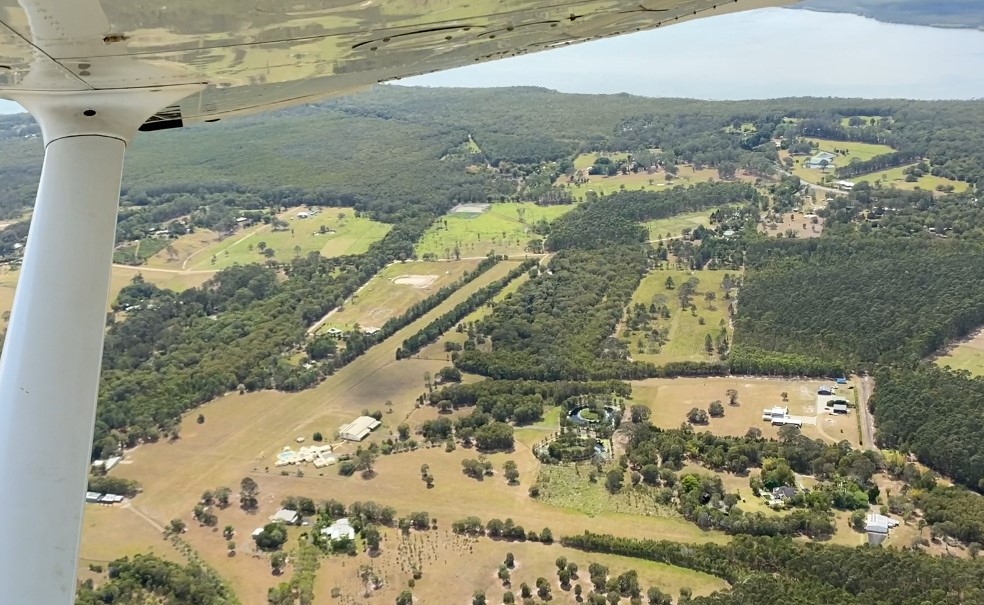
I’d recently noticed there’s a private airstrip just near Boreen Point and the owner welcomes guests so I thought we should take a look at it from the air. I did an orbit over the top while Gary took a video.
It looks like a very well maintained 800 metre long airstrip. Well worth a visit sometime.
From there we headed for Cooroy and then down the VFR route on the western side of the Bruce Highway via Nambour and back to Redcliffe where the touchdown was silky smooth.
IVW had checked out and I was happy with it. We were ready for our flight to Palmers Island near Yamba the following weekend as part of the aero club flyaway.
In the aftermath of MSF’s crash I realised I’d need to hire a Cirrus from someone else as, at least for the forseeable future, Mike wouldn’t have a plane. MSF had been a “Generation 1” SR22 with fairly basic avionics so to build up my confidence in flying again while acquainting myself with the more sophisticated avionics in the more recent model SR22s that are available for hire, I decided to do some “refresher” training with Adam Starr out of Archerfield. By 30th October 2023 I hadn’t flown with him for over a year so it was high time to do an IFR refresher anyway with the aim of it making me feeling comfortable with private hiring one of the SR22s that he has access to or one from Team Aviation next door.
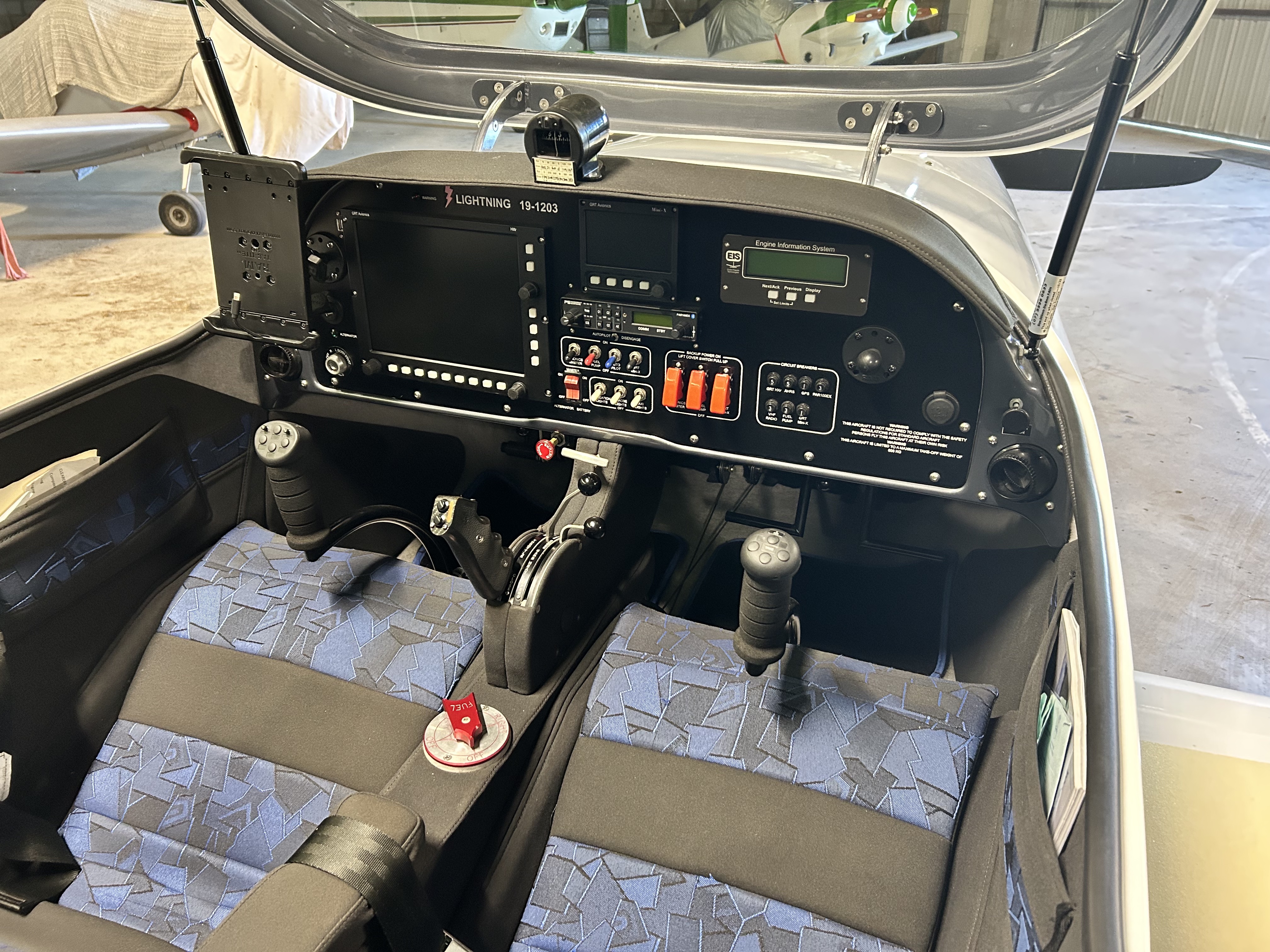
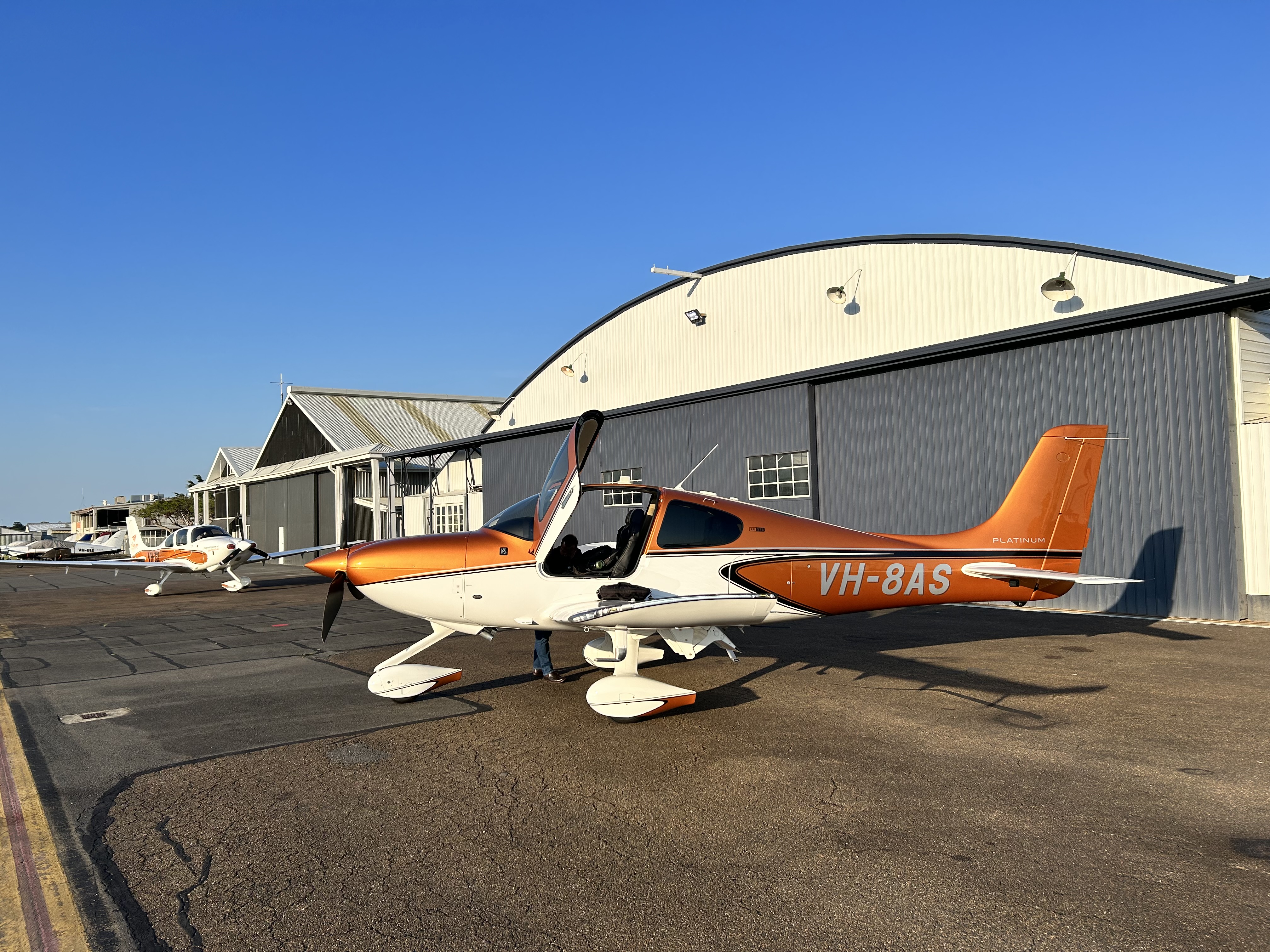
Adam had recently taken delivery of a new Generation 6 SR22 that belongs to a guy he’s known for many years. This was VH8AS, with only 20 hours on the tacho. It was still being run in and hadn’t had its first oil change yet. It didn’t have deicing equipment or oxygen but it had the whizz bang Garmin Perspective Plus avionics which is a bit more highly featured than the system in MSF was.
After a bit of a chat about my recent flying experiences and how I prepare for a flight each time, we headed out to the apron and I preflighted 8AS. The wing was noticeably higher than MSF, giving it a bit more clearance for the prop. It also featured remote locking/unlocking and door handles that were easy to use. All in all, a very nice plane and one that would be good to hire in the future if it’s available.
I’d planned a flight to Warwick to do a couple of instrument approaches and to practice some night landings. As a result, we departed YBAF around 5:30 so we’d arrive at Warwick just before last light. Adam suggested I change my planned route to fly via waypoint Huugo to make sure I avoided Amberley airspace on the way out.
It was good VMC weather so we did a VFR departure with the switch to IFR once we were airborne. We’d stay low as we headed away from the circuit, staying well below the jets coming into Brisbane from the south west. That’d meant we wouldn’t have to hold and wait for a gap in the jet traffic. The Archer tower had closed at 5pm so it was pretty much like departing Redcliffe on a CTAF and then being identified by Brisbane Centre once we were at circuit level.
Departing YBAF was straight forward, turning onto a heading of 135M at 1000ft until we reached an industrial estate just south of the Logan Motorway. We were switched from Brisbane Centre to Brisbane Approach who gave us a clearance to Huugo with a climb to 7000ft. Although we could have flown at 6000ft and 7000 wasn’t the standard altitude for a westerly flight Adam said it was smarter to fly higher. I’d just told him that I didn’t like to fly higher than 7000ft without oxygen so that’s why we hadn’t chosen 8000ft. We climbed using the FLC (flight level control) mode of the autopilot, something that MSF didn’t have either. It’s a safer way to climb on autopilot, where you set an airspeed rather than a rate of climb, avoiding the potential of airspeed reducing to unacceptably low levels as you climb.
On the way out to Huugo Adam handed me the “hood” and as we turned towards Warwick he told me to disengage the autopilot and fly by hand. He also turned off the main AHRS (attitude and heading and reference system) so I’d have to refer to the secondary instruments for hand flying. This increased my workload considerably, especially as I was still becoming familiar with the different layout of the Perspective Plus system. As a result, my approach into Warwick was less than average and Adam took over about 3 miles out as I was too low on the glide path. I continued with a missed approach and then climbed back out to the initial approach point to carry out a hold. I flew that on autopilot so it went ok and then it was time to head back to Amberley with full instruments.
It was dark by this time so we flew direct, being handed over to Amberley approach as we went. They cleared us to the initial waypoint for the RNP approach into YBAF. This started ok but I forgot the 10 mile call and didn’t descend as quickly as I should have and as a result, when I somewhat belatedly turned on the runway lights with the PAL system, I saw that I was way too high to land. The ATIS had indicated a 25 knot north wind that was basically all cross wind on RWY10L so it was a pretty easy decision to go around – the 25 knot crosswind wouldn’t make the landing particularly easy. After a fairly standard circuit I was on final for RWY10L with a rather stiff crosswind. I was tired and it would not have been smart to fly further night circuits in those conditions so I aborted the plan of further night circuits and did a full stop landing. The touchdown was not ideal. I didn’t kick it around to have the nose lined up with the runway exactly and there were some sideway forces on touchdown. Not pretty. However Adam did explain that a couple of hangars on the northern side of the runway that we’d passed just before touchdown result in wind shear in those conditions and he would usually land a bit further down the runway so he’d stay above the hangars and avoid the wind shear effect. So I hadn’t coped too badly.
As we taxied back to the hangar we agreed that another lesson was required before I’d hire the plane. Next time it’ll be to Kingaroy to give me a bit more time to plan the approaches.
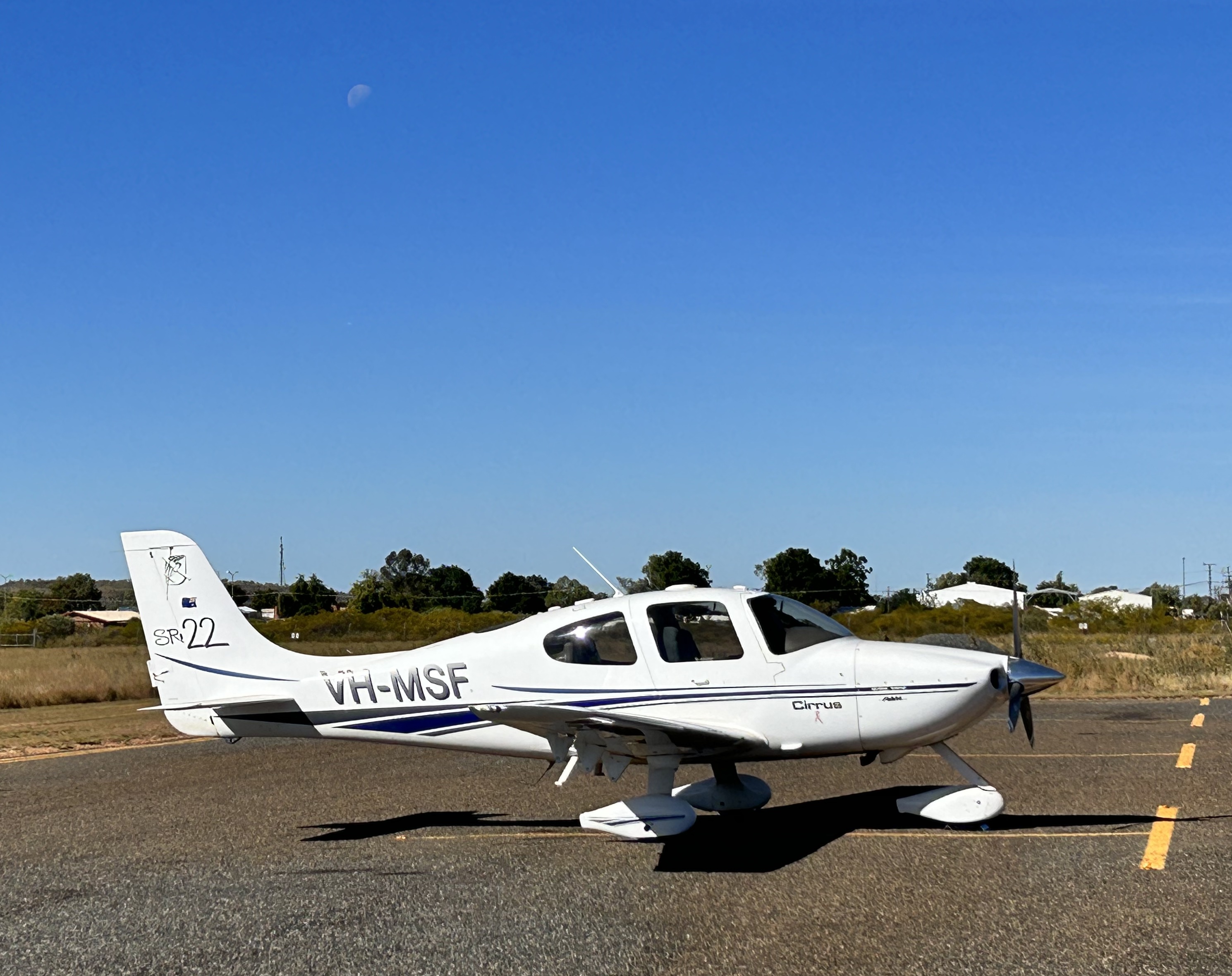
On Thursday 14th September 2023 I flew up to Caloundra in MSF so that AMS could fit a new starter motor. We’d been having difficulty starting the engine on our trip to the Kimberley and it had been getting worse so after it totally refused to start after doing a few circuits one day Mike decided to have it checked out. AMS determined that the battery was fine but the starter motor was on the way out so ordered a replacement. Not only was it new but it was also bigger than the original. Mike was unable to fly up to Caloundra in the week leading up to our flyaway to Mudgee so I agreed to take the plane up there for him. AMS said it’d only take two hours to swap over the starter motors so I decided I could spend a couple of hours at the beach while it was done.
As it happened, my old work mate Paul Rayner was visiting from Hobart so it was an opportunity to take him for a flight while helping Mike out. We took off from Redcliffe on a perfect day and in no time were descending into the circuit at Caloundra. As is often the case at Caloundra, there was what appeared to be a trainee pilot who joined downwind in front of us. He was flying a strange circuit so I asked him his intentions over the radio but he must have been too preoccupied to respond as he flew a very tight base and final for a touch and go. We managed to stay well clear and gave him room to maneuver and watched as he touched down. We then turned final and landed has he climbed out again.
We taxied to the AMS hangar and left the plane there. The Redcliffe Aero Club Vulcanair twin VH-VMV was in the hangar having a major overhaul including replacement of its two engines at $80,000 each so we had a close look at it.
Glen from AMS kindly lent us his ute so we could drive into Moffat Beach for morning tea and a walk.
Returning to the airfield two hours later we dropped into the Queensland Aviation Museum, a couple of hundred metres down the road, to view its collection and have some lunch.
Eventually it was time to head for home. Back at AMS we climbed aboard MSF and lo and behold the engine started first go! It was so easy! A world of difference! It had never started as easily before. If only we’d had a new starter motor years ago it would have saved a lot of anguish.
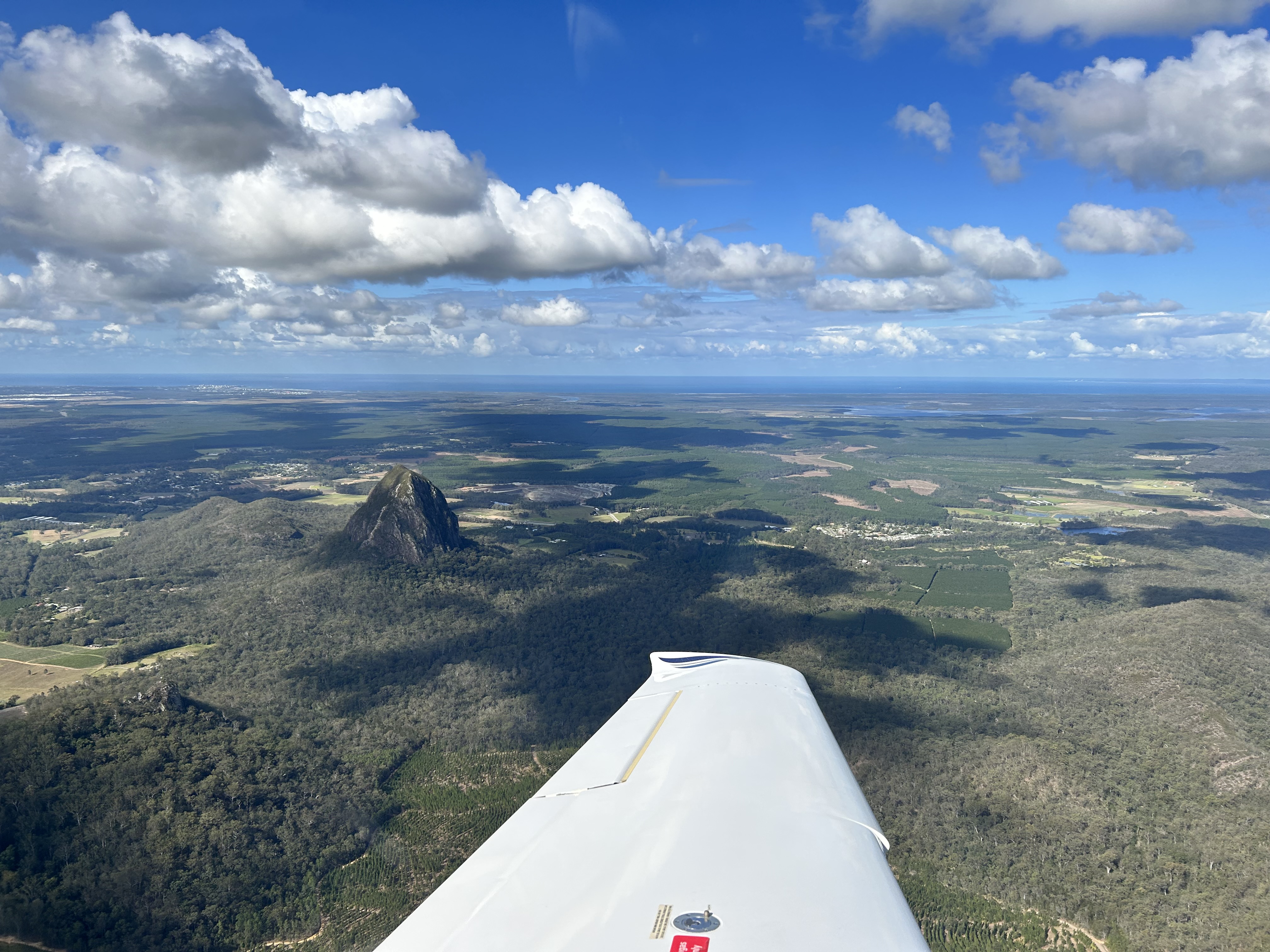
We took off and headed west to give Paul a few of the Glasshouse Mountains before tracking overhead Caboolture for Redcliffe.
Another smooth touchdown and we were home. Mission accomplished and all ready for our flyaway to Mudgee the following morning.
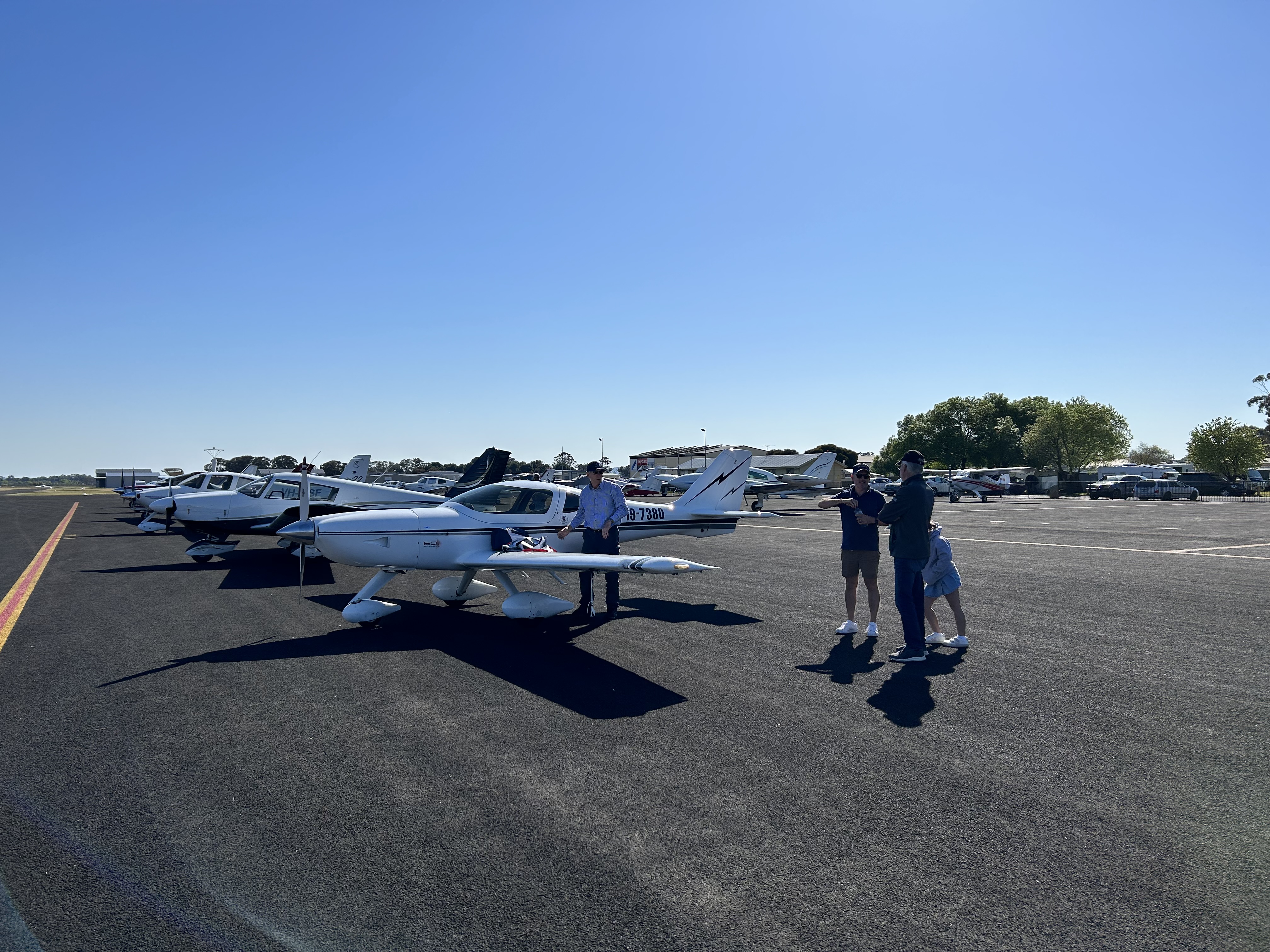
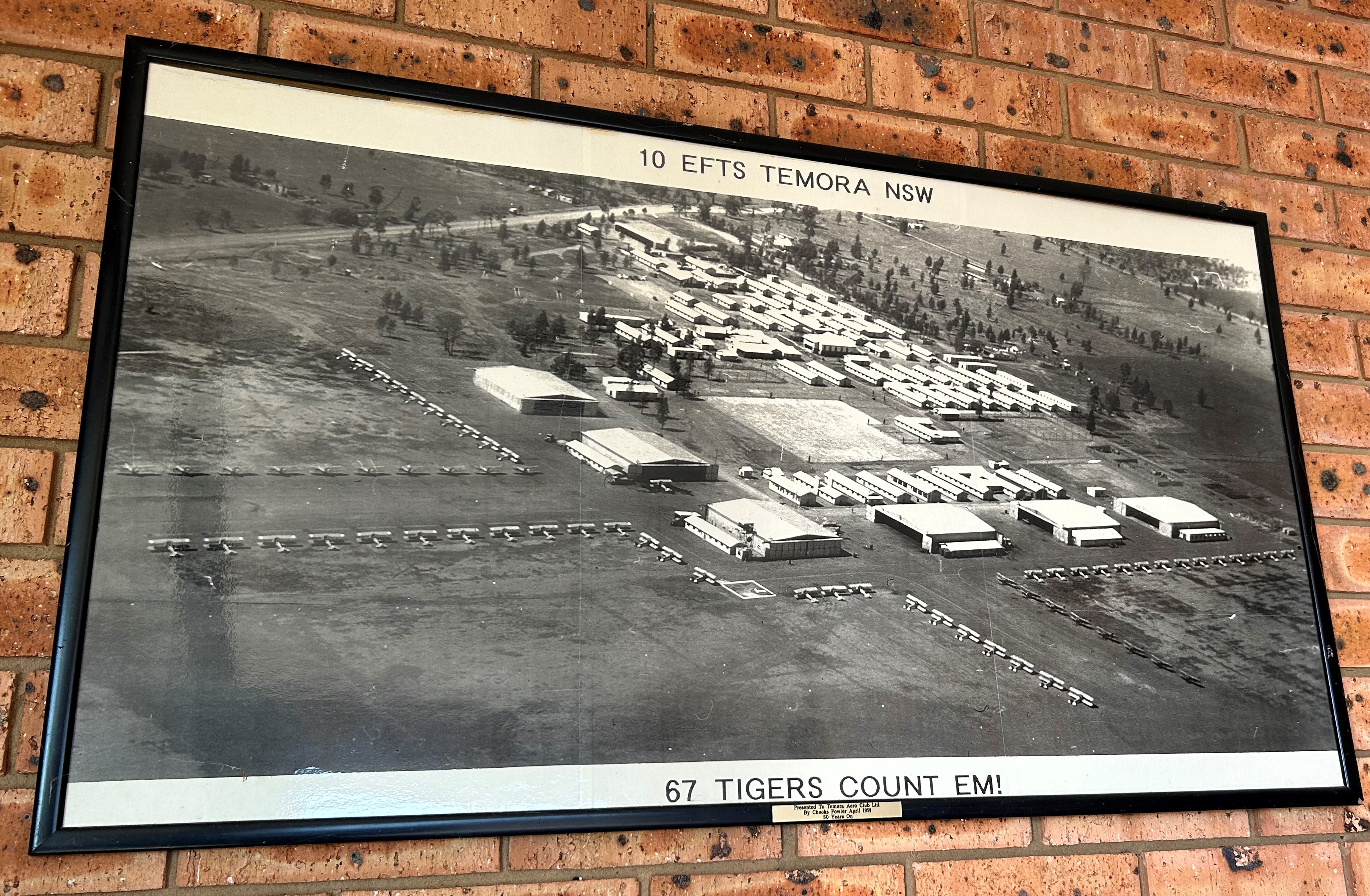
The Temora Aviation Museum hosts monthly air shows and it was decided to organise an aero club flyaway to attend their September 2023 airshow while basing ourselves at Mudgee for the weekend. Six aircraft took part with Mike Cahill, Brett Silvester and me in MSF, Bryan Galvin, Mike Gardiner and Gary Ayre in Cherokee BHN, Sam Keenan, his wife Jac, and daughters Ava and Georgie in C310 JTV, Neil Jensen in 19-7360, Paul Smeath, son Ben and grandson Josh in C182 ROC and Peter Nally with three friends in Cirrus YVR.
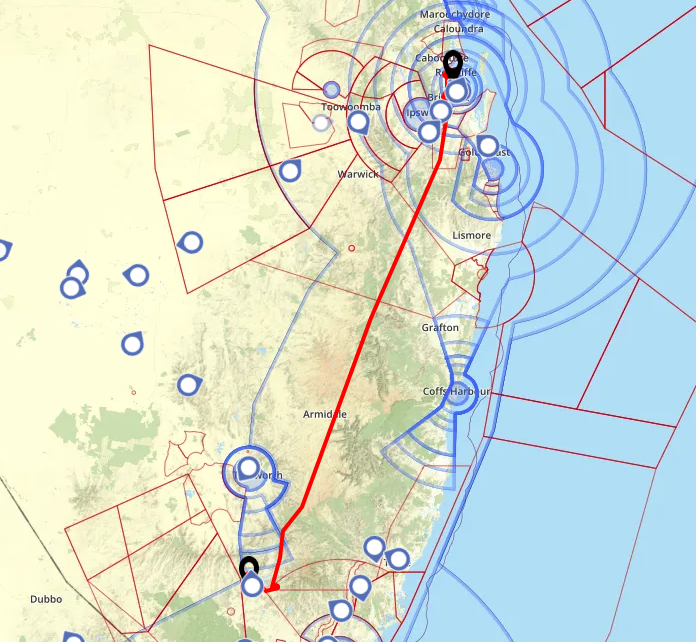
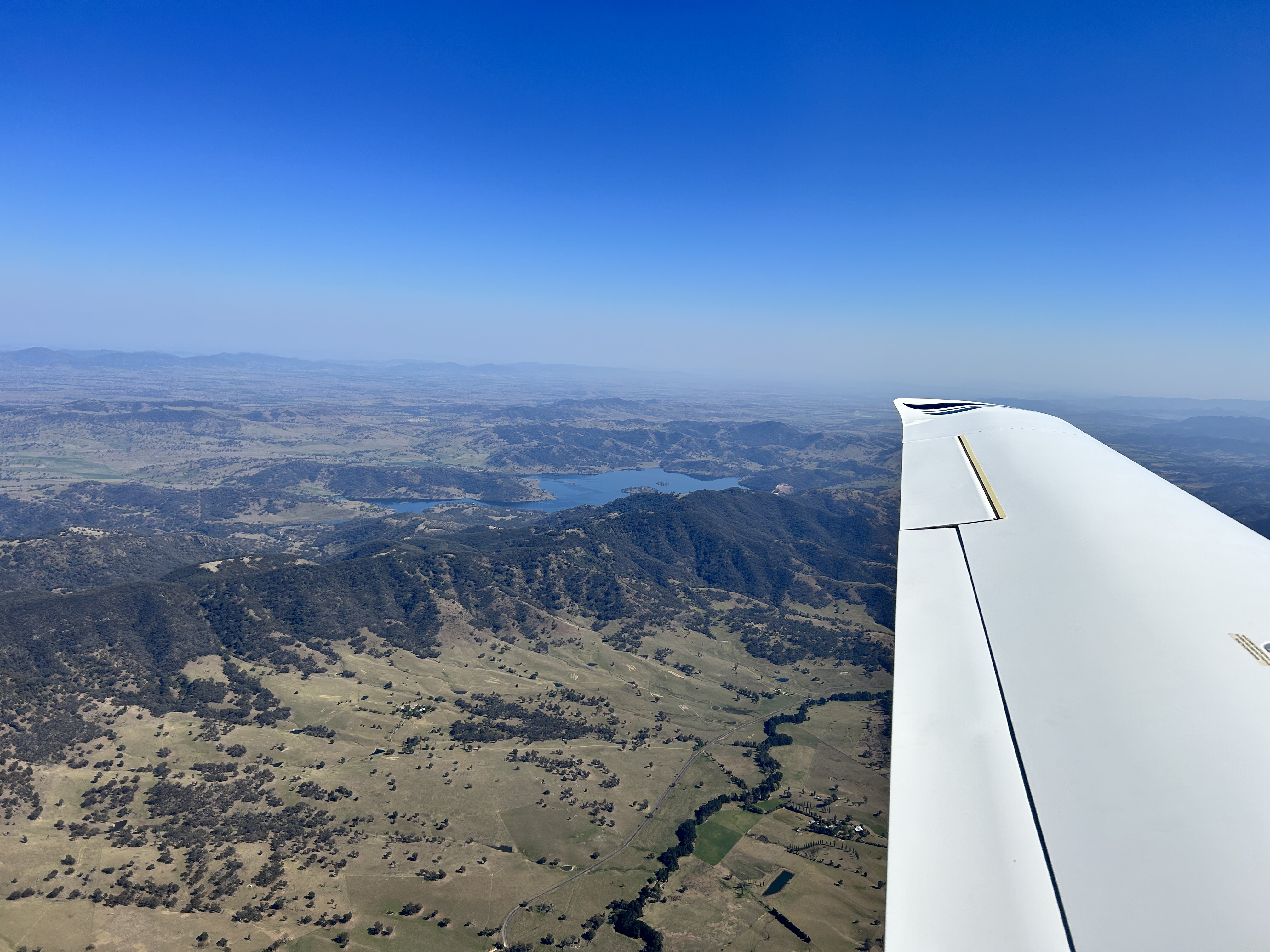
The first leg on Friday 15th dawned fine with beautiful flying conditions, and MSF departed Redcliffe just after 8am with me flying as PIC and Brett as copilot. We obtained a clearance to climb to 6000 ft and tracked direct for overhead Archerfield, then to the southwest over the Scenic Rim. We flew over some interesting terrain as we flew the dividing range to the east of Armidale.
The plateau stretched out to the west of us while deep gorges separated us from the coastal plains to the east. In just over 2 hours we were descending into Scone.
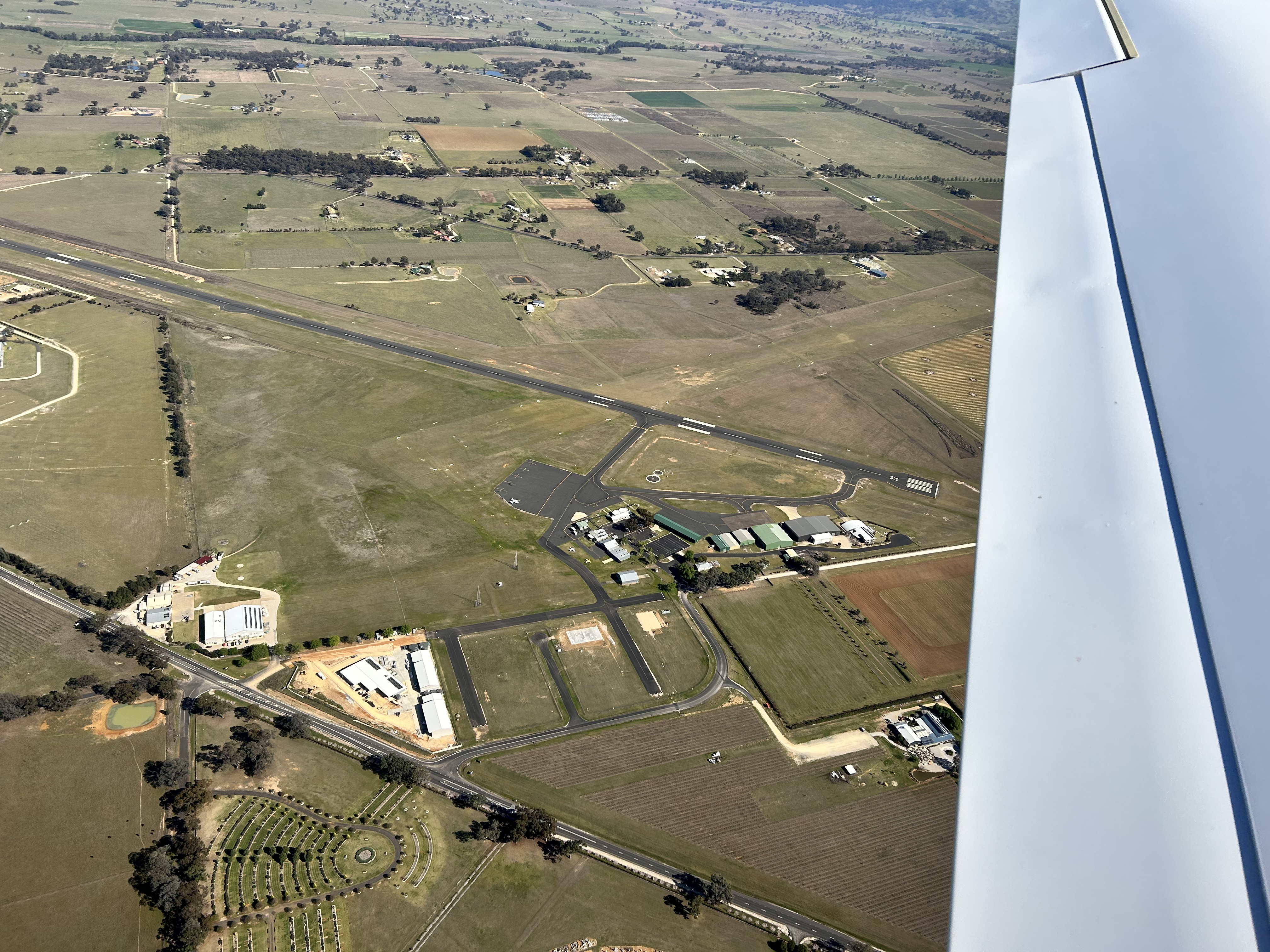
I practised an RNP instrument approach into Scone with one holding pattern before starting the descent. It was clear skies but I focussed on the instruments while Brett kept a lookout. About 5 miles out I broke off from the instrument approach and joined left downwind for RWY11. A smooth touchdown and we rolled into the grassed parking area opposite the aero club bulding.
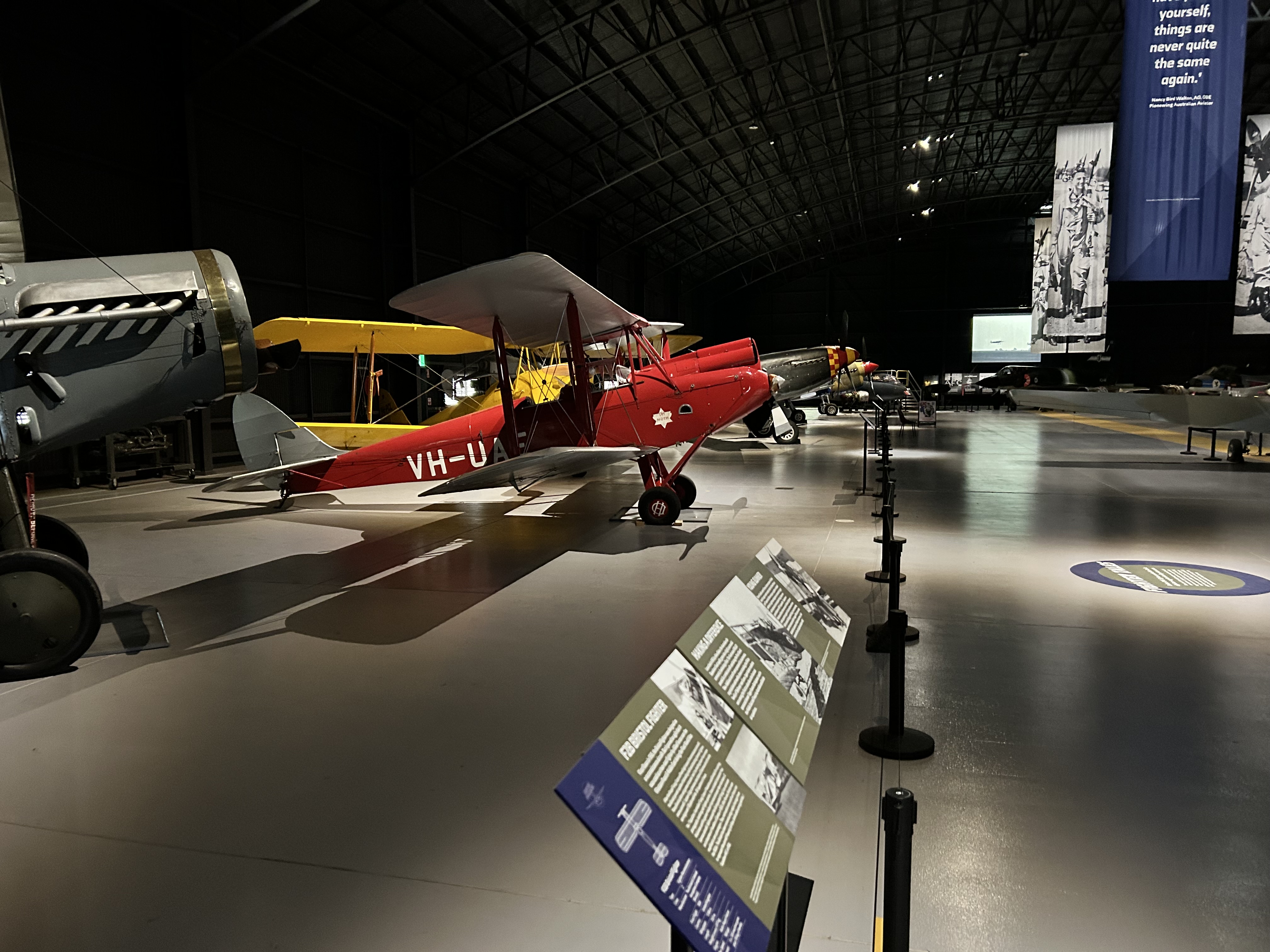
We’d arranged a tour of the Hunter Warbirds Museum at 11am and arrived early enough to enjoy a cup of coffee beforehand. The museum opened 18 months ago and has an impressive collection of aircraft. An enthusiastic ex-RAAF guide gave a detailed history of virtually every aircraft, some of which are privately owned and stored at the museum for display purposes. Many are in flying condition and therefore absent from time to time visiting various airshows or just being flown by their owners.
They also have a Spitfire simulator and a 737 simulator that visitors can learn to fly.
After a quick lunch at the cafe it was a 30 minute leg from Scone to Mudgee with Mike as PIC and Brett as copilot again. Both Scone and Mudgee have significant high ground in close proximity to the circuit area and Mudgee requires right circuits on Runway 22, which happened to be our arrival runway.
The Mudgee Aero Club hospitality was on display, the Club President Gary Chapman and his wife Denise plus various members meeting us on arrival and treating us to afternoon tea. They also provided us with the Club loan car for the weekend and a lift to town for those who couldn’t fit.
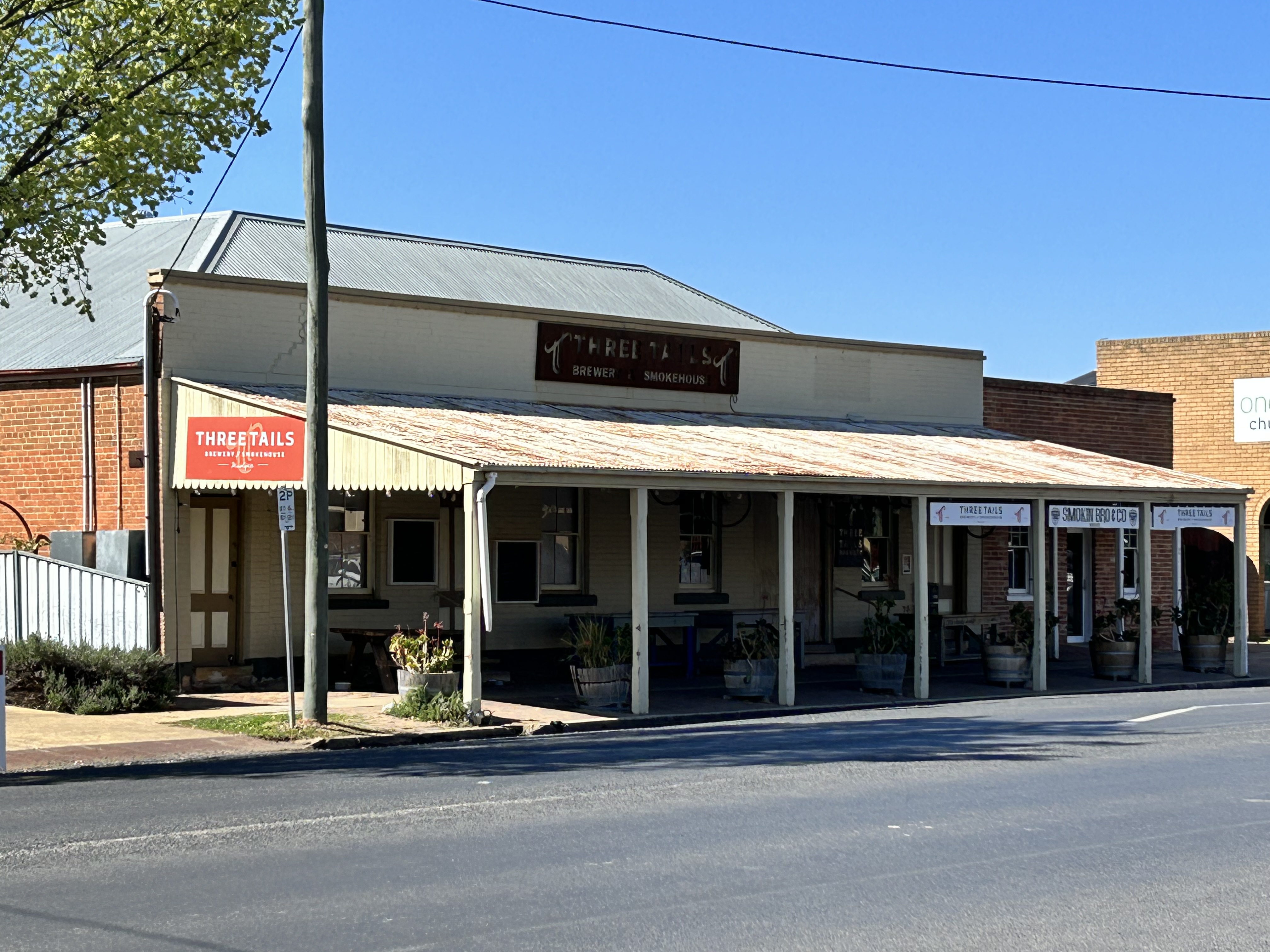
The evening was spent at the Three Tails microbrewery and smoke house trying some of their alcoholic and non-alcoholic beers.
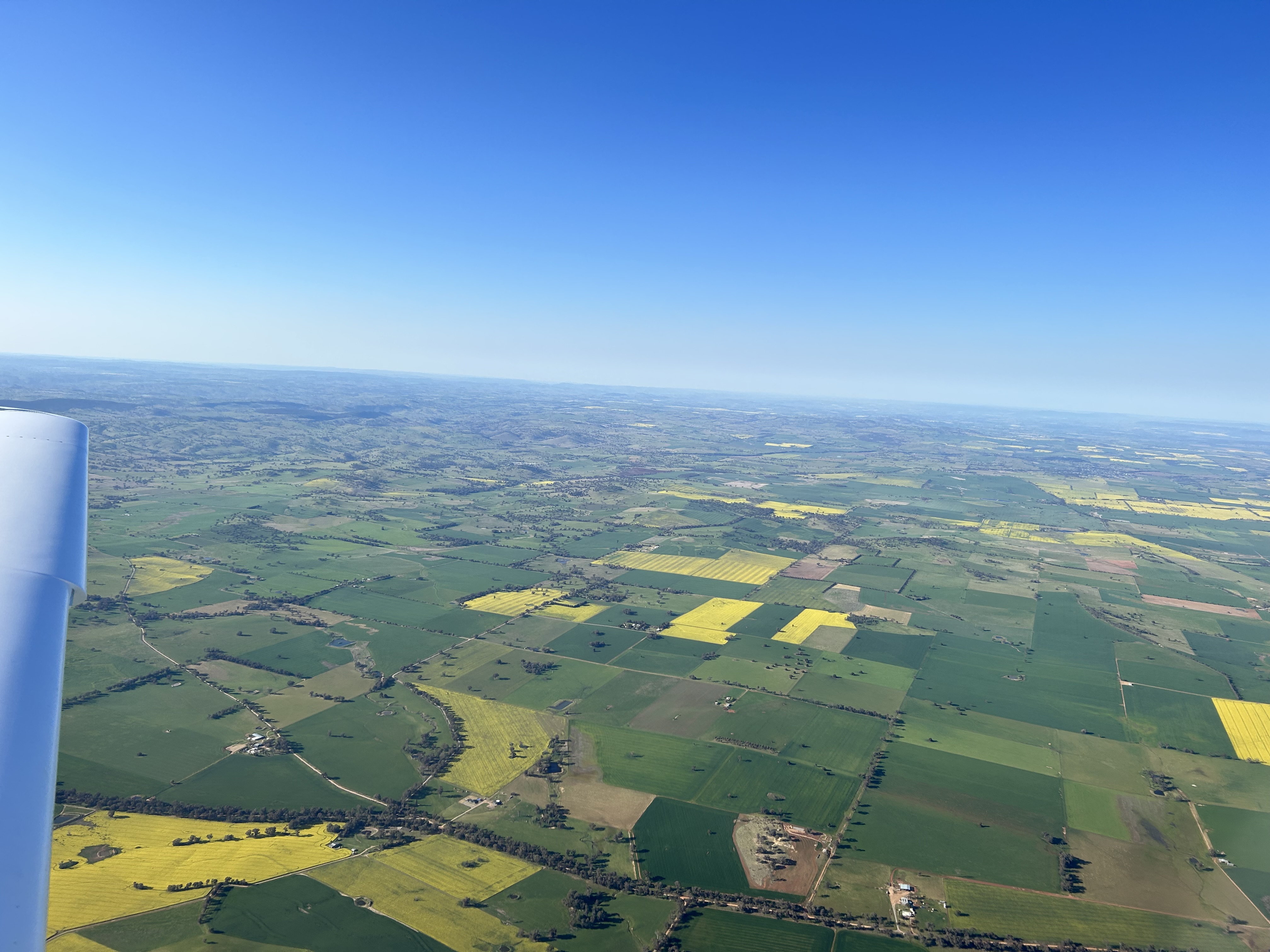
We rose early on Saturday 16th (Brett said too early) to beat the expected rush at Temora approximately 150 miles to the south-west. The Mudgee locals had warned us about high traffic density and the presence of pilots who may not be so diligent with their radio calls so we wanted to avoid any close calls and thought it prudent to arrive before opening time. Departing Mudgee at 7:30 I was PIC again as Brett wanted to practise an instrument approach on the way back in the afternoon. We flew under clear blue skies once again and over a green carpet scattered with yellow patches of canola.
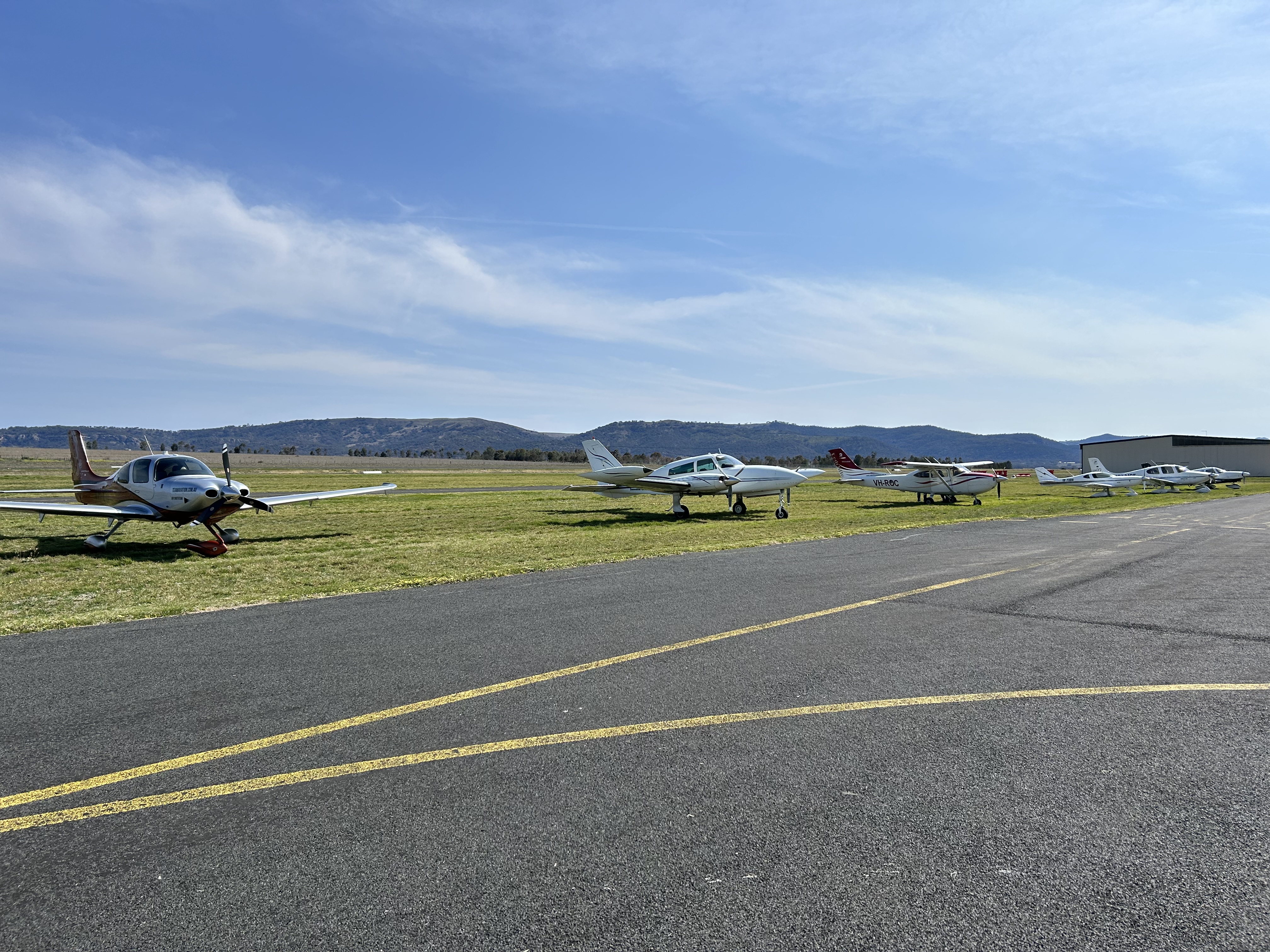
There was no other traffic ahead of us as we descended into Temora and no sound of a Unicom officer as had been mentioned in the fly in notes. Obviously we were too early for anyone to be around. I decided to join downwind for RWY 36 as that would give us the shortest taxi to the apron even though there’d be a slight right crosswind so I stated my intention when we were 5 miles out. As happens one plane had to barge in at the last moment and it was Sam who was flying the 310 and just couldn’t help but overtake us on the descent and join downwind for RWY 05. He obviously wanted the longest runway. So I changed my call and followed him as he made a long downwind, turned base and then final. I extended my downwind even longer to give him time to exit the runway and then also turned base and final. Slowing to 80 knots I watched as he landed ahead of me and taxied to the far end of the runway and taxiway. I held off as long as possible and touched down just as the stall warning went off and Sam gave his vacating call.
The other aircraft followed us in and we gathered to walk over to the museum, where a line of visitors was already forming. It was 9:15 and it didn’t open until 10am.
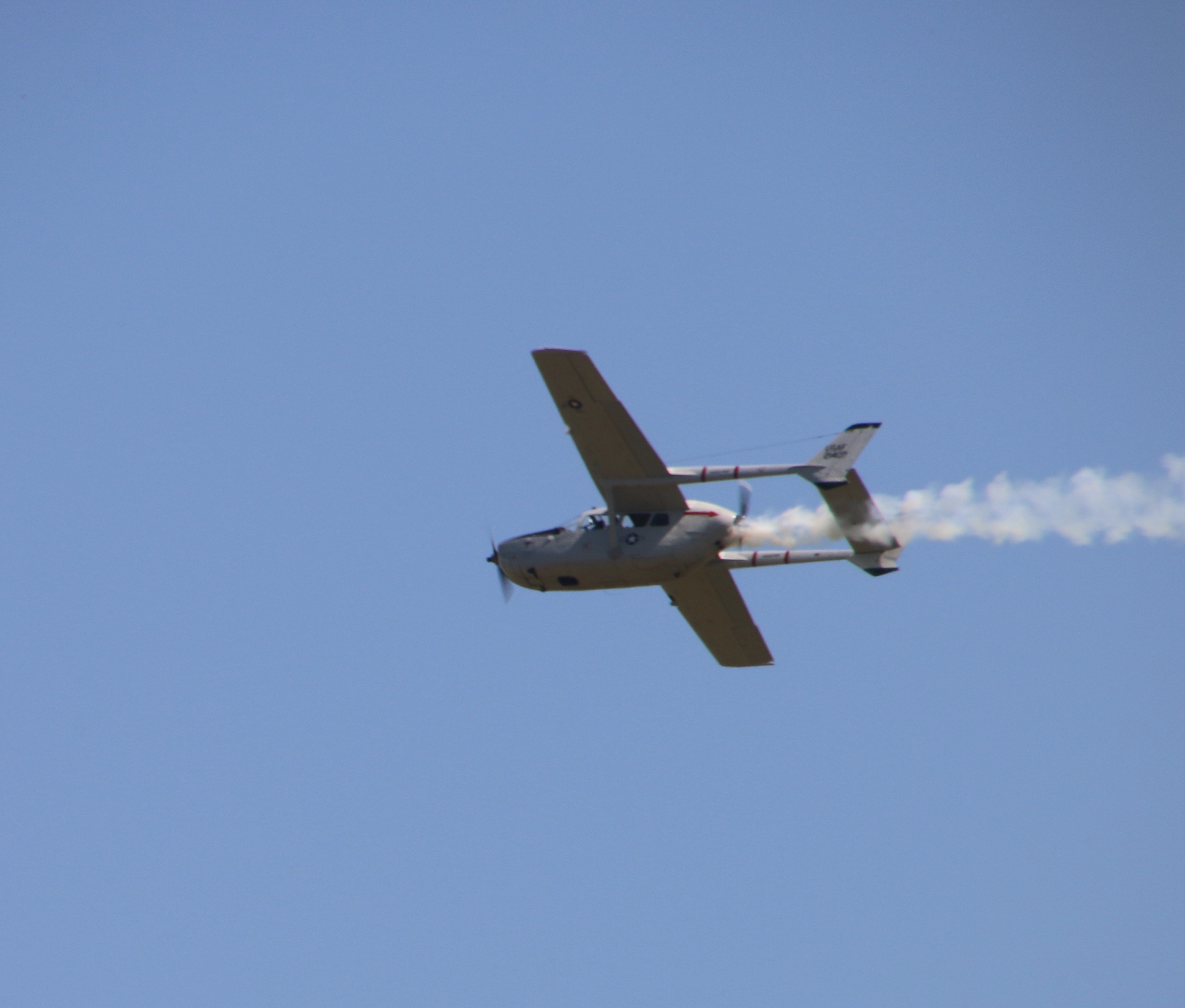
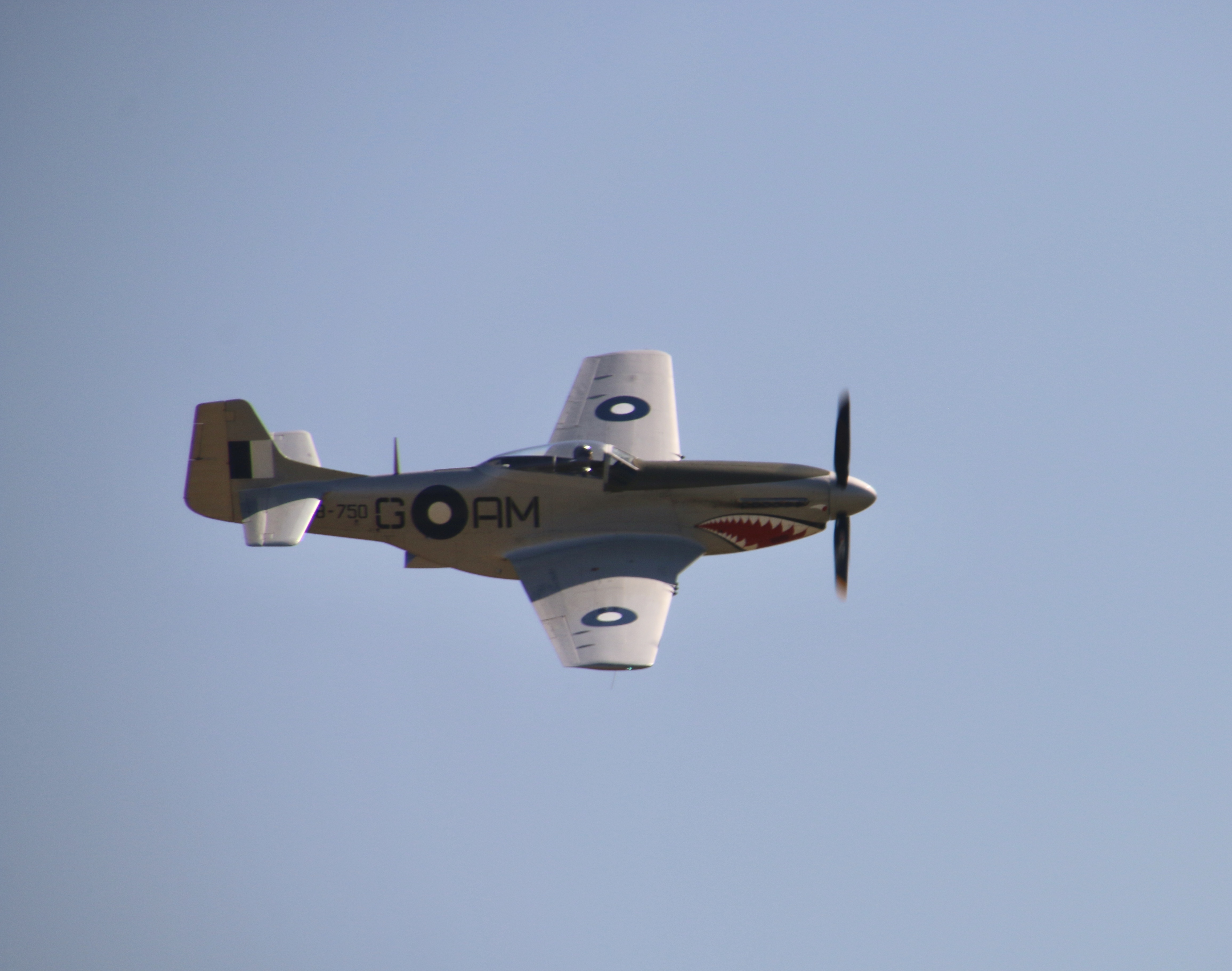
The airshow was well attended, hosting thousands of visitors on the day. Flying displays by the Spitfire, Kittyhawk and Mustang were most impressive as were the Cessna Birddog, Cessna O-2A, Wirraway, Winjeel, Harvard, Tiger Moth, Ryan monoplane, CT4 as well as a PC21, the RAAF’s current ab initio trainer. A flying-condition Hudson bomber was on static display while a flying-condition Canberra bomber undergoing detailed maintenance could be viewed in an adjacent hangar.
Local weather was picture perfect for the airshow.
We had some great tailwinds for the return flight to Mudgee in the afternoon and Brett carried out an instrument approach into RWY22.
That night we had predinner drinks and dinner at Kelly’s Irish Pub.
Sunday was a restful day where we dropped out to Lowe Family Winery to buy a bottle of Jodie then headed to Burnbrae Winery on the road to Hill End for an afternoon of wine tasting and live music from a girl with a guitar. Some of us drank a bit too much wine and decided to stay in for the evening while the rest of us had dinner at the Oriental Hotel.
Brett was PIC again with Mike as copilot and he’d initially planned via Port Macquarie and Coffs but ATC cleared us direct shortly after takeoff so we went that way.
Once again it was clear blue sky with no clouds.
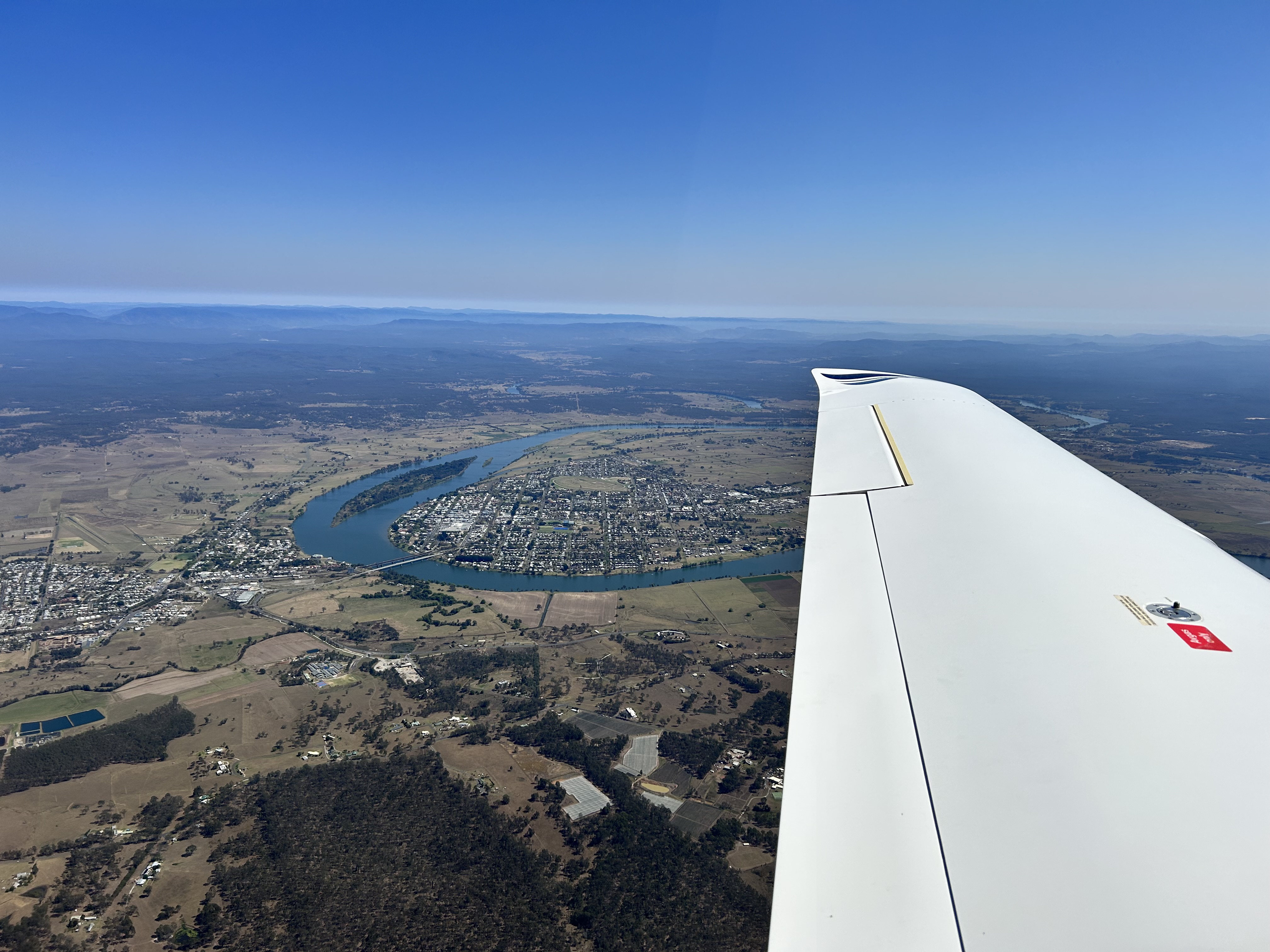
On the way we passed over Grafton straddling the Clarence River.
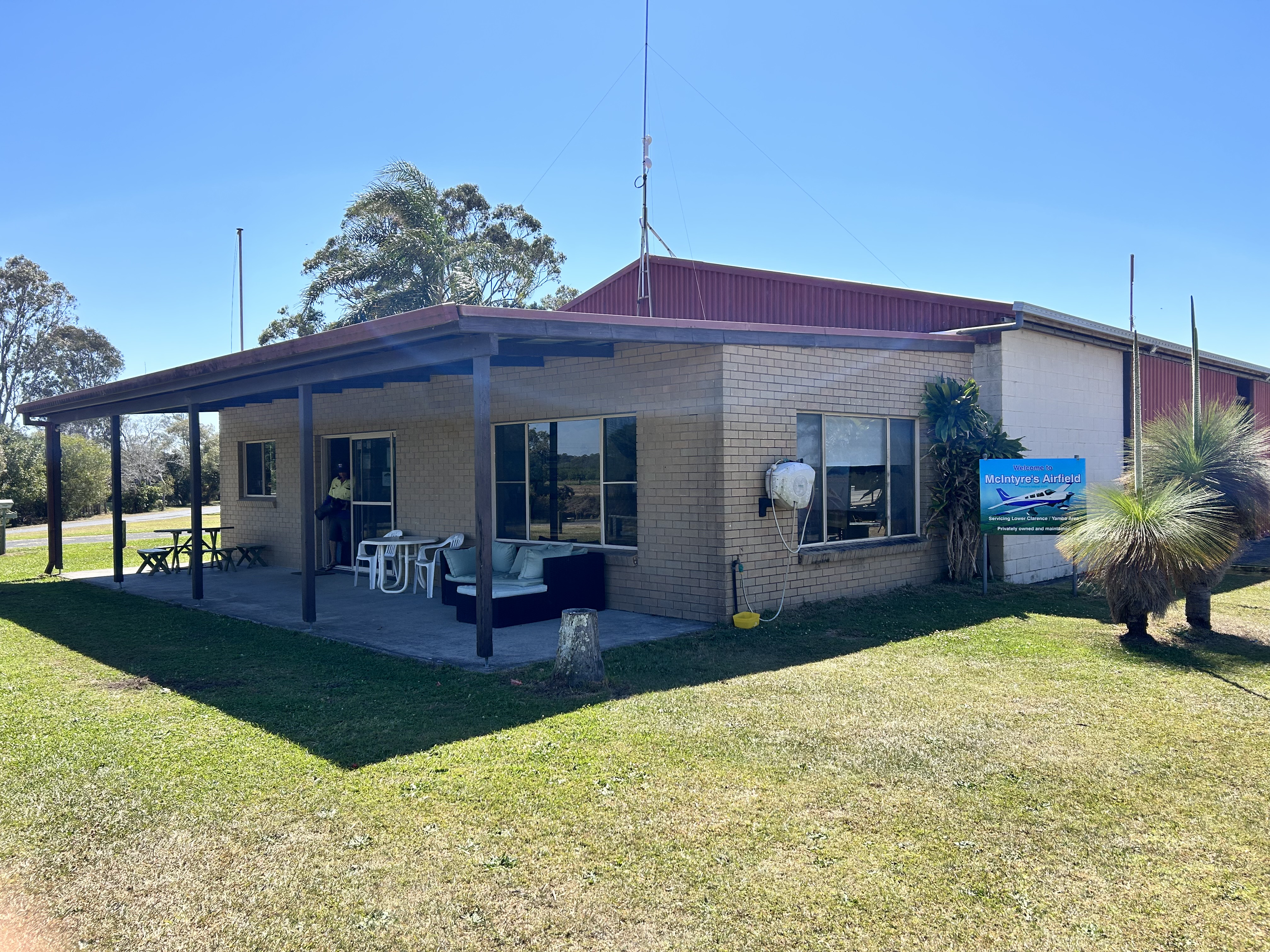
McIntyre’s Airfield is a privately owned and maintained ALA situated 4nm from Yamba. It is kept in immaculate condition but can be a bit hard to spot from the air. We’d actually flown right over the top of it before we identified it. Brett was a bit fast on his first approach so did a go around and landed smoothly on his second attempt.
The patriarch Bob McIntyre had died only a week before at age 83 so the family were still coming to grips with his death. As his son Murray told us, Bob was out on his mower the day before looking as fit as ever and just died overnight. It was a shock to everyone. Bob’s wife met us on arrival and made us all a cup of tea and offered some biscuits while Murray got the loan car out of the garage. They’d had a memorial service for Bob the day before so they were still cleaning up but were very hospitable.
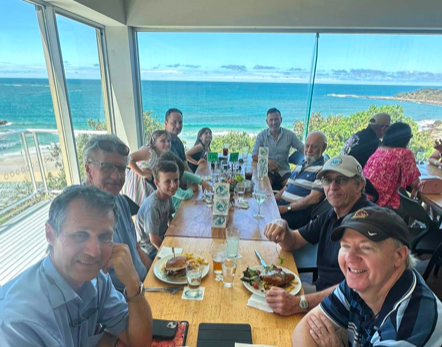
We drove the loan car 10 minutes into Yamba and stopped at the Pacific Hotel where we could take in views of the beach from the dining room.
After we eventually dragged ourselves away from the food and views at the hotel, we drove back to Palmers Island and boarded MSF for the trip to Redcliffe.
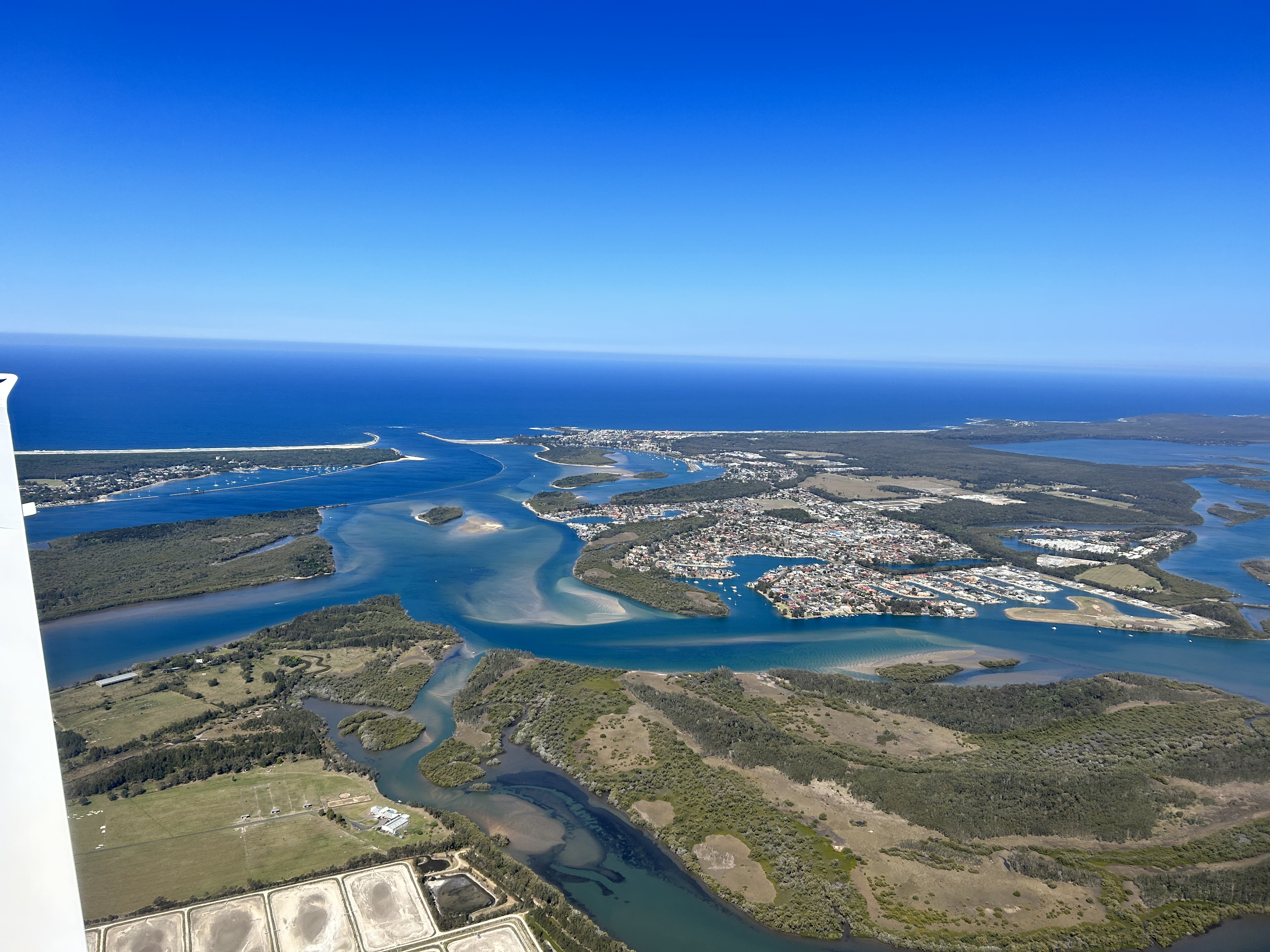
This time Mike was PIC with Brett on the radios. Climbing out we had a great view of Yamba and the mouth of the Clarence River.
On our way to 8000 ft we passed through the Evans Head restricted airspace that had become inactive 30 minutes before.
Further north we had great views of Brunswick Heads and Cape Byron.
Then Pottsville
And Fingal
And over to the Scenic Rim.
As Brisbane approach stepped us down we passed South Stradbroke Island
and the mouth of the Logan River.
and Brisbane International Airport
and the CBD.
Finally we descended into Redcliffe for another smooth landing.
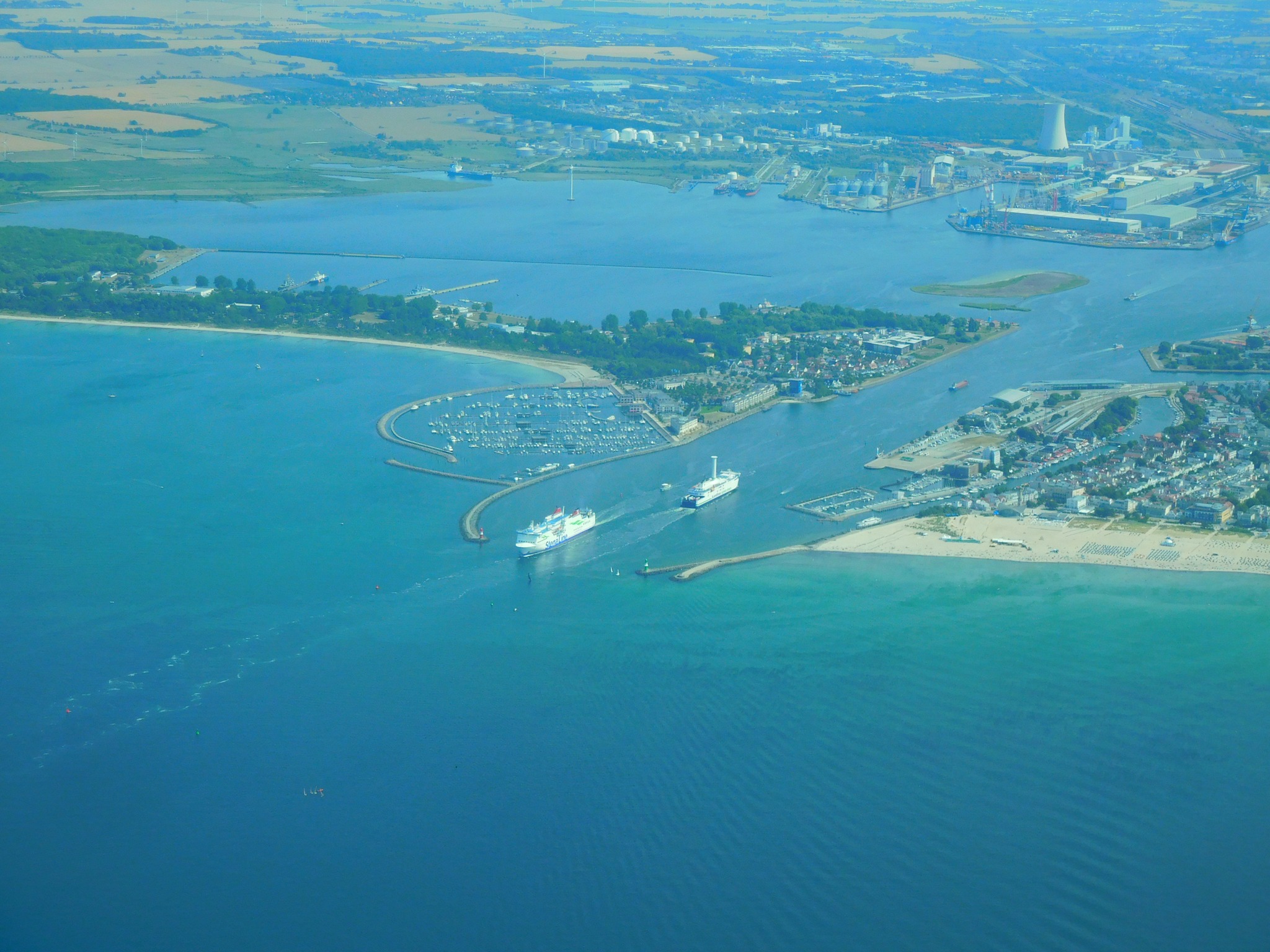
In July 2023, during a visit to Germany, Sigi and I visited the Baltic coast with our friends Hans and Johanna and their daughter Carolin. We stayed for a few days near Barth, a small town on the German Baltic Sea coast just west of the island of Ruegen. There are lots of waterways and islands and a general aviation (GA) airport. The OstSee flying school is based there and were happy to take me on a couple of instructional scenic flights ie me in the left seat and Mike the owner in the right seat as flight instructor.
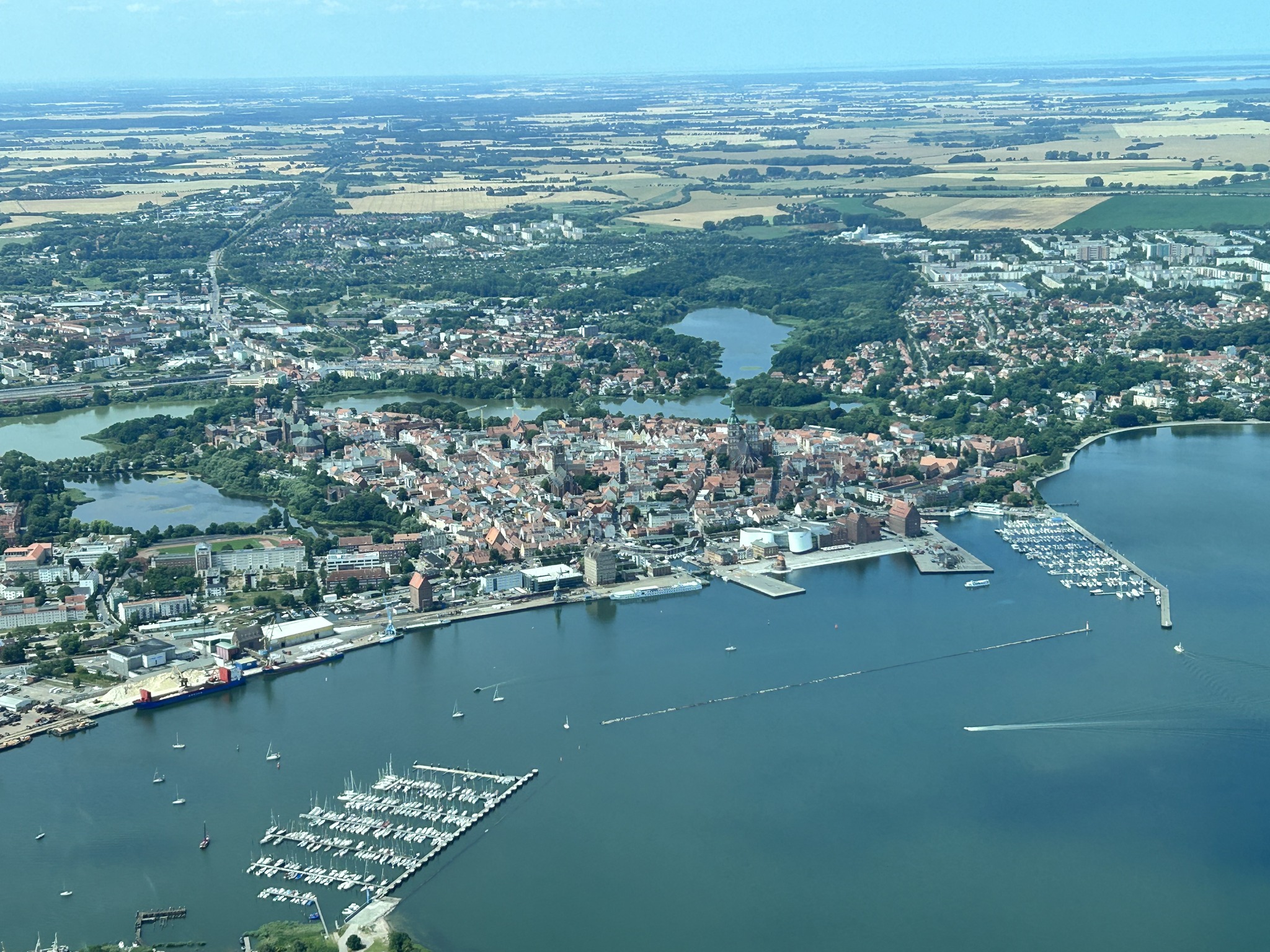
D-EJTC is a 1975 C182 with high grade avionics and an engine that burns Mogas. For the first flight it was just Mike and me so I could get to know him and vice versa. We flew to the coast to the northwest and followed it past Prerow and Zingst and on around the coast of the island of Ruegen and then on to the Polish border, passing over Peenemuende where the V1 and V2 rockets were built towards the end of WW2. We also passed over a 4km long beach resort comprising the world’s longest building. Prora, built on the command of Adolf Hitler between 1936 and 1939, consists of several identical connected six-storey buildings. Added up, they measure 4500 metres in length. On the return journey we flew past Stralsund, the mainland gateway to Ruegen.
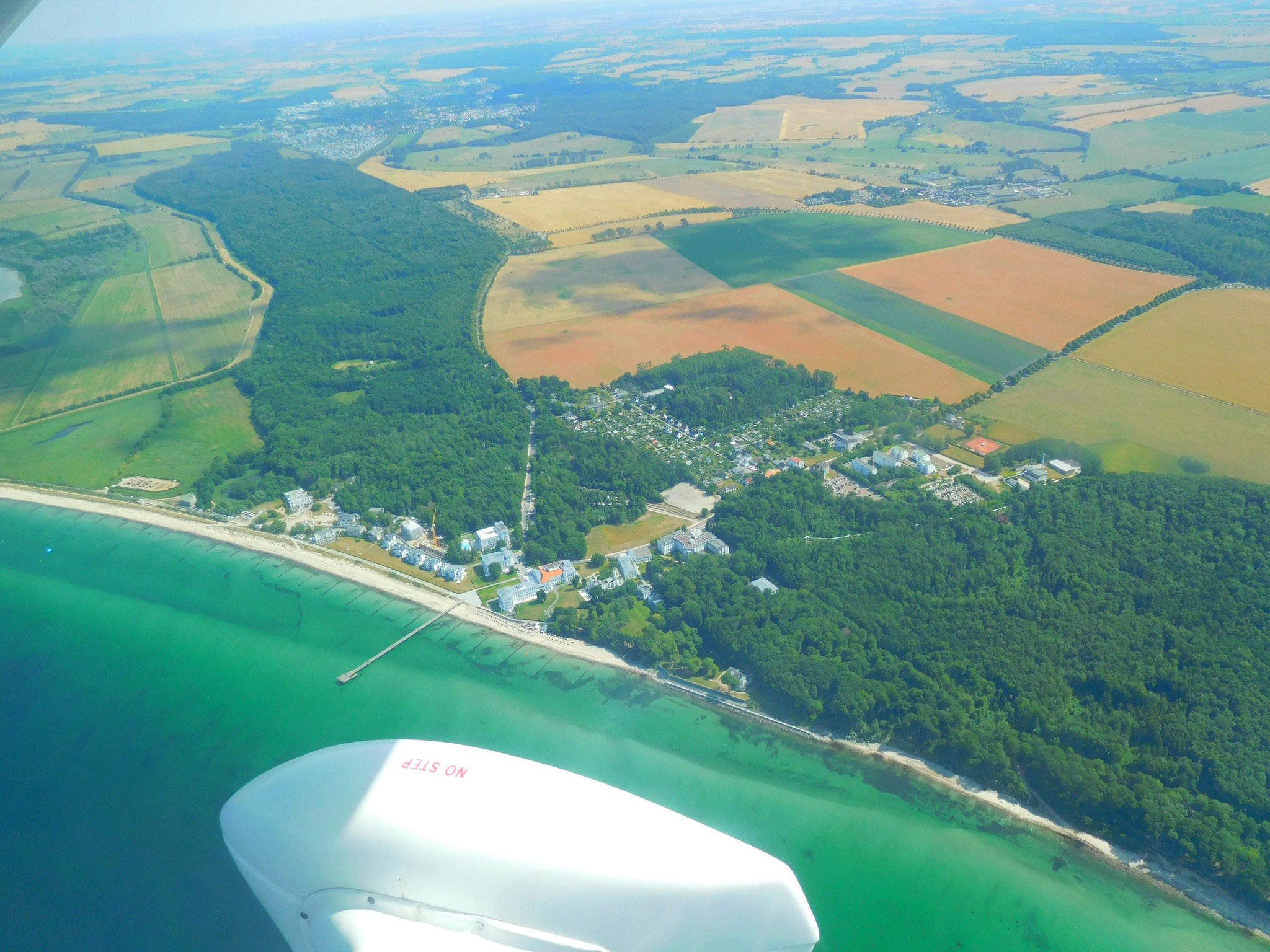
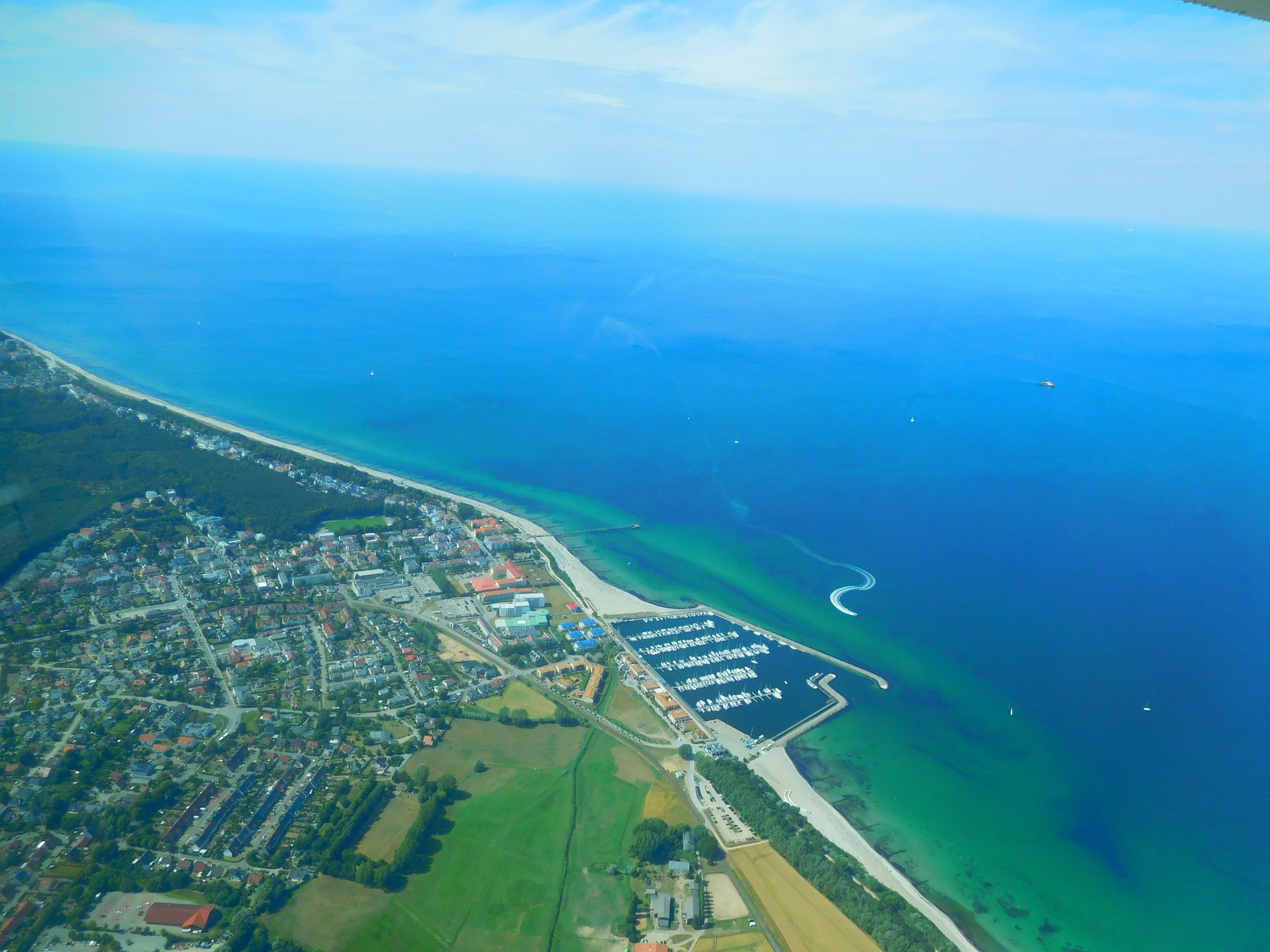
We returned to Baarth for lunch and to pick up Hans and Carolin, who flew with us on the afternoon flight, this time to the west, past Rostock and Warnemunde then Heiligendamm, where a G8 meeting was held in 2007 and the seaside resort of Kuelungsborn.
It was perfect weather for a flight with great visibility due to a torrential downpour the day before. I learned how the German towers operate on these smaller airports with a traffic controller who gives advice but does not have control in the sense that Australian air traffic controllers do. As always, the PIC is still ultimately responsible for conflict avoidance, as we discovered as we backtracked while someone appeared on final straight ahead of us. I think the Australian pilot to pilot system of communications at uncontrolled airports works just fine.
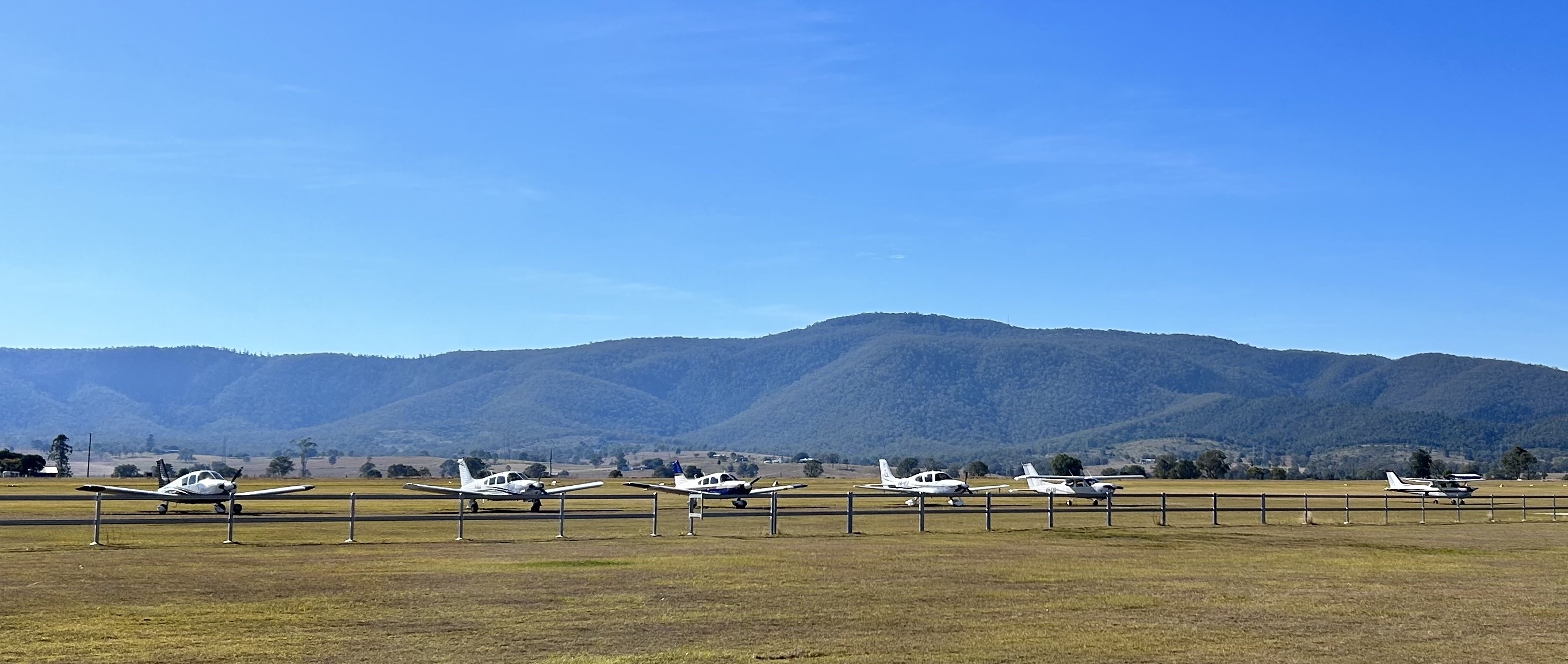
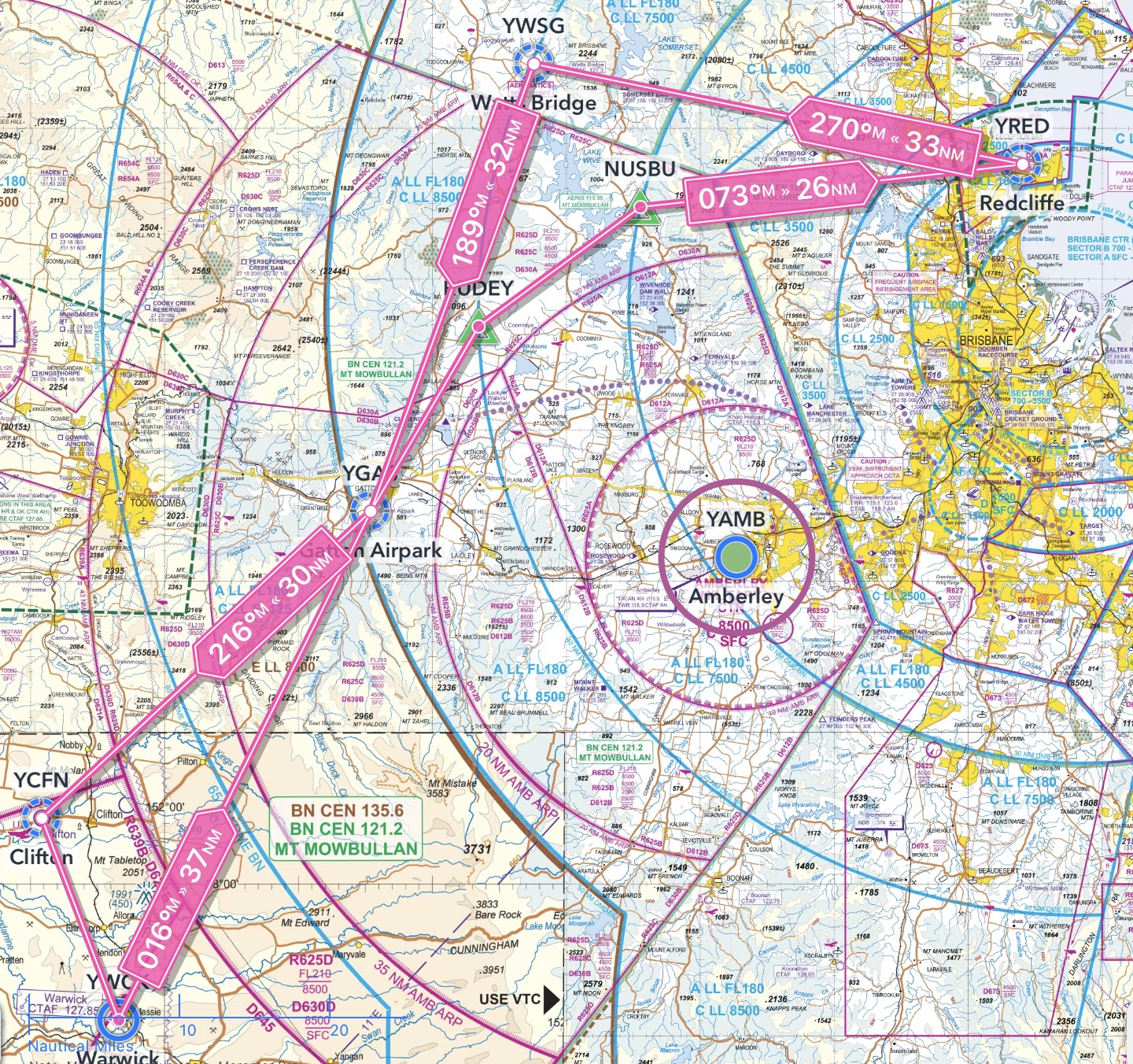
Sunday 18th June 2023 was a perfect Brisbane winter’s day – and perfect for flying. Not a cloud in the sky, no wind. The forecast maximum was 23 degC, so not too hot, not too cold. Yes there was a bit of fog out west in the early morning but it had cleared by 10am. Redcliffe Aero Club had planned a “coffee hop” flyaway to a variety of small airfields west of Brisbane and when the planets aligned weather wise it was too good an opportunity to miss. We could practise those short field landings and takeoffs and a bit of VFR navigation. Brett Silvester came with me in MSF as copilot and navigator. There were 8 aircraft that took part from Redcliffe, Caboolture and Southport. The “official” course included Kilcoy, Watts Bridge, Gatton Airpark, Clifton, Boonah and Heck Field. I decided to avoid Kilcoy and Heck Field due to tight runway length for the Cirrus and diverted to Warwick rather than Boonah at the end as I’d been to Boonah a few weeks before and I wanted to meet up with Tony and Shawn, a couple who have a hangar at Warwick, and were planning a trip to the Kimberley in August. I wanted to share our knowhow of where to go when they get there.
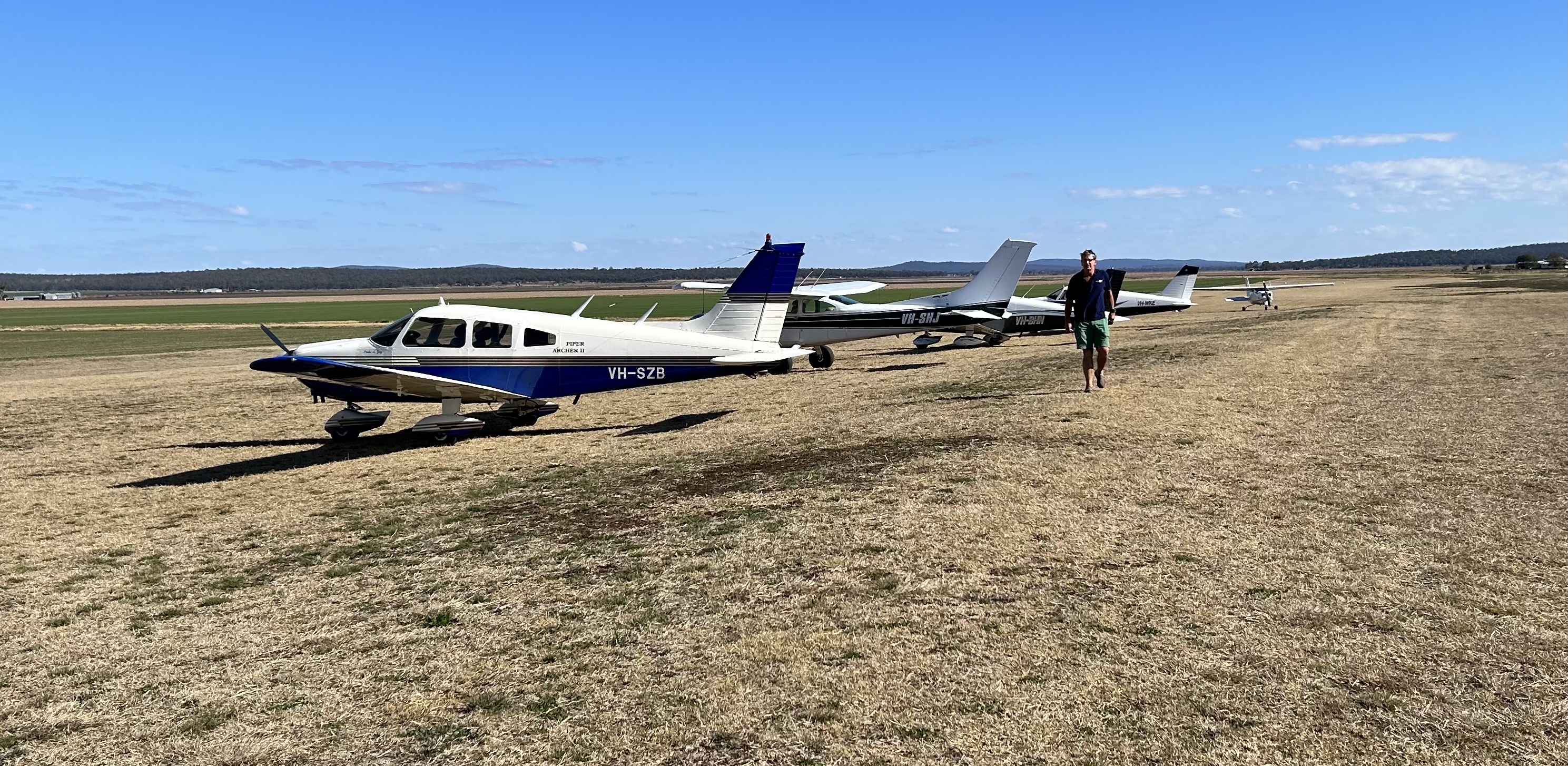
So our first stop was Watts Bridge. Although the other seven aircraft had flown to Kilcoy, they’d left earlier than us so all eight aircraft happened to converge on Watts Bridge within about 5 minutes of each other but all managed to sort ourselves out to land in sequence without any traffic jam eventuating. https://wattsbridge.com.au
There was instant coffee and bickies provided by the airfield owners, and a chance to catch up on a few old friends from the aero club and make a few new ones.
Less than an hour later we were heading about 20 miles south to Gatton Airpark. This time I led the pack in MSF as it was the fastest bird in the flock. After we landed each of the other planes followed us in quick succession.
Luc George lands WKE at Gatton
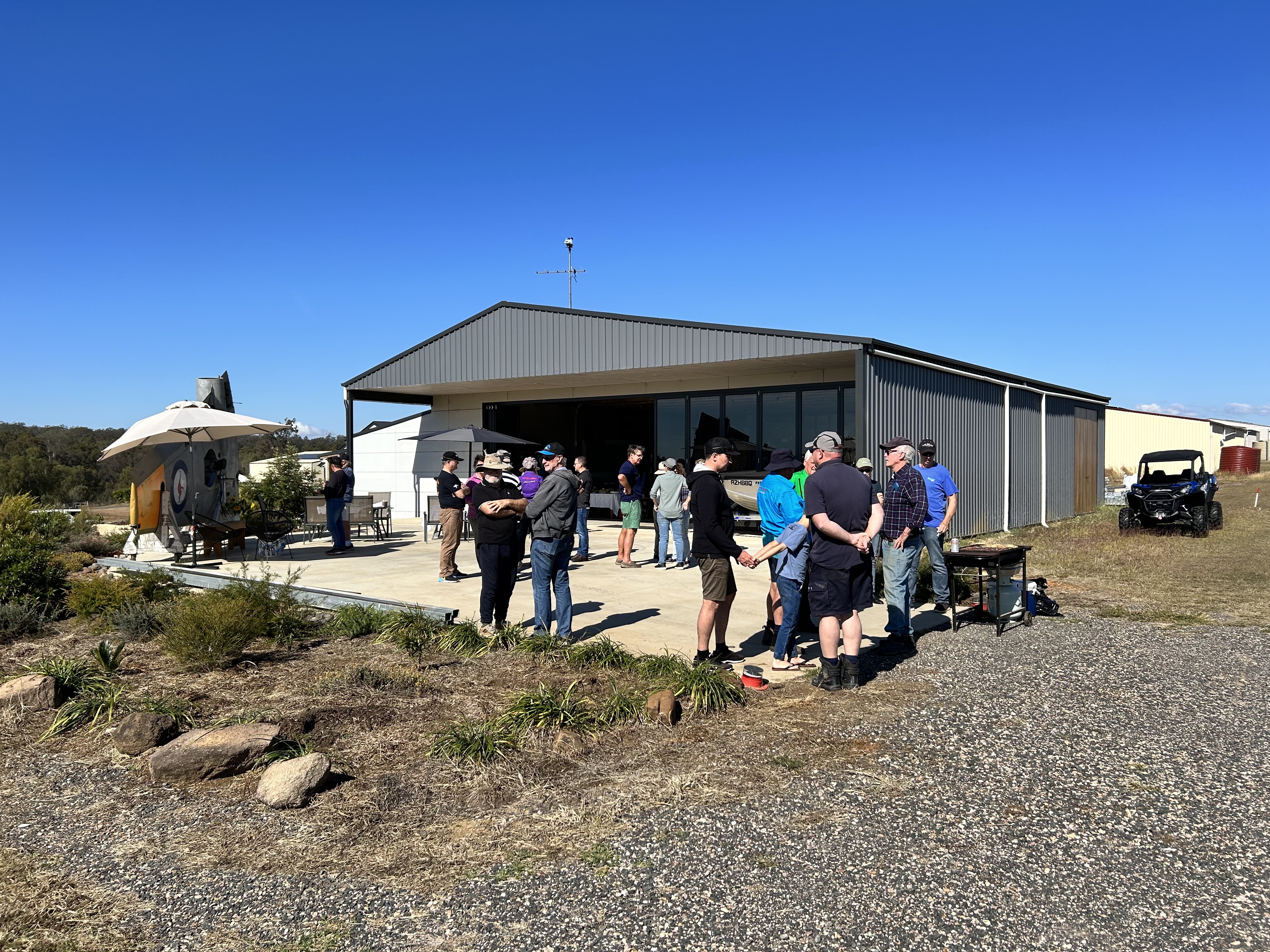
Gatton Airpark (https://gattonairpark.com) is an impressive setup created by a husband and wife when they subdivided their property and had it designated an airpark about 15 years ago. There are some twenty or so houses there now, each with its own hangar that they can taxi their planes up to. A group of the owners were waiting for us when we landed and had prepared a magnificent BBQ.
They also had a professional espresso machine in the hangar and were soon preparing barista coffee for us. Once again we made some new acquaintances and learned about their particular aviation adventures.
An hour later Brett and I led the way again, taking off in MSF for Clifton, about 25 miles to the south west. I thought I’d been to Clifton many years ago during my PPL training but realised on landing (after thinking on the way in that it looked nothing like I remembered) that I’d actually flown into Pittsworth before, not Clifton. Not far away but very different layout. Part of the reason I had trouble recognising it.
After a bit less than an hour we split off from the main group. After they all took off for Boonah, Brett and I flew the 5 minute hop across to Warwick where there was some confusion as a glider pilot on final called RWY 09 when he was really on RWY 27. After a quick call on the radio one of the other pilots confirmed it was really 27 that was active. We had one more cup of tea with Tony and Shawn, sitting on the deck of their hangar house located directly next to the taxiway.
By 3:30 we were heading back to Redcliffe, flying over the dividing range and directly over the top of Gatton Airpark at 3,500ft.
We were careful to skirt around the Amberley airspace that had become active in the early afternoon. It was good light as the sun descended in the west and we passed back over Lake Wivenhoe.
We touched down in Redcliffe at 4:30. The end of another perfect winter’s day in SE Qld.
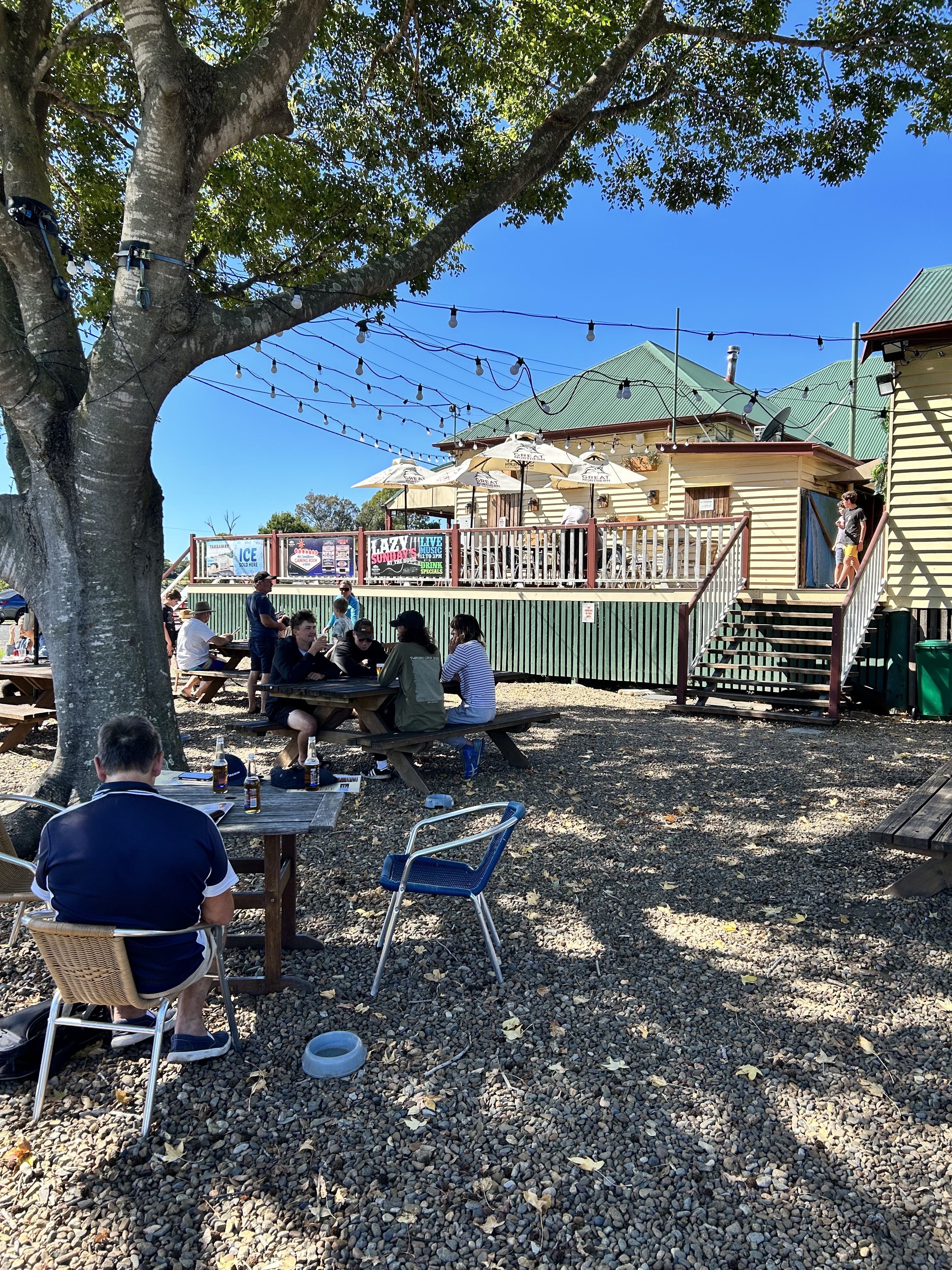
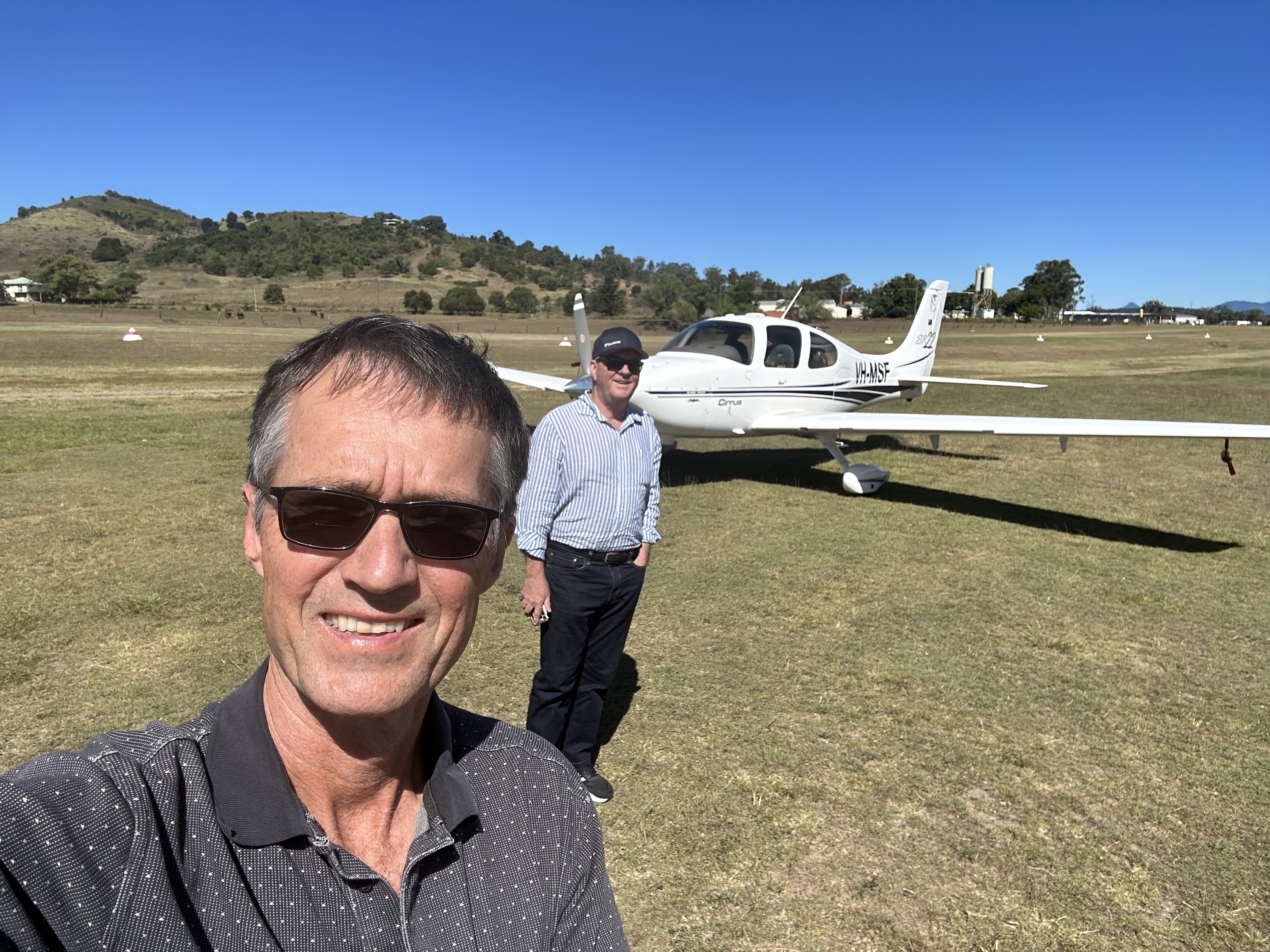
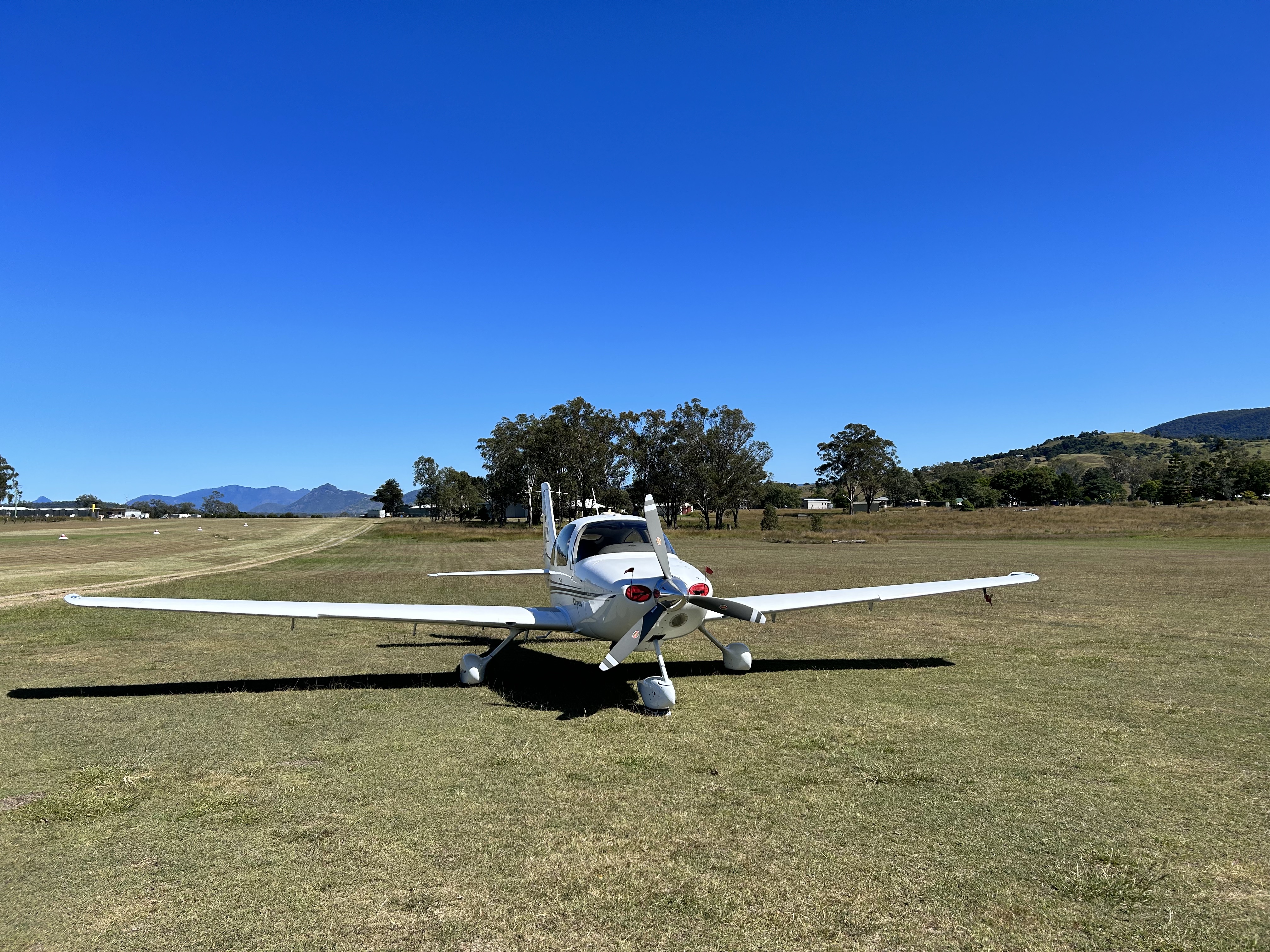
On May 1st 2023 we did a quick trip out to Boonah for lunch to check that everything was working well on MSF before we departed on our big trip to the Kimberley in WA. Brad Green and Luc George came along for the ride. From the airstrip it was a 15 minute walk to the Dugandan Hotel. It has a great beer garden (we drank Zero beer of course) and delicious traditional Aussie hamburgers. The airfield owner Nigel Arnott showed us around his impressive hangar/workshop.
Purnululu (Bungles) – Hooker Creek – Tennant Creek – Barkly Wayside Inn – Mount Isa – Winton – Emerald – Agnes Water – Hervey Bay – Redcliffe
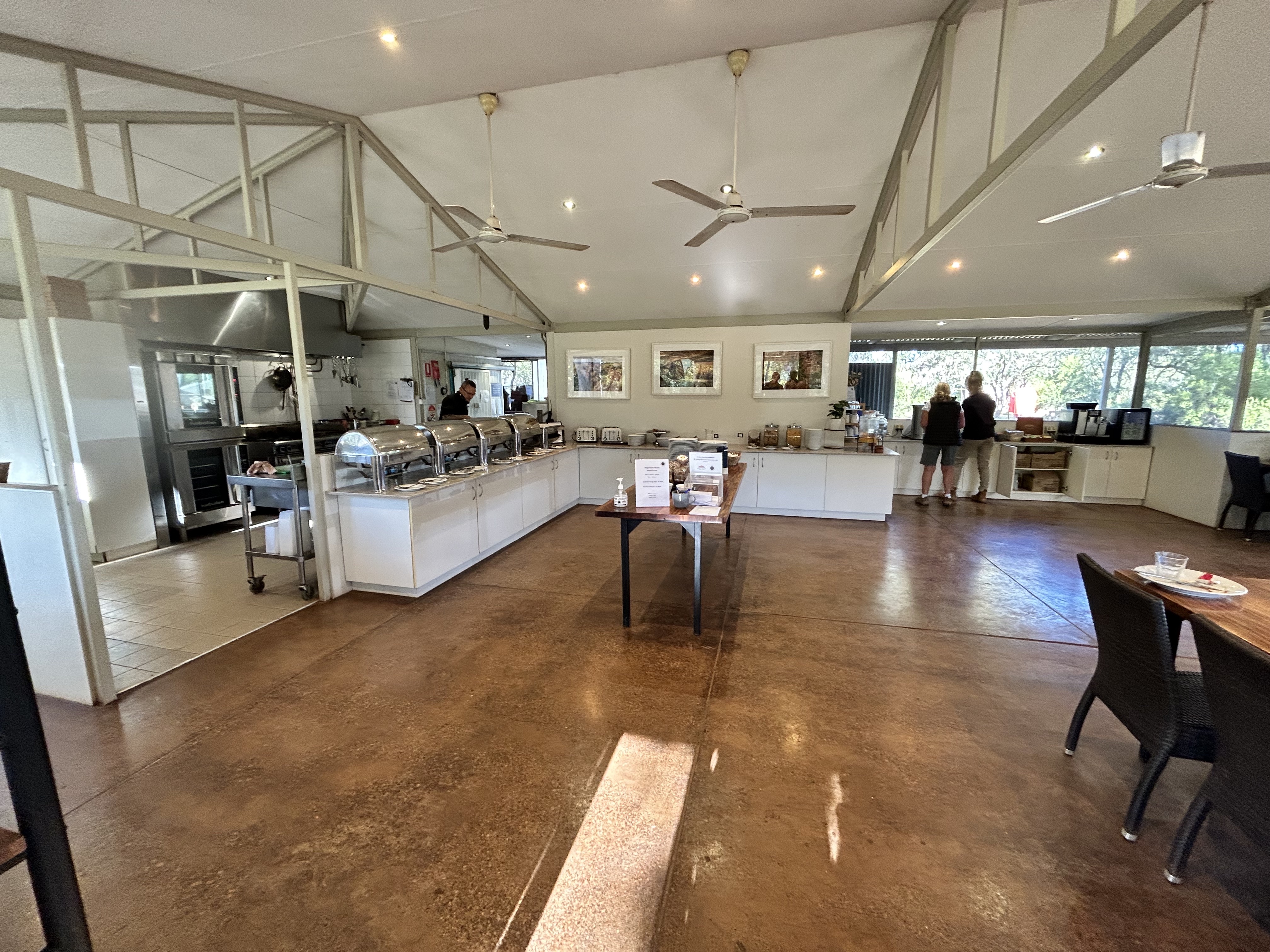
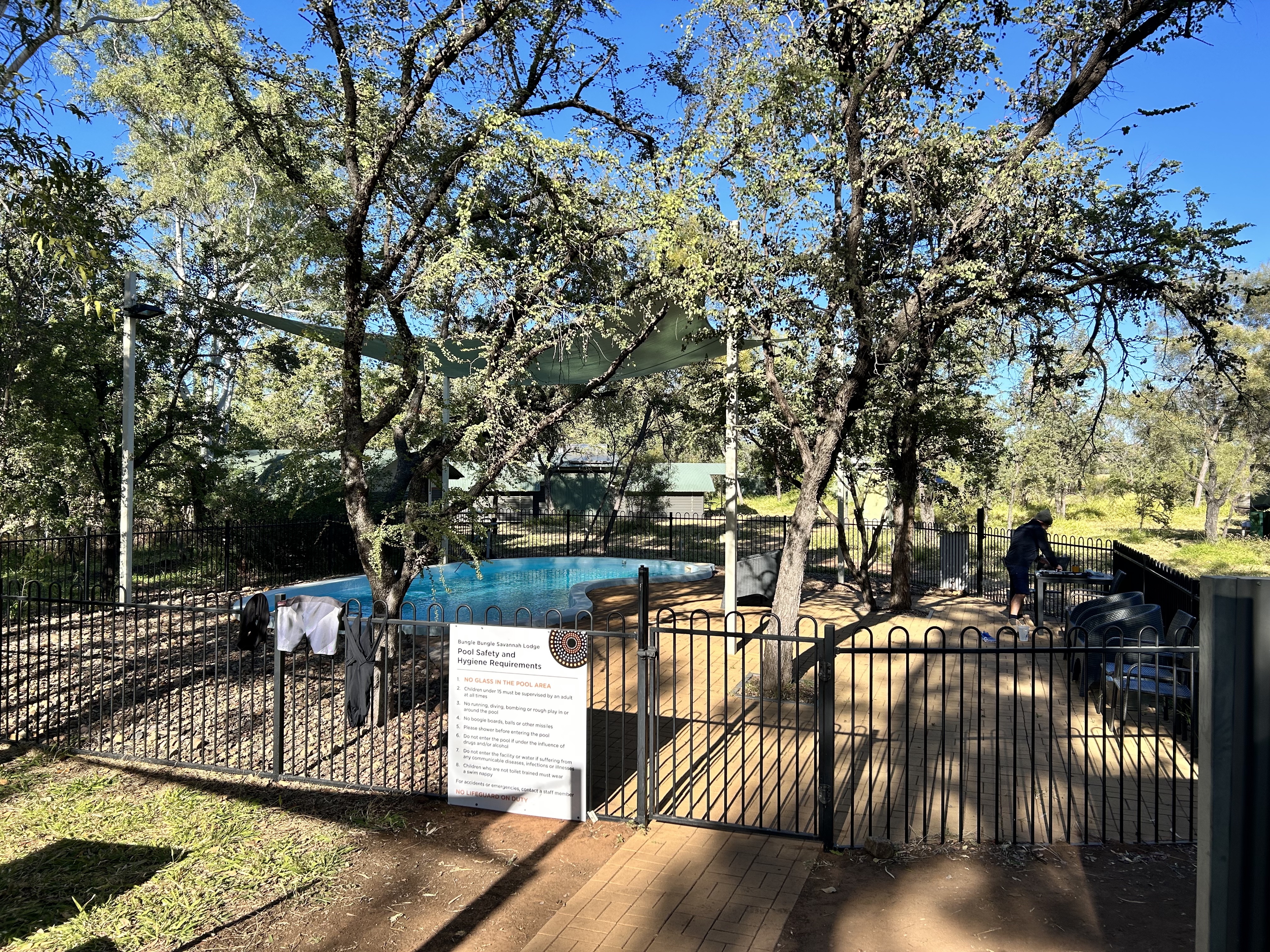
29th May 2023 dawned like all the other days in the Kimberley. Blue sky and not a cloud in sight. The only difference was the temperature. Being so far inland and with clear skies it had dropped to about 8 degrees overnight. So it had been a cold night at the Bungle Bungle Savannah Lodge and the cabins weren’t exactly warm. If you’re heading that way in May – September take some thermals with you for the early morning. A beanie and gloves will also be worthwhile. It’s a desert climate.
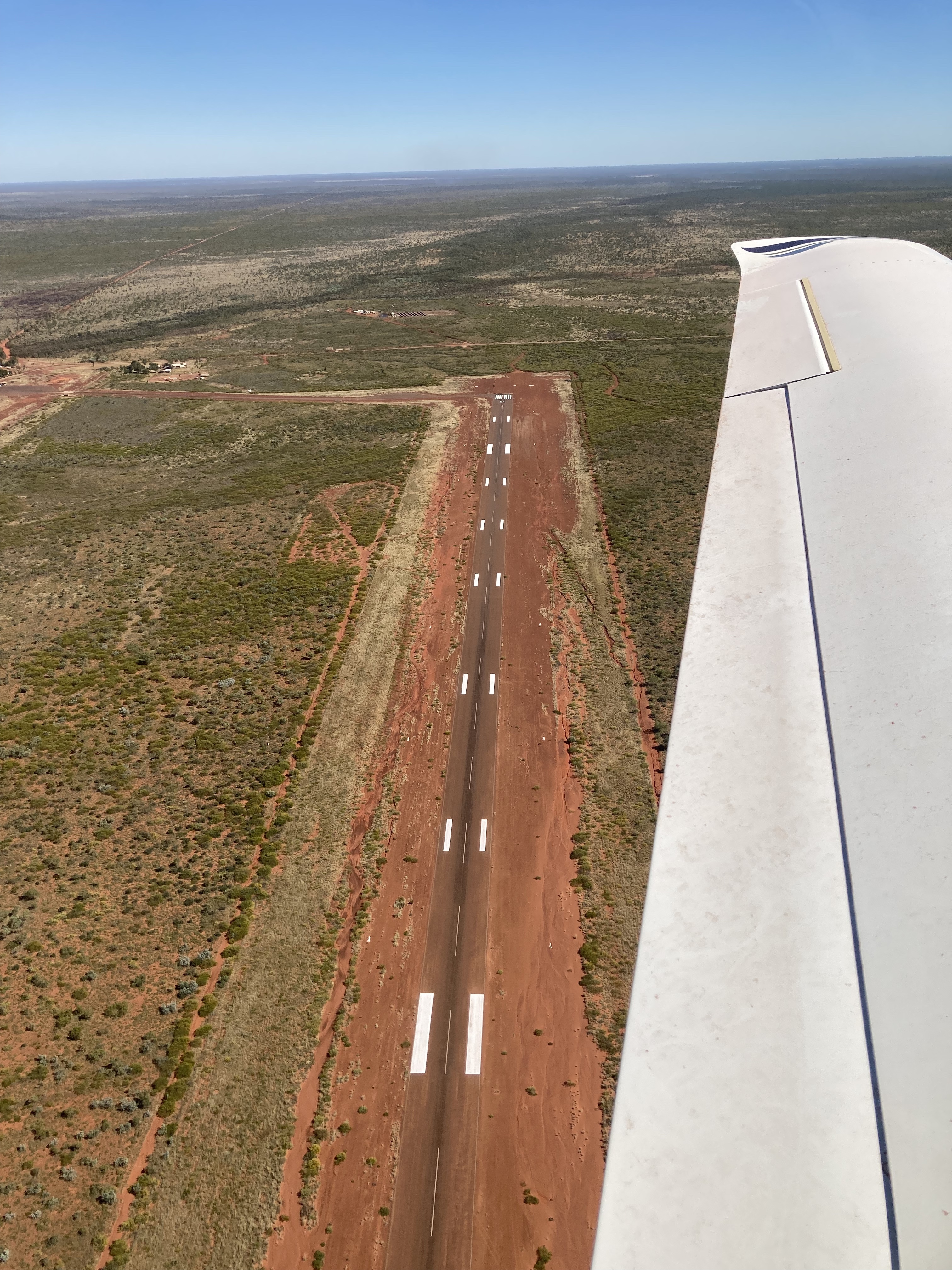
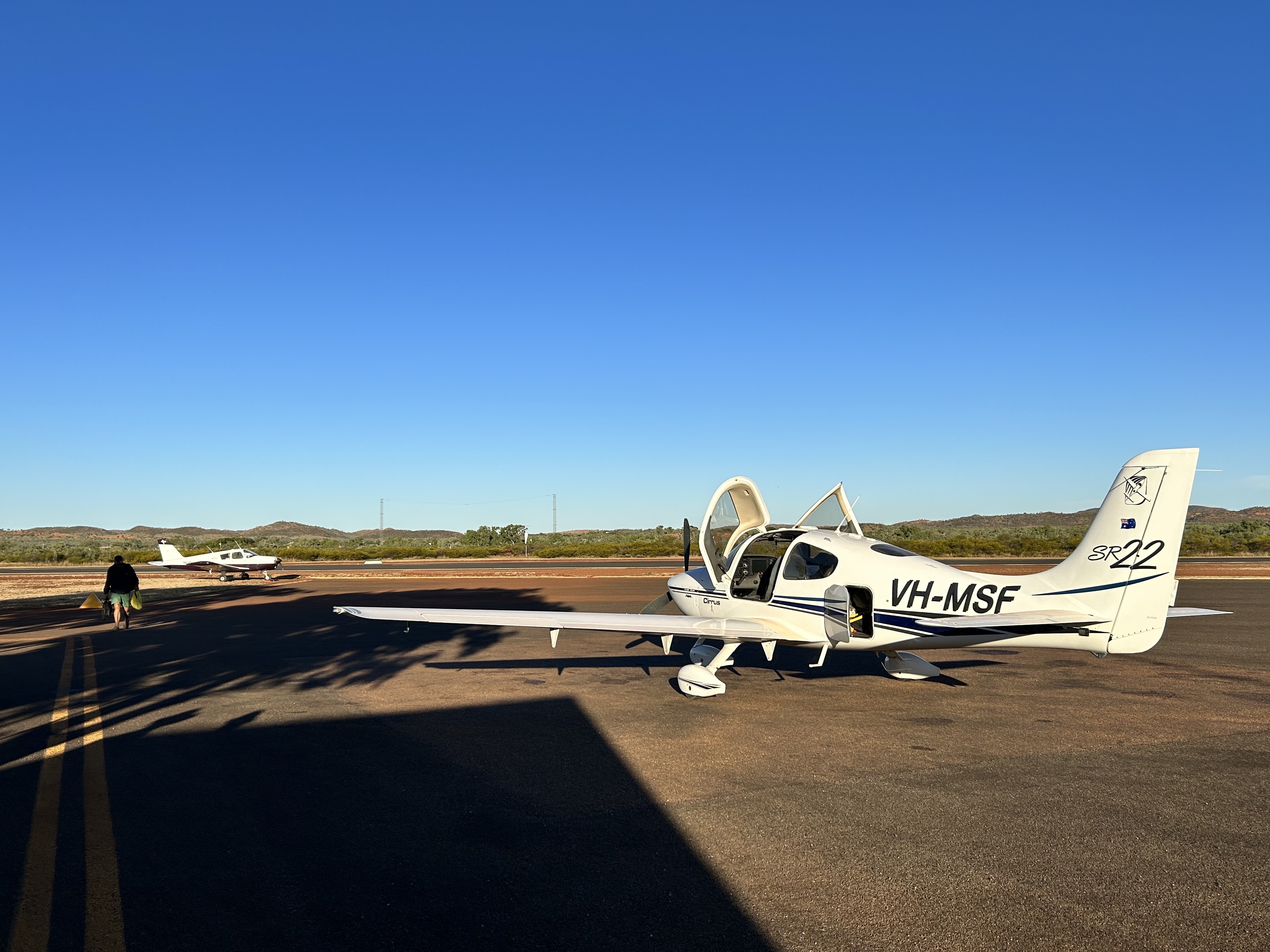
Anyway, the hot breakfast warmed us all up and at 8am we were transferred back to the Bellburn airstrip. MSF was a bit reluctant to start due to the cold but Luc’s tip of rotating the propellor to get the oil flowing and positioning the prop to ensure minimum effort required by the starter motor did certainly help.
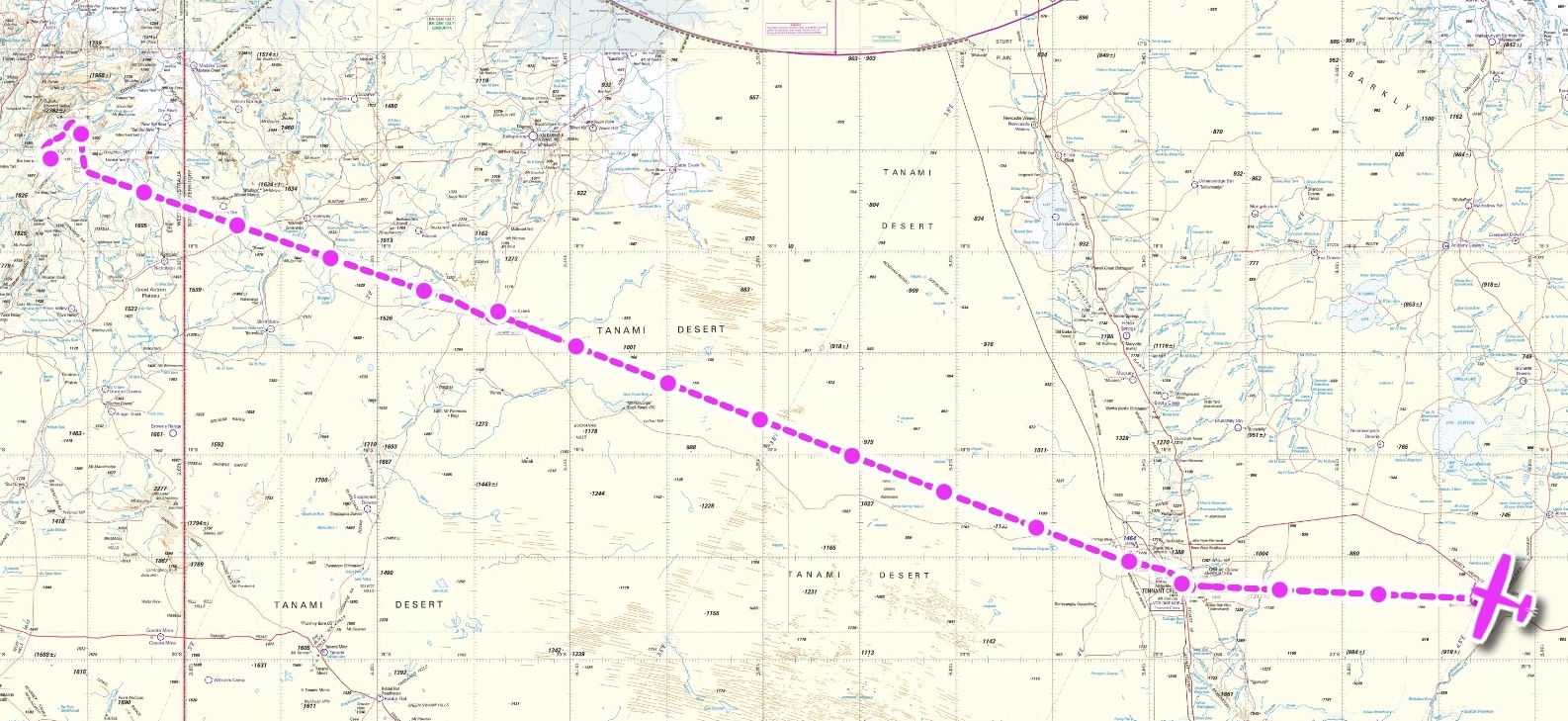
From Purnululu it was a “long haul” flight to Barkly Wayside Inn via Hooker Creek and Tennant Creek. We did a quick pass over the Bungles and then tracked direct for YHOO, losing 90 minutes as we crossed into the NT.
The first leg was 60 minutes with some smoky parts to fly over. At Hooker we had to queue for Avgas as possibly the only other customer for the day had landed ten minutes before us and then discovered his company credit card had no money on it. I presume he resorted to his personal card as he eventually filled up and pulled his Cessna out of the way.
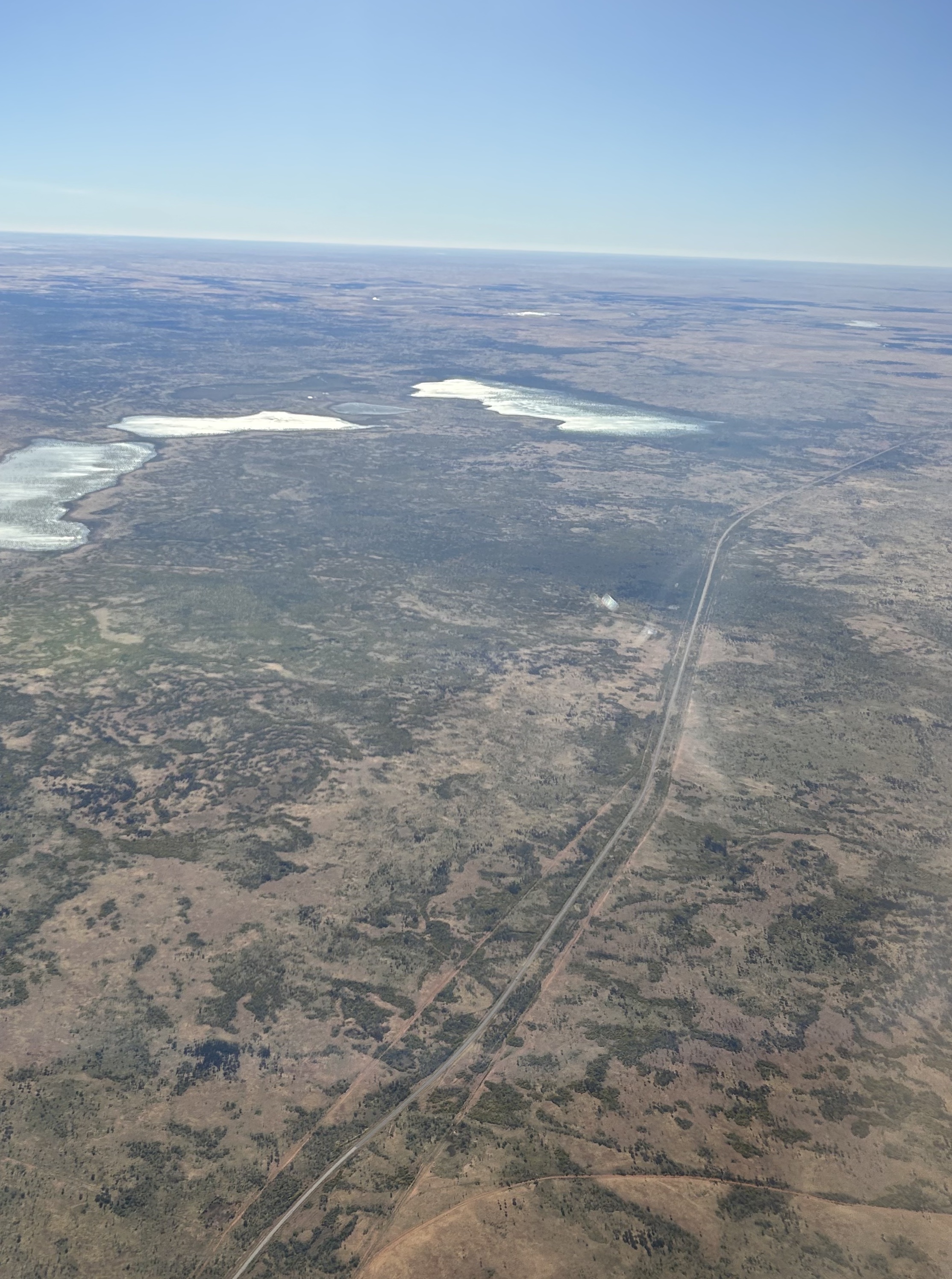
Meanwhile Sigi and Rita had bought sandwiches and salad at the community store so we were all set for a picnic at Tennant Creek. Taking off we spent the next 90 minutes flying over the northern end of the Tanami Desert that was uncharacteristicly green. They have had a lot of rain this past wet season. An Airnorth King Air was also planning to land at Tennant Creek so we let him land first while we did an orbit over the town.
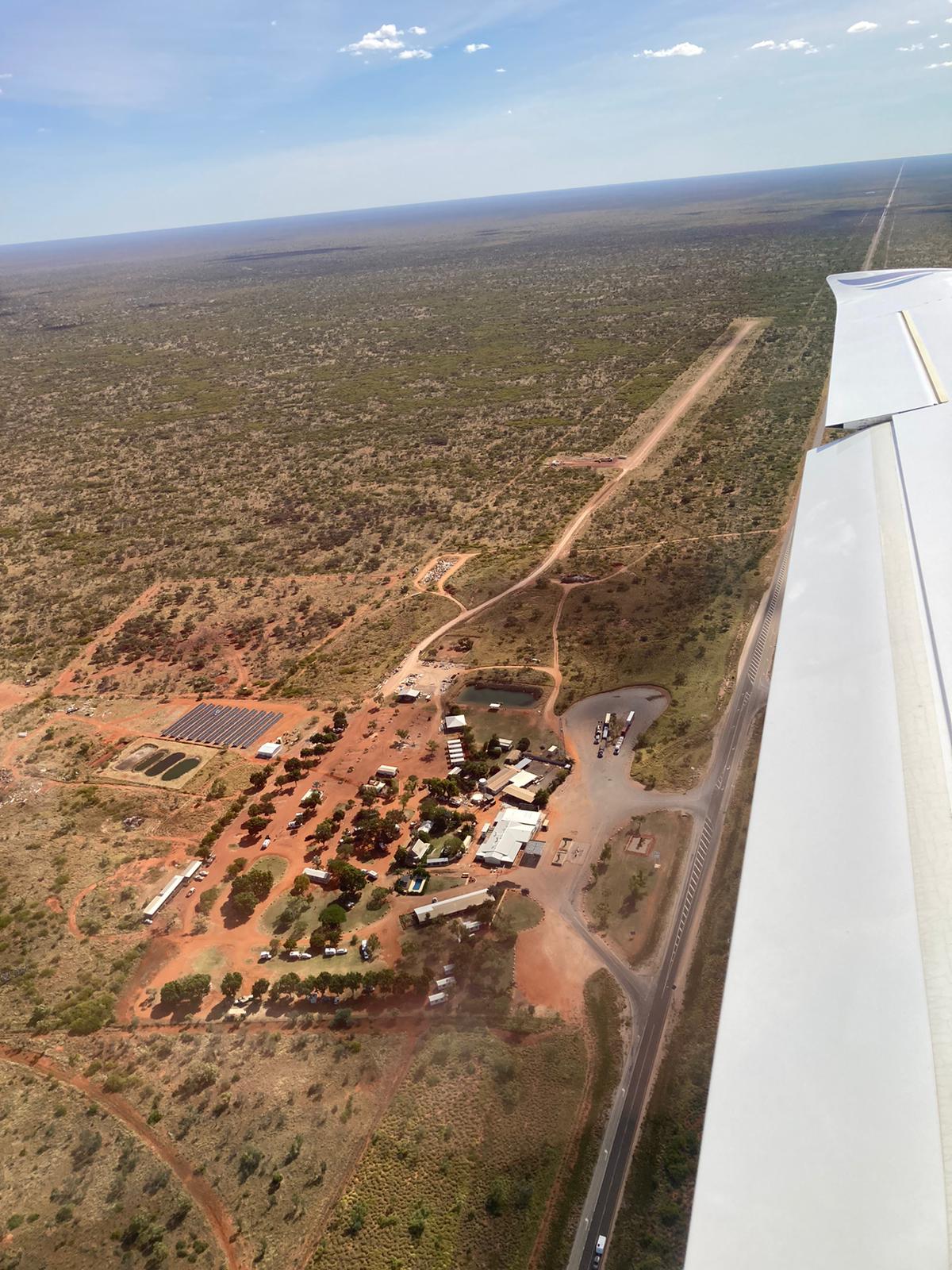
After refuelling we had intended on walking down town as it was only 1 km but decided we’d rather just get to Barkly as soon as possible as we were keen to see whether the new roadhouse had really been completed and was open for business. We were soon flying the last 30 minute leg. We landed and taxied towards the apron while an elderly couple watched in amazement. They didn’t realise they were standing in the middle of the taxiway! After a bit of furtive sign language they suddenly realised they were about to be sliced and diced if they didn’t move out of the way so our way was clear to the bowser once more. No cement mixer this time and no wayward trucks and the apron looked a little bit less like a scrap yard.
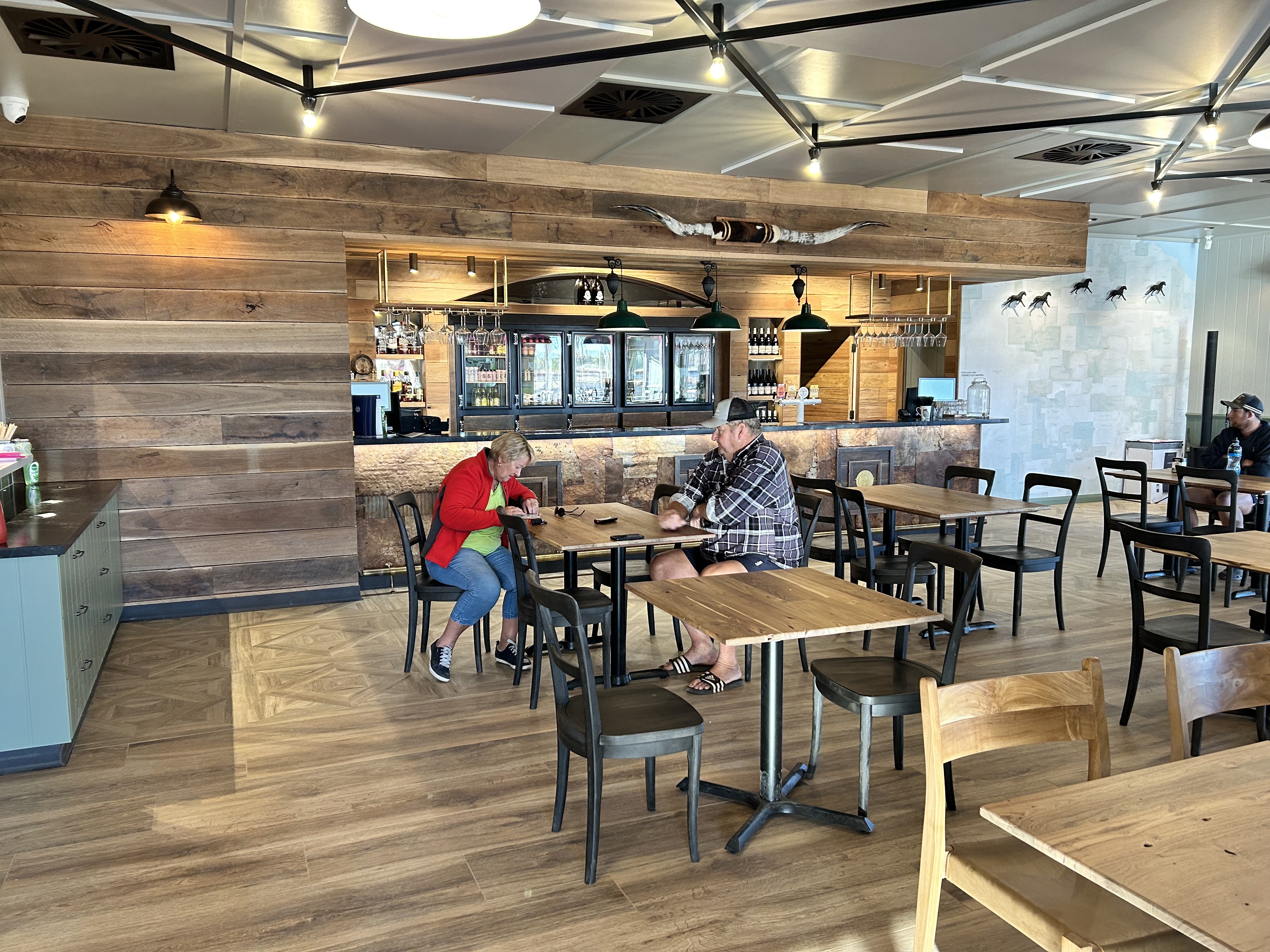
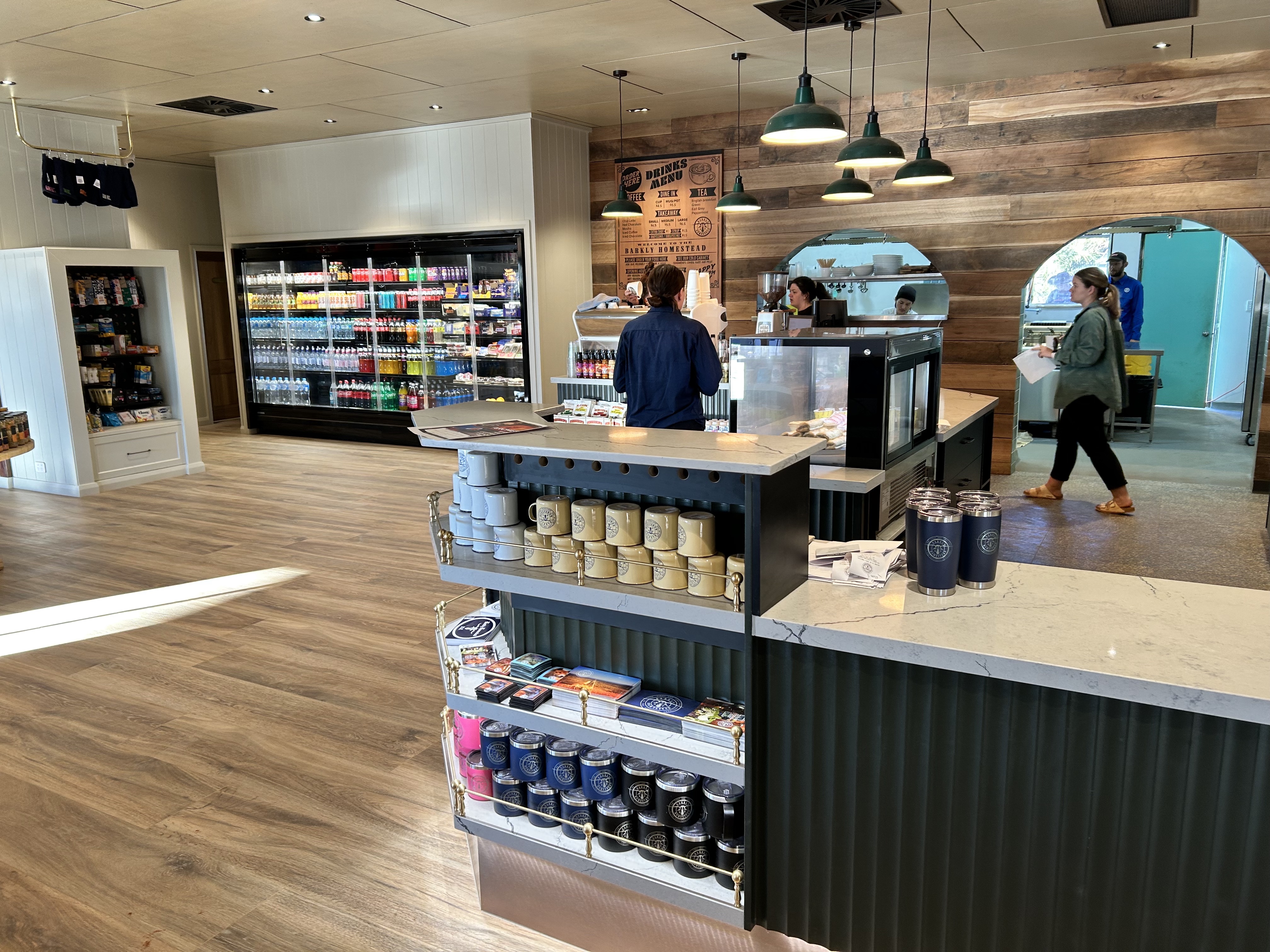
After filling up again we pushed MSF back into a gap between the building materials that covered the lay down area. And were we impressed by the new buildings? You bet we were. A great new roadhouse complete with live music and all completed in 4 months according to the manager. Quite an achievement.
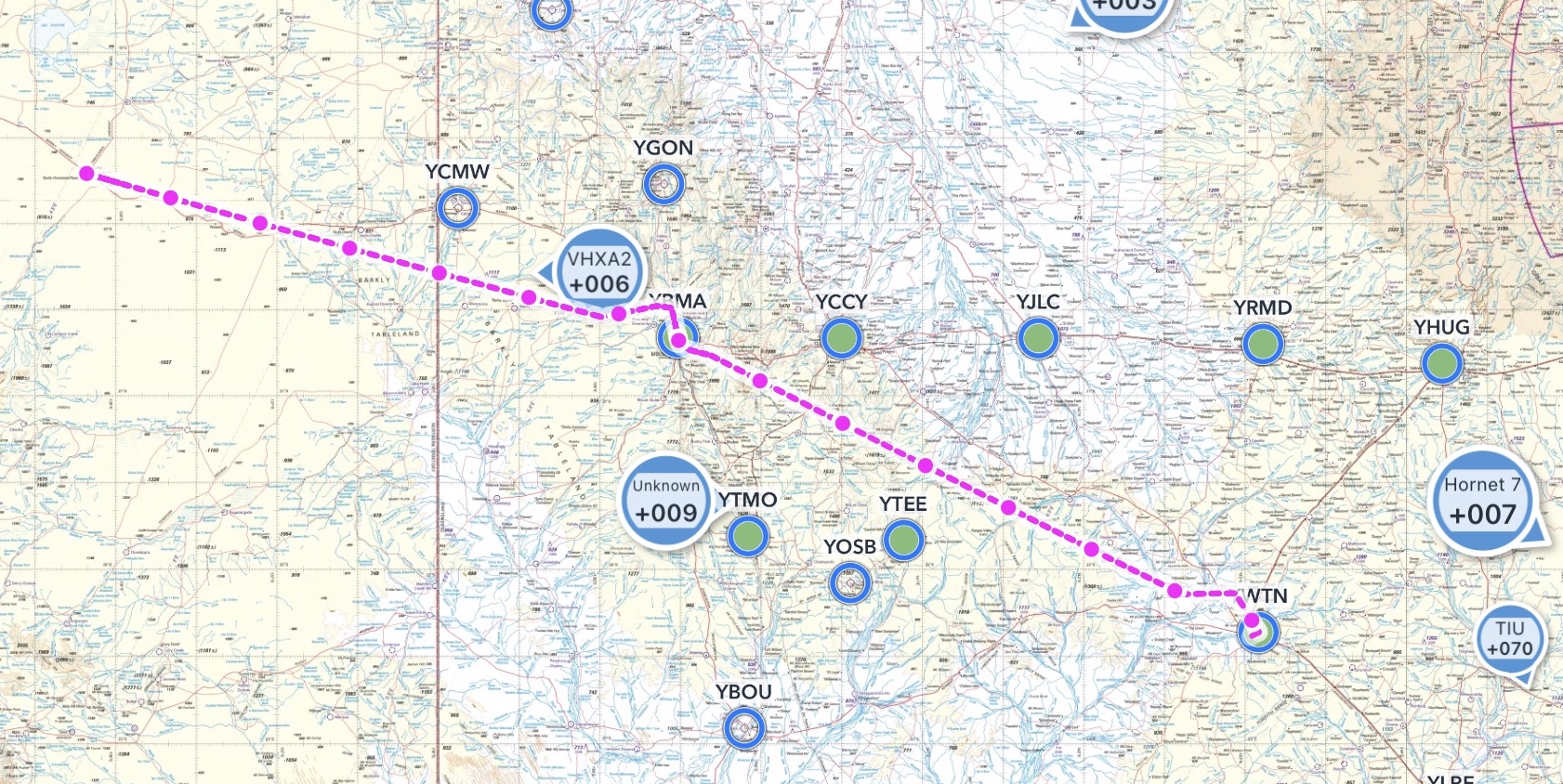
It was another big day from Barkly Wayside Inn to Winton. It is a big country isn’t it? At only 10 degrees it meant we needed to rug up again until the sun got up a bit. MSF required a bit of coaxing again to get going but after a few attempts the engine fired up and we taxied out of the lay down area to the strip, avoiding pedestrians on the taxiway as we went.
Departing Barkly Roadhouse
It was over an hour VFR to Mt Isa where I did a practice RNP instrument approach. The terminal was open and the cafe was selling coffee so we struck the jackpot.
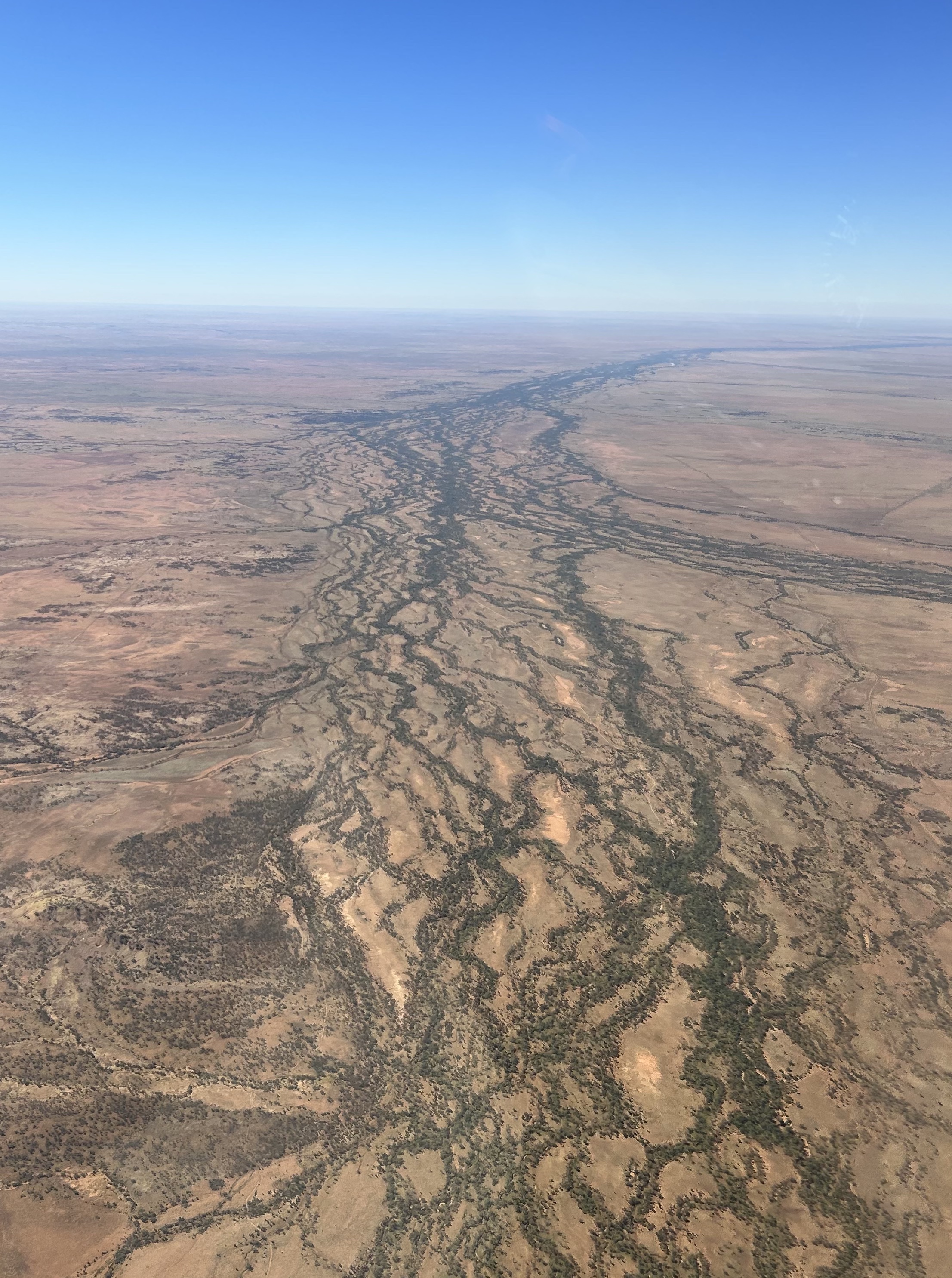
There was VHF coverage from there on so we were IFR to Winton, passing over the Diamantina River on the way.
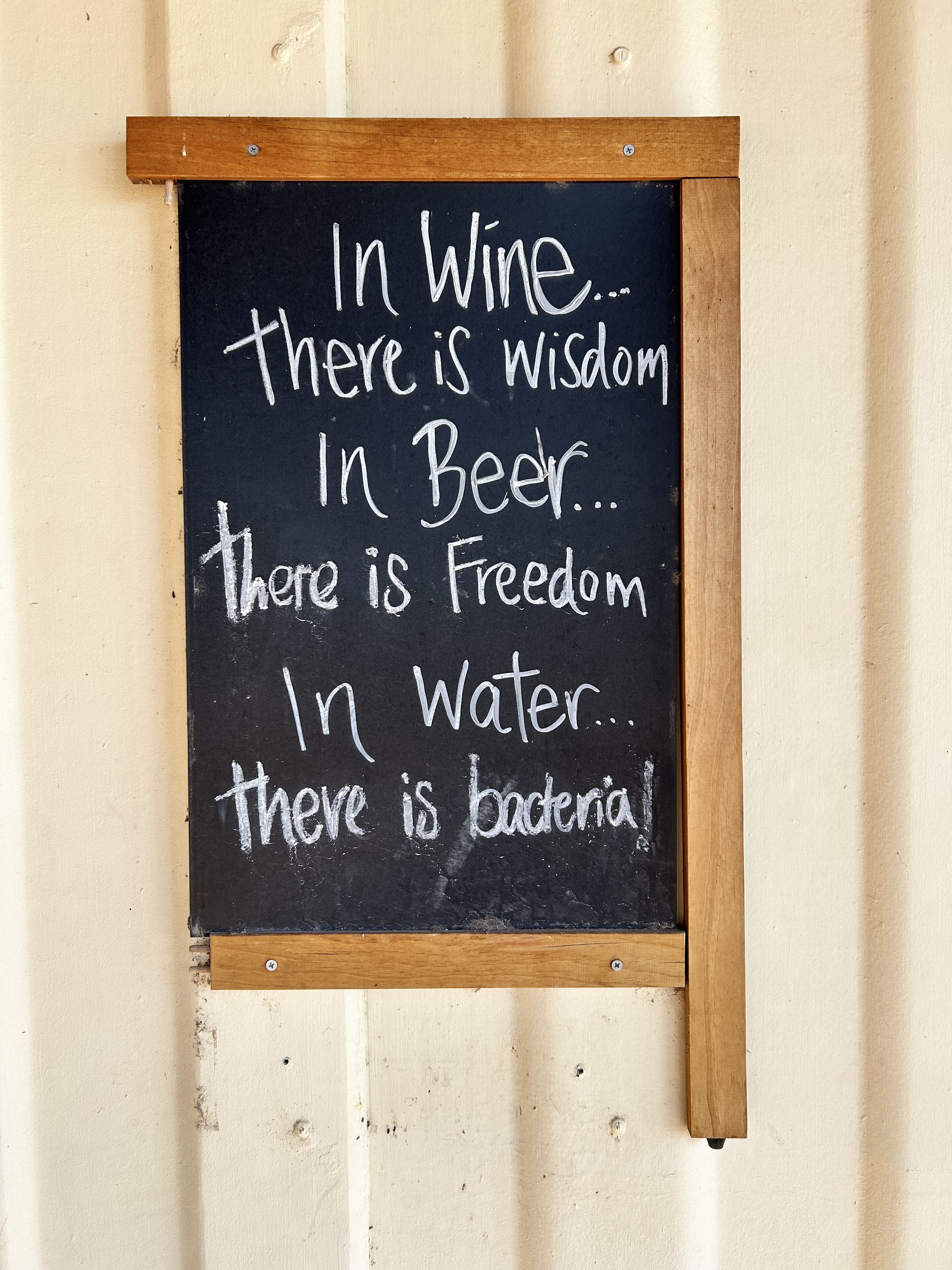
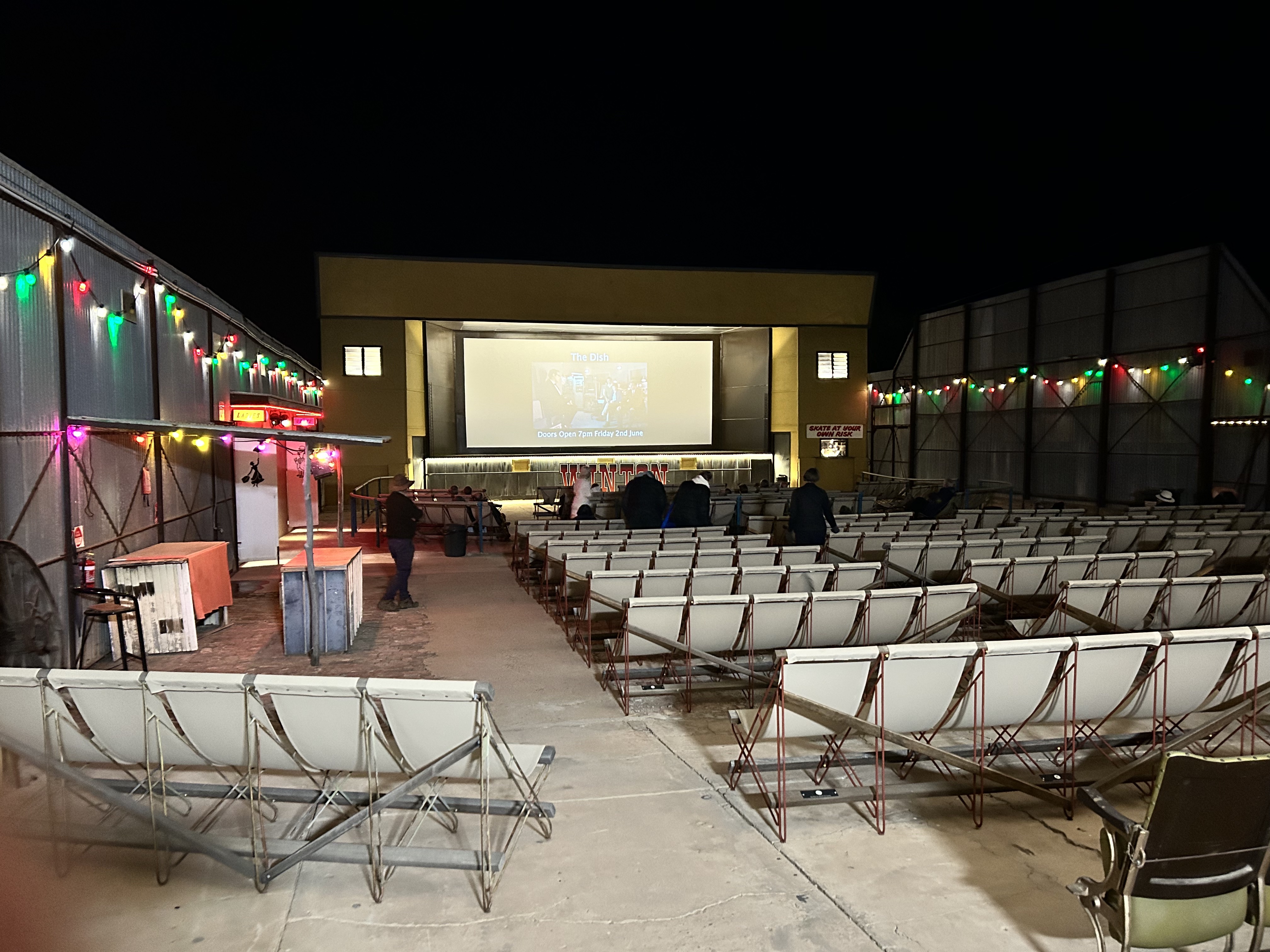
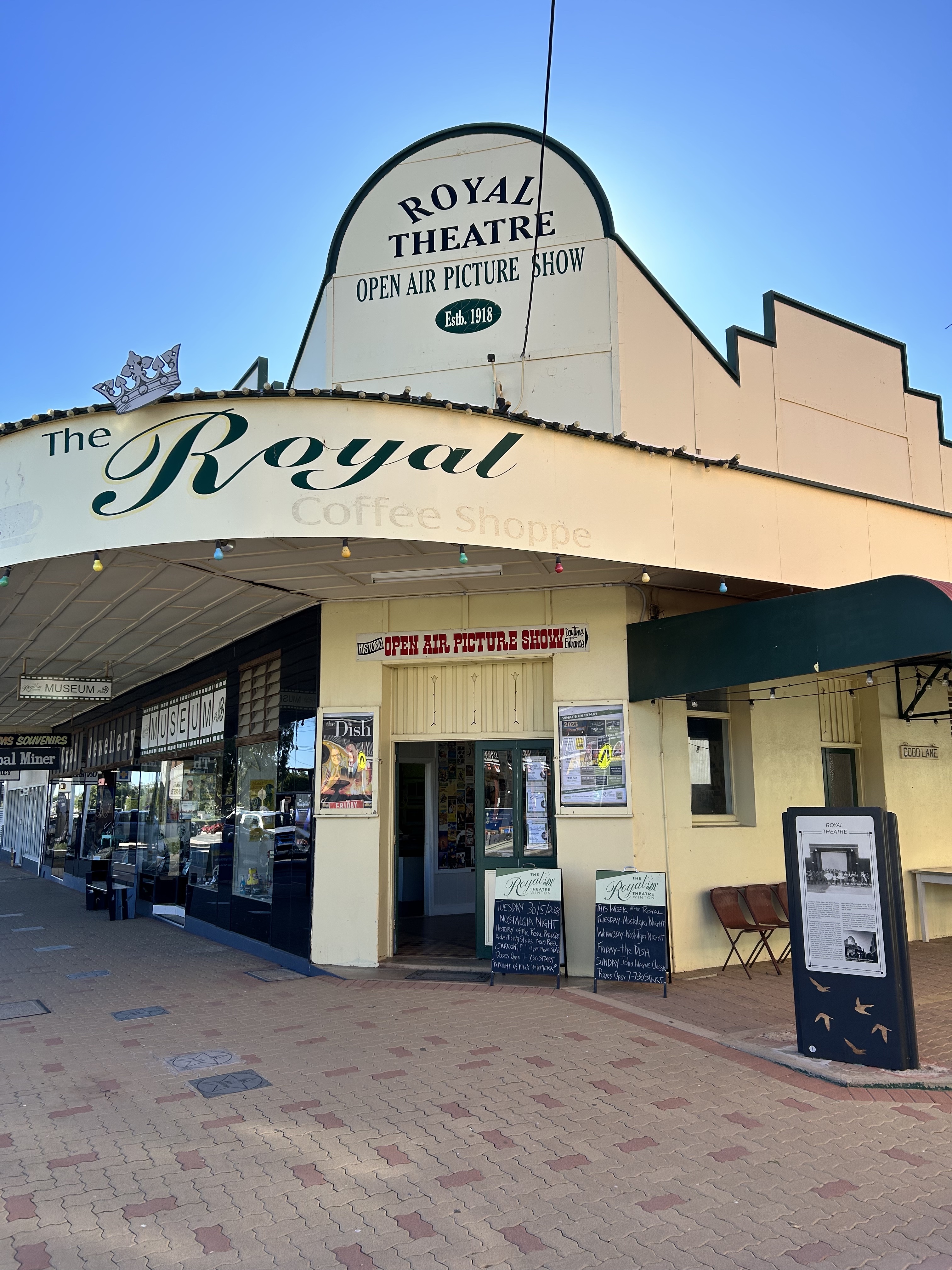
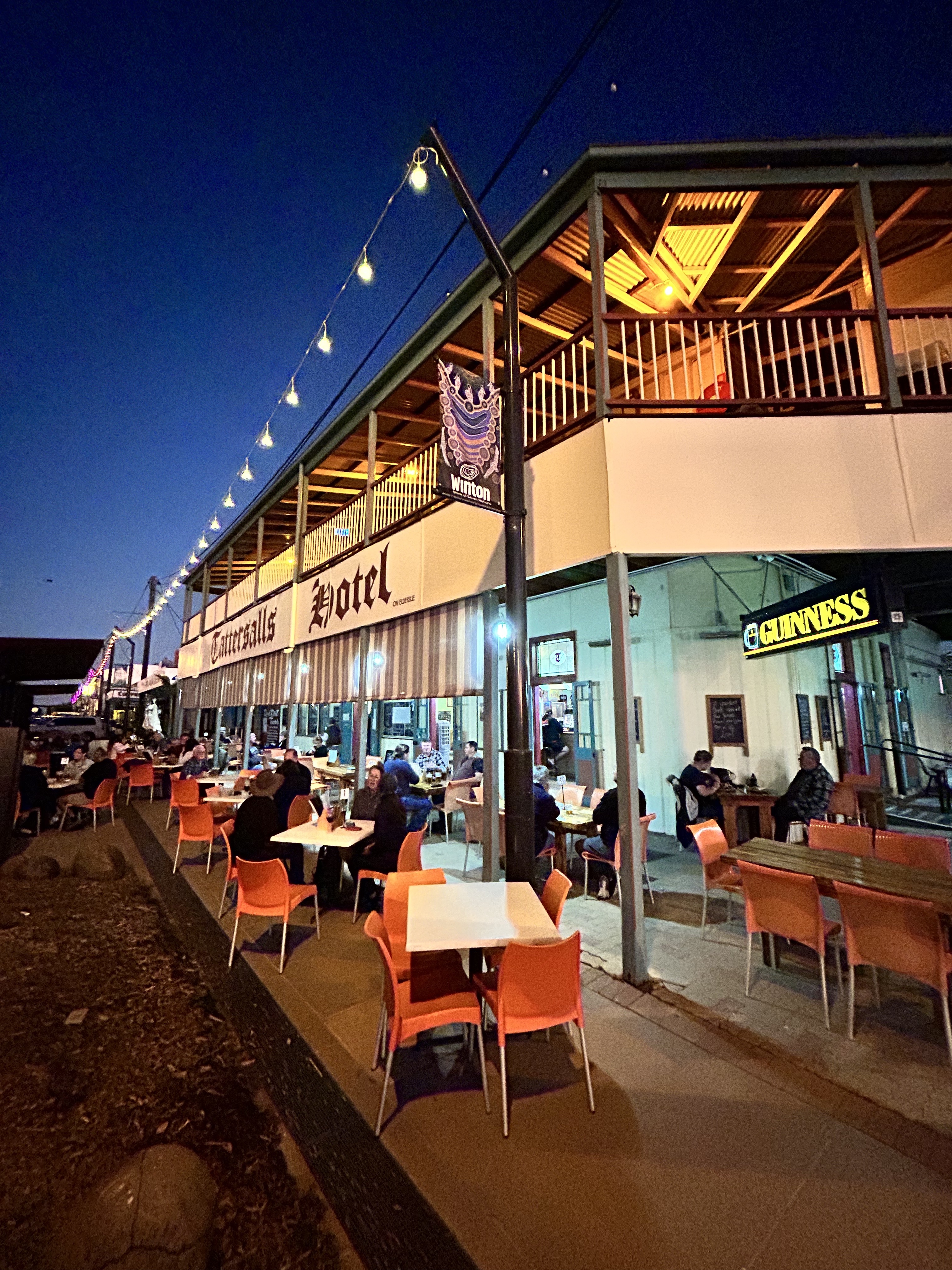
After another RNP approach we tied down for the night. Adam from the Outback Motel was waiting for us and before long we were taking in the wonders of Winton. There was a poetry recital by Gregory North at the North Gregory Hotel followed by dinner at the Tatts Hotel as the sun set. We finished the day with a nostalgic movie night at the open air Royal Theatre. It’s one of only two open air cinemas in Australia. Where’s the other one? You guessed it – Broome. As the temperature dropped to 10 degrees we watched newsreels from the 50s, old adverts, cartoons and silent movie skits. Very funny. And we could remember many of them from our childhoods.
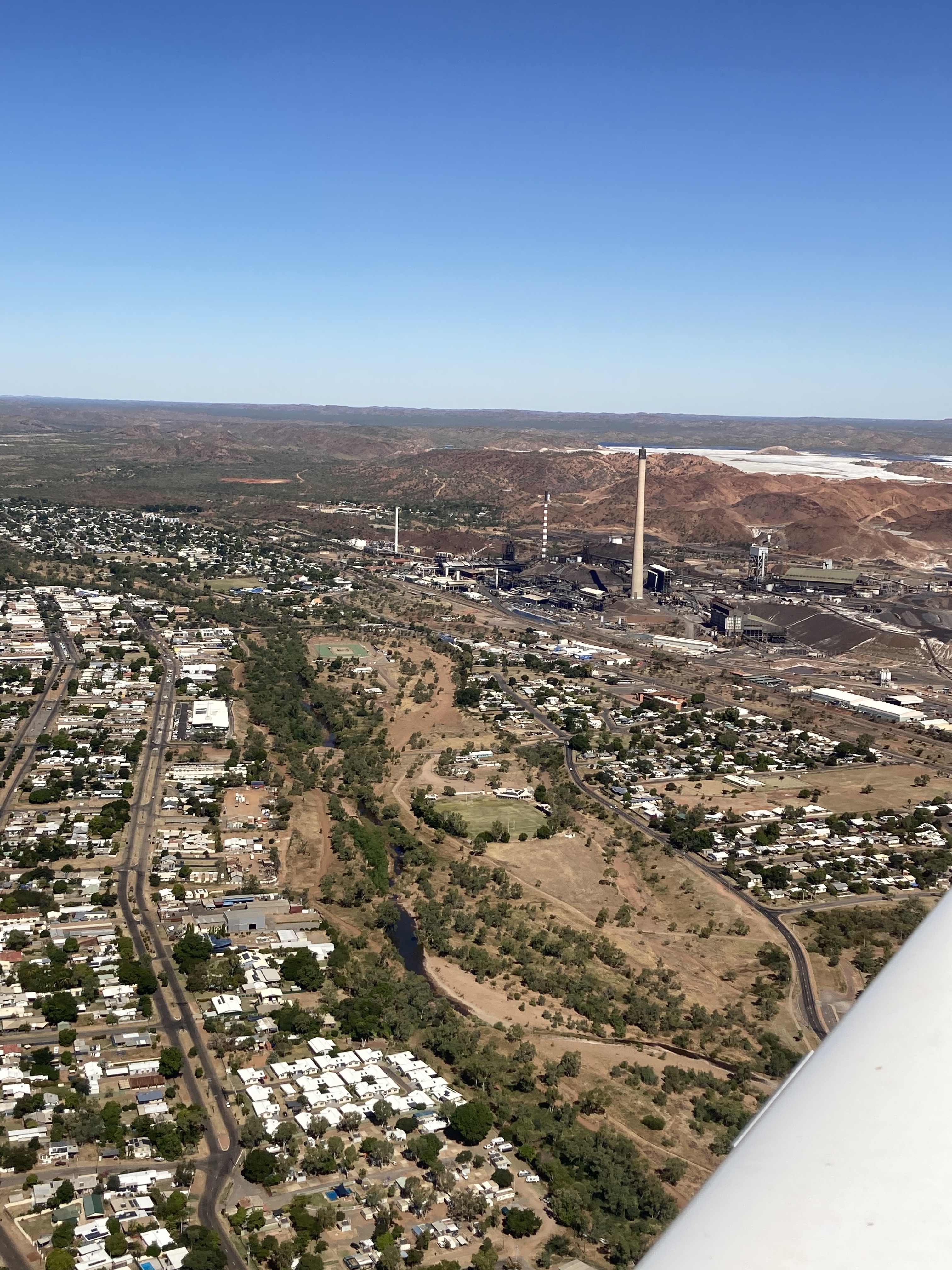
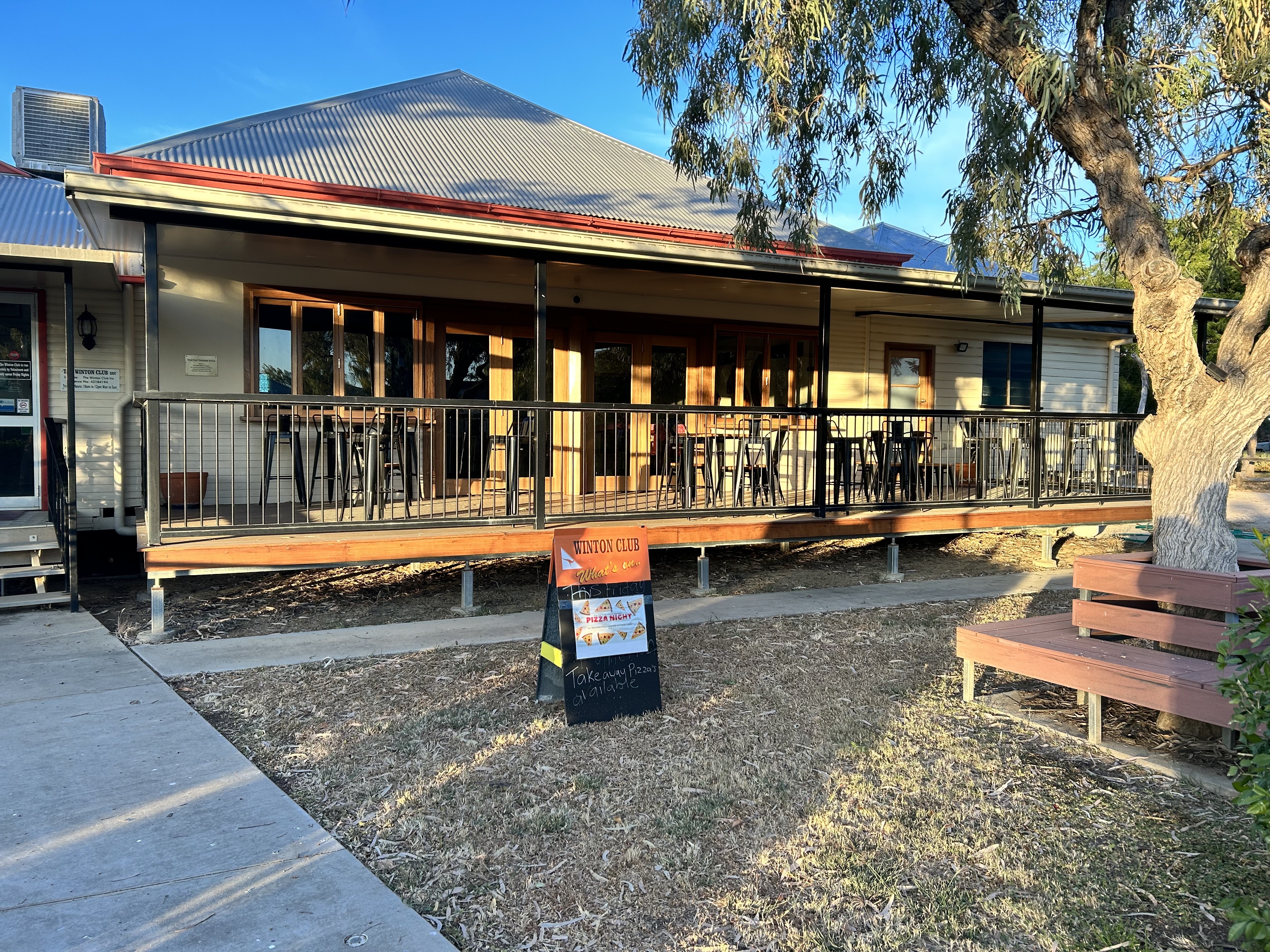
ur Kimberley Krusade was drawing to an end and it really was time to head for home. Another cold morning start at Winton meant we had time to observe the feeding of the Brolgas at the Outback Motel and do a quick walk around town before breakfast. We checked out the Winton Club, site of the first QANTAS board meeting.
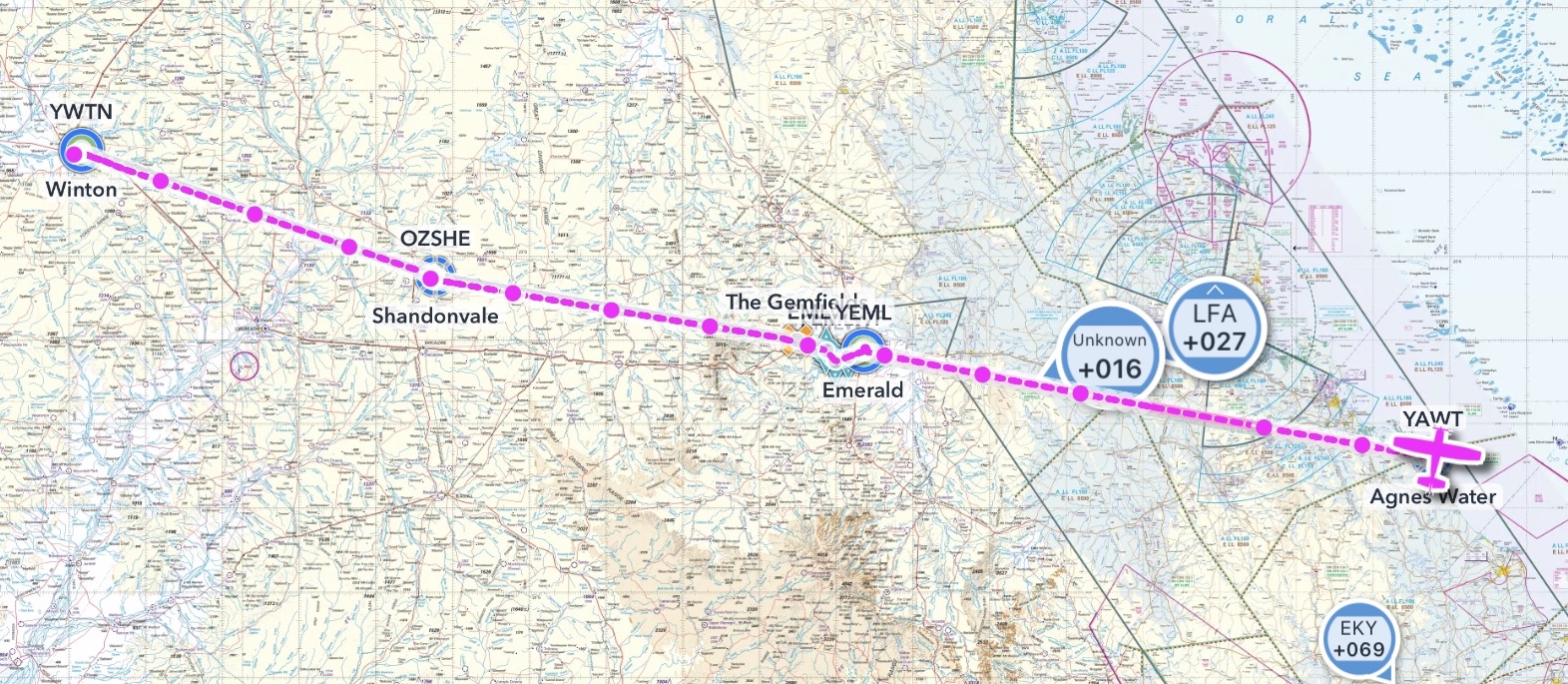
After breakfast Adam dropped us back at the airport. Our track to Emerald had us passing directly over Shandonvale so we couldn’t resist a couple of orbits at 5000ft to say G’day to Deon and Lane.
Another opportunity to practise an RNP instrument approach led to a straight in approach at Emerald.
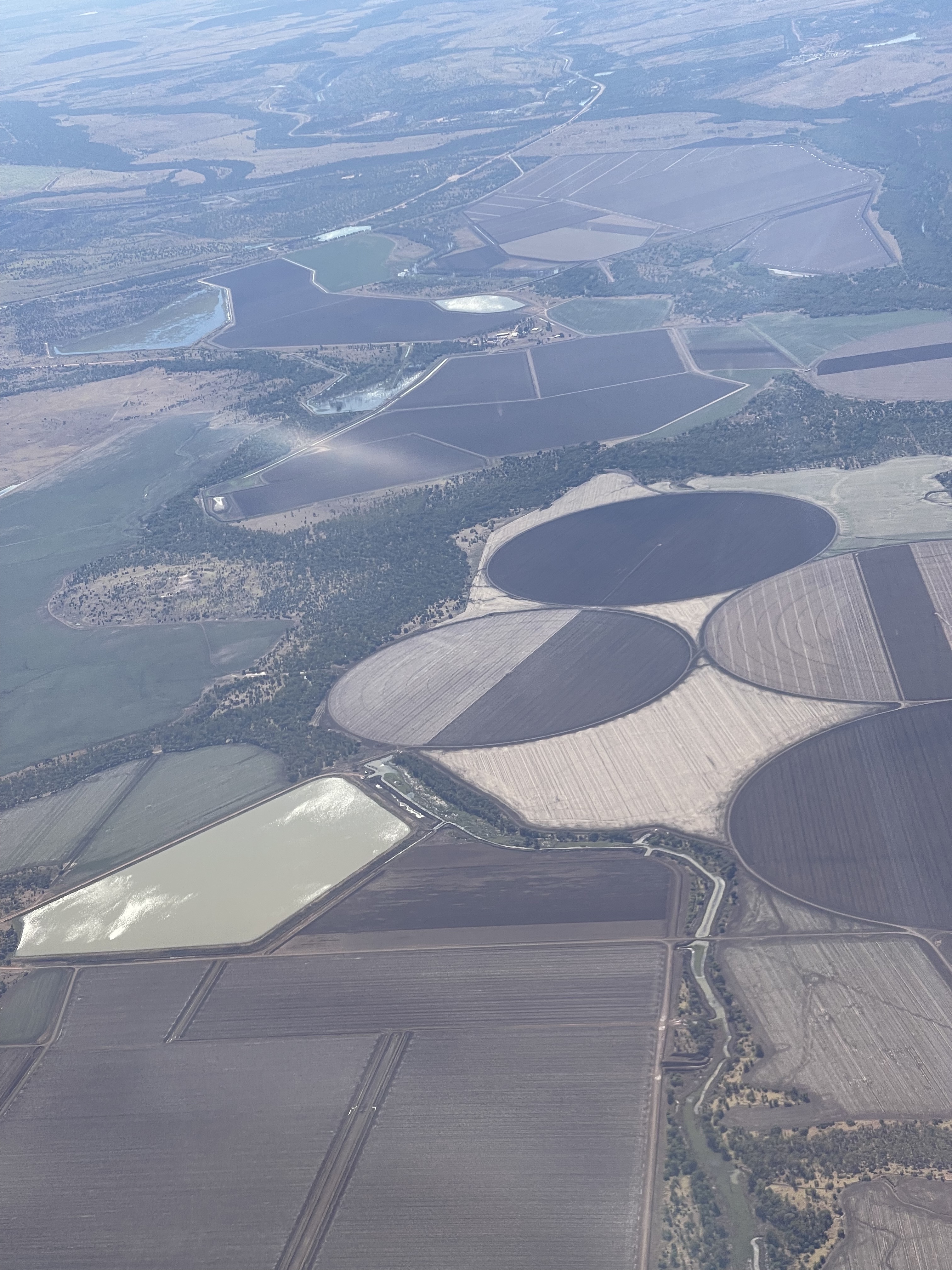
We where we did a quick refuel and ate a sandwich before we were off further east, passing over a cotton gin, some irrigated fields and a Blackwater coal mine.
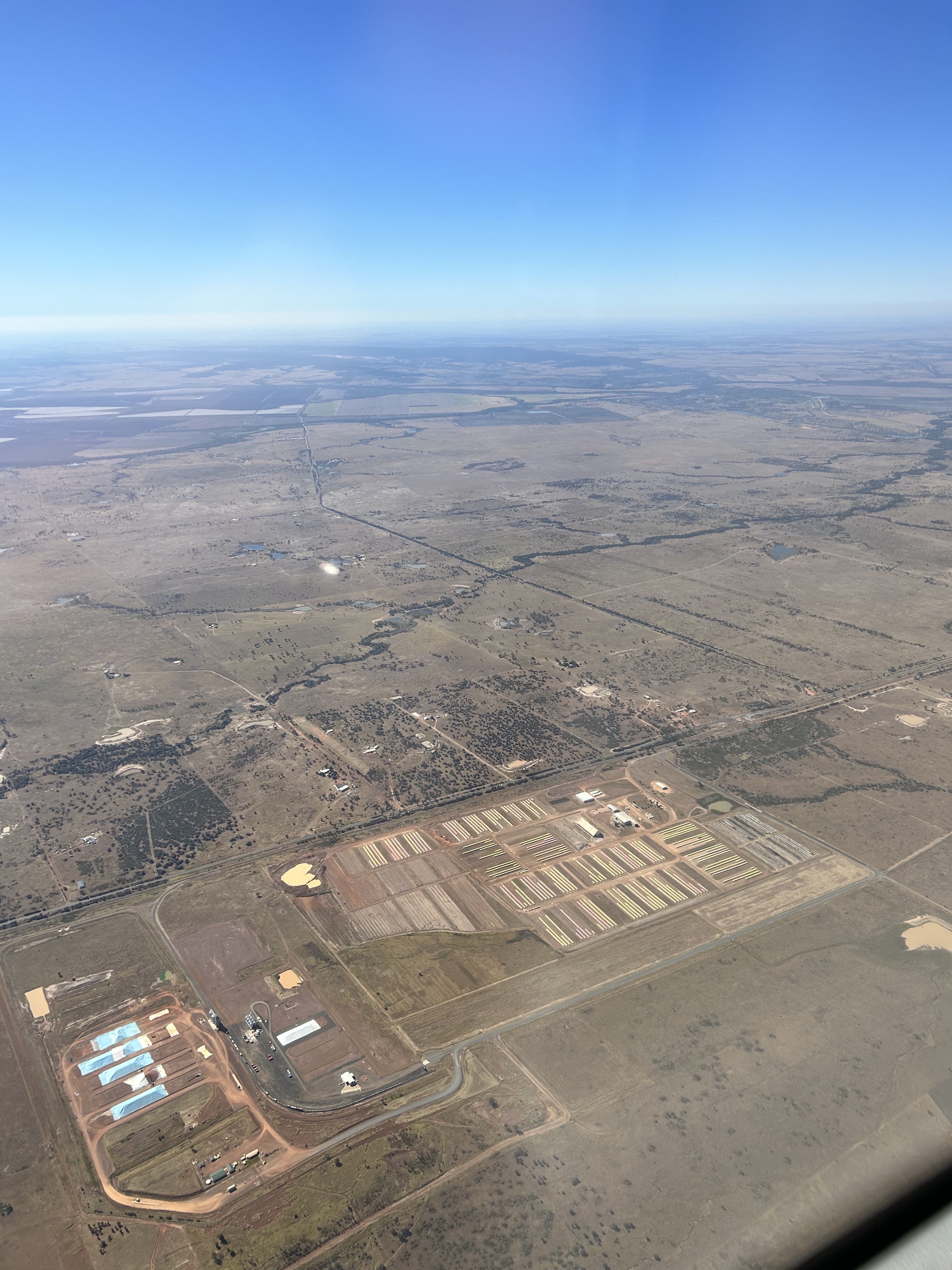
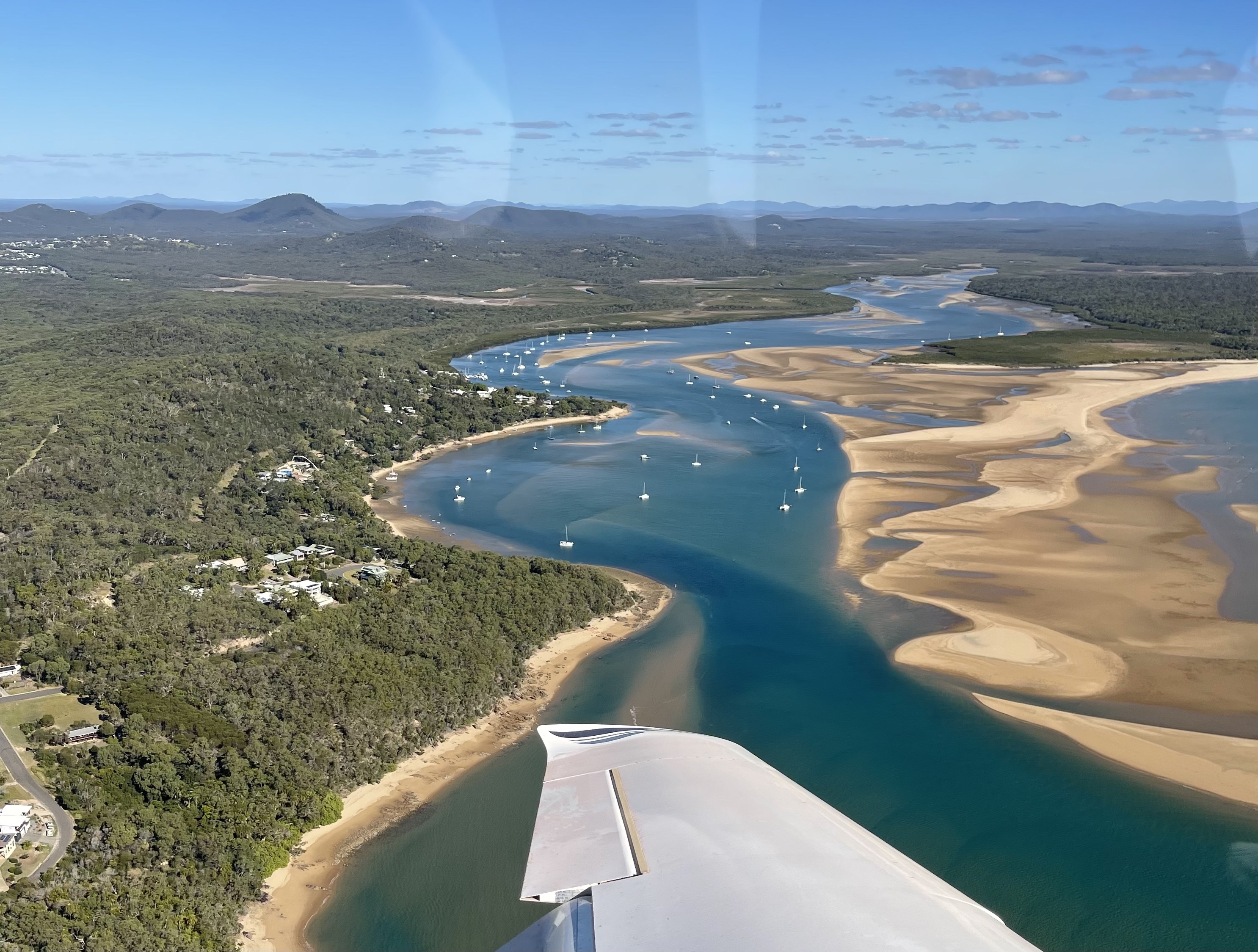
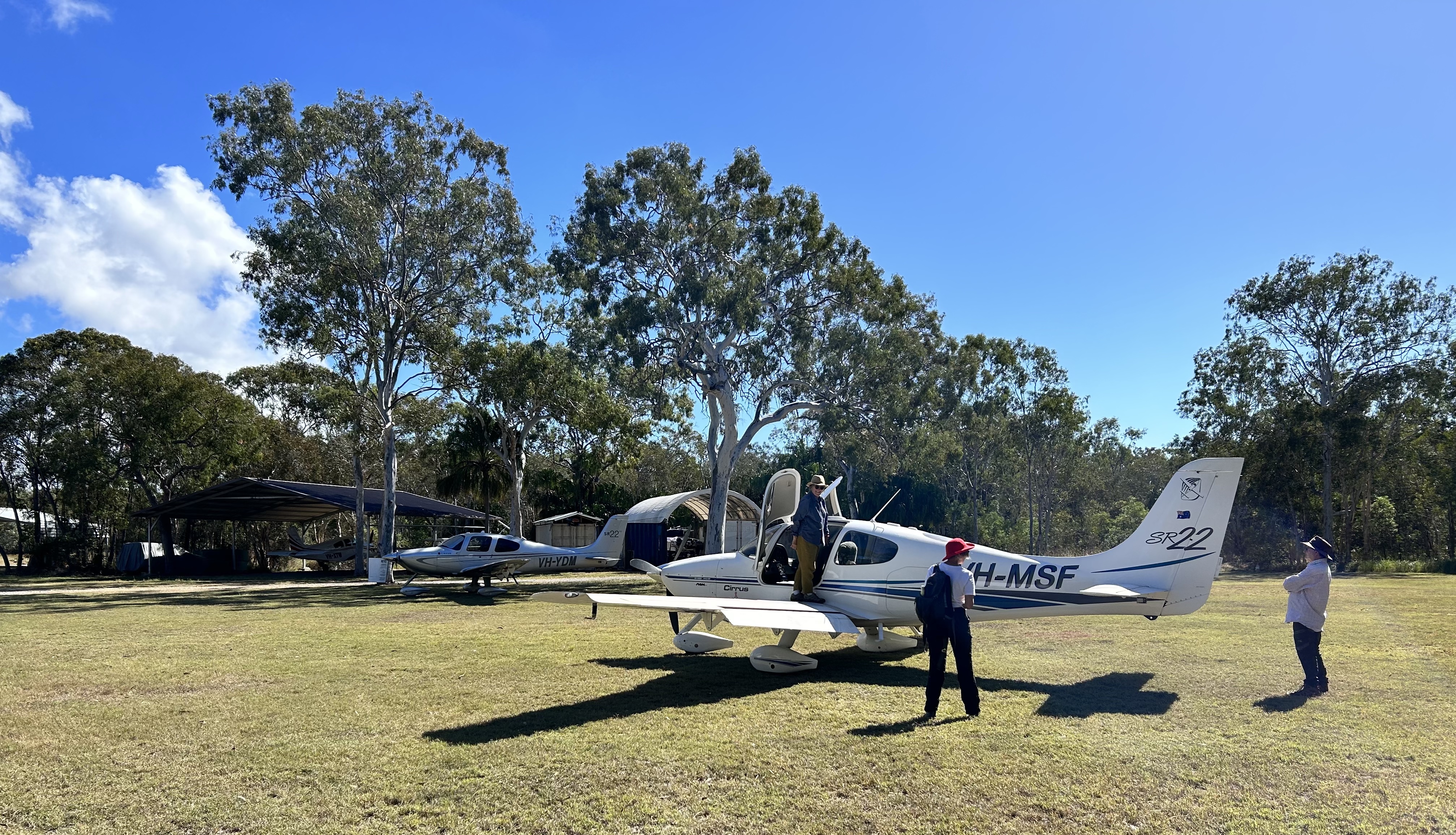
We descended into Agnes Water, still our favourite beach resort, where we’d decided to spend the last two nights of the trip. A few stratocumulus clouds met us as we approached the coast. The first real clouds we’d seen for nearly three weeks. As recommended by resident “ARO” Woody, we did a 300ft overfly to chase away any lingering kangaroos and then returned for a full stop. It was time to relax and enjoy an east coast sunset and sunrise for a change.
One last day at the beach before returning to normality. We made the most of it, enjoying the sunrise, then coffee and breakfast at the Holidays Cafe.
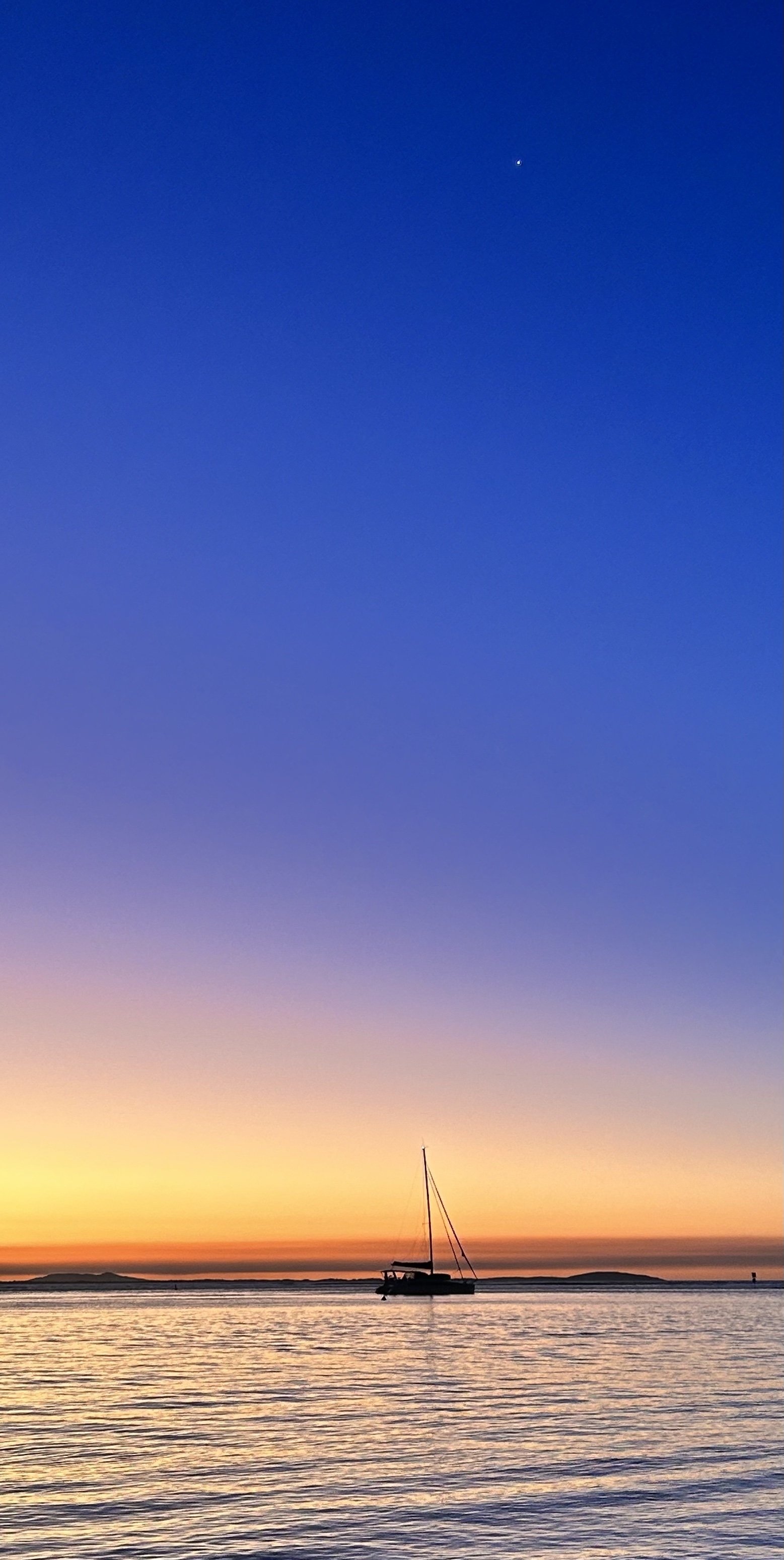
A few walks and a couple of swims and a bit of lazing around filled in the day. Then we caught a taxi to 1770 to enjoy a picnic while watching the sun set.
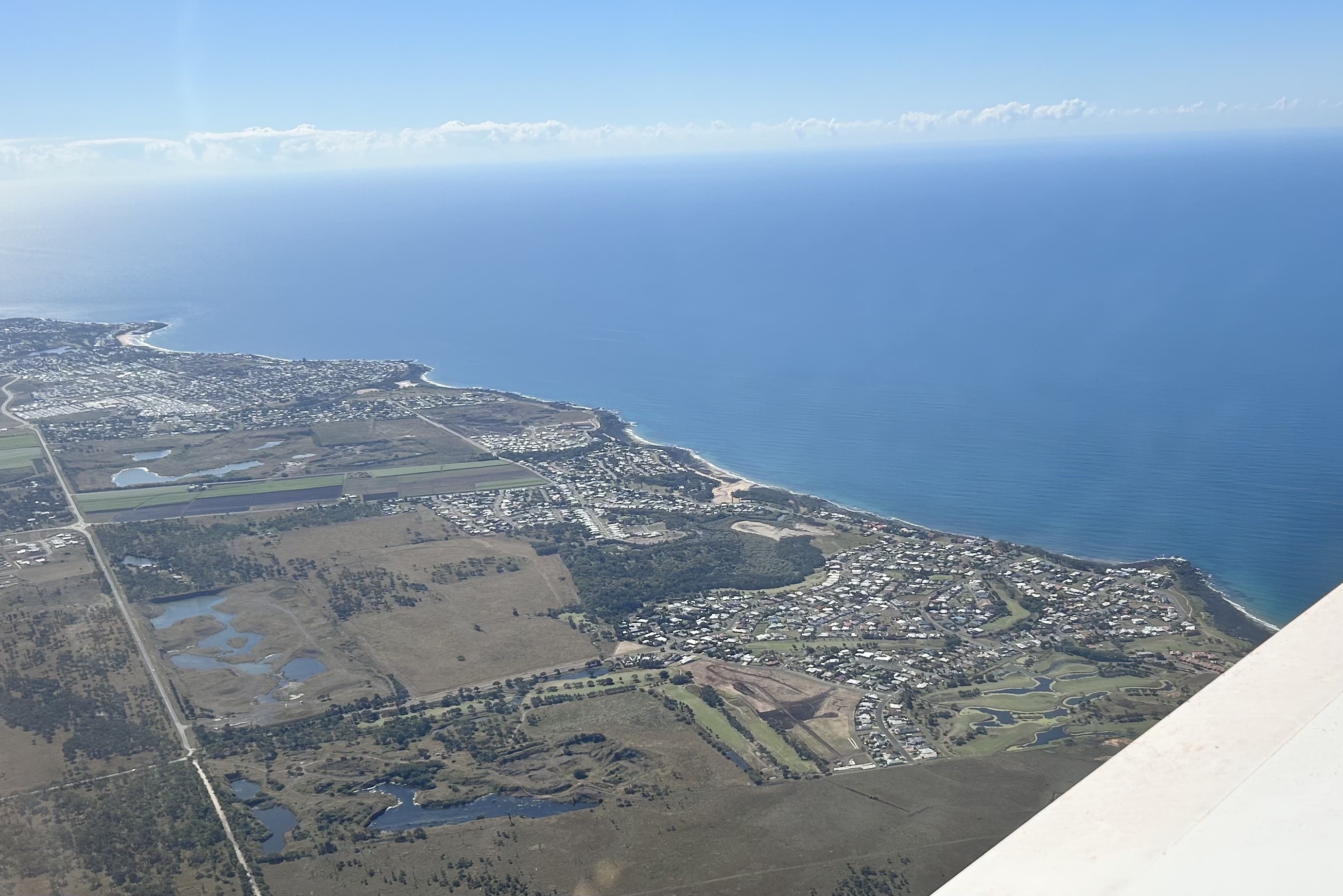
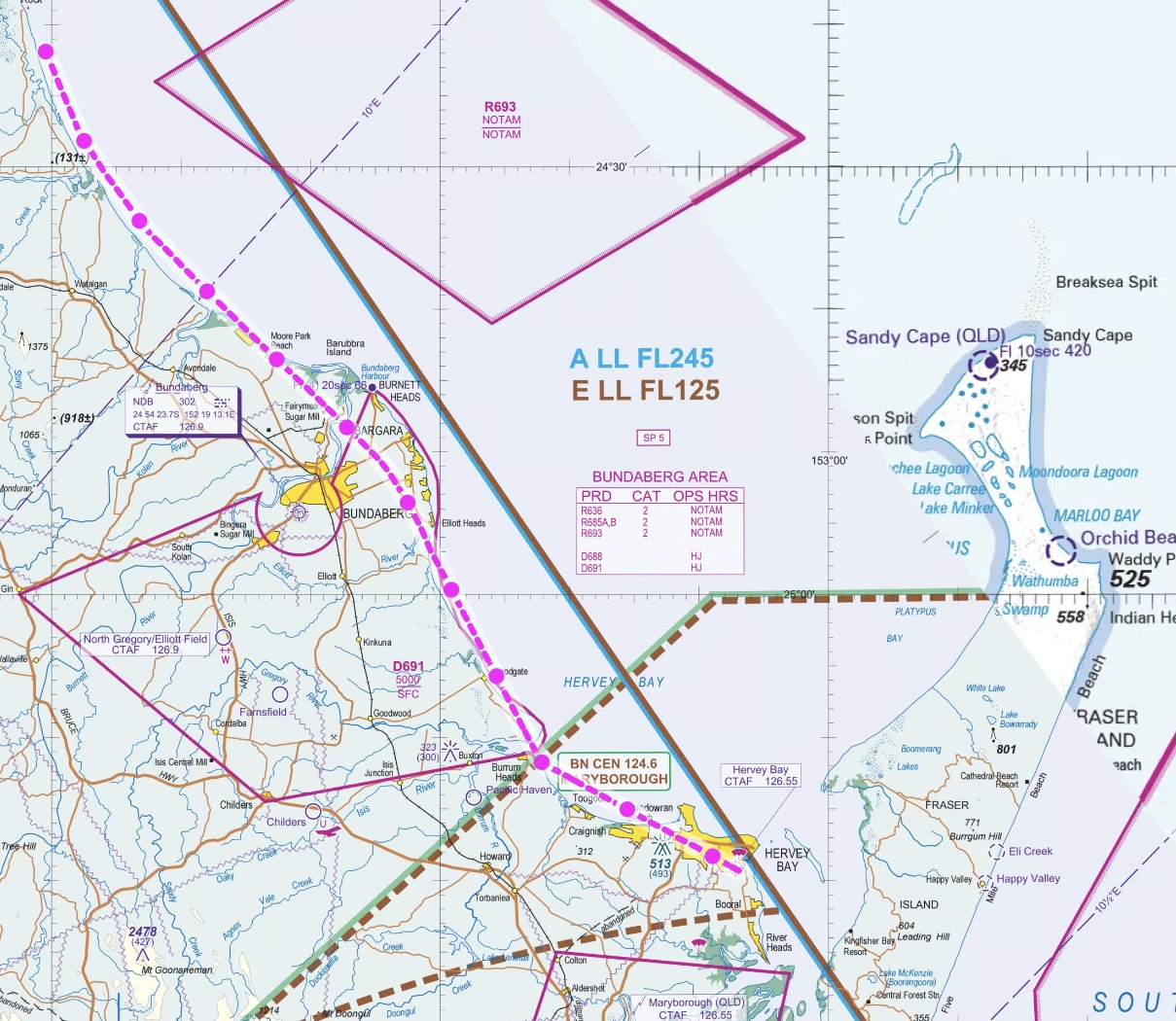
Following a relaxing day at the beaches of Agnes Water and The Town of 1770 we had to refuel once more for our flight back to Redcliffe to finish our Kimberley trip. The decision was to refuel at Hervey Bay so we could have lunch there. We took off and headed south along the coast.
It was another perfect day as we flew along the coast past Bundaberg and Bargara.
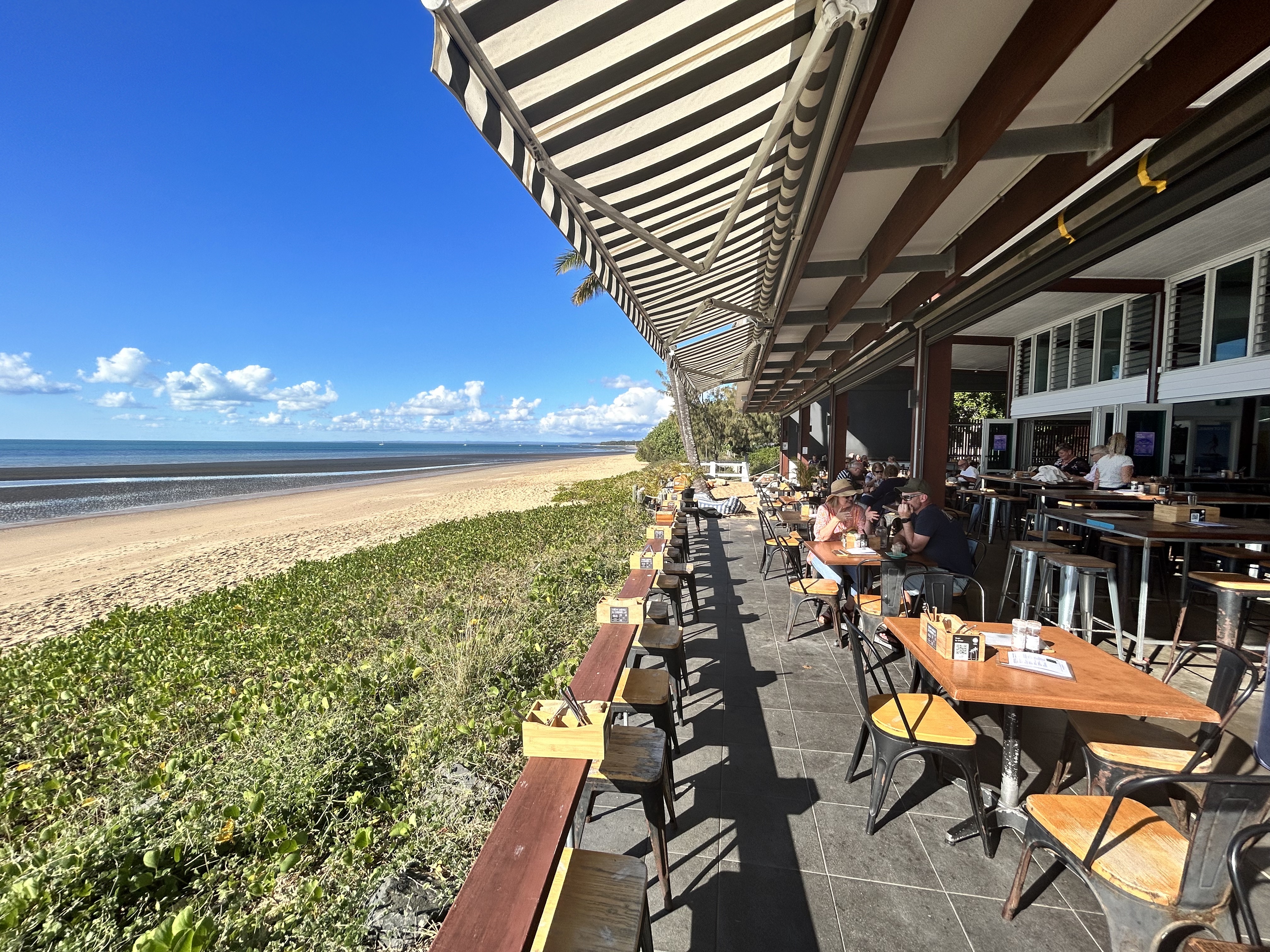
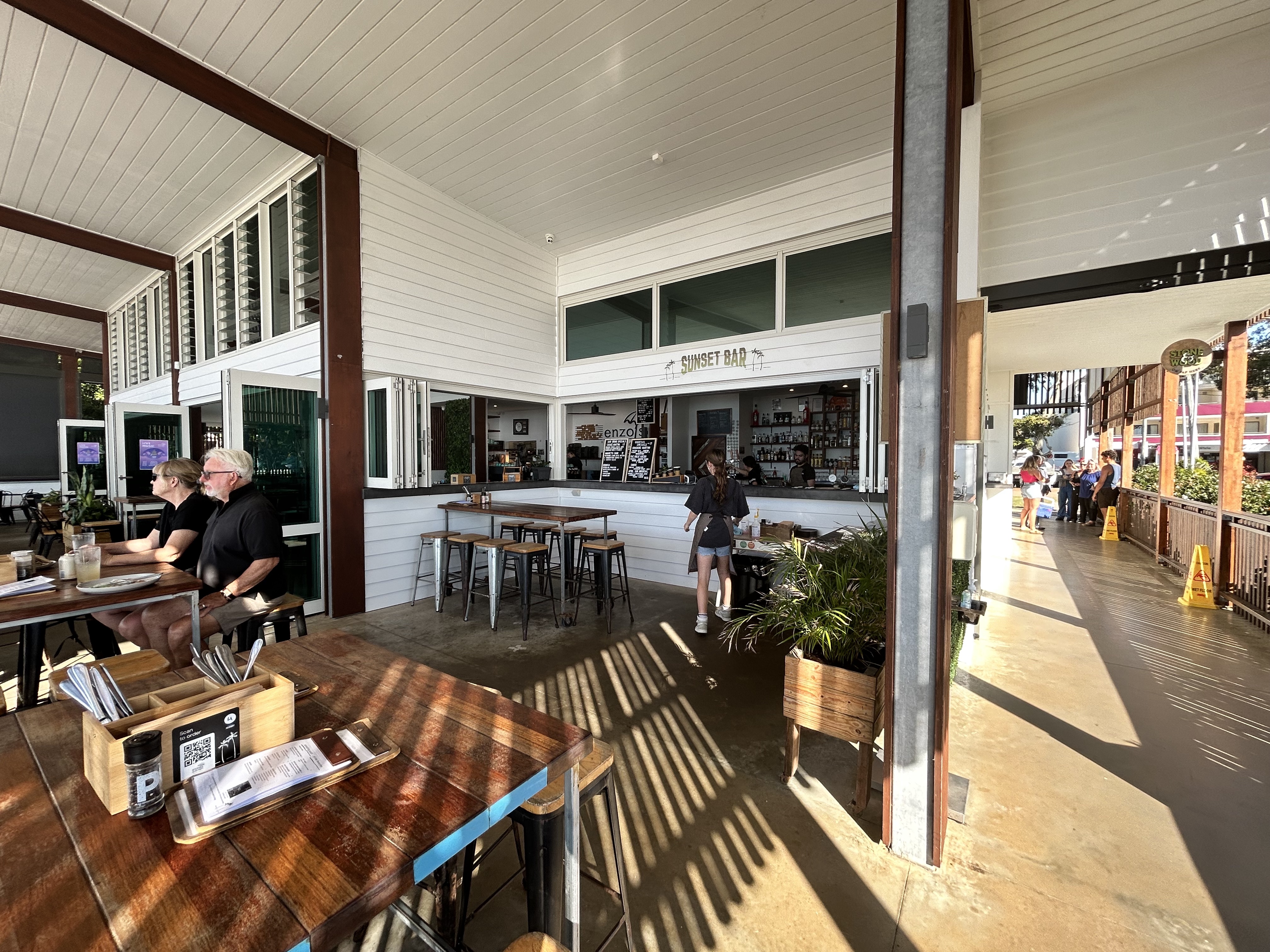
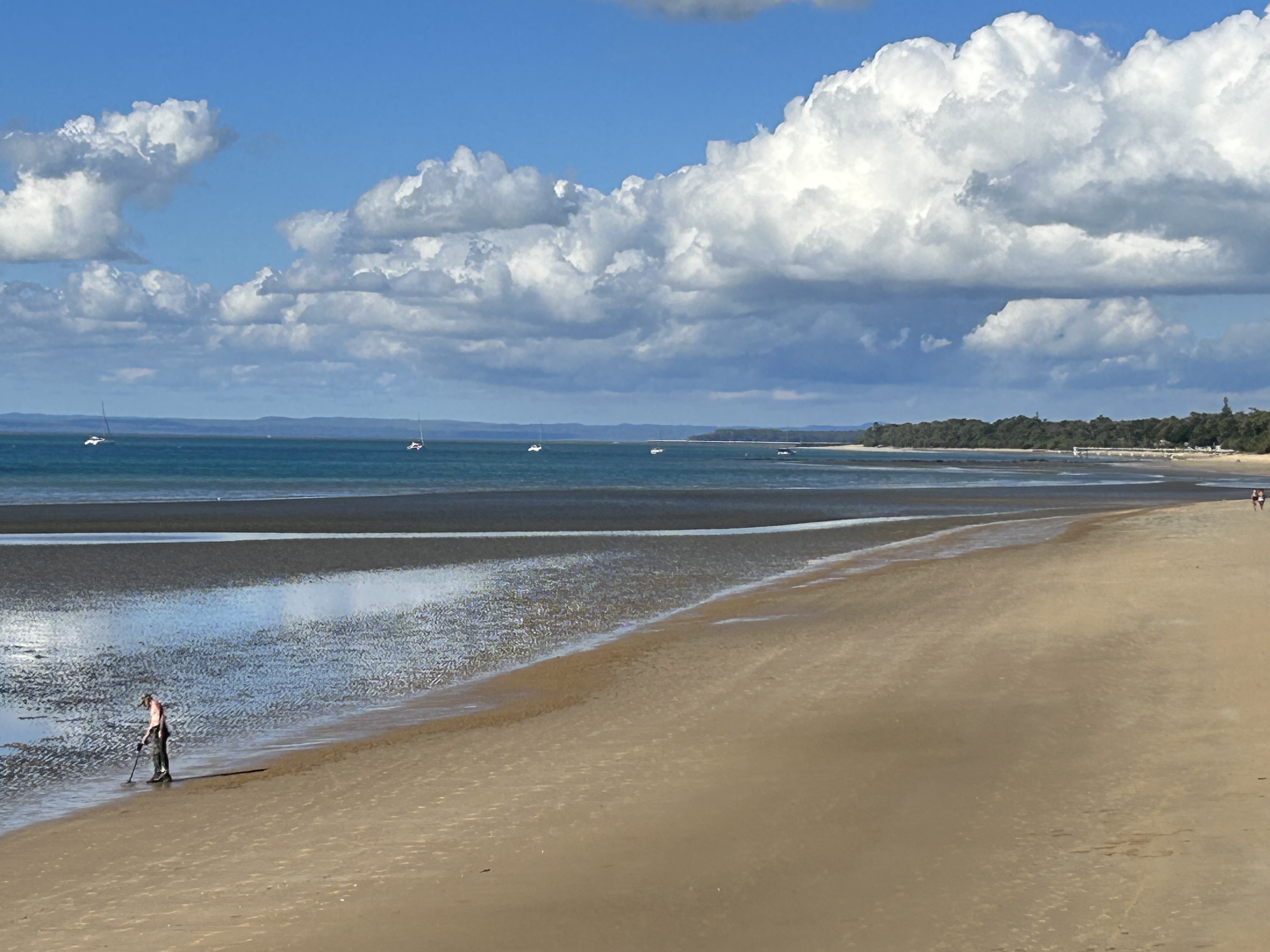
A short taxi ride brought us to Enzo’s on the beach, a great little lunch spot where we could enjoy fish and chips while gazing across the water to K’Gari Fraser Island.
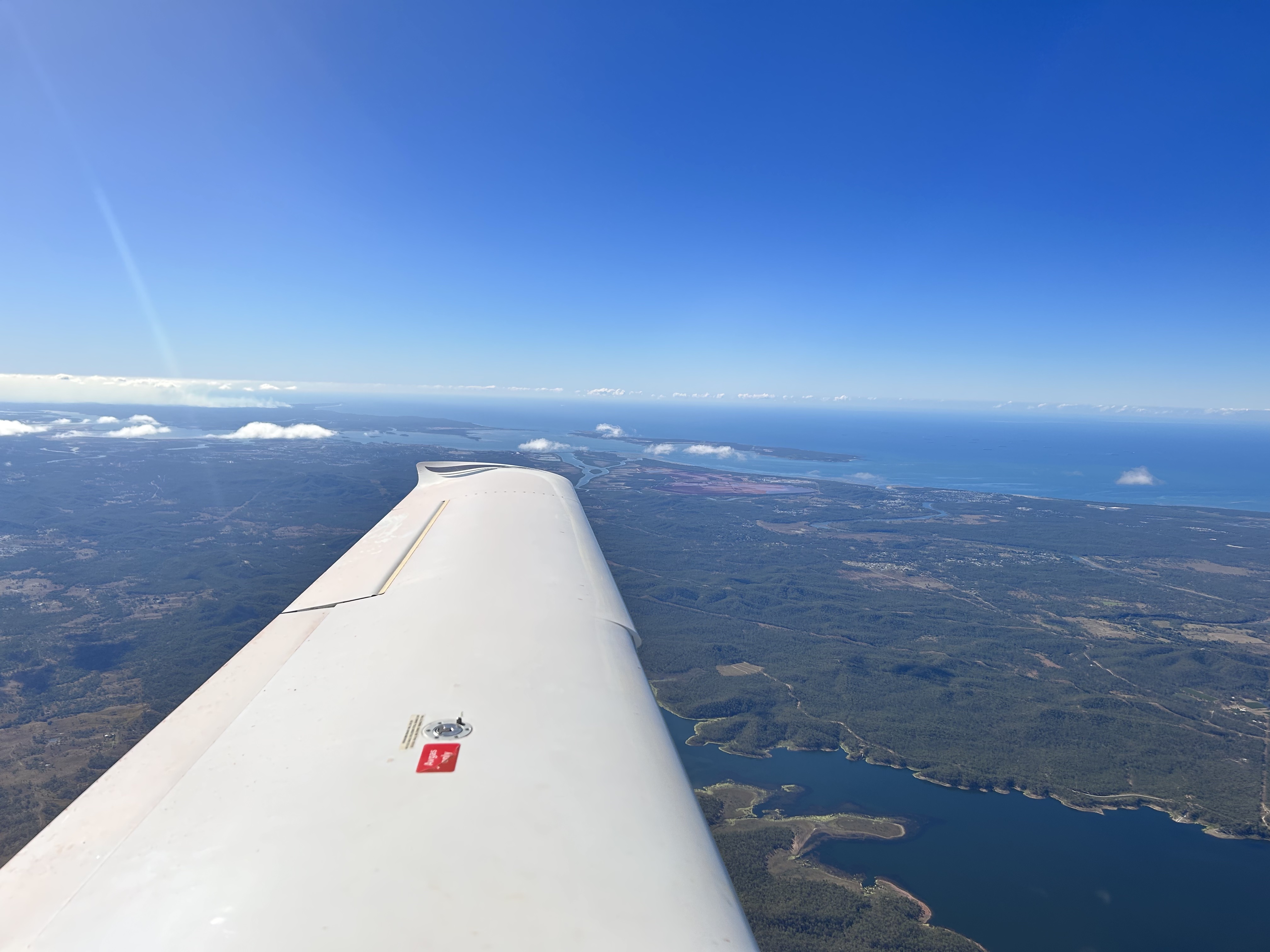
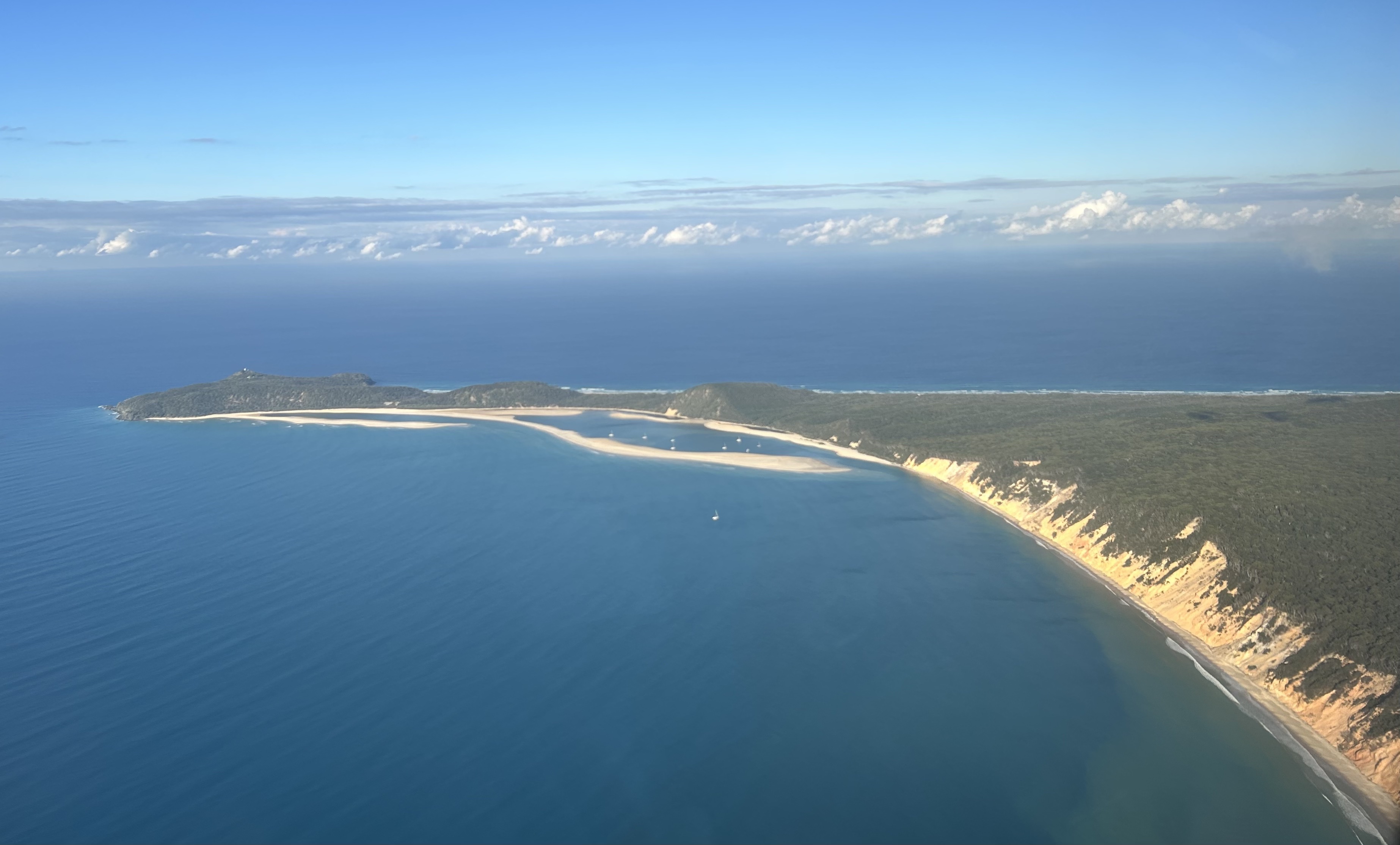
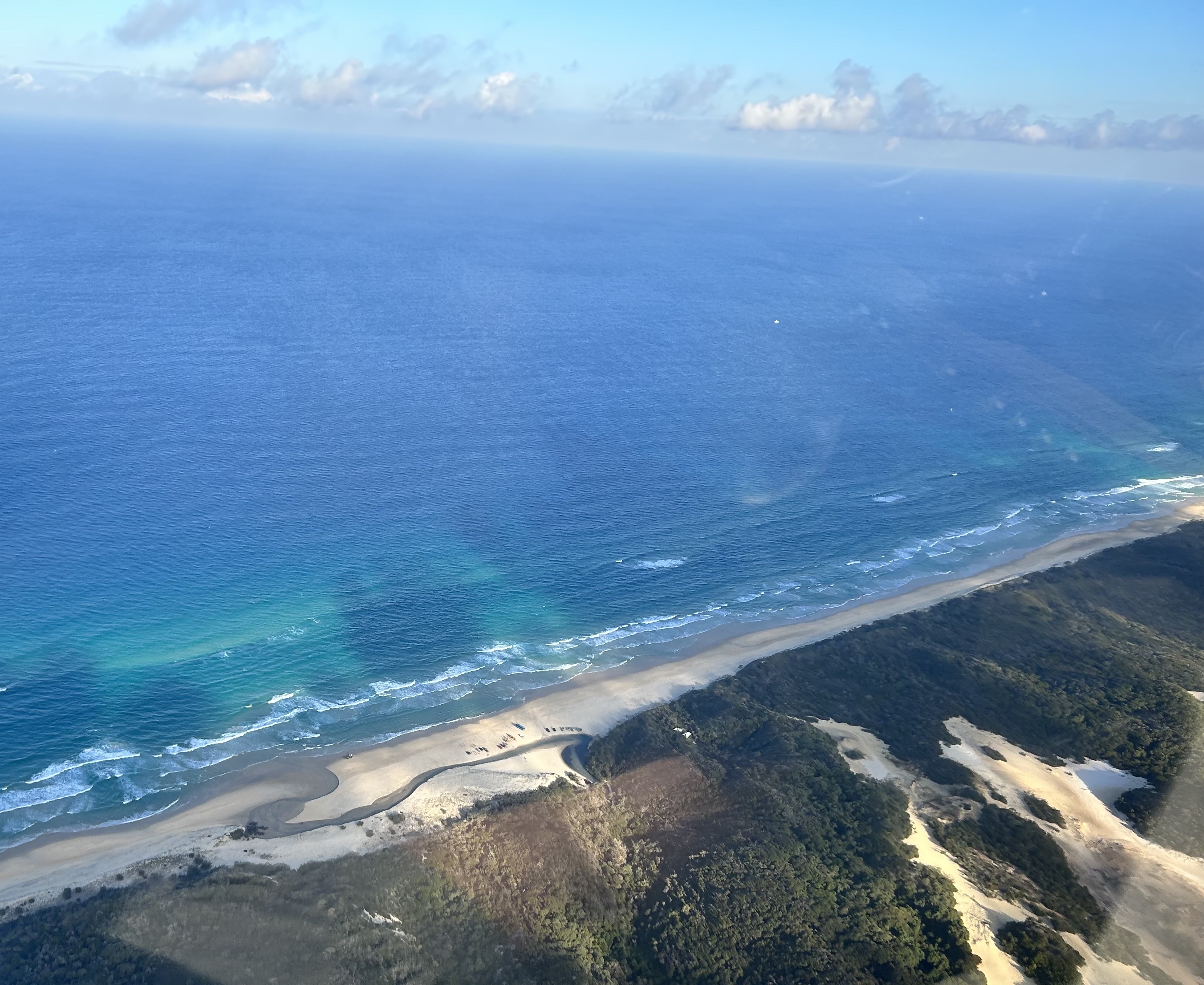
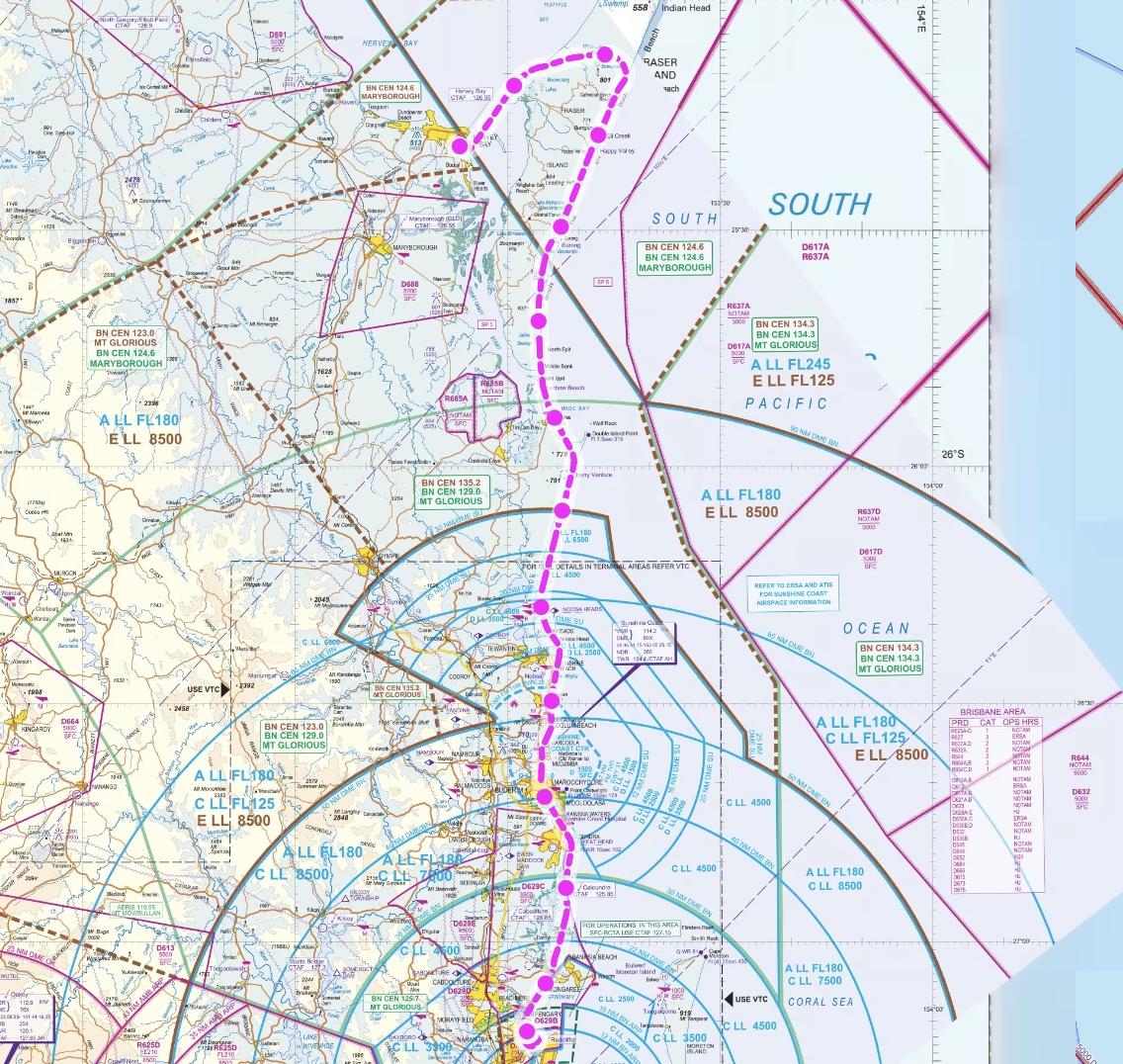
Taking to the air again we tracked for K’gari Fraser Island and flew down the coast at 2000ft past Cathedral Beach, Ely Creek, Eurong and on to Double Island Point before reaching Noosa. A Virgin 737 was taking off from Sunny Coast so we had to fly over the top of the airport to avoid his wake turbulence then on past Caloundra and over Bribie Island to Redcliffe.
We were home. Just in time for our monthly aero club barbecue.
It had been an amazing trip of over 4700 nautical miles and 33 tacho hours over 22 days. The Kimberley is definitely one of the most scenic parts of the country, even if you have to fly a long way to get there. I must give a plug for Birgit Bradke’s excellent downloadable pdf travel guide “Destination Kimberley”. At $32.70 it is a bargain. I bought it online in 2019 when I was first planning this trip and it was extremely helpful in identifying the best places to go. Once you buy it Birgit updates it annually for free so you have up to date information whenever you finally get to go (in my case almost 4 years later). And I’d also like to give thanks to Alec Munro from AviAir who was so willing to share his knowledge of the Kimberley with me both before and during the trip. The guys at the Tower in Broome were also very kind. I recommend a trip to Kimberley to anyone who can spare the time and the resources to get there.
Drysdale River – Derby – Horizontal Falls – Cygnet Bay – Broome – Halls Creek – Purnululu Bungles
It was the 22nd May 2023 and the start of the second week of our flying safari in the Kimberley. Just when we thought the trip couldn’t get any better, it did.
Departing Drysdale River Station
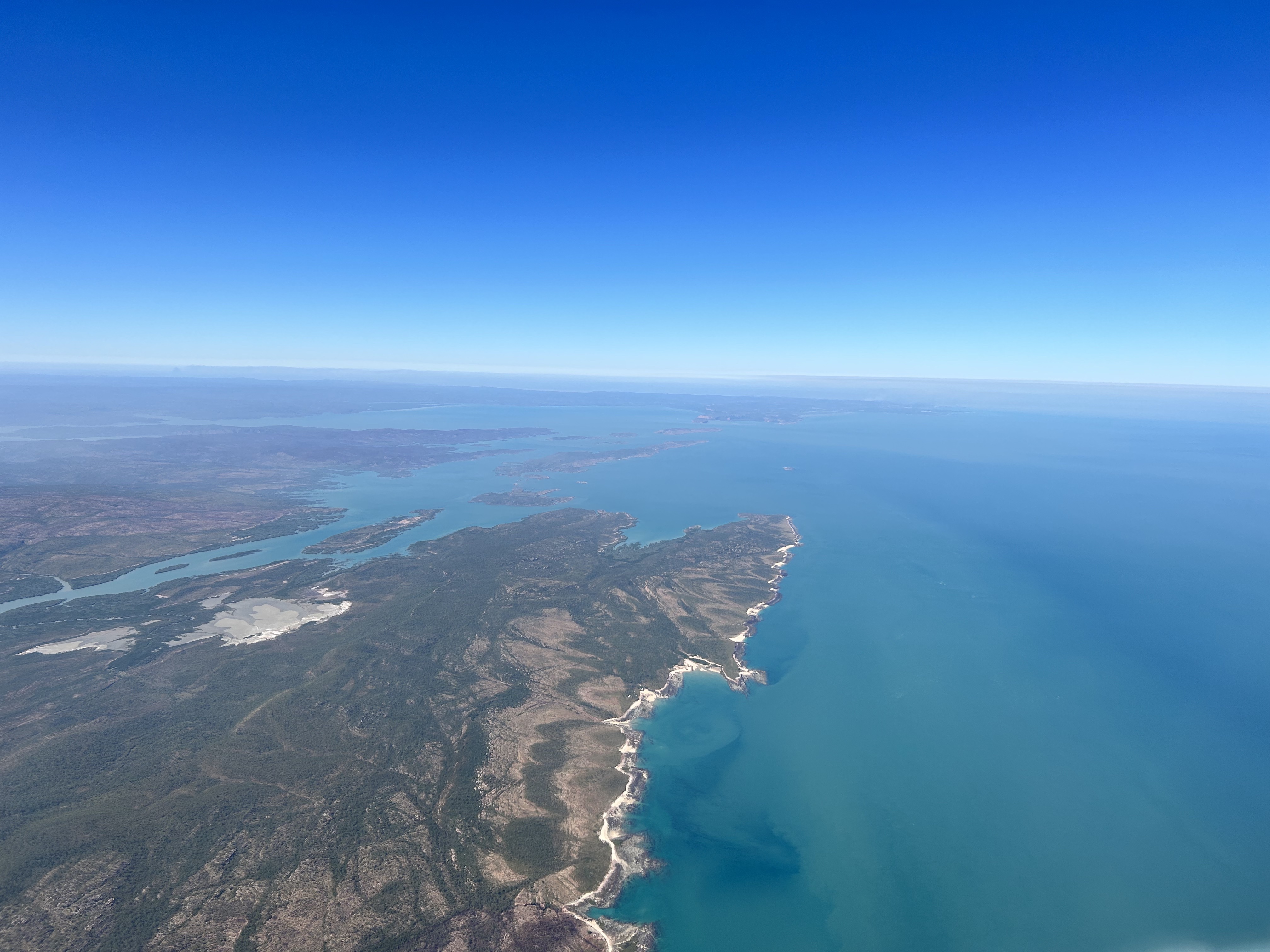
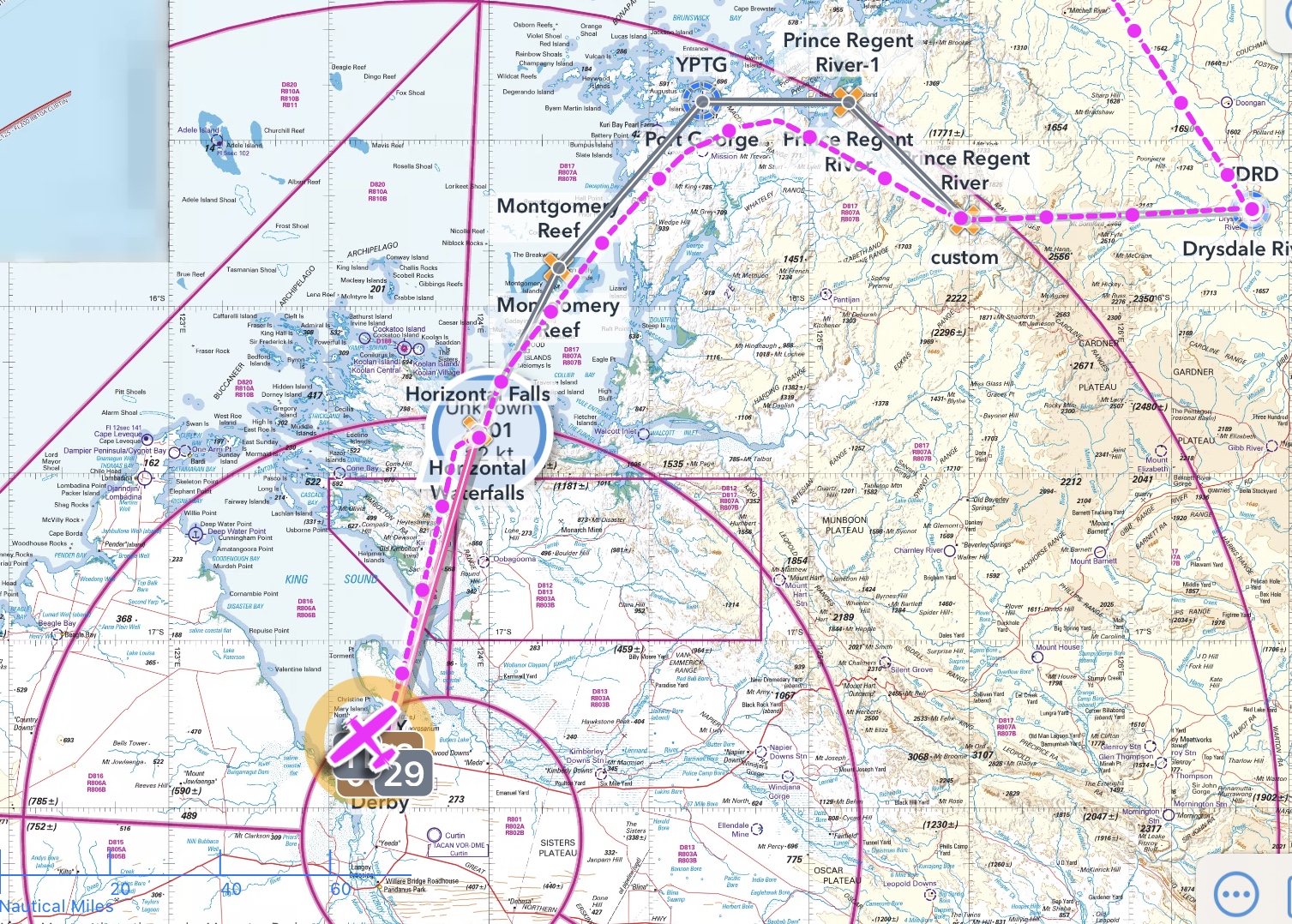
From Drysdale River we had an exceptionally scenic flight over the Prince Regent River and along the coast to Horizontal Falls. The Prince Regent River bed is in a fault line that runs NW to SE for some 50 or so miles in a pretty straight line. It delivered us to the Bonaparte Archipelago with its hundreds of islands and waterways.
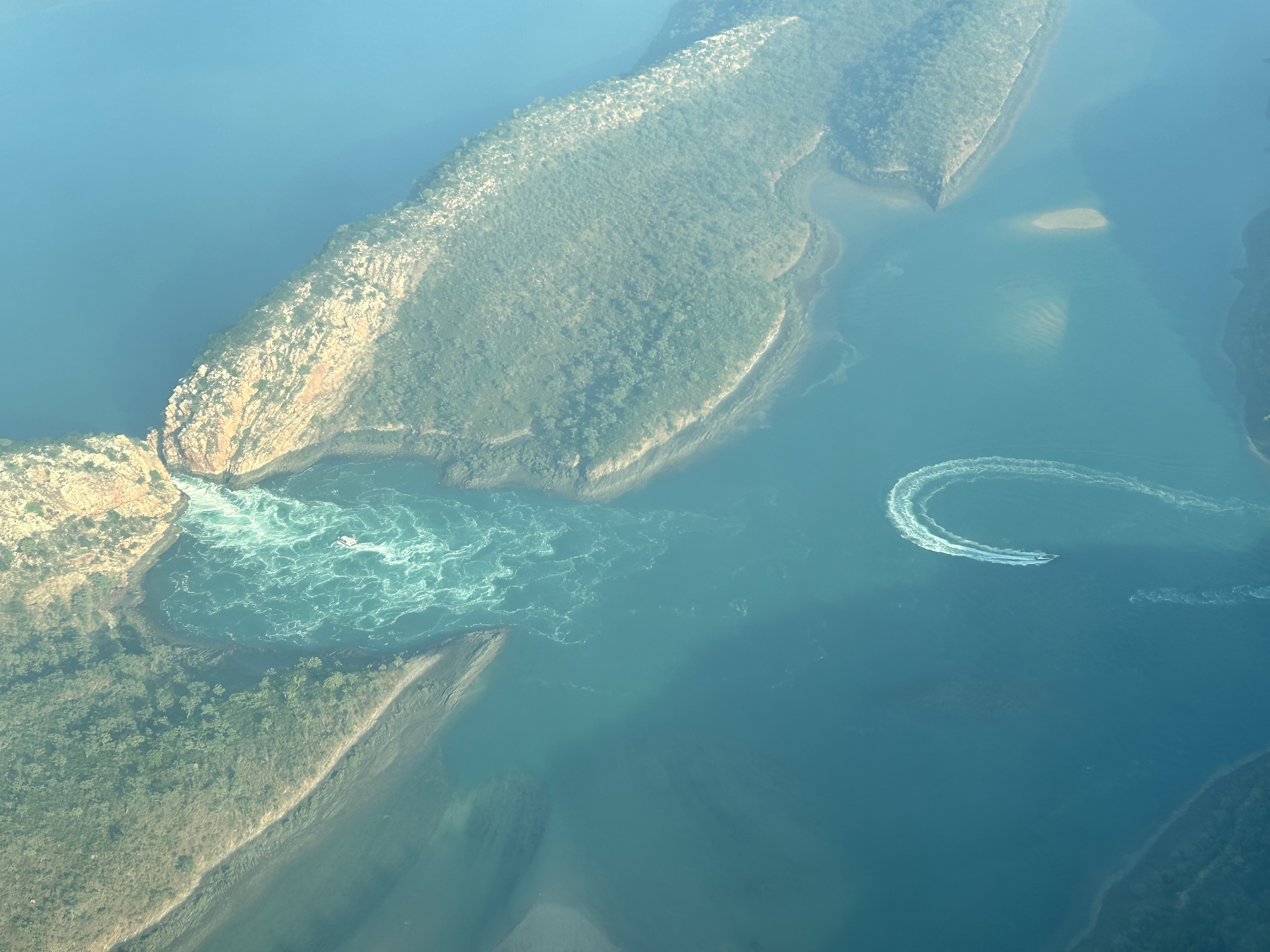
The coastal part passed over Montgomery Reef before reaching Horizontal Falls where we did an orbit over the top to check out where we’d be staying that evening. From there it was a 20 minute hop to Derby.
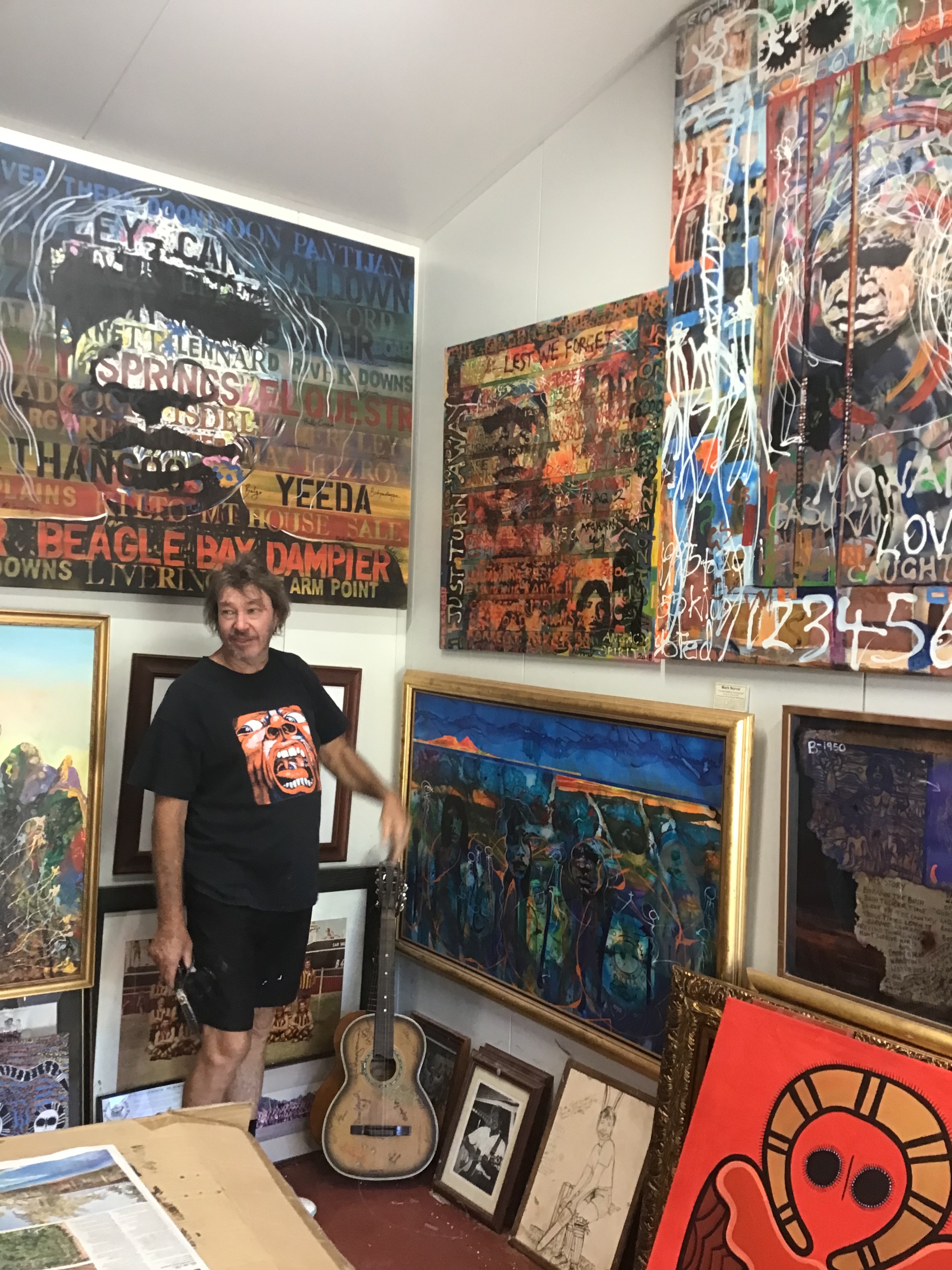
We had a few hours to kill before we’d be delivered to the Falls by seaplane so called a taxi (thanks to “DLA” in OzRunways notes for the phone number) into town and visited the Mark Norval Gallery. Mark is an art teacher who has lived in Derby with his wife Mary for 40 years and has helped develop the artistic talents of local indigenous people. His gallery has an amazing array of traditional and modern art by artists from all over the north of WA. He also has a huge collection of vinyl LPs.
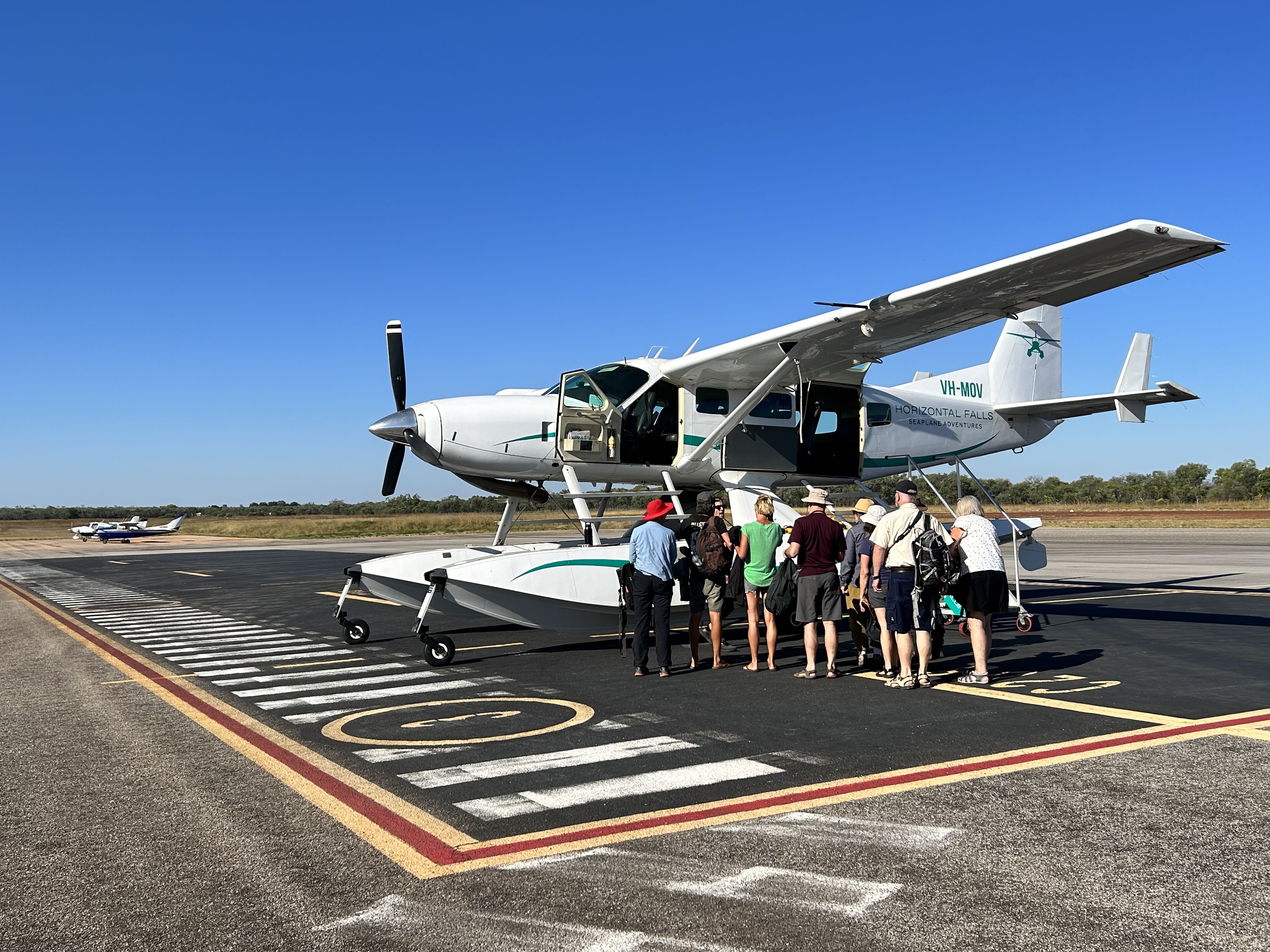
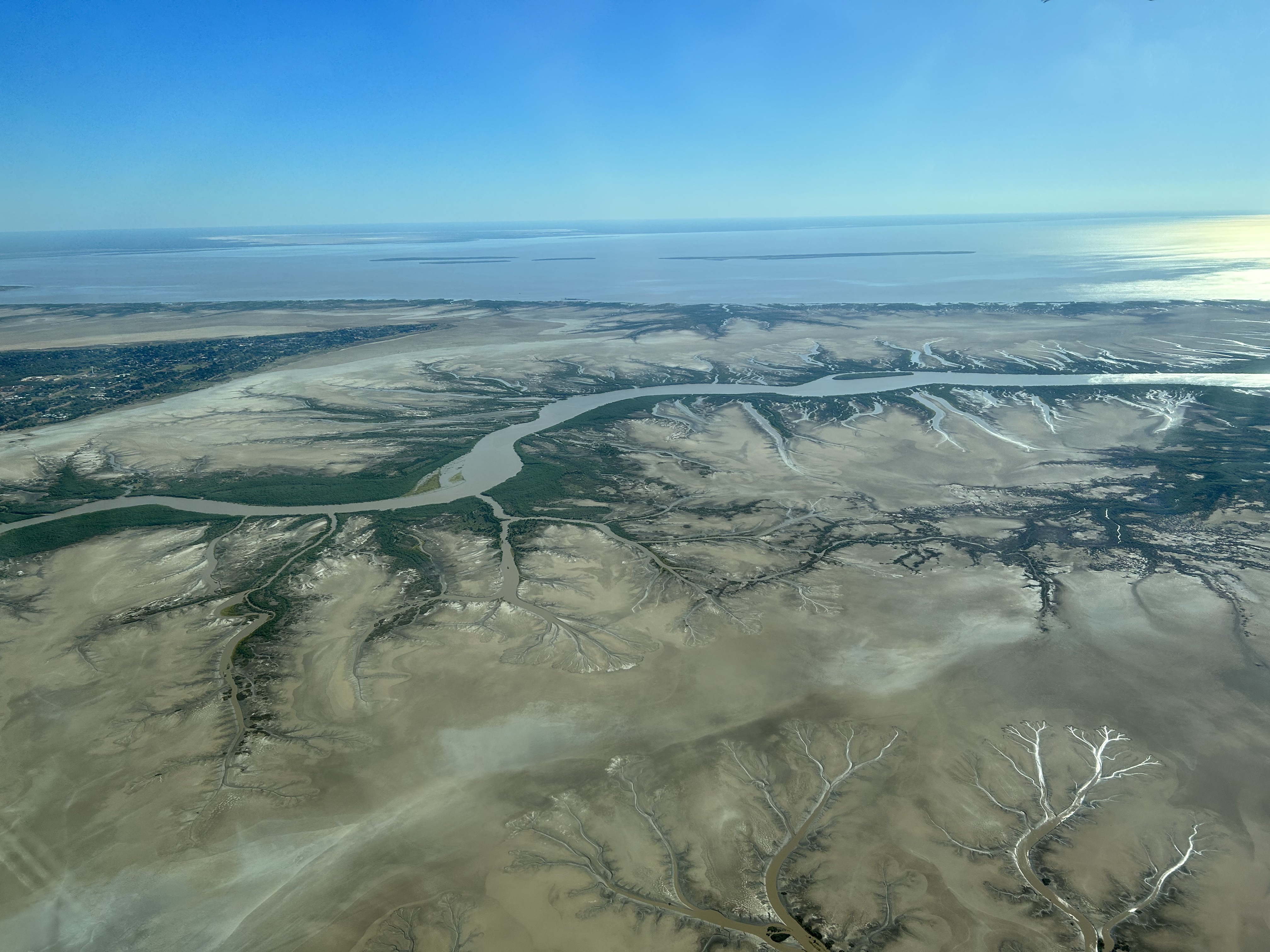
Back at the airport Izzy our seaplane pilot helped us aboard the amphibious Cessna Caravan for the 30 minute flight back to Horizontal Falls. With the sun lower in the sky and a prime window seat for all on board we had spectacular views of the country north east of King Sound with its thousands of islands and promontories.
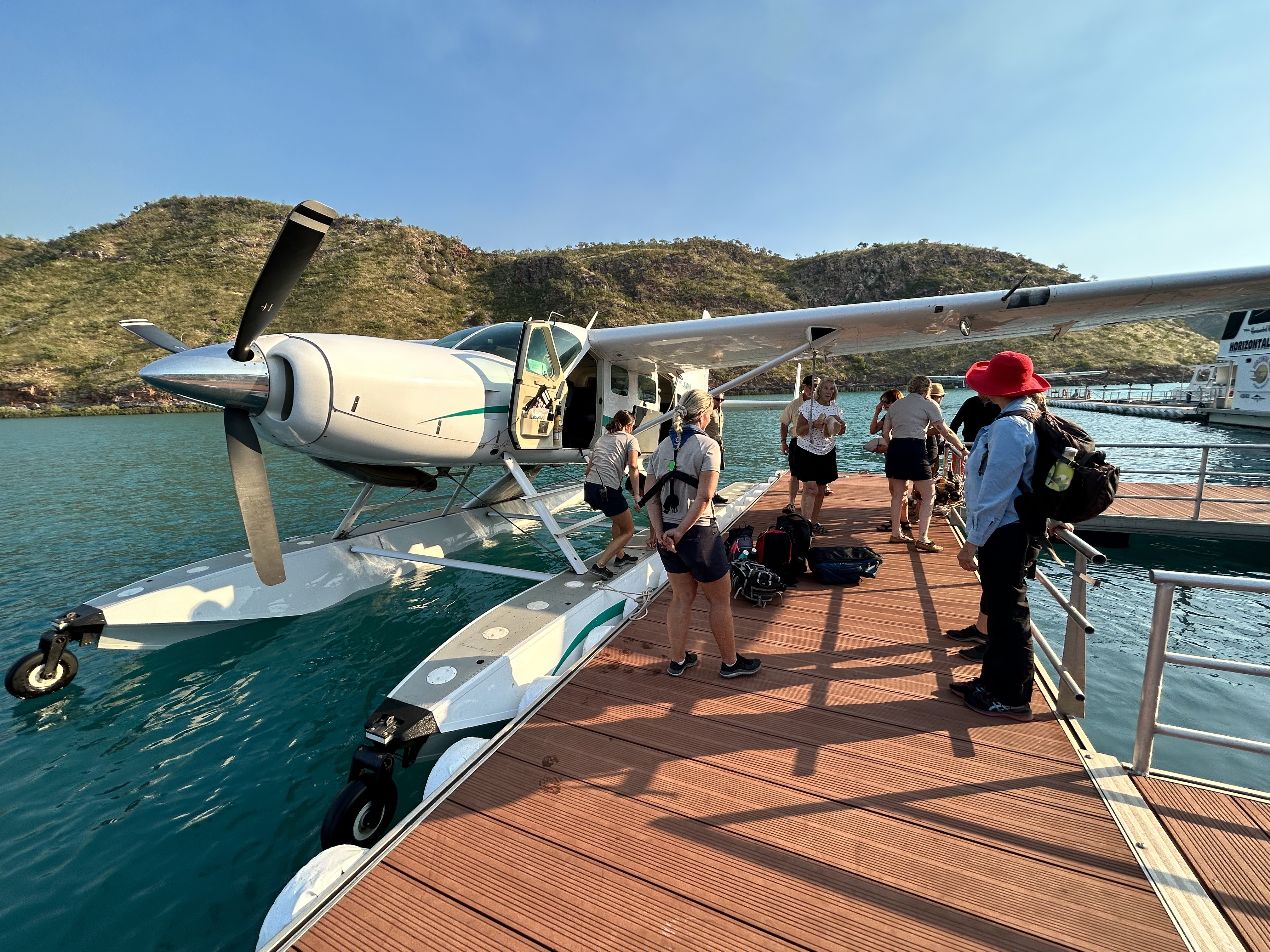
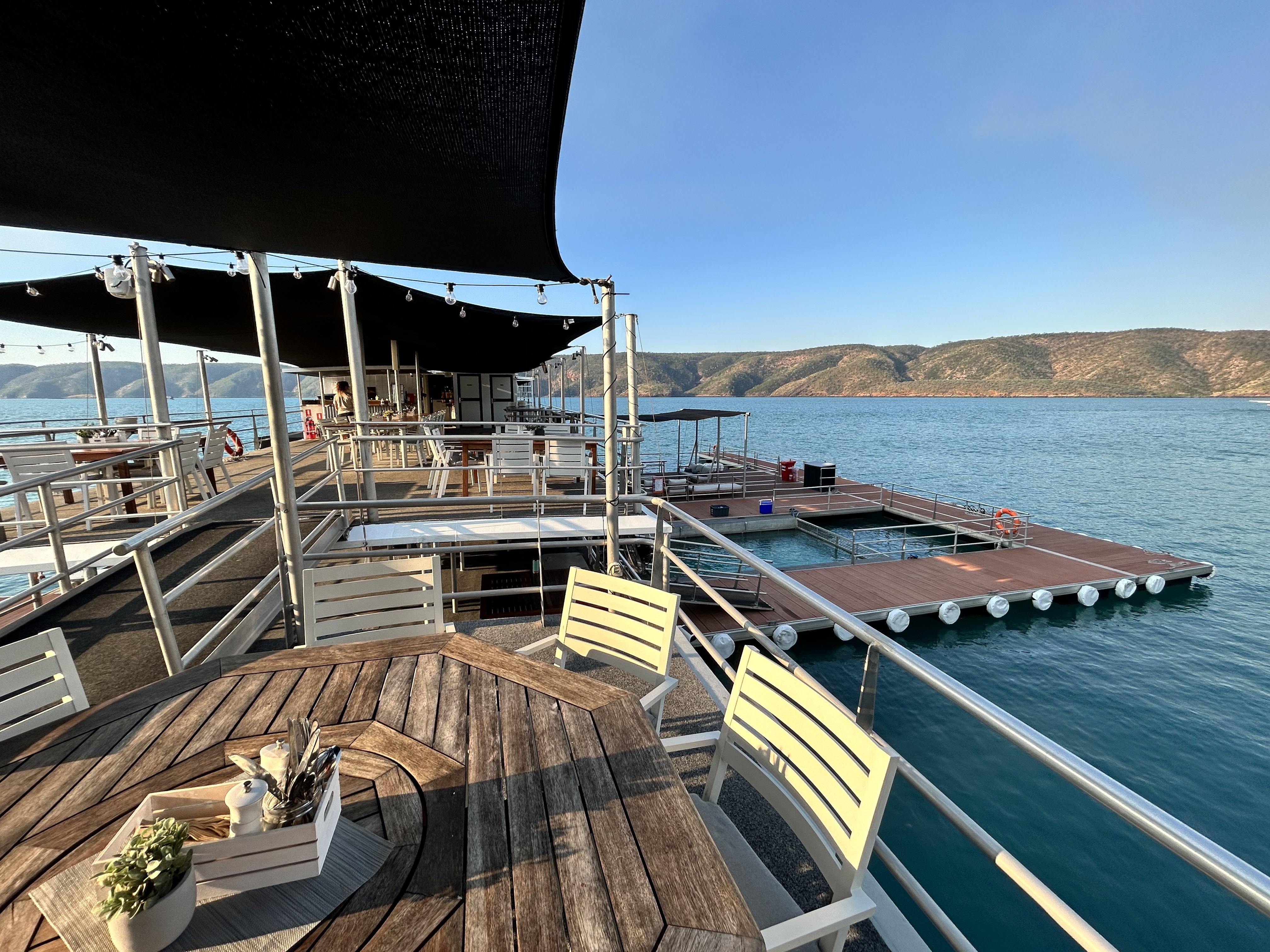
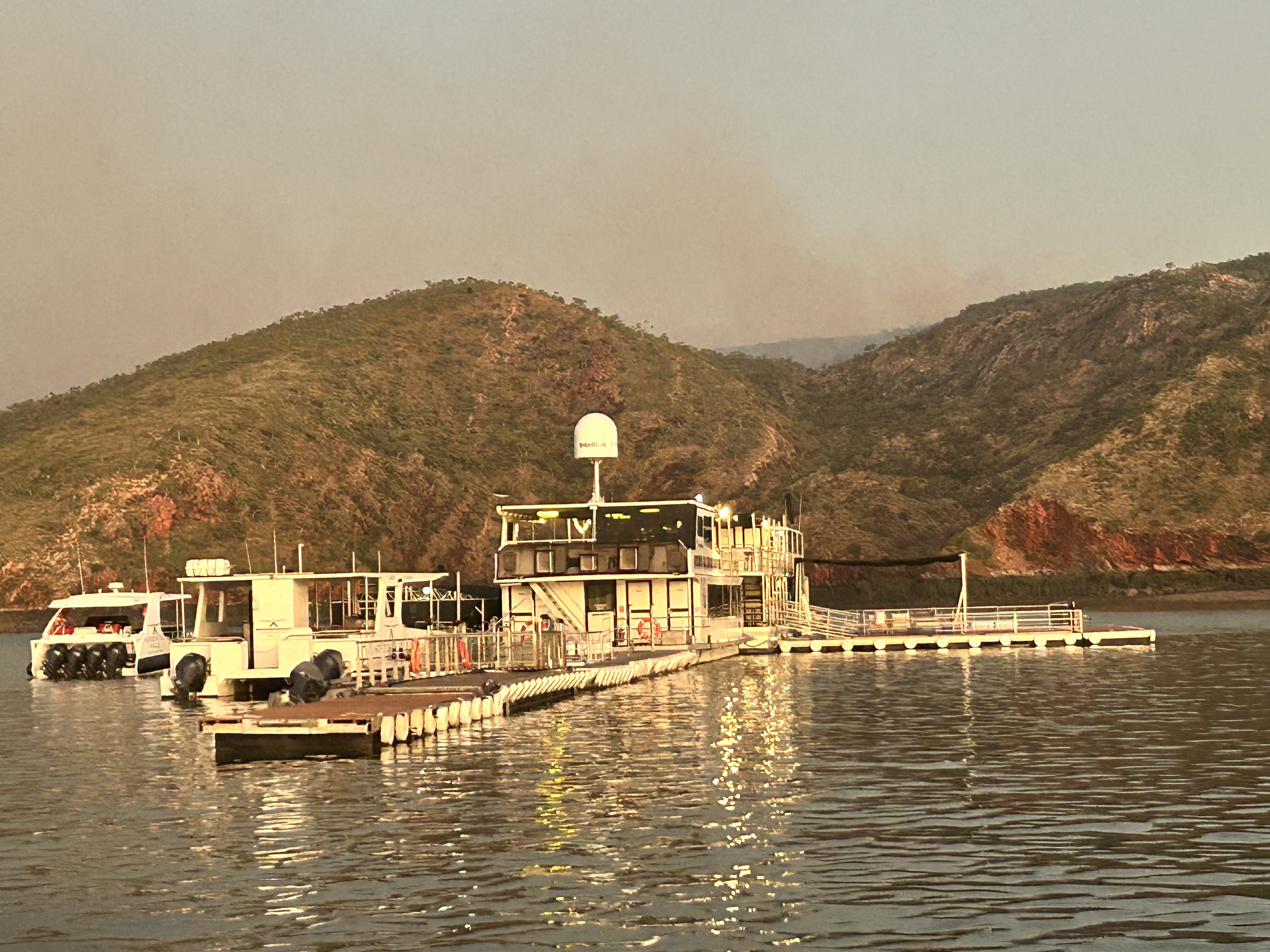
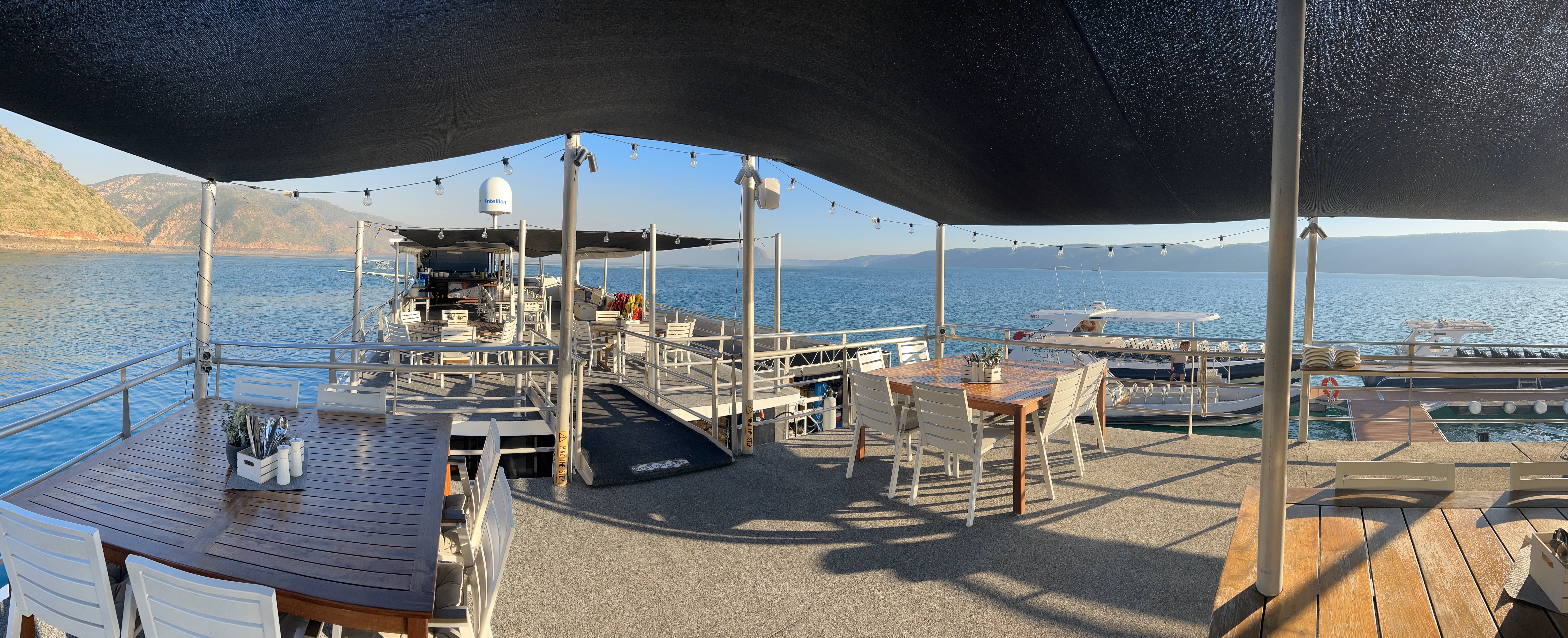
Landing on the water next to our floating hotel we felt like we’d entered some sort of James Bond movie. It was populated with smart young girls whose hospitality skills surpassed anything I’ve seen for a while. It felt pretty special as the 10 of us who were staying overnight were greeted as the day visitors departed on a couple of sea planes bound for Derby. The check in was followed by a shark feeding demonstration where we could swim next to the sharks (separated by a metal grill).
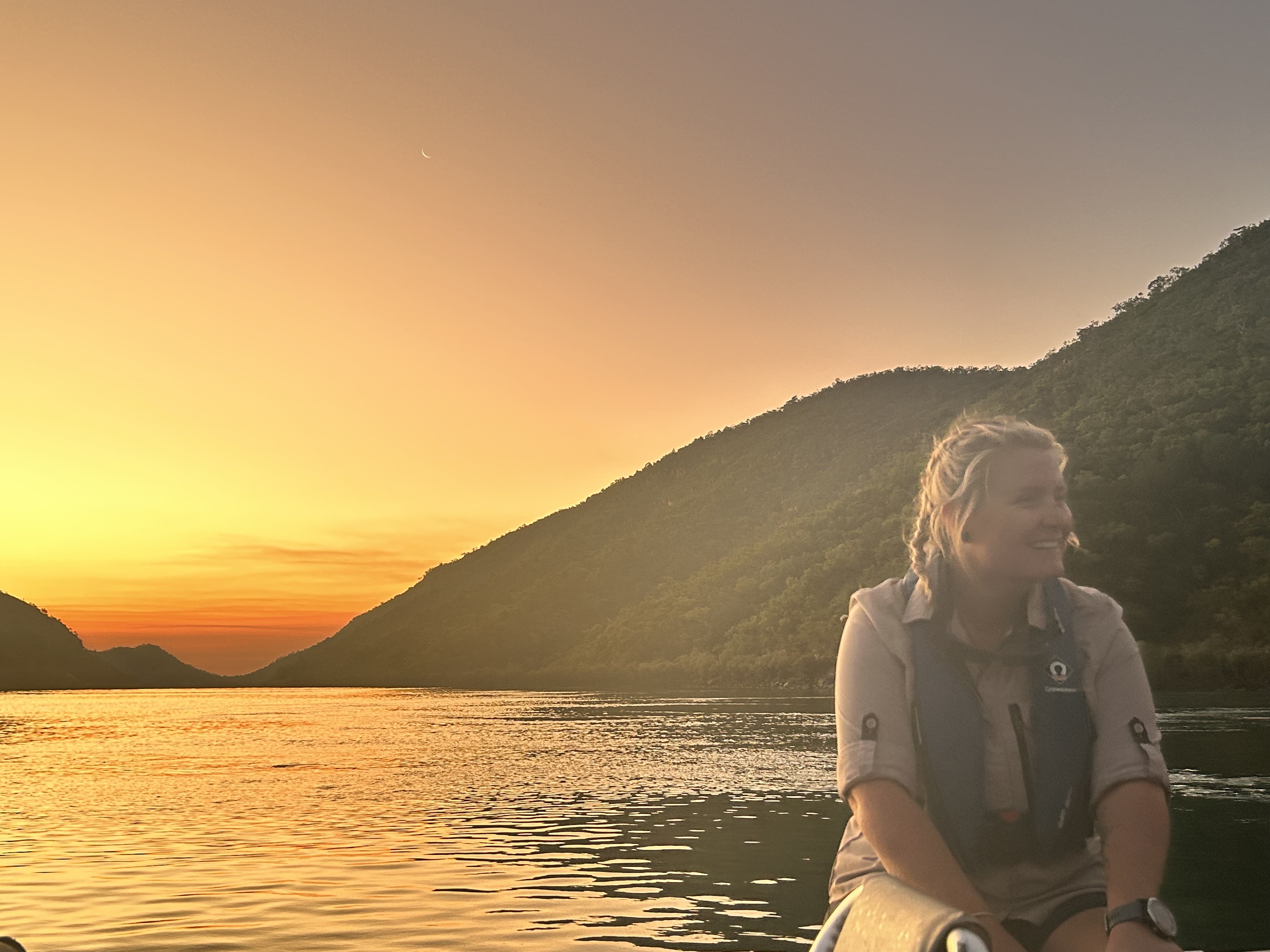
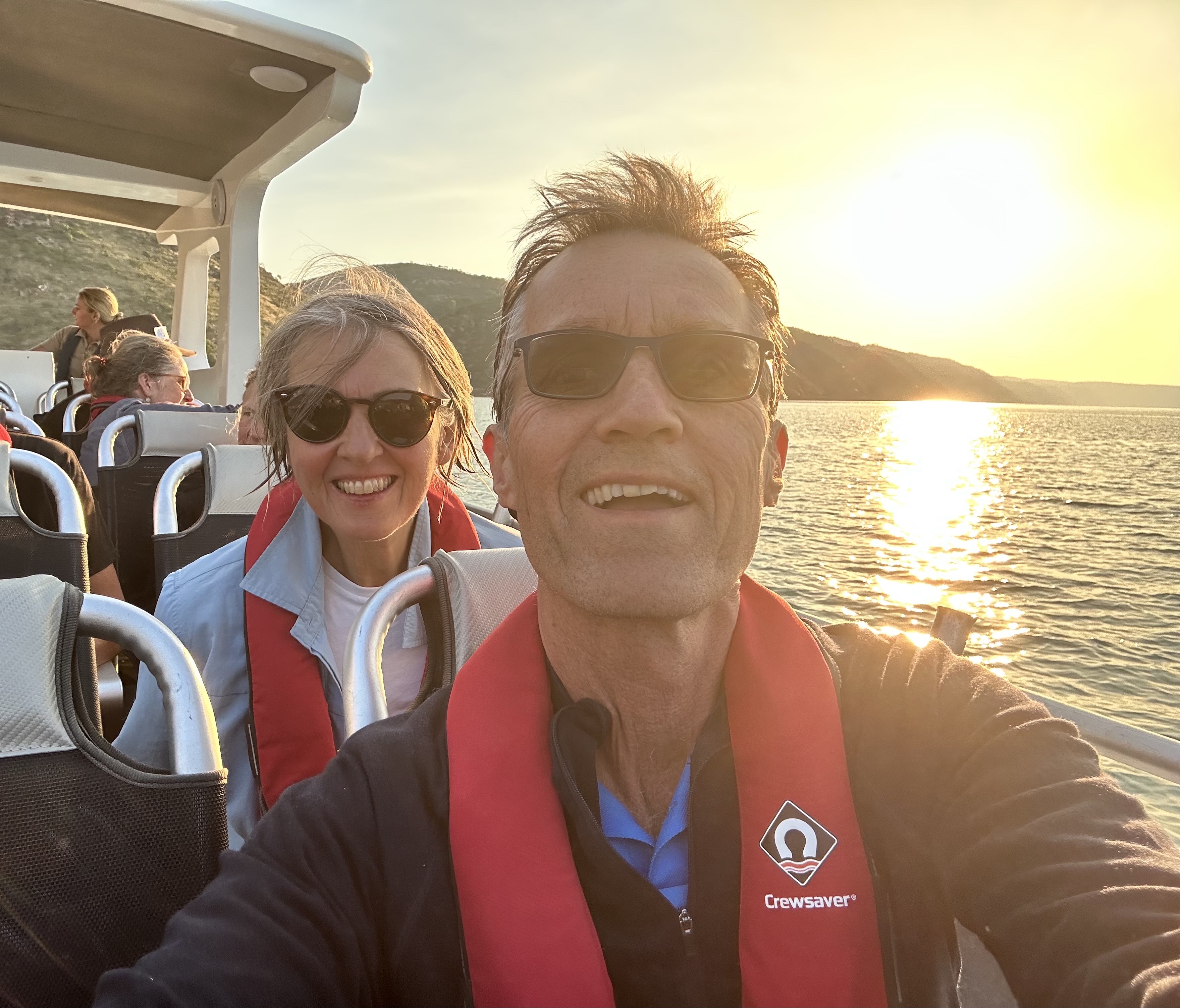
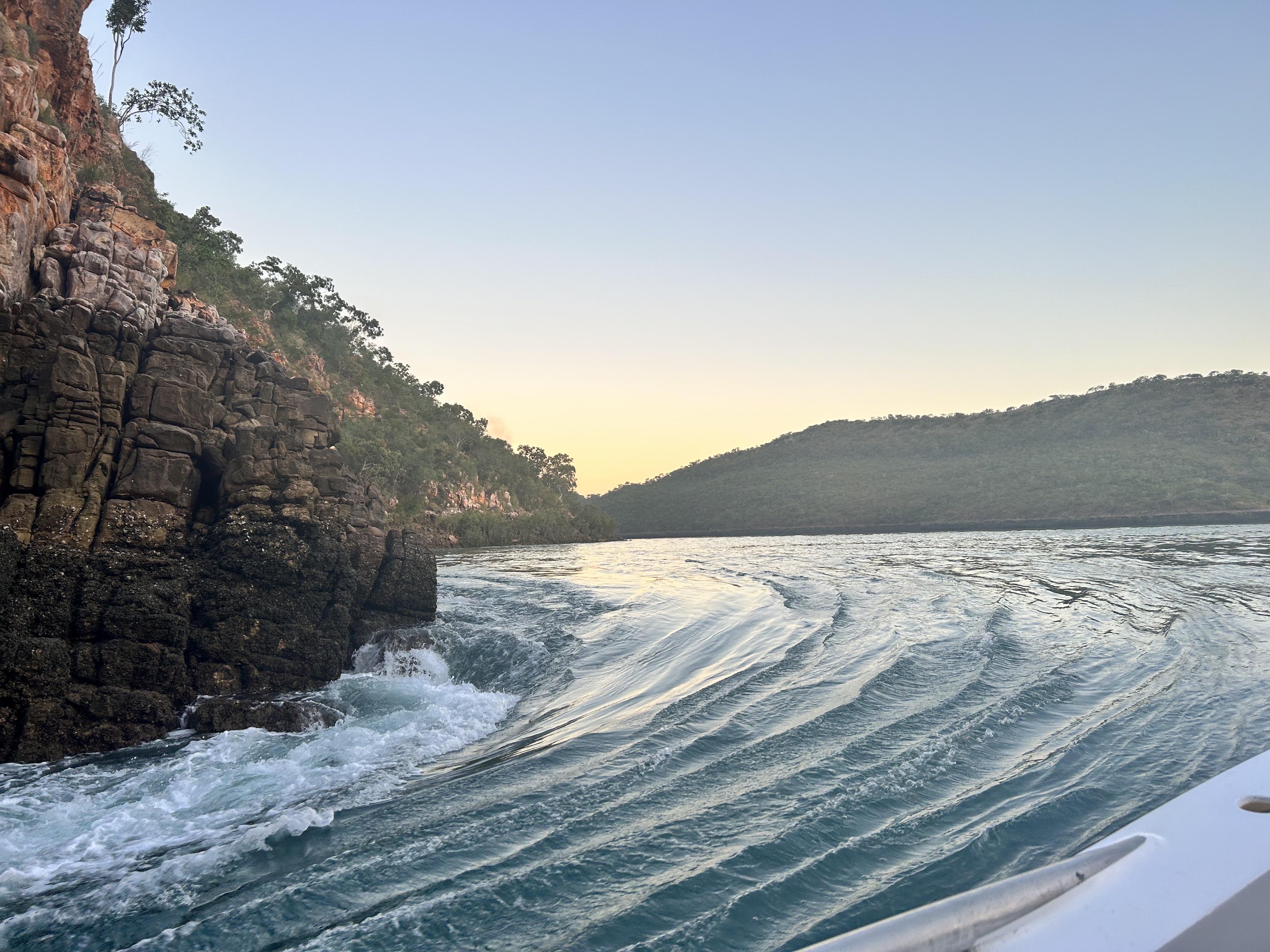
With Swiss precision we boarded a fast boat for a trip out on the water to explore the surrounding bays and delivery to the Horizontal Falls for a few passes at high speed just as the sun set in the west. Hayley our skipper couldn’t help but burst with enthusiasm as she explained the geology and history of the region.
Back at the mother ship the cheese and nibbles was followed by a meal of freshly caught barra, cooked skilfully by a couple of the other girls. Those girls were all a credit to their employer. It was just fascinating how they all worked together seamlessly. After a very satisfying meal they left us to enjoy the sunset and chat with our new friends while they retired to their own cabins at the far end of the mother ship.
The Bond girls had our hot breakfast ready at 6am on the dot. We packed our bags and vacated our rooms and Hayley was ready and waiting in the speed boat as we climbed aboard at 6:30. It was off for another few passes through the wide gap as the sun rose. Hayley is a bit of a rev head so was clearly enjoying shaking us up a bit. We arrived back at the mother ship as four amphibious aircraft landed, full of day visitors. Climbing on board one of them we took off and did a couple of orbits over the falls as the day trippers whizzed through the falls below us.
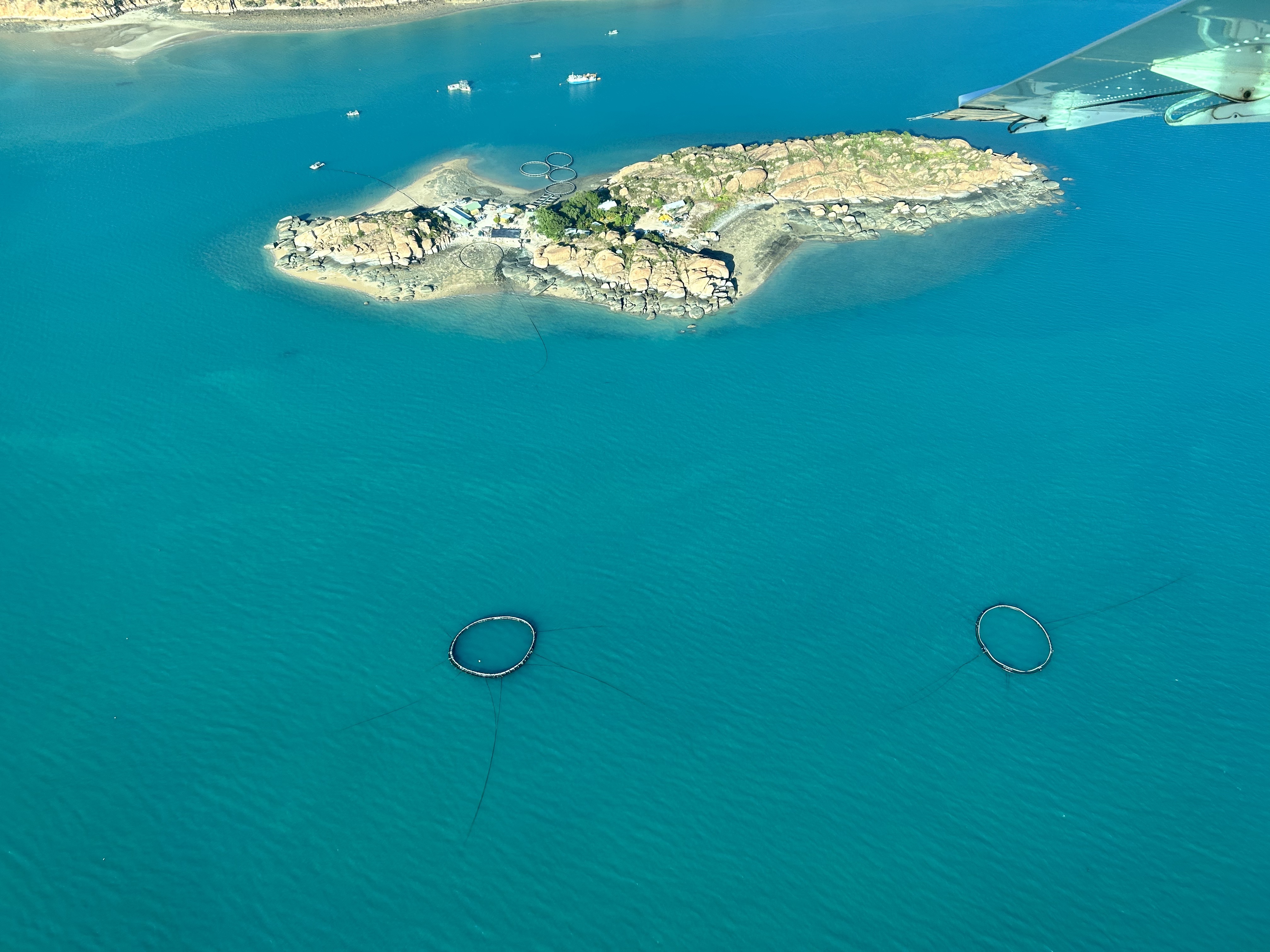
On the way back to Derby we passed over the Cone Bay barramundi farm that had supplied our dinner the night before.
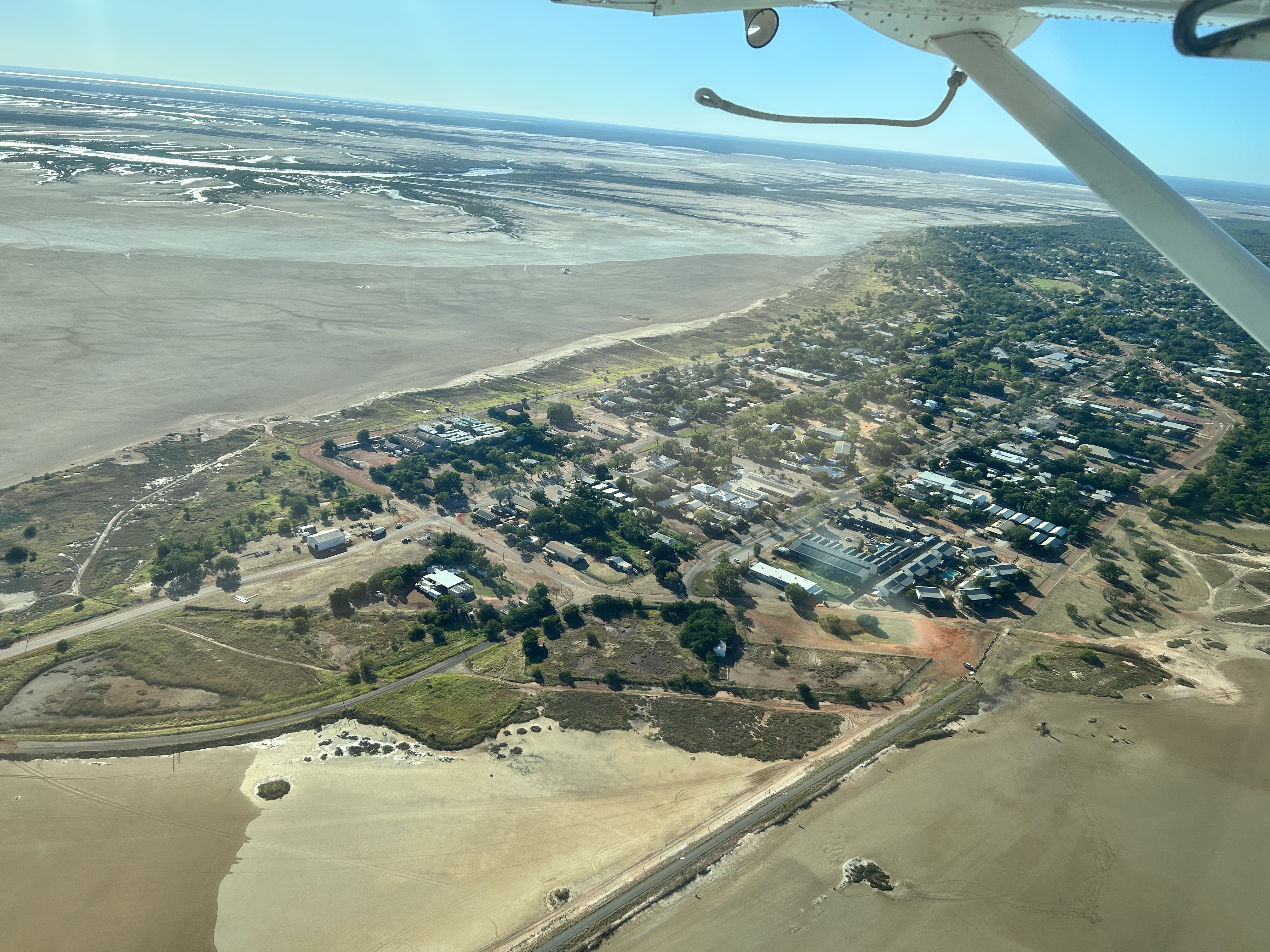
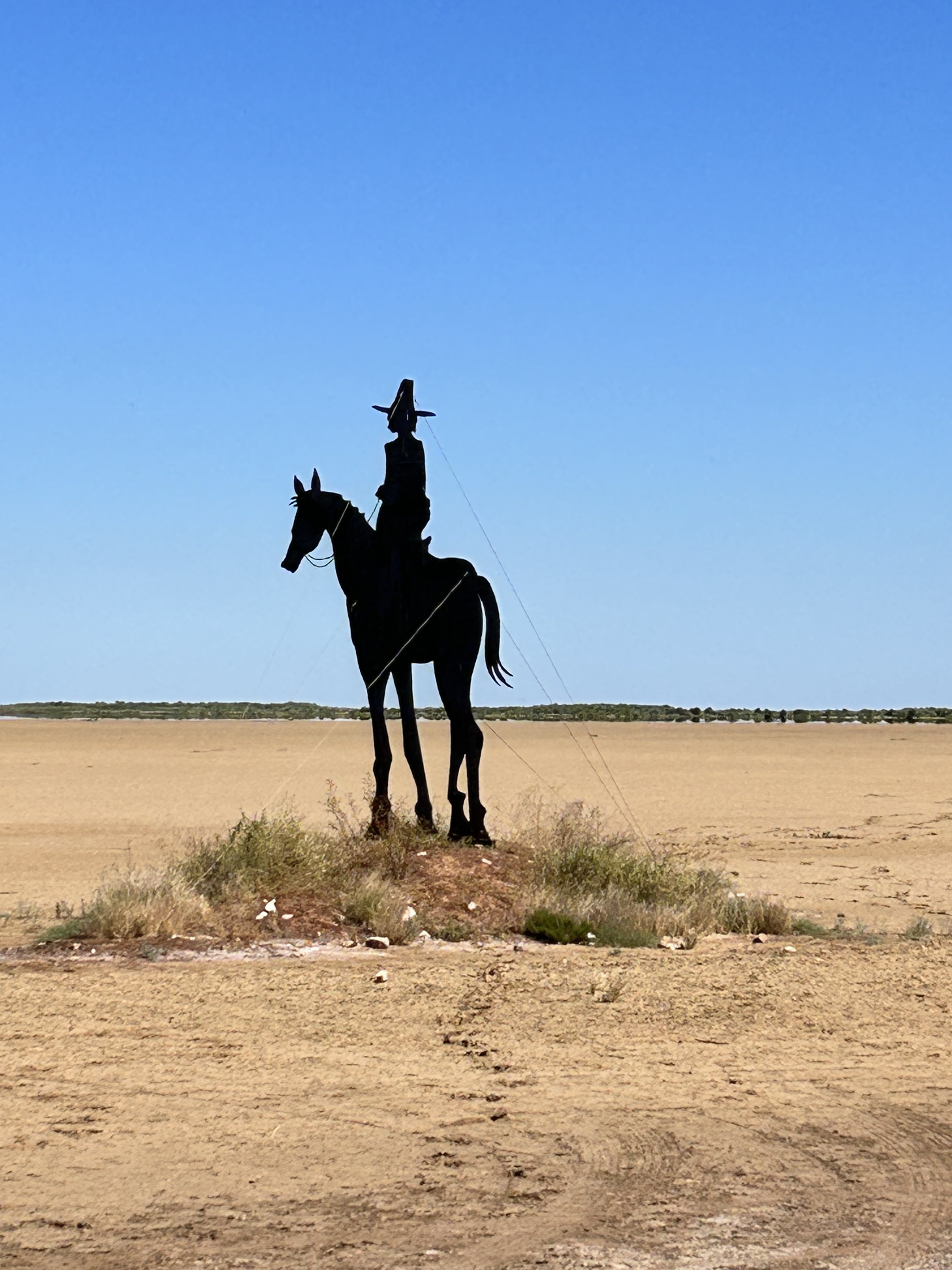
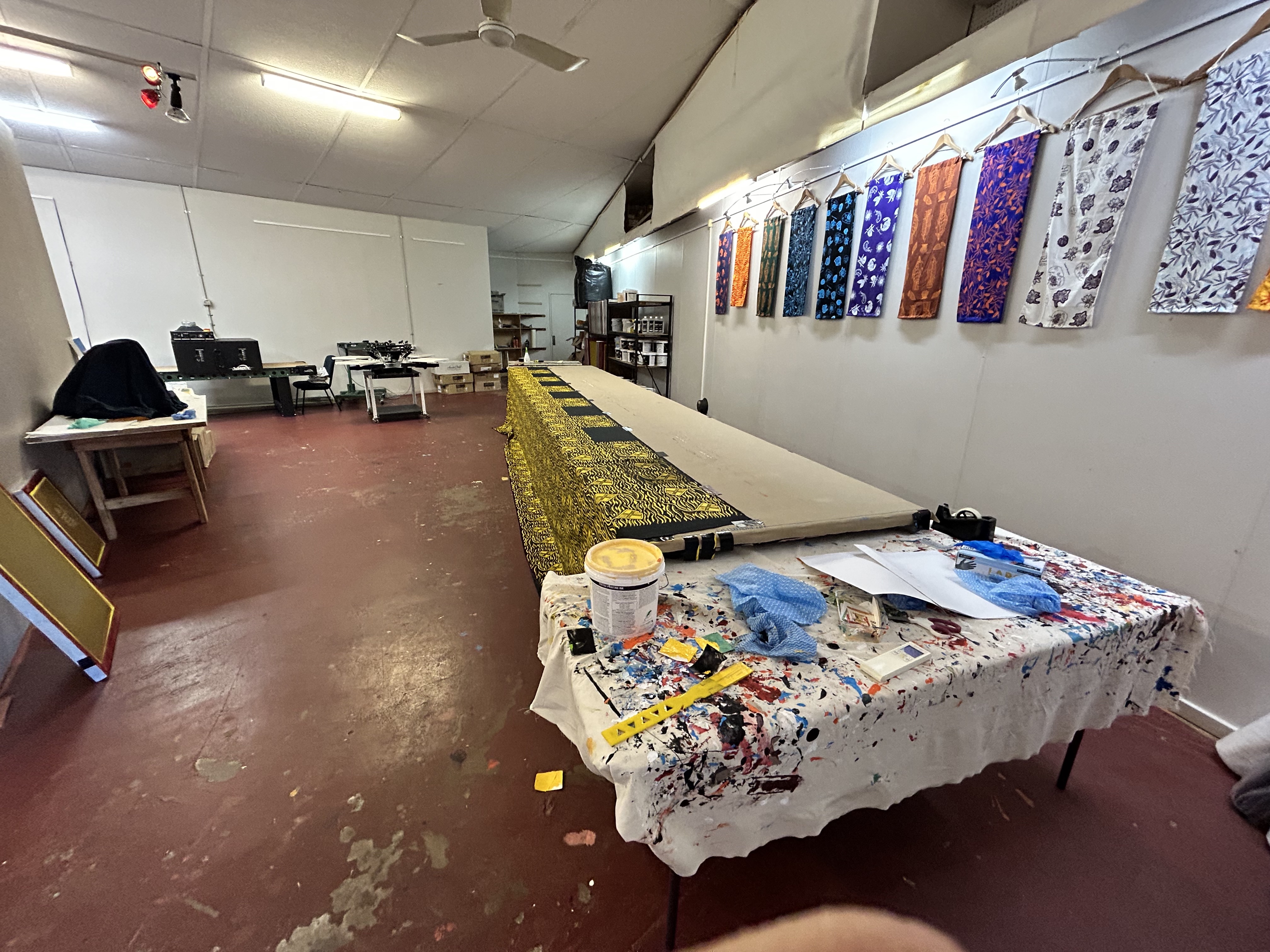
Landing back at Derby the bus took us into town for a coffee and a visit to another gallery who do silk screenings of local art. The wharf at Derby is pretty famous because of the 11 metre tides so we had to walk out there to have a look, passing some larger than lifelike sculptures on the way. Afterwards the Jila Gallery provided lunch and coffee.
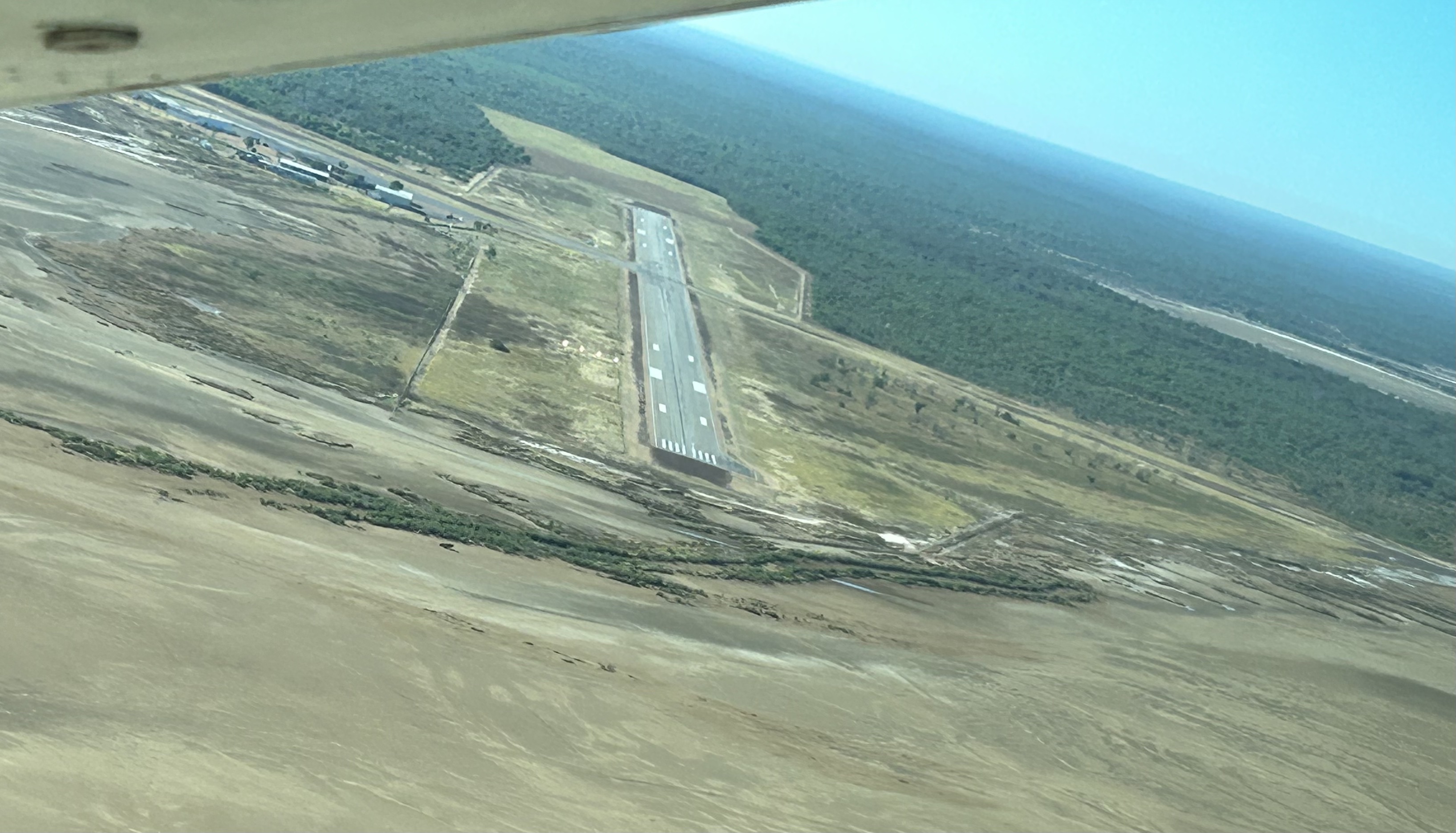
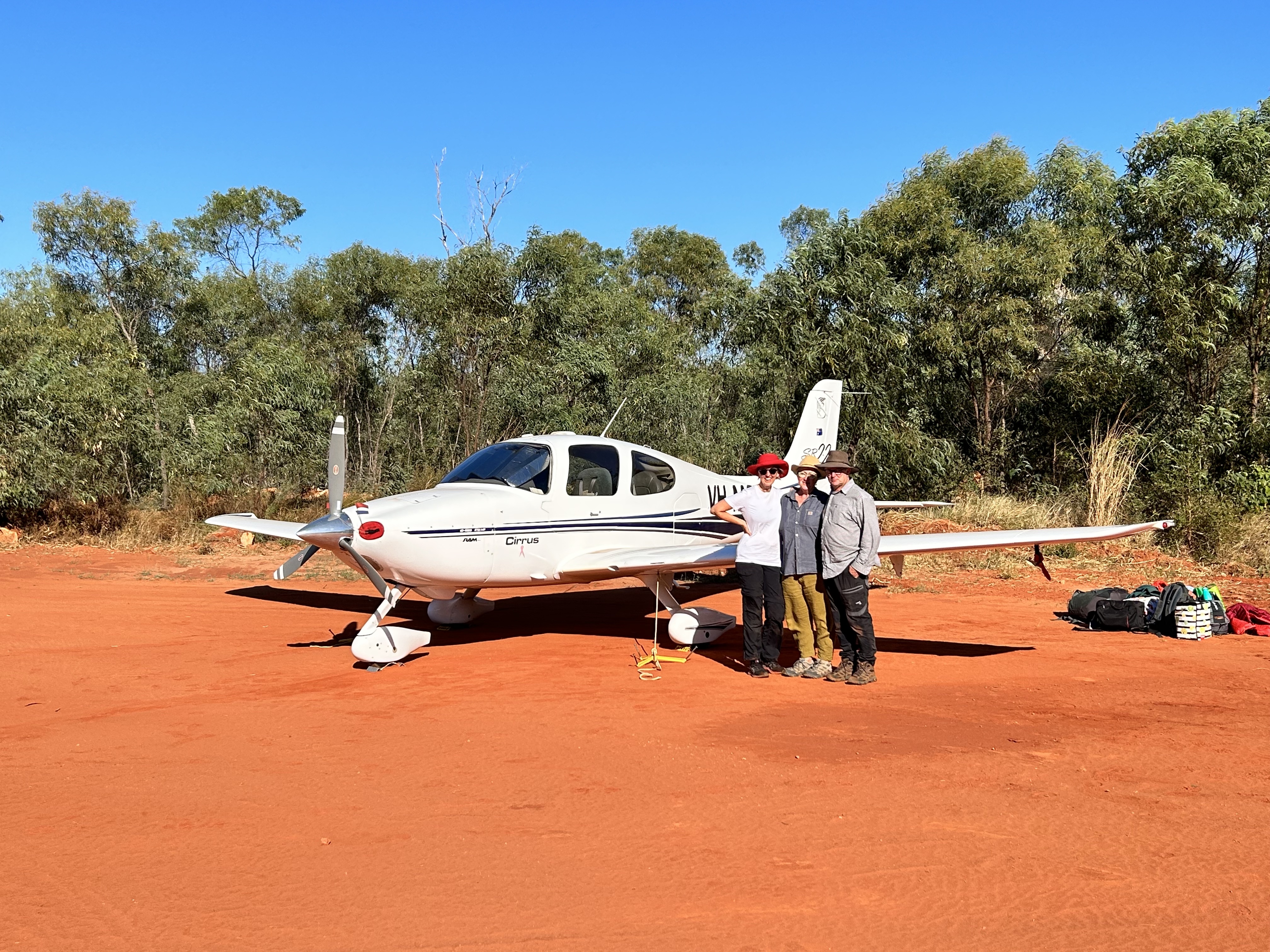
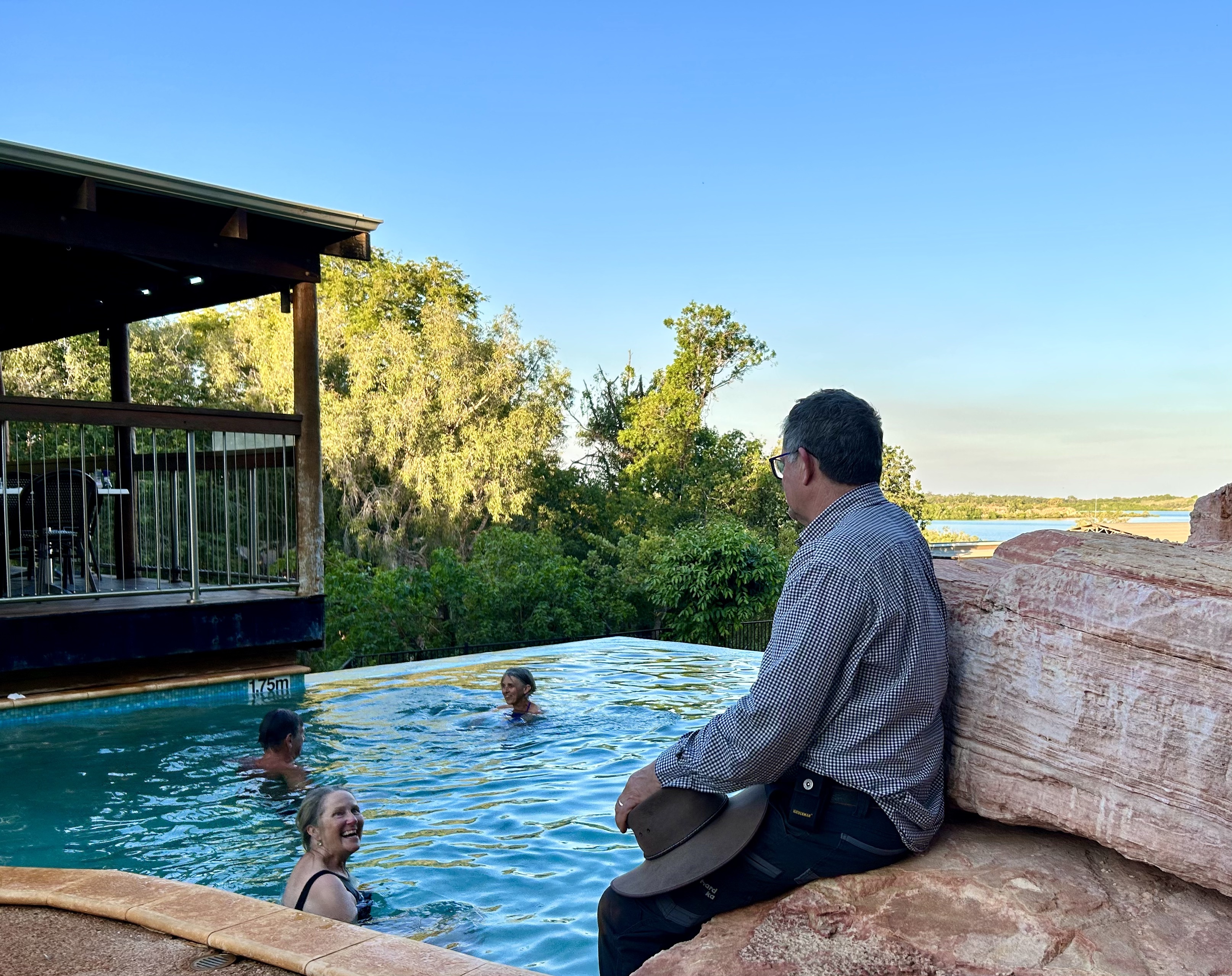
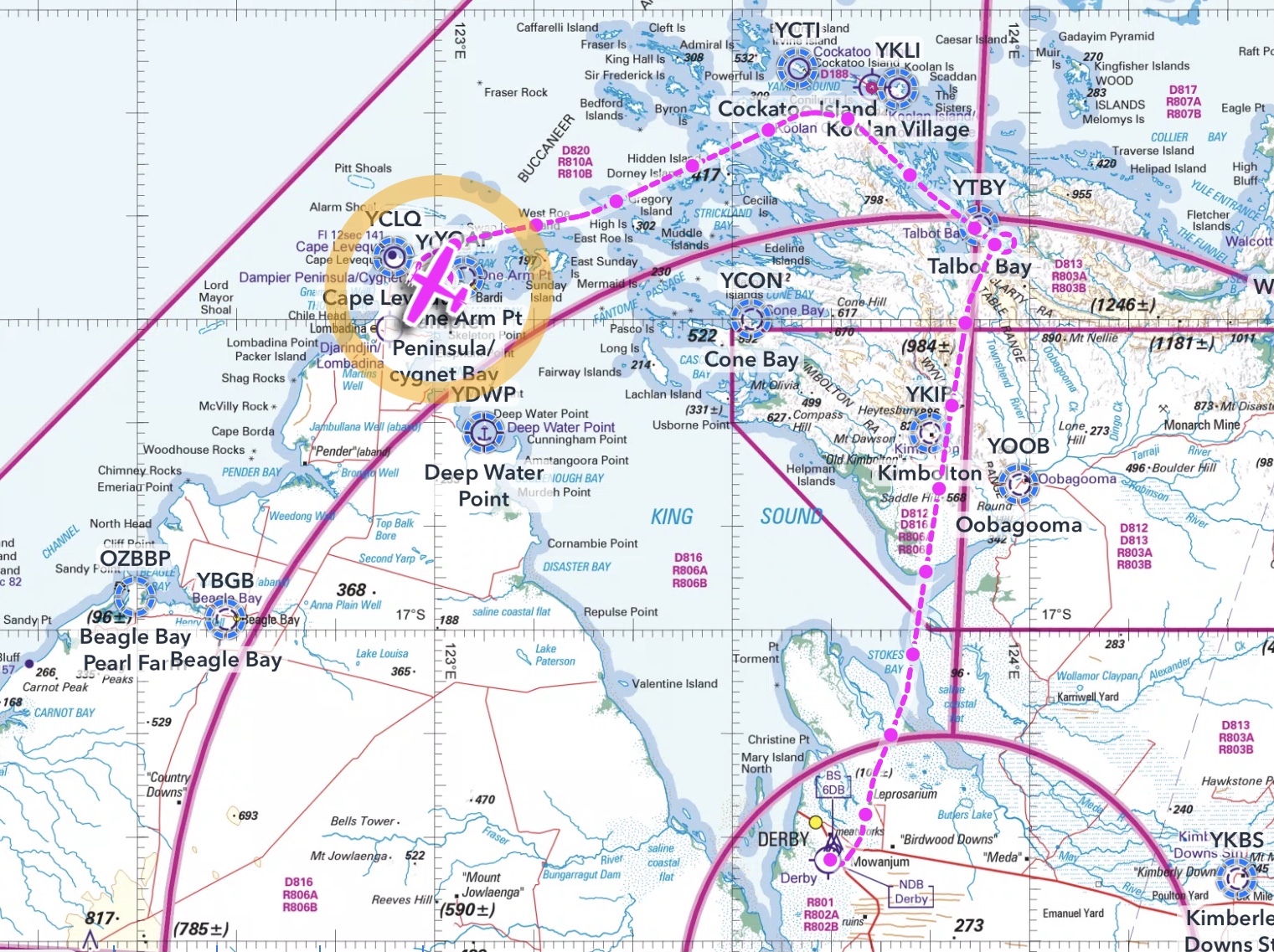
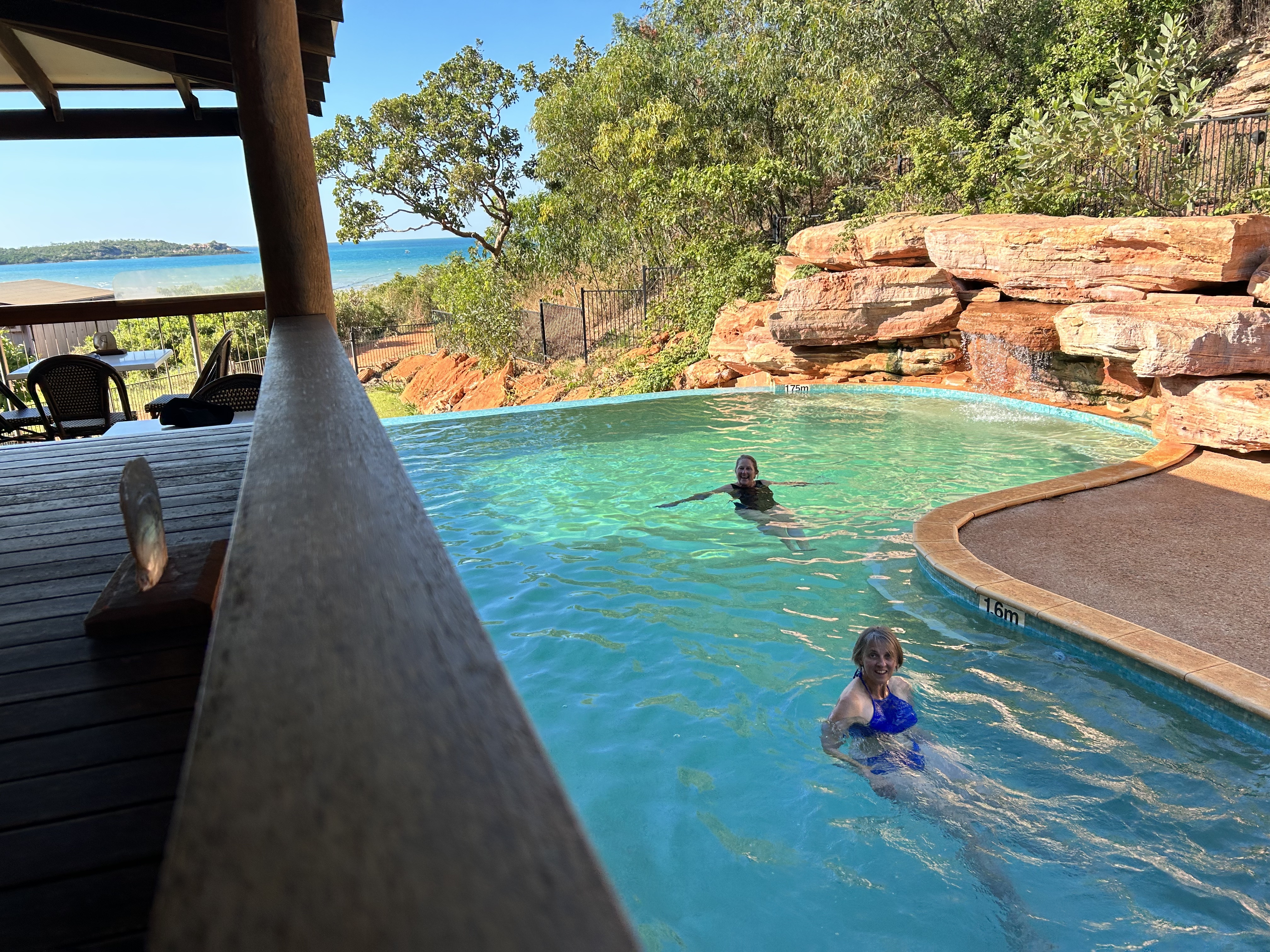
Back at the airport we took off in MSF for one last pass over Horizontal Falls before tracking along the coast past Cockatoo Island and its iron ore mine. We landed at Cygnet Bay at the north end of Dampier Peninsula. The dirt strip is bull dust over a clay base apparently. No good when wet but fine when it’s dry. It was time for a refreshing swim in the Pearl Farm’s infinity pool. Sigi noticed she’d left her favourite Cirrus pullover at the Jila Cafe in Derby. Don’t panic! A quick phone call and the cafe owner arranged to post it to us in Brisbane free of charge. And it arrived a couple of days after we got home. Now that’s service! https://www.jilacafe.com.au
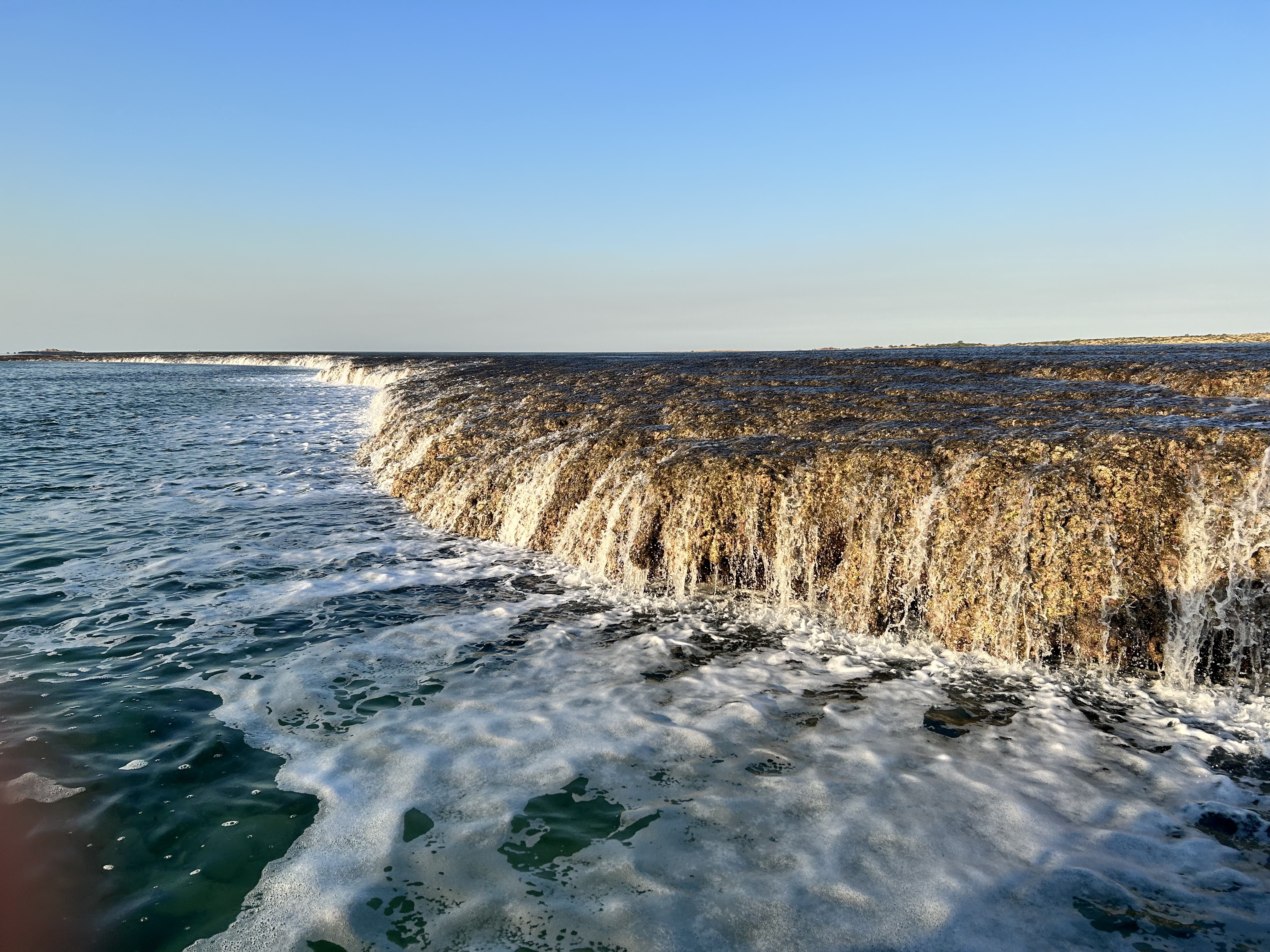
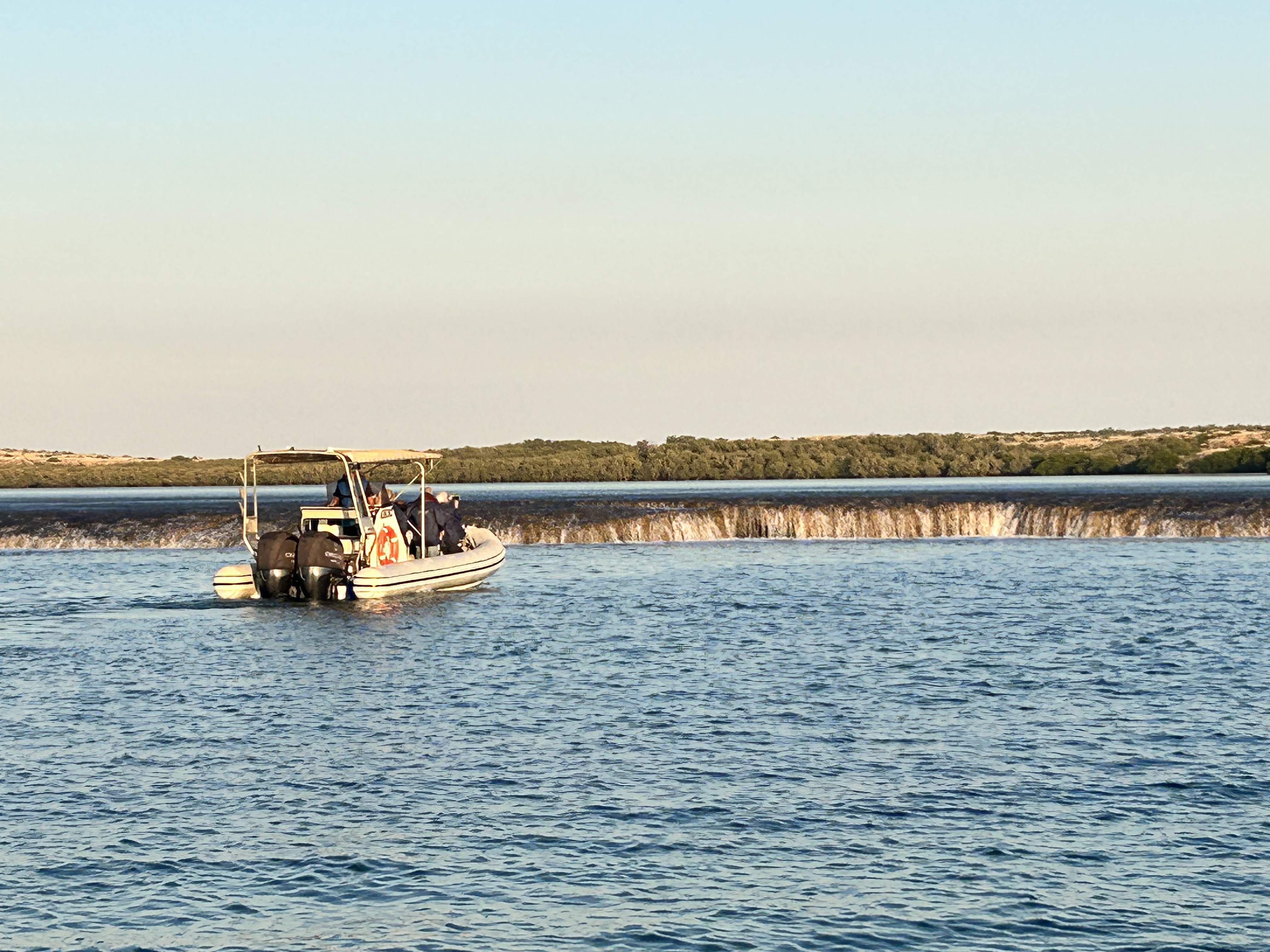
The next day in Cygnet Bay started with a 6:15 departure on an amphibious boat to the Waterfall Reef about 30 minutes away. The 11 metre tide was on the way out so there was plenty of water cascading over the edge. Flocks of terns were busy diving for fish that were being swept along by the rushing tidal waters.
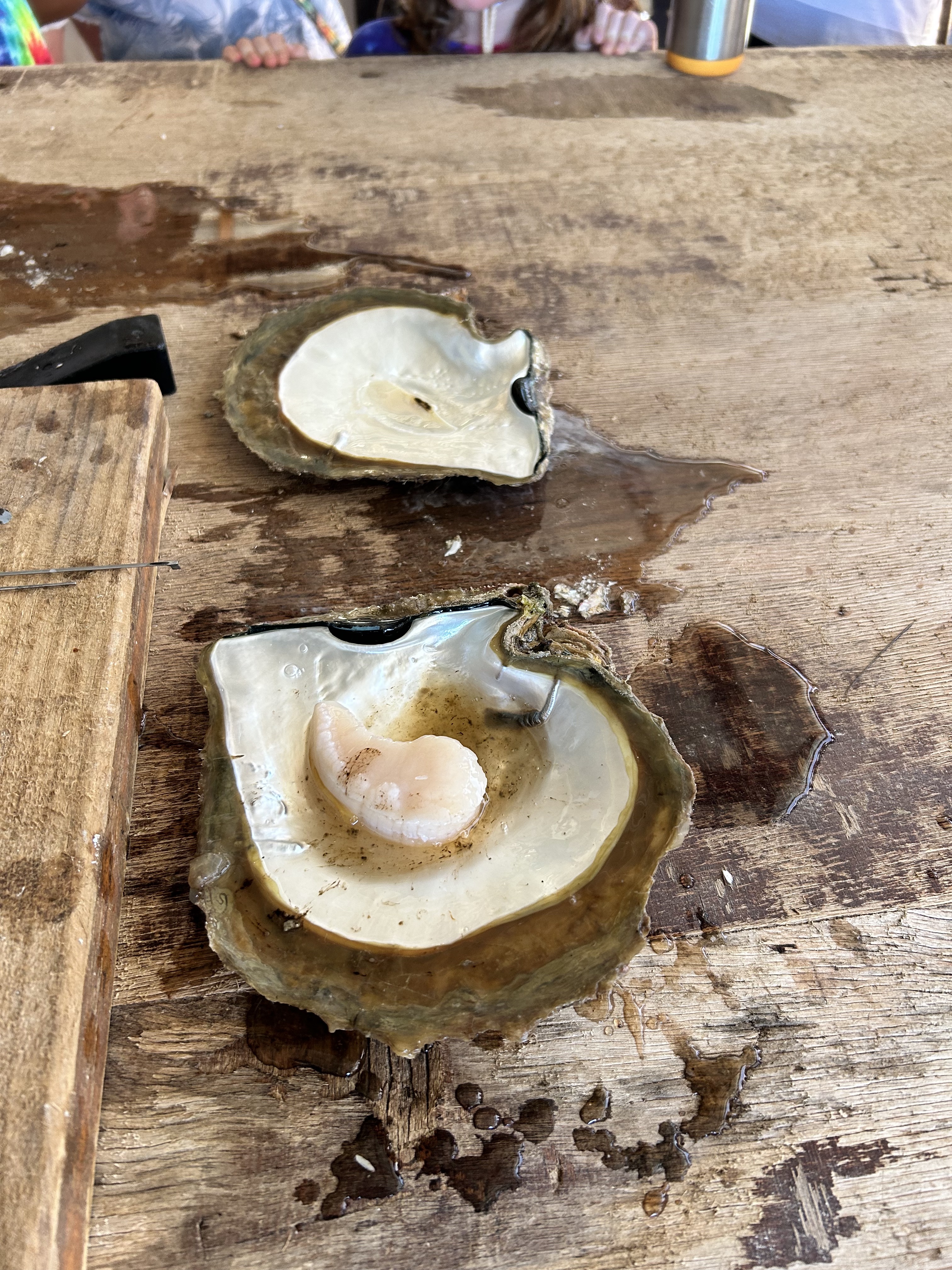
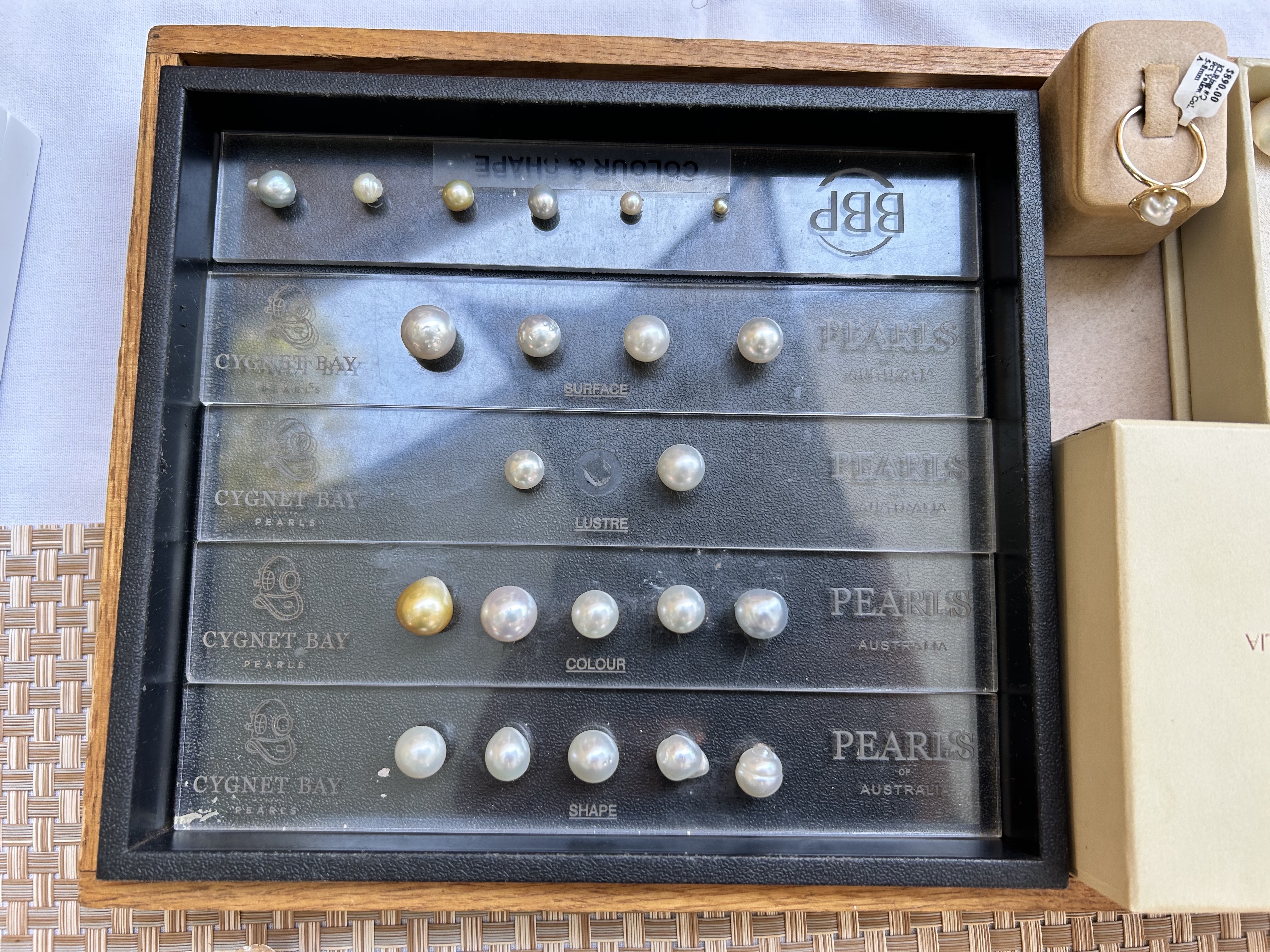
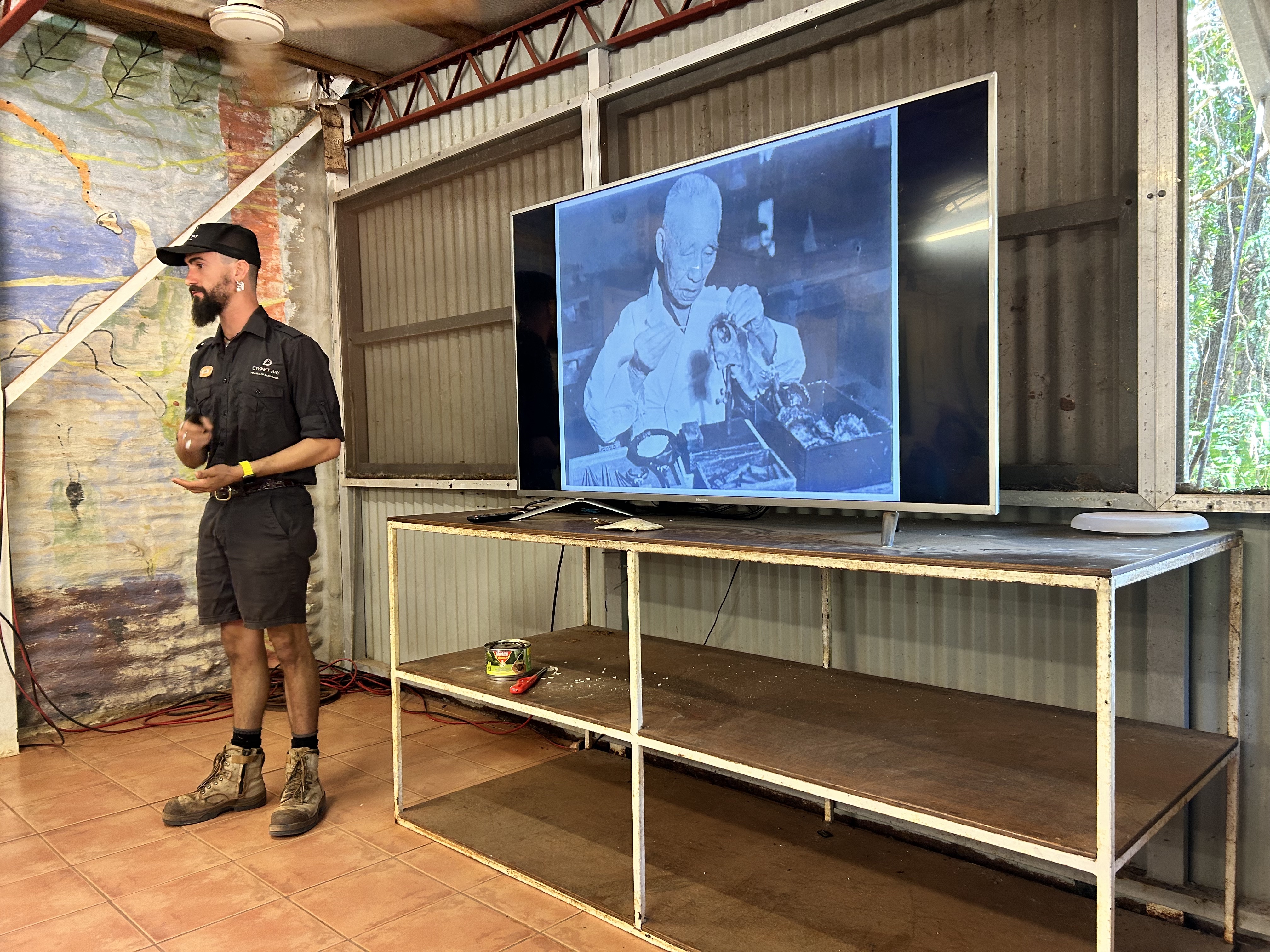
Back at the Pearl Farm we took part in a tour of the operations where our guide went into great details of how pearls have been cultivated since the place was set up in the 1970s.
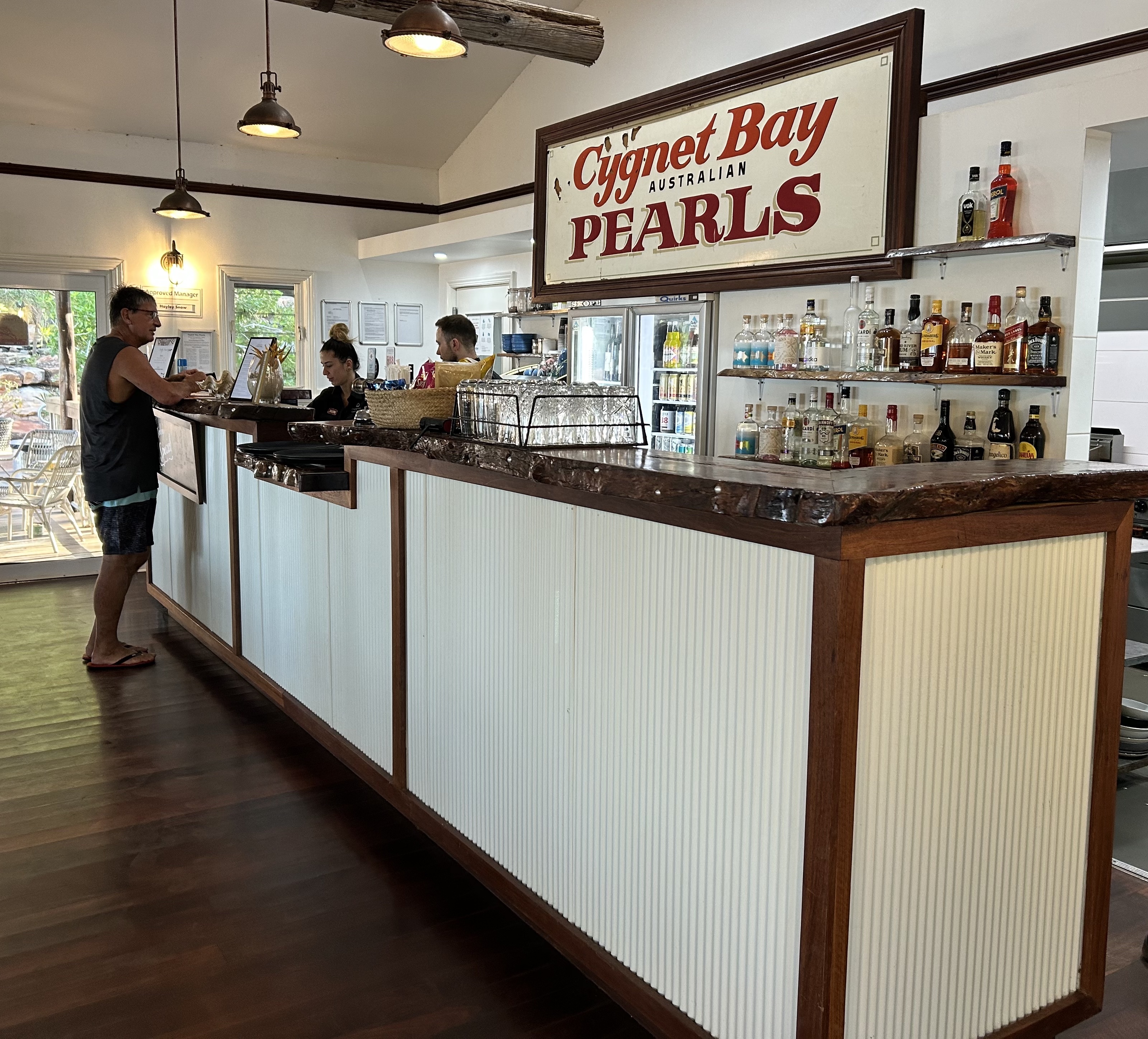
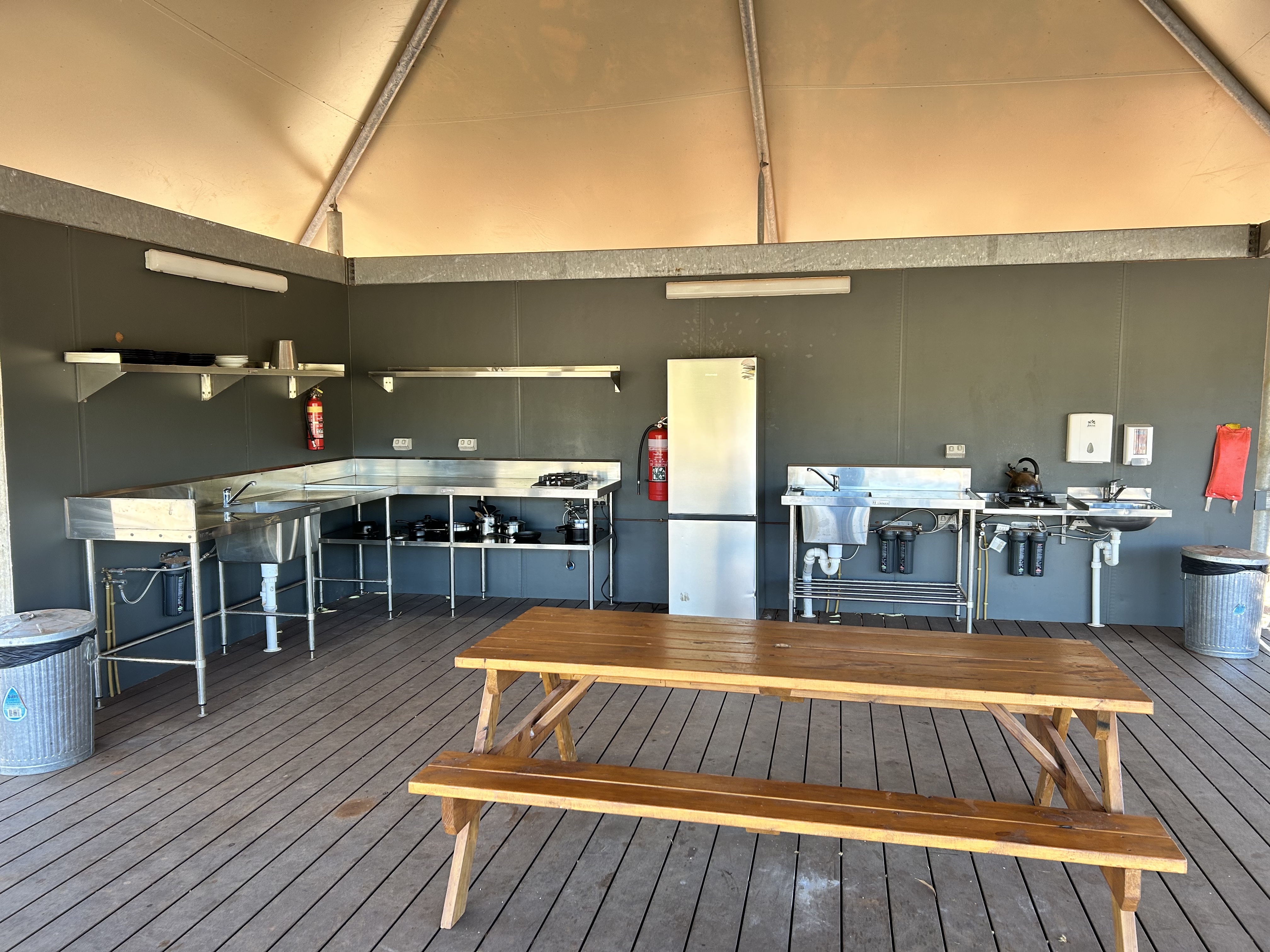
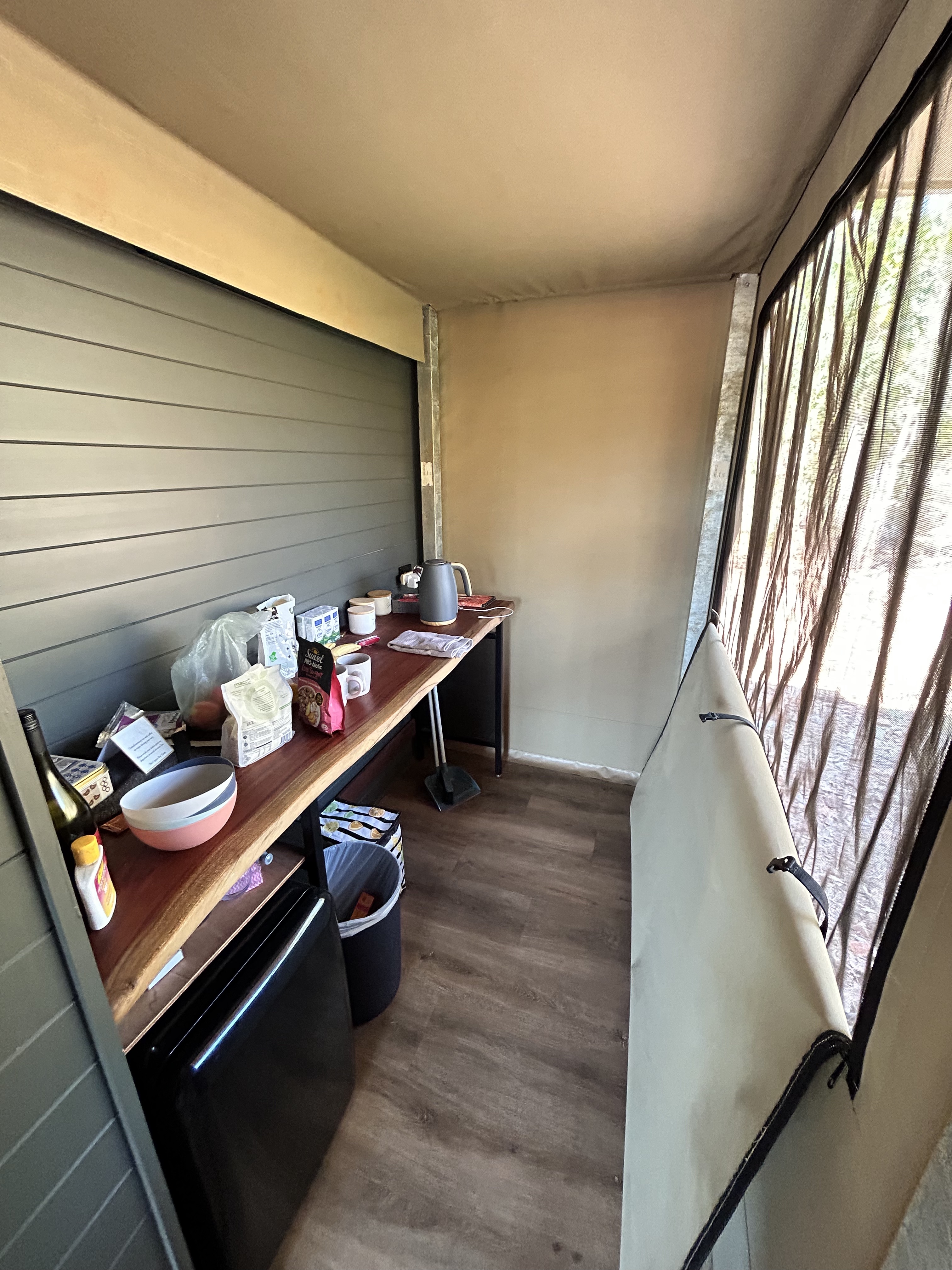
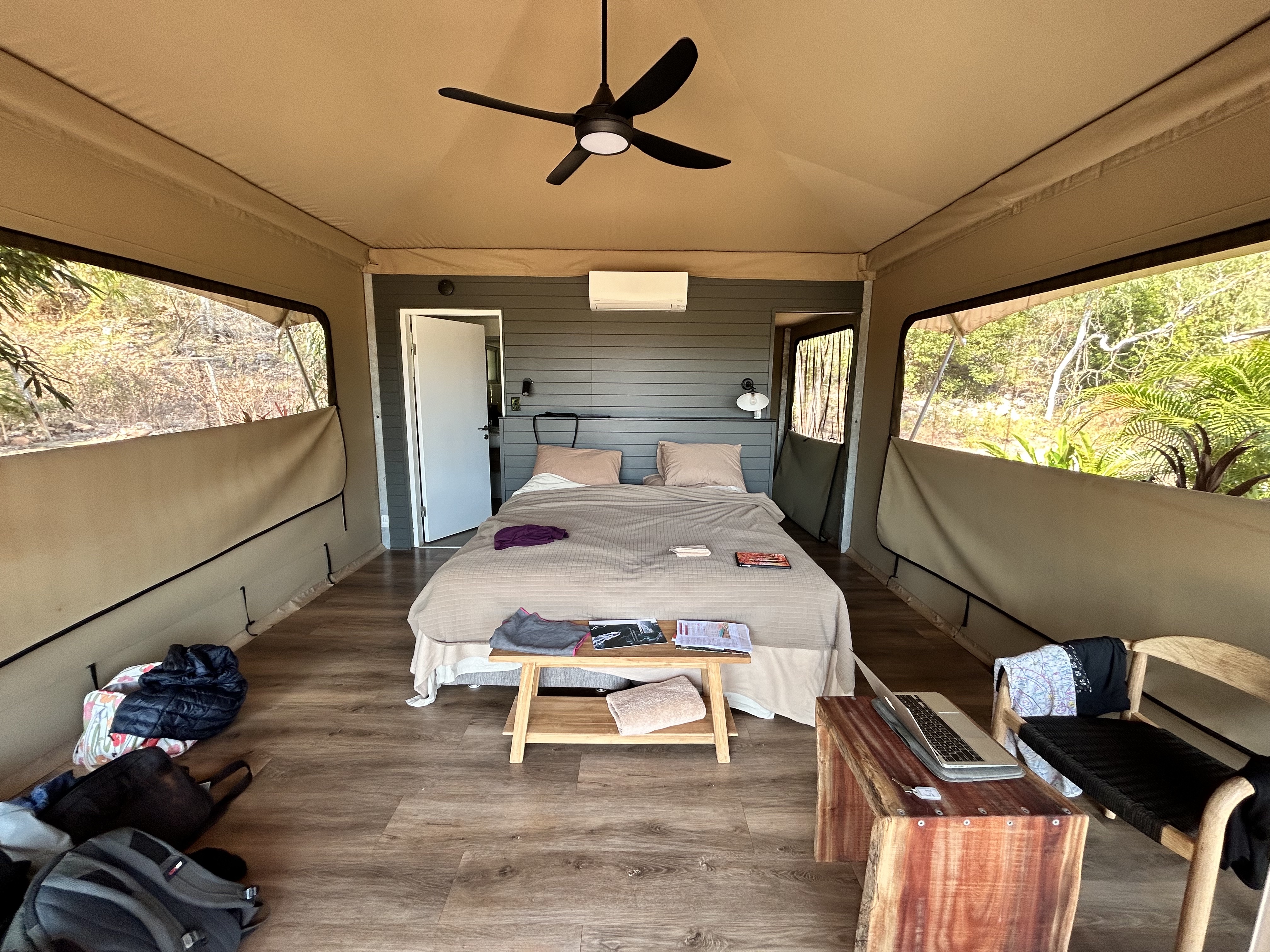
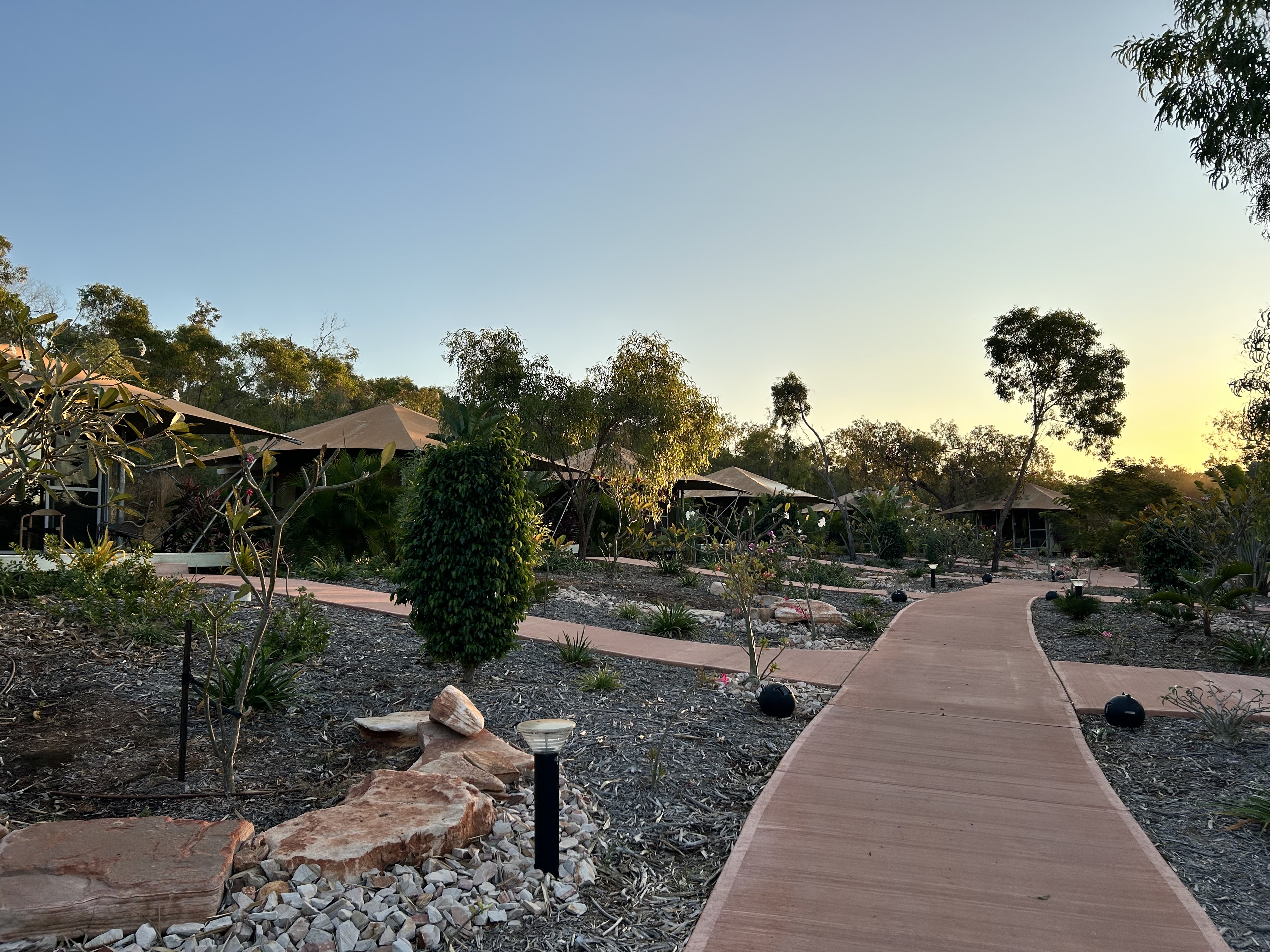
The accommodation at Cygnet Bay varied between bare campsites to refurbished pearler cabins to luxury glamping tents. They had a great communal kitchen for the campers and a great restaurant/bar/cafe overlooking the infinity pool. The only real negative was the $50 each way transfer fee from the airstrip. A bit steep for what it is. The deck restaurant and bar area were well designed and the food was good and reaonsably priced. The kitchenette was well fitted out so that we could make our own breakfast easily. We enjoyed both dinners there while having our breakfast out the front of our glamping tent.
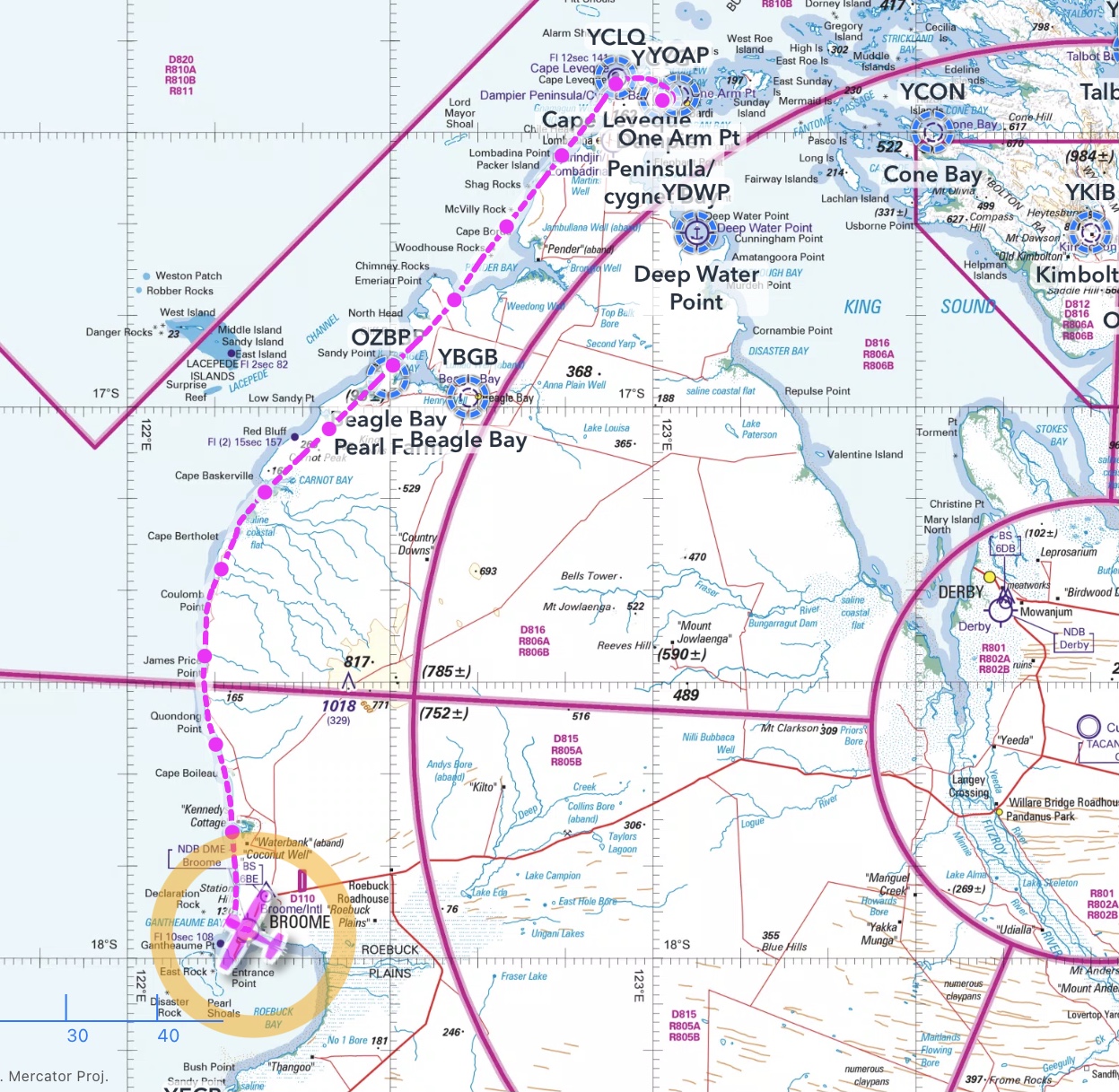
After a morning walk to explore the local area we were driven out to the Cygnet Bay airstrip just after 11am. There was a bit of traffic around so I was glad to have my Ping USB device that identifies all the ADSB transmitting traffic in the vicinity and displays them in OzRunways on the IPad. Turning left past One Arm Point we headed west initially in an attempt to spot the Cape Leveque airstrip that has been decommissioned. Couldn’t spot it.
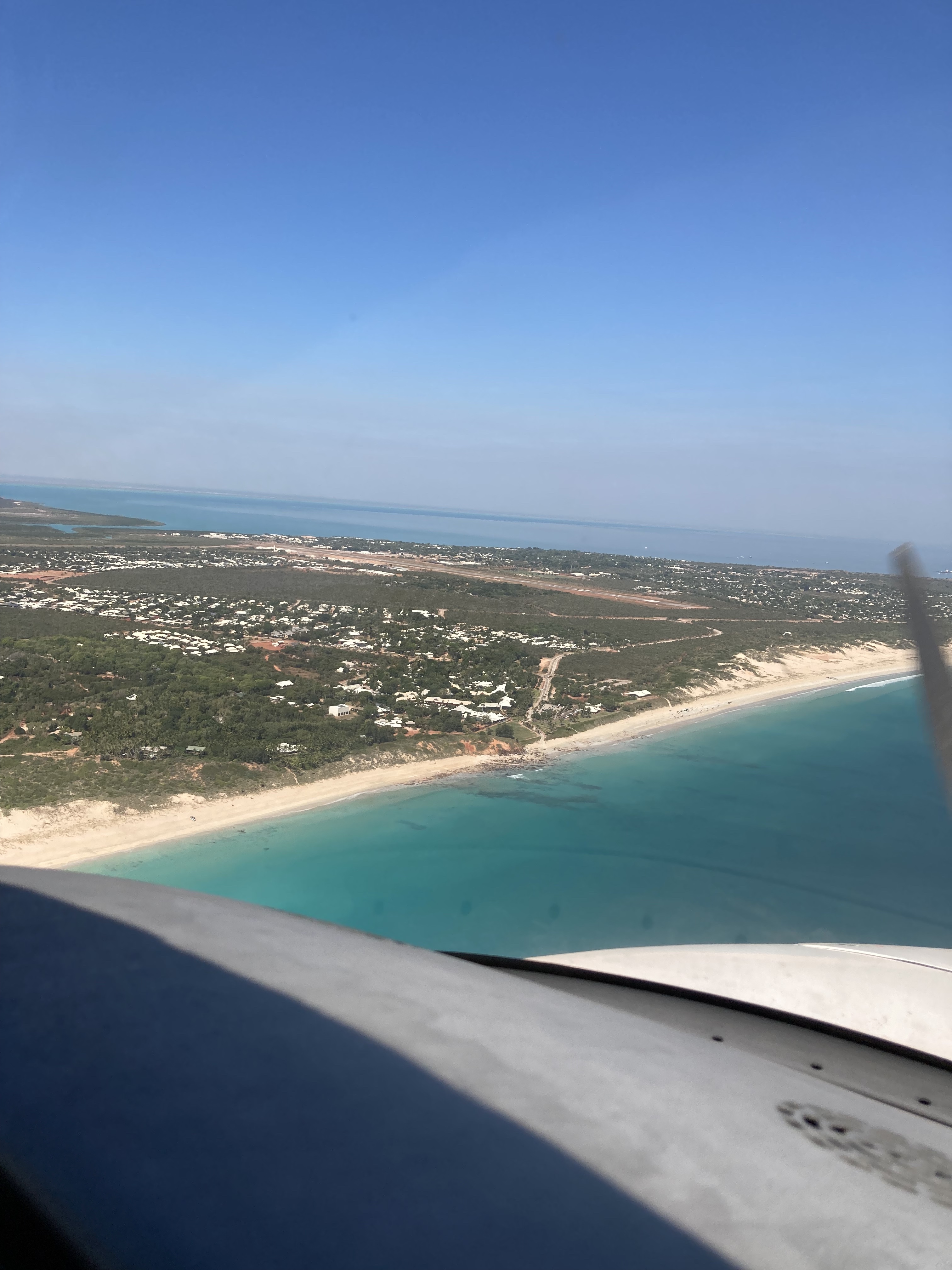
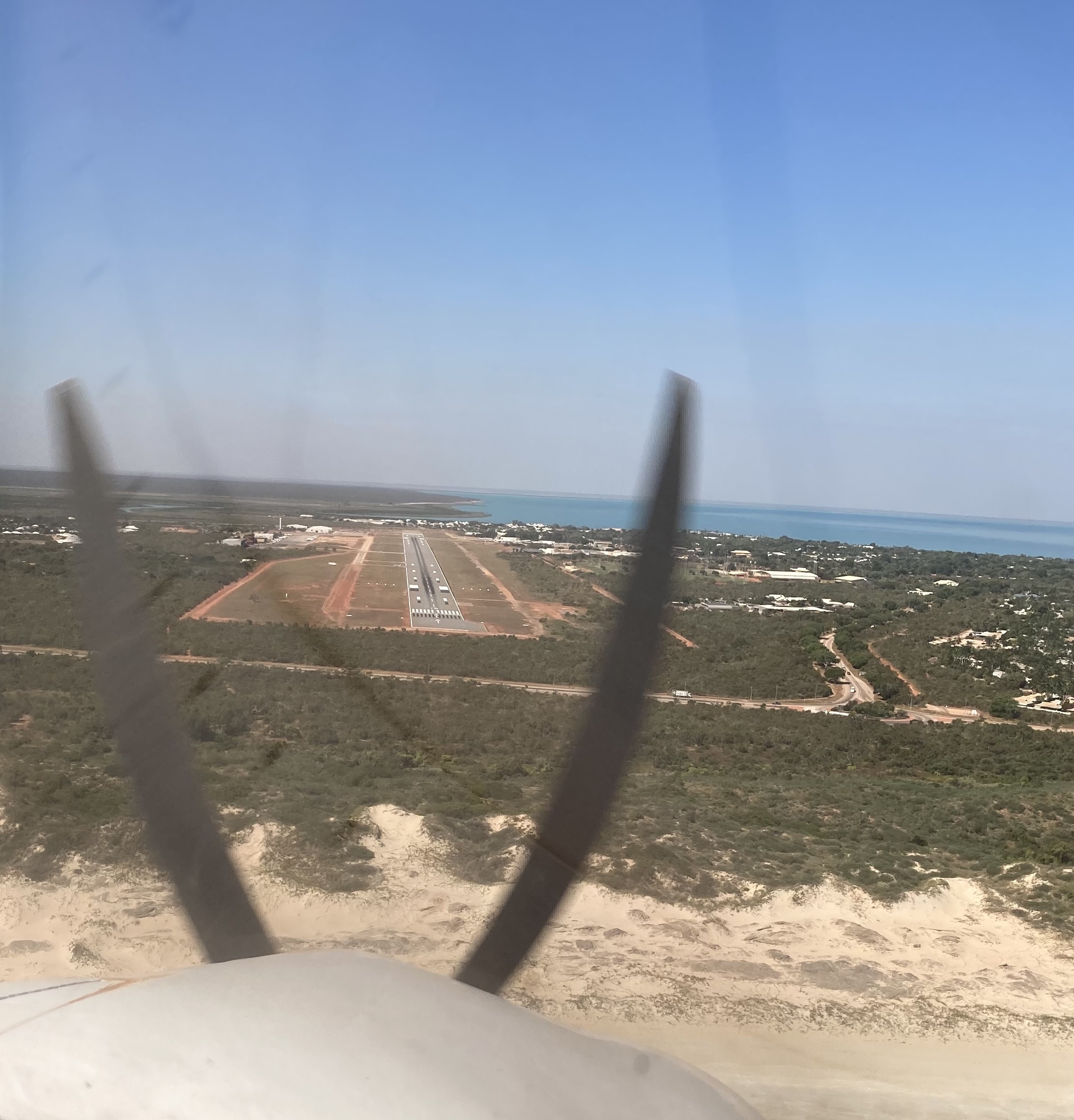
So we continued down the coast at 4500ft, passing Luc in his Cherokee, who was further inland at 2500ft. The sealed strip at Lombadina, used by the offshore oil and gas traffic as a refuelling base, stood out, as did the dirt strip at Beagle Bay. There were lots of fires burning inland so the visibility was not ideal due to the smoke but was still greater than 25km along the coast. Descending to 1500ft by James Price Point we were cleared by Broome Tower and followed a Cessna in to join base on RWY10. It’s a big runway.
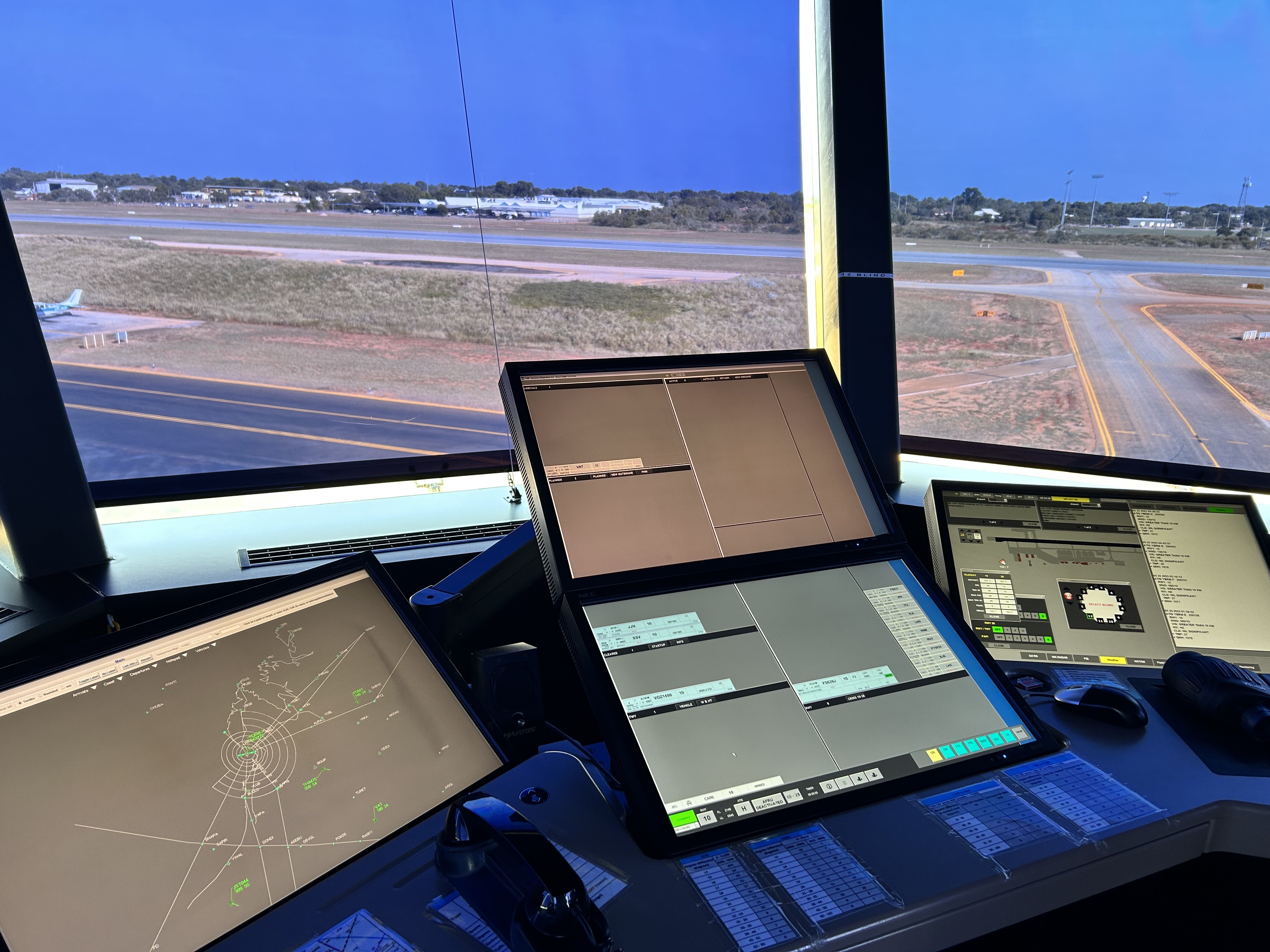
After tying down and arranging transport for our passengers to the BNB, Luc organised a minor repair to WKE and we walked over to the tower to have a chat with the air traffic controllers. They were happy to show us around and explain their procedures and systems.
The Courthouse BNB turned out to be an oasis not far from Chinatown. The owner had it on the market as she wanted to retire.
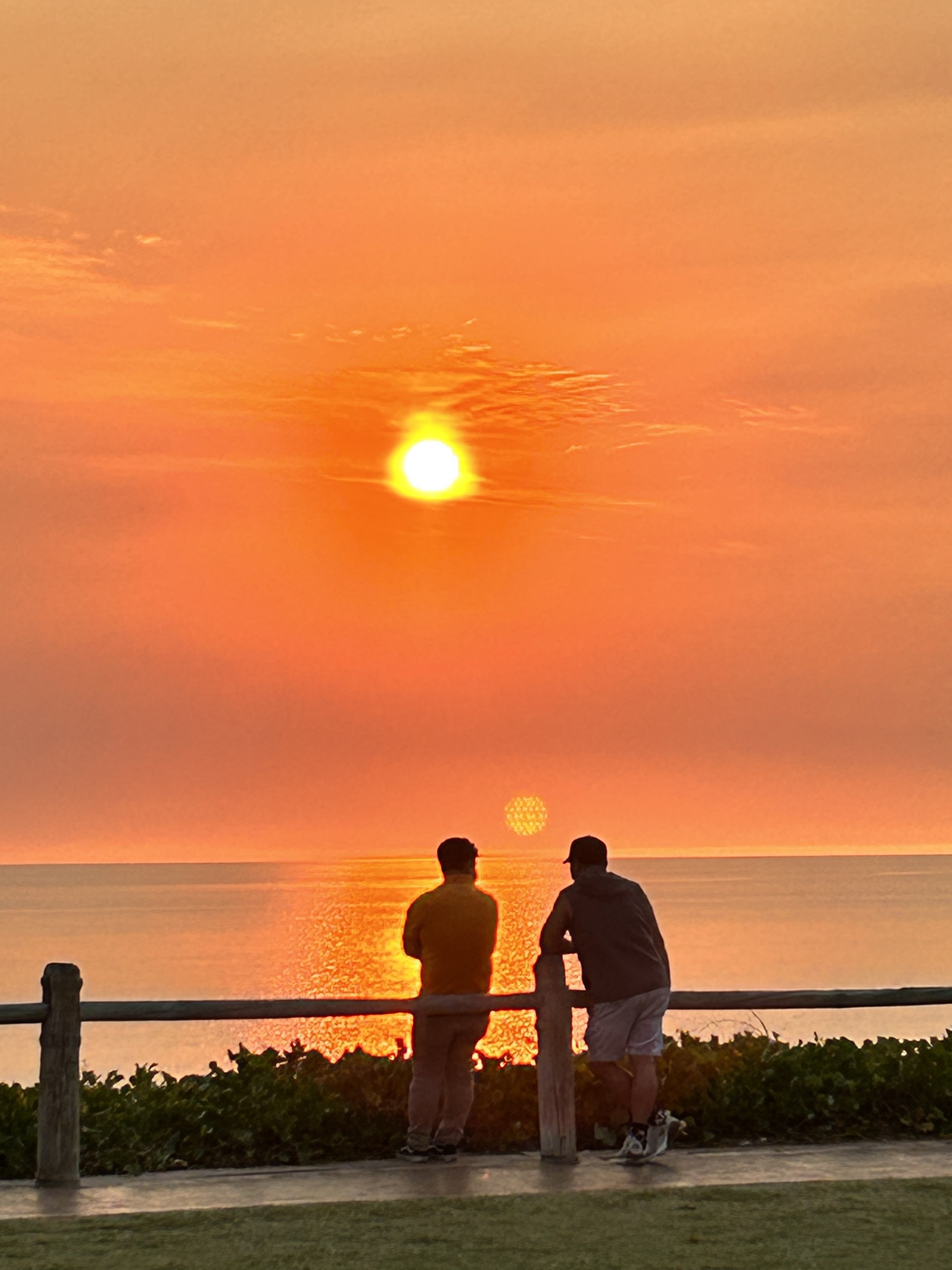
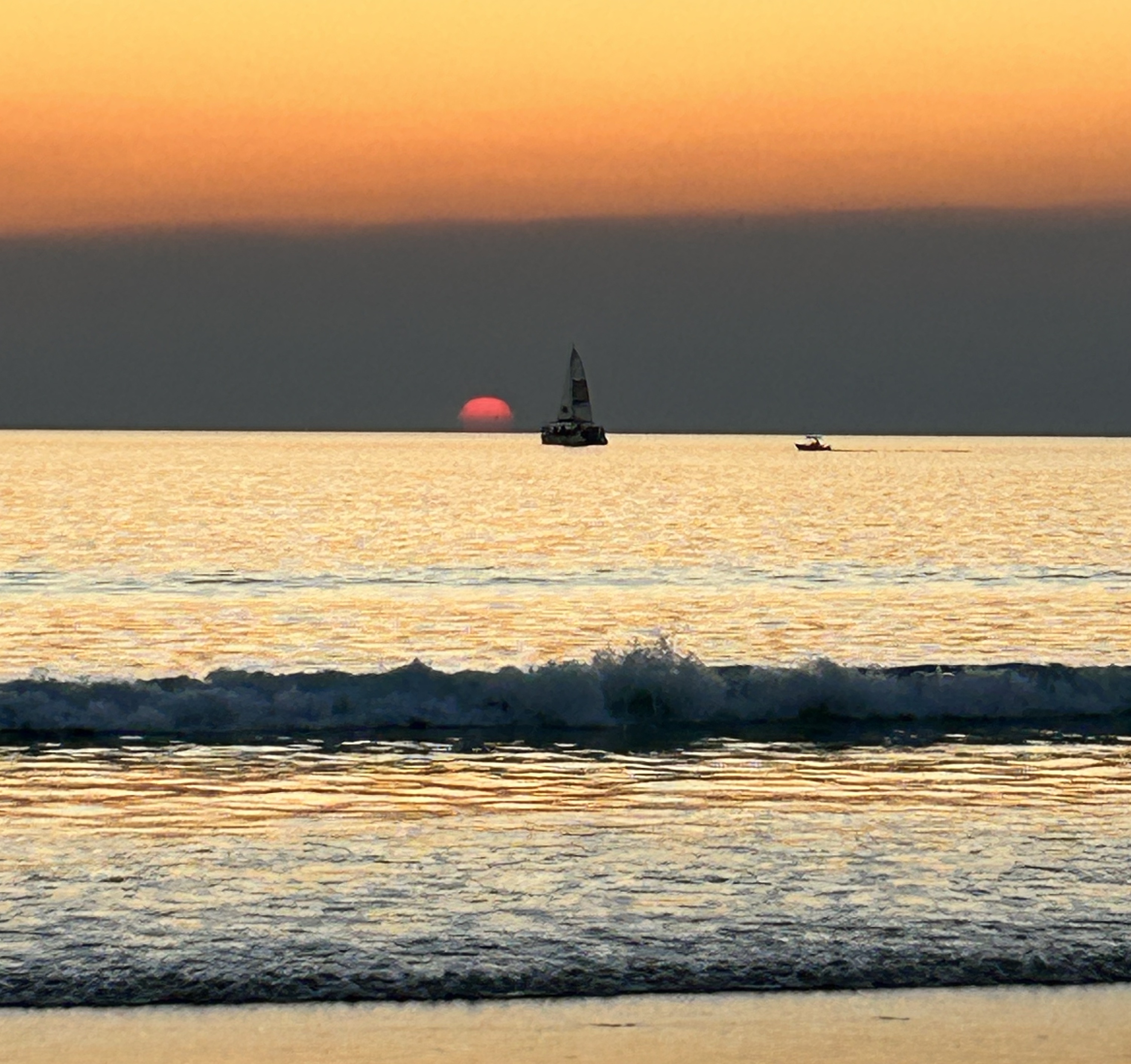
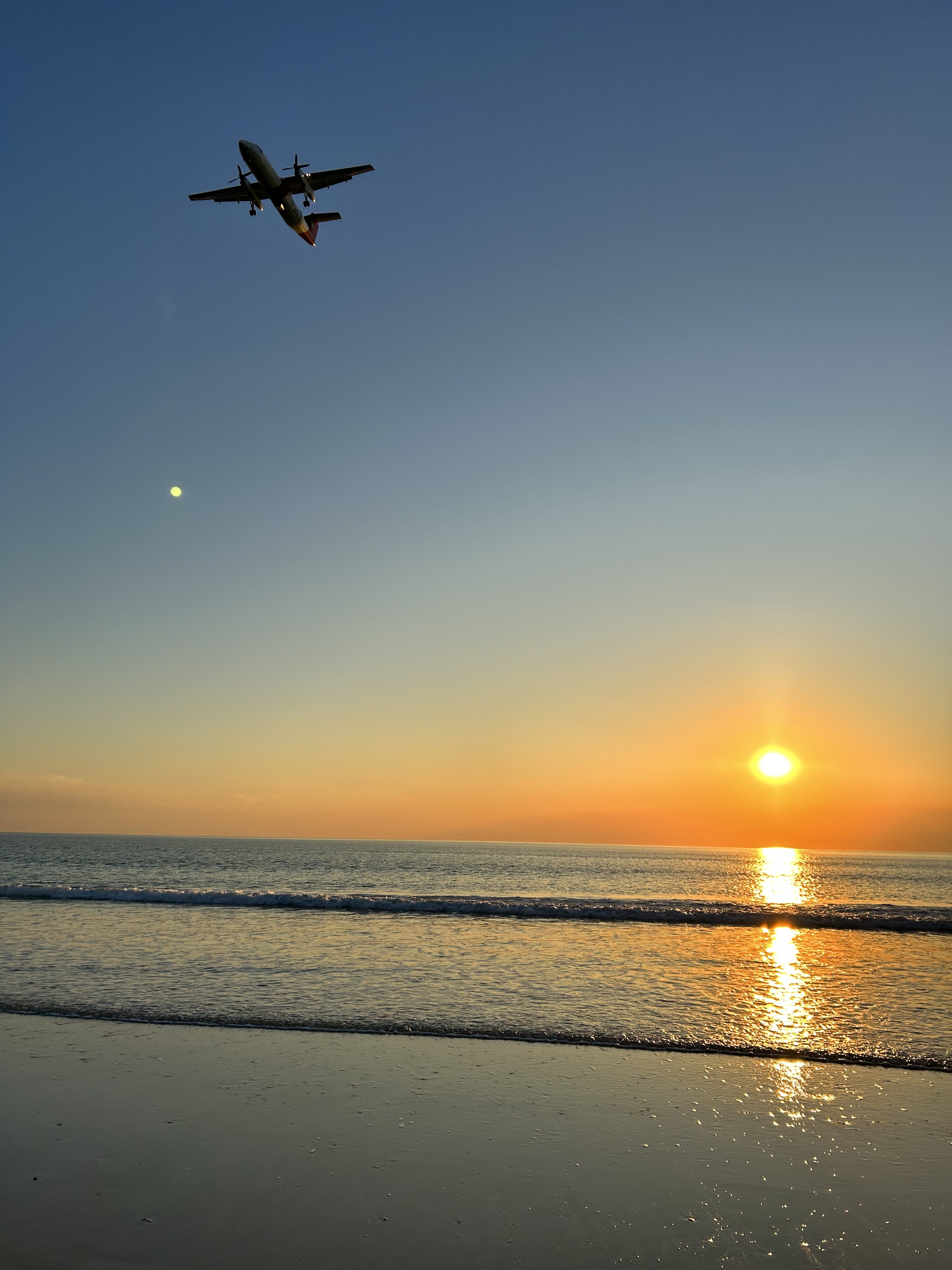
After a quick cool off in the pool we caught the very good bus service out to Zander’s at Cable Beach for a sunset aperitif. It was stunning as expected. After another ride back to Chinatown we grabbed the last table at Johnny Sausage, an upmarket Italian restaurant for a great meal with great service. Highly recommended.
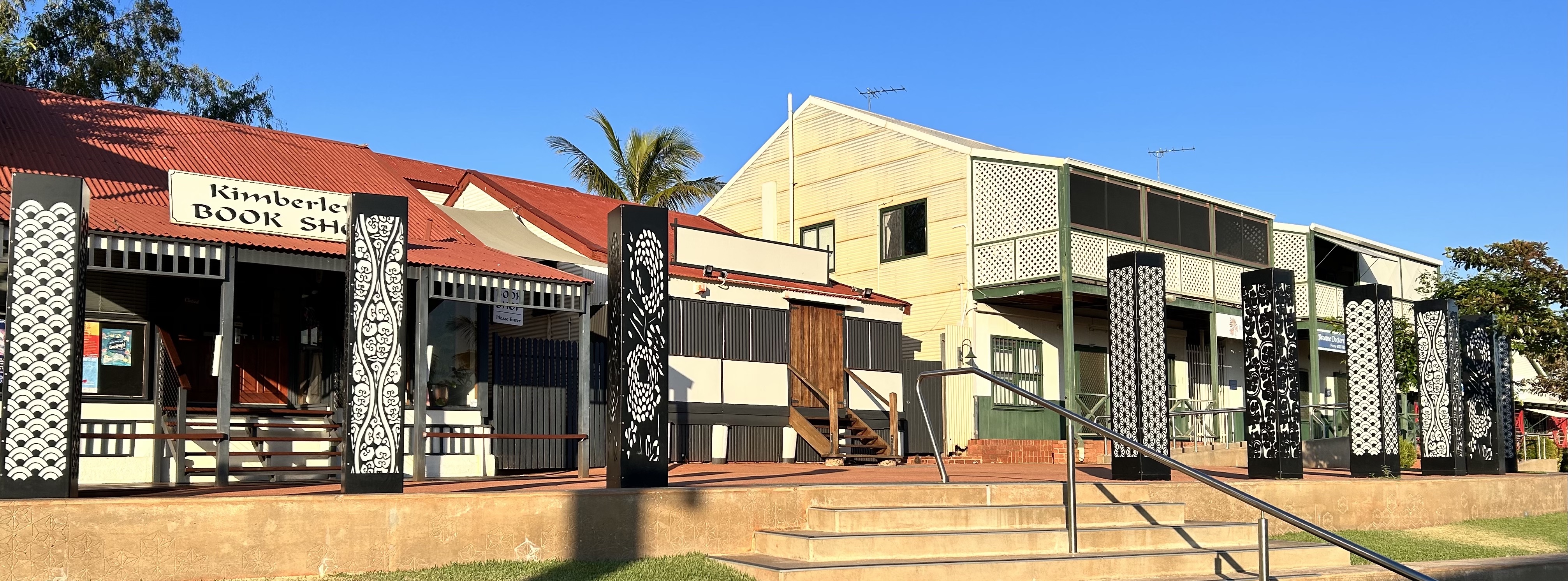
There’s a lot to see in Broome and plenty of history. The Courthouse BNB was a great central base for exploring. Friday started with an early morning tour of the “big art” around Chinatown with Chris from Salty Plum walking tours. The Chinatown and Town Beach precincts were upgraded for $30m a few years ago and part of it was installation of numerous sculptures and other artworks. Chris spent an hour and a half with us explaining the history of the town.
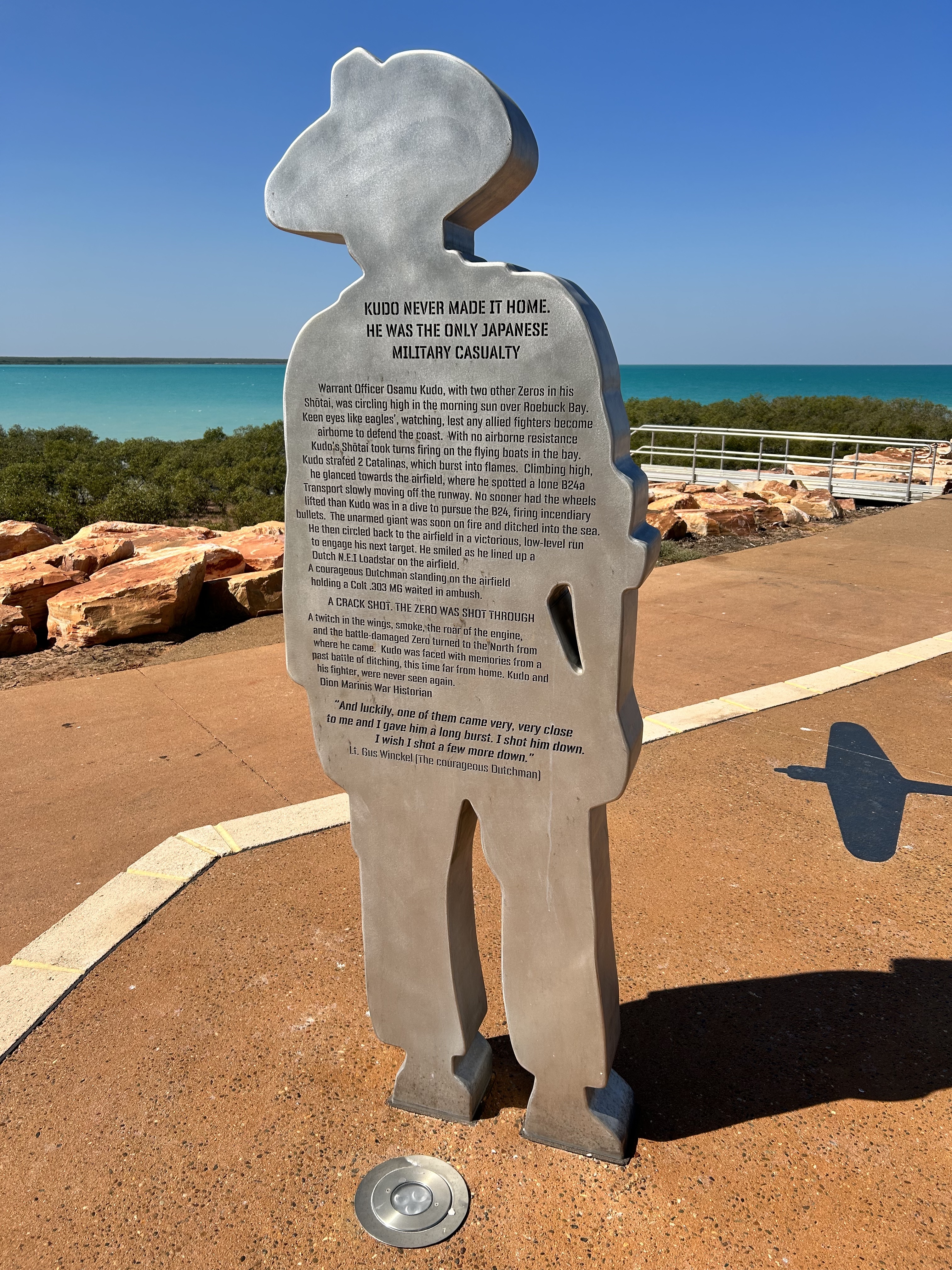
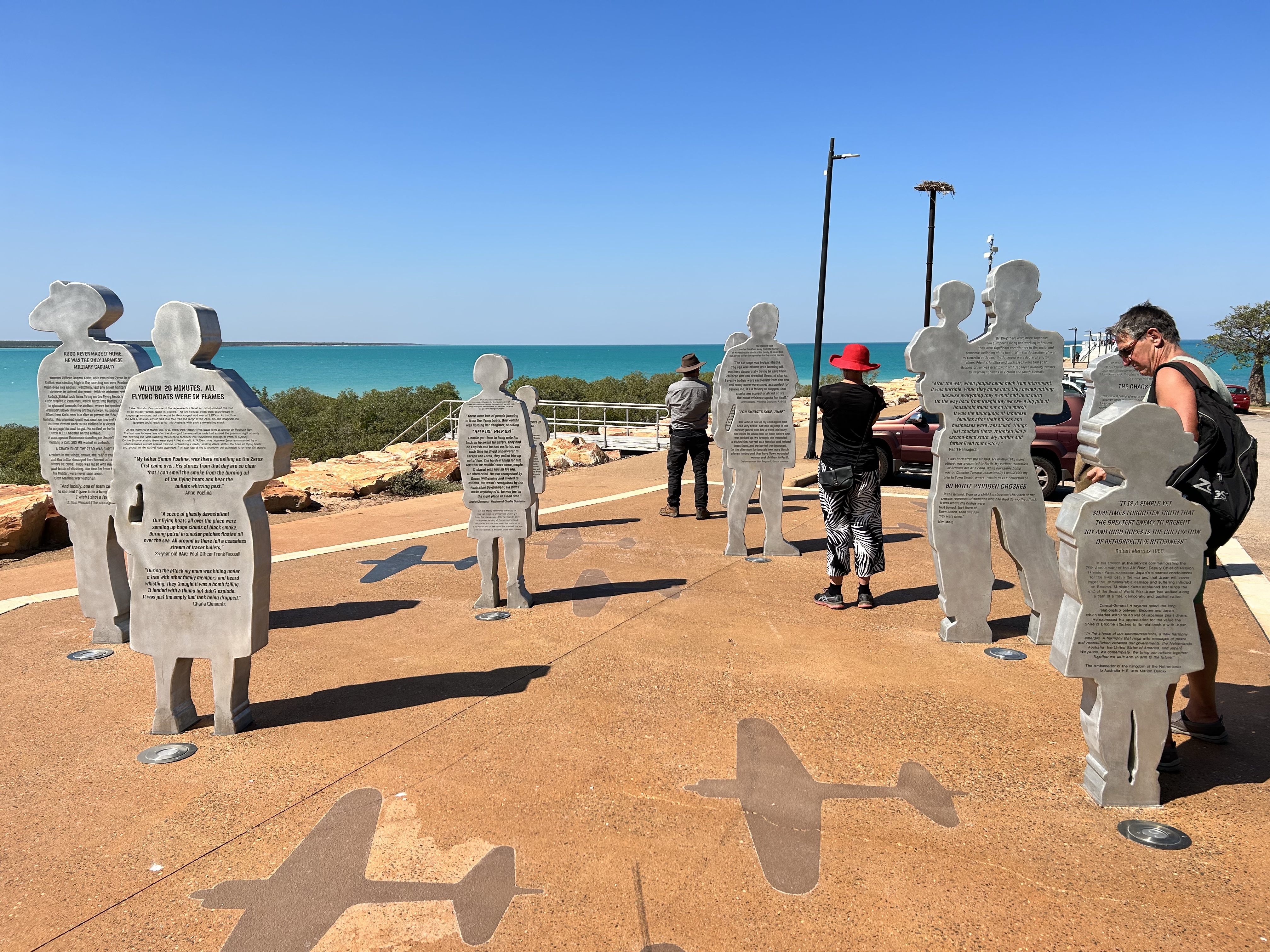
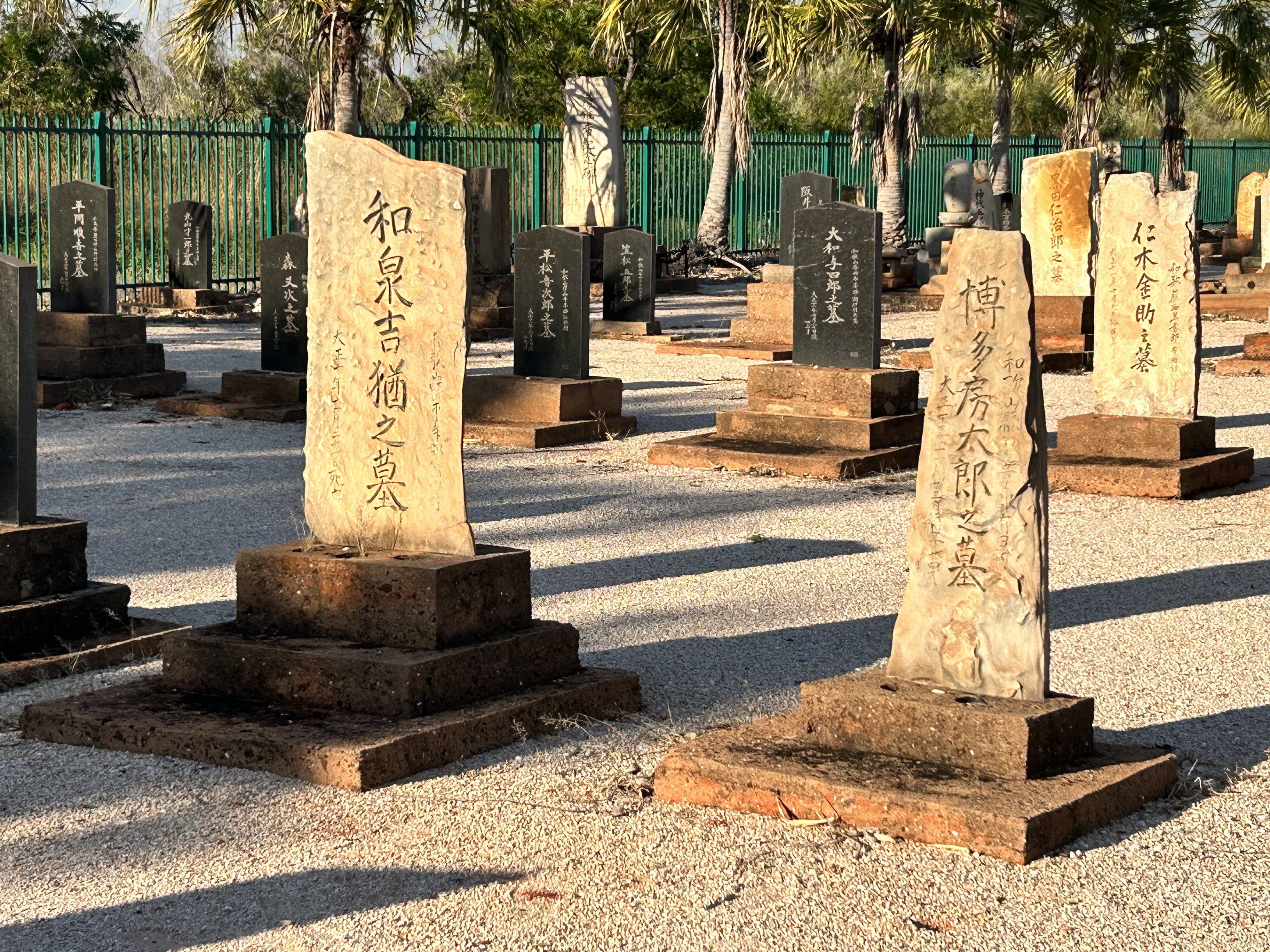
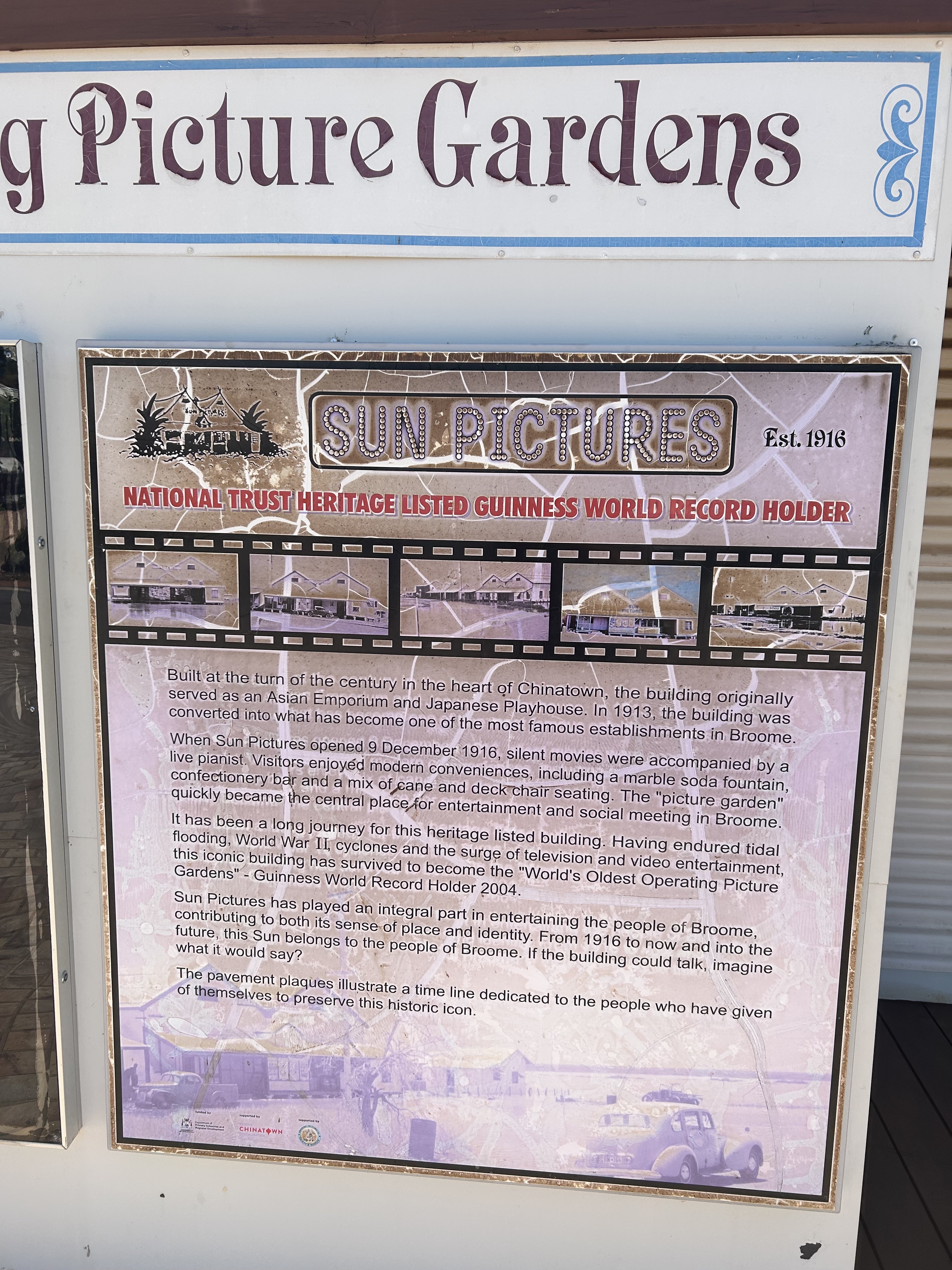
After breakfast we walked along to the town beach jetty where there are sculptures in memory of the victims of the Japanese aerial attack on Broome during WWII. We were totally unaware of this attack and how many people were killed, mainly refugees escaping Indonesia. We watched a young guy pluck a number of fish out of the water at the end of the jetty. No bait required! Who needs a boat?
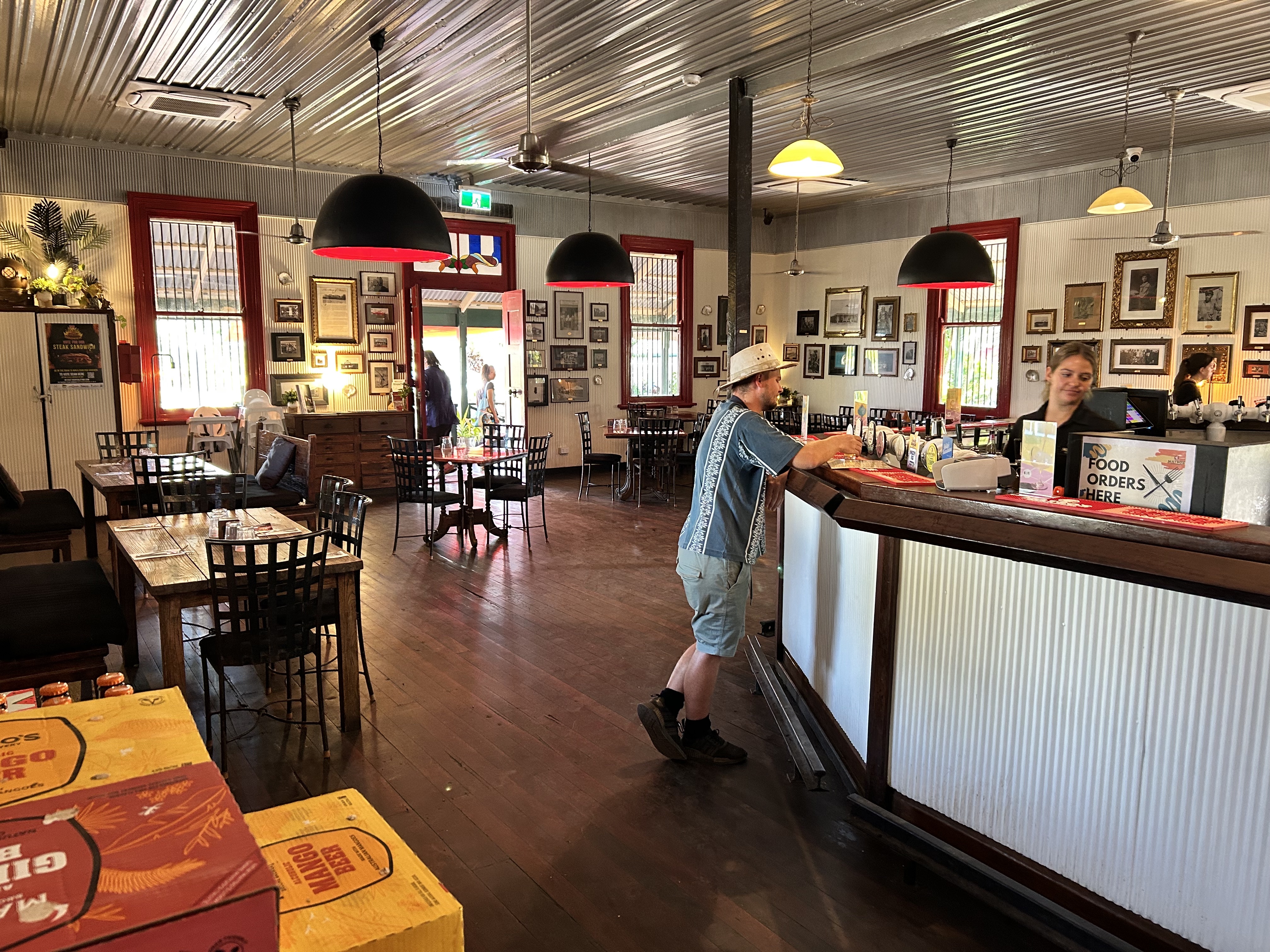
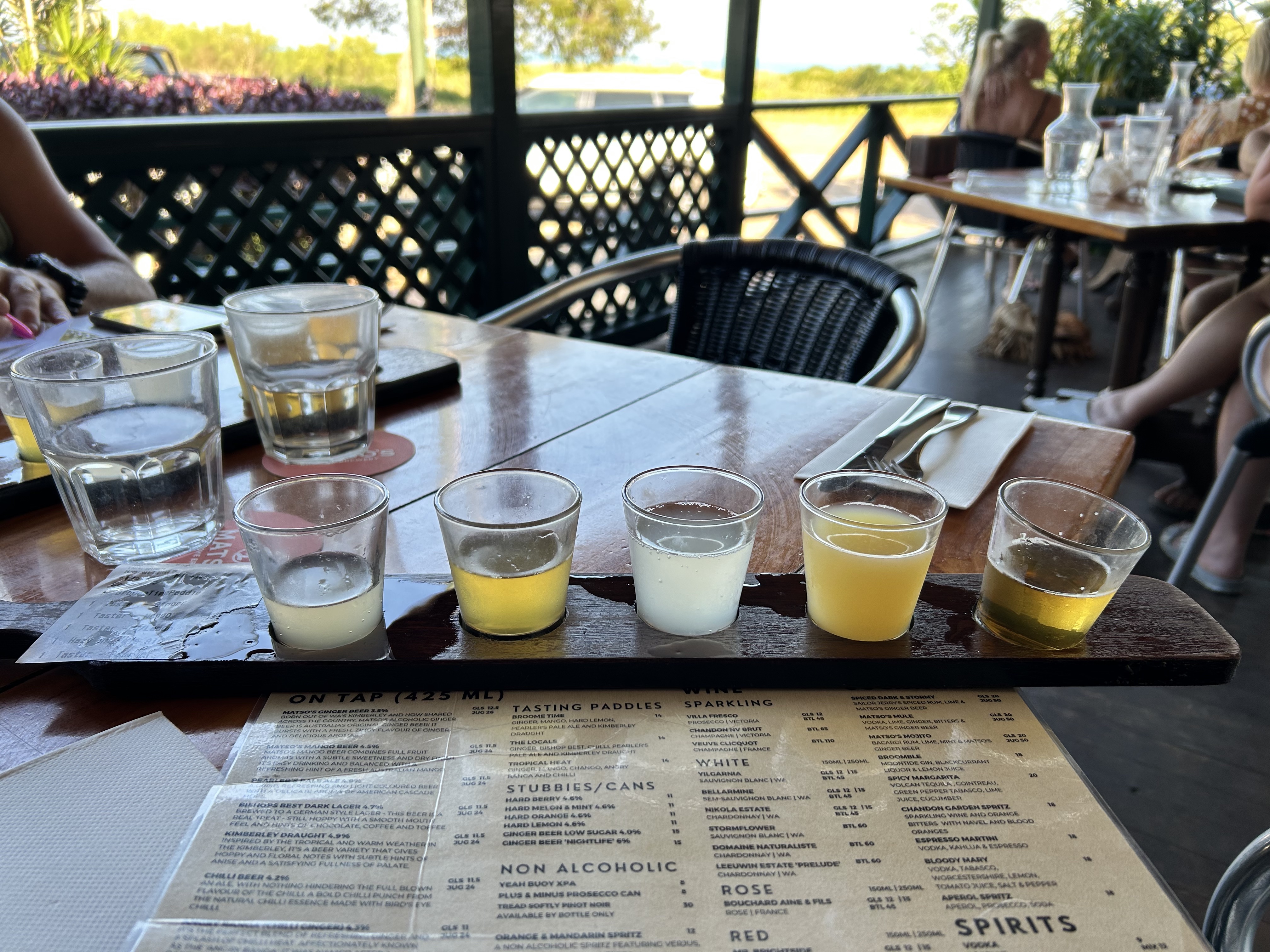
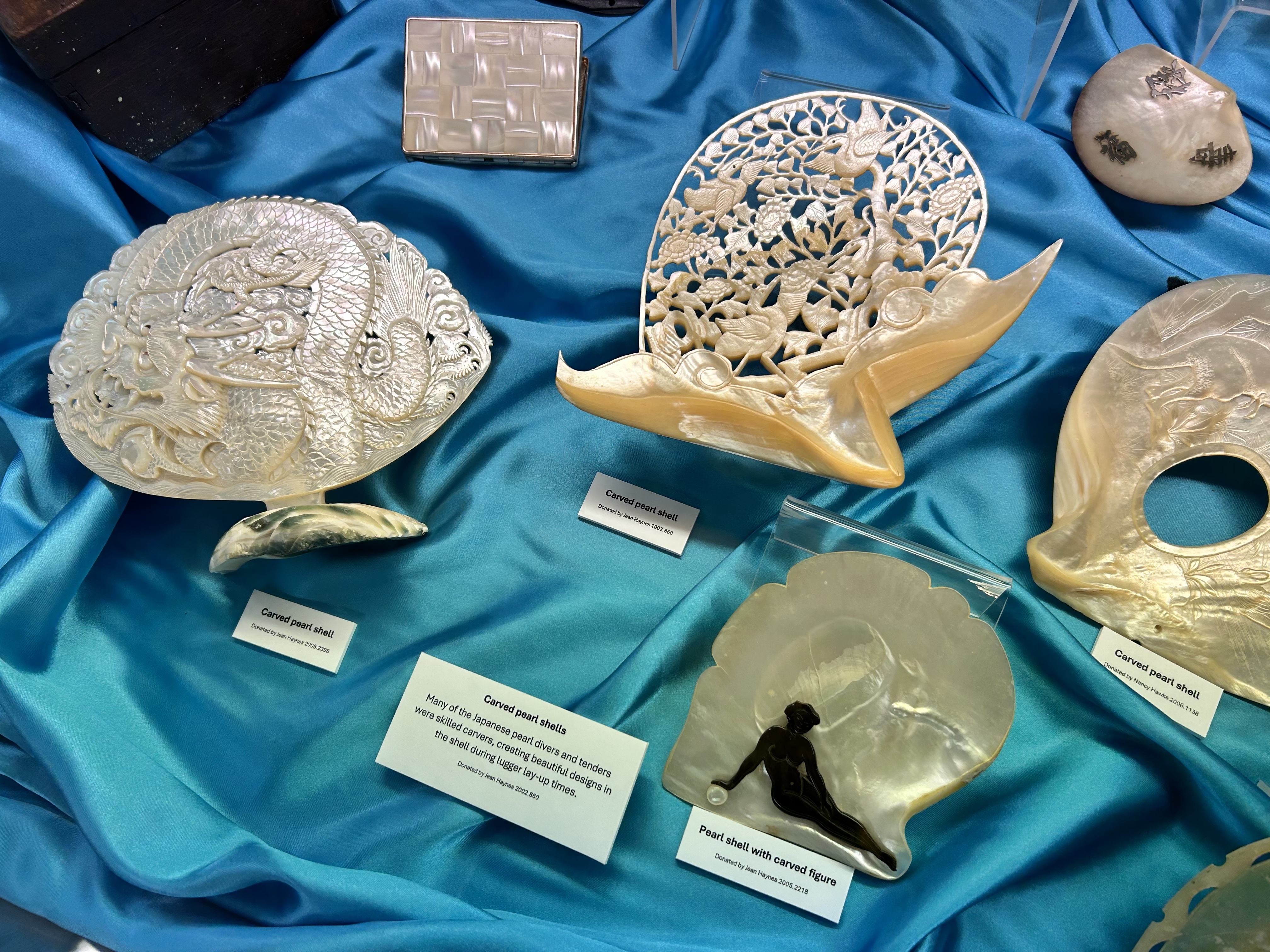
The museum nearby gave us a bit more info on the pearling industry over the years while Matso’s Brewery introduced us to mango beer over a Bibimbap.
A short ride on the superb Broome Explorer bus brought us to the Japanese cemetery and from there it was only a couple of km stroll to Cable Beach to see the sun slide into the Indian Ocean one last time. At 22,000 steps for the day it made our hike to Mitchell Falls pale into insignificance.
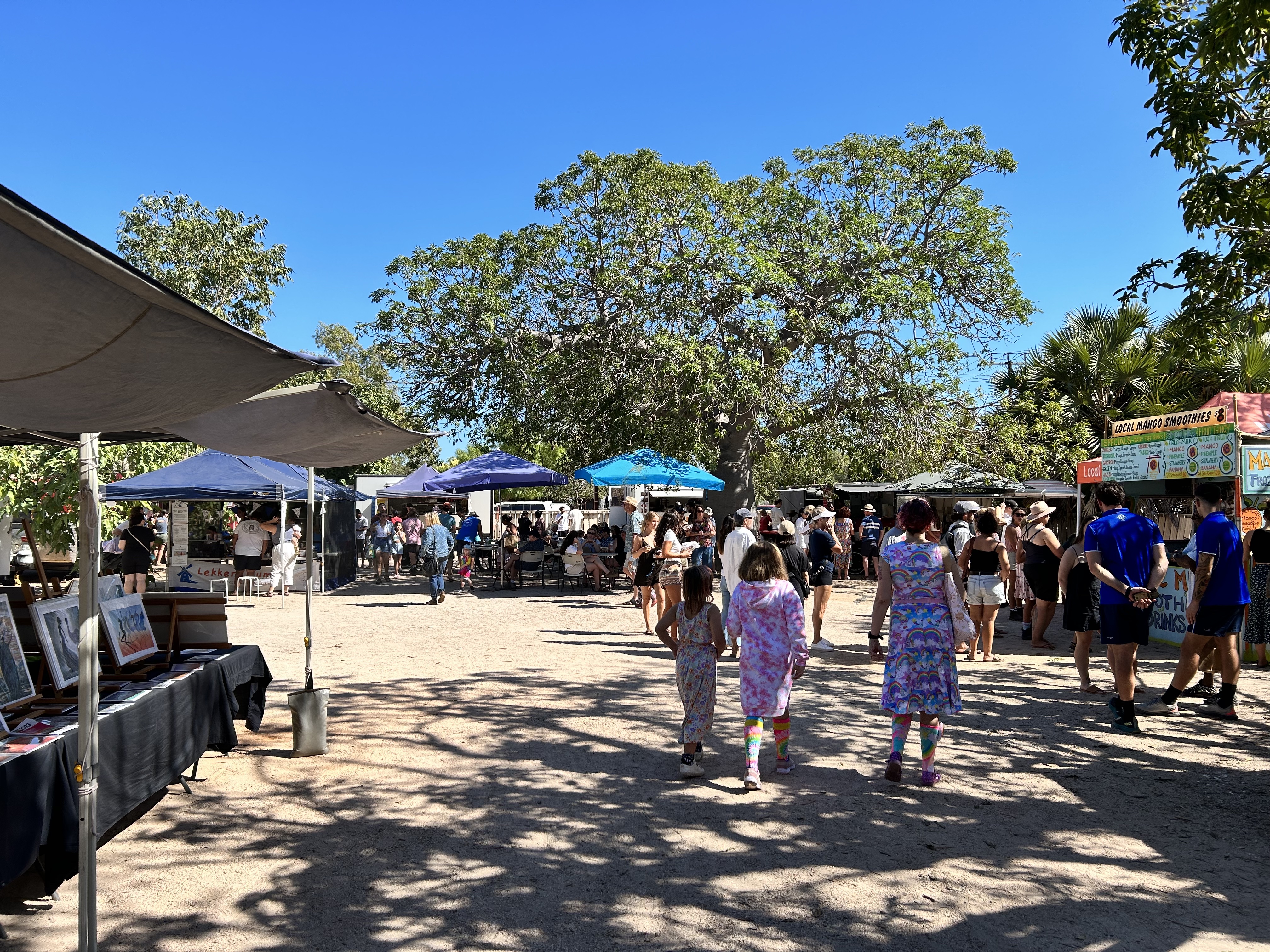
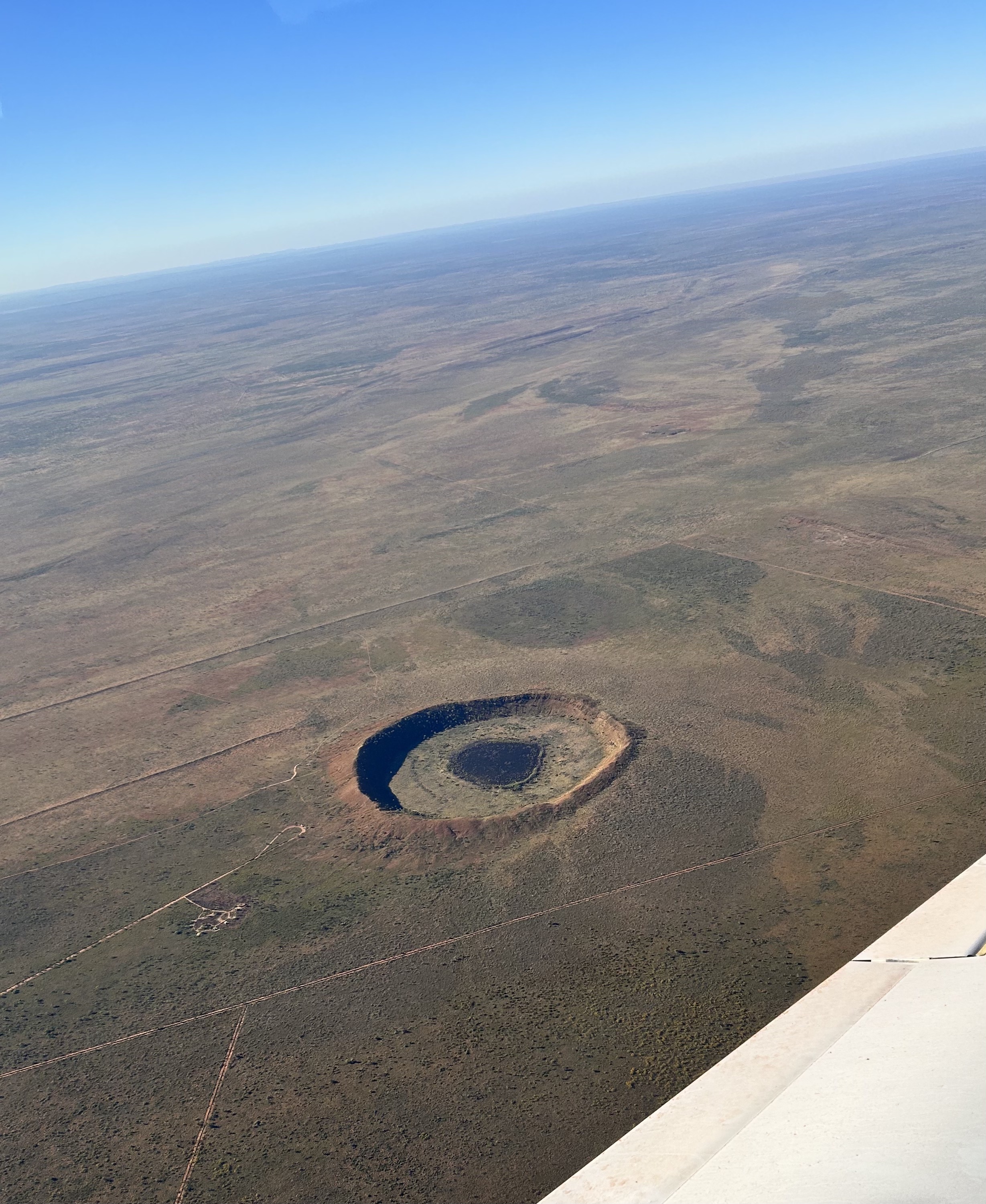
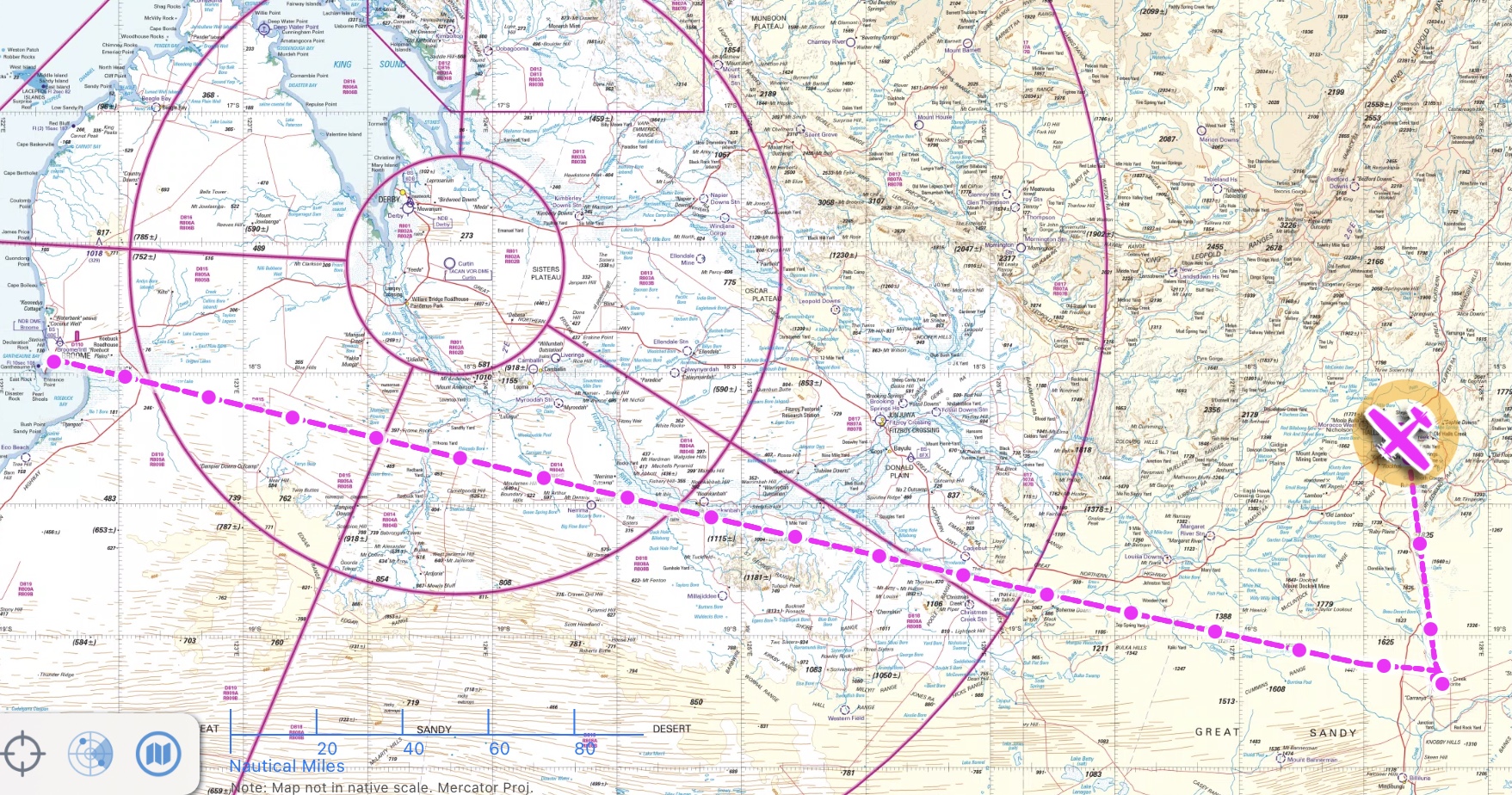
It was time to head east once more. From Broome it was more than a two hour flight to Halls Creek via the Wolfe Creek meteorite crater. But first another sunrise walk and visit to the Saturday markets.
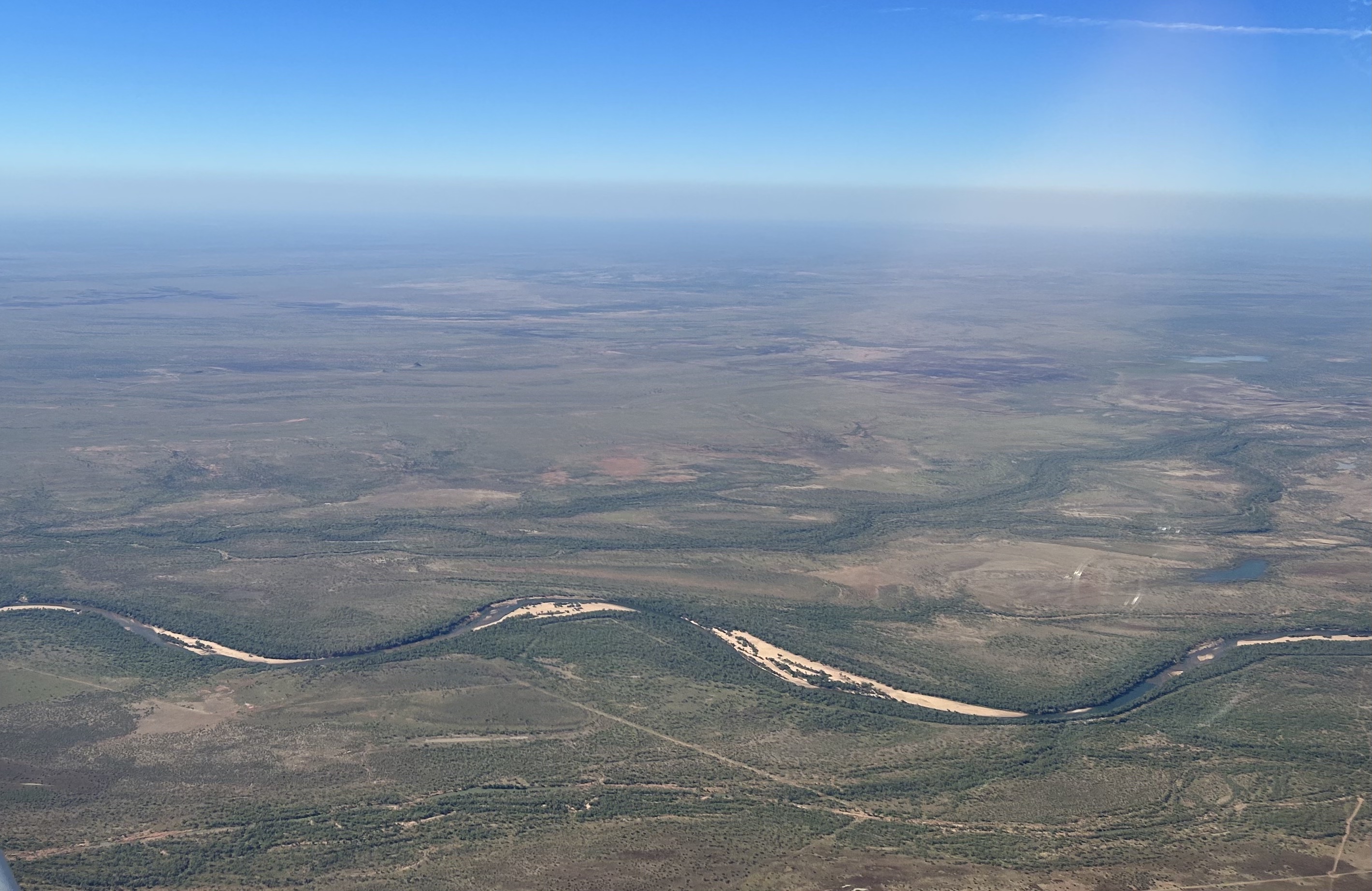
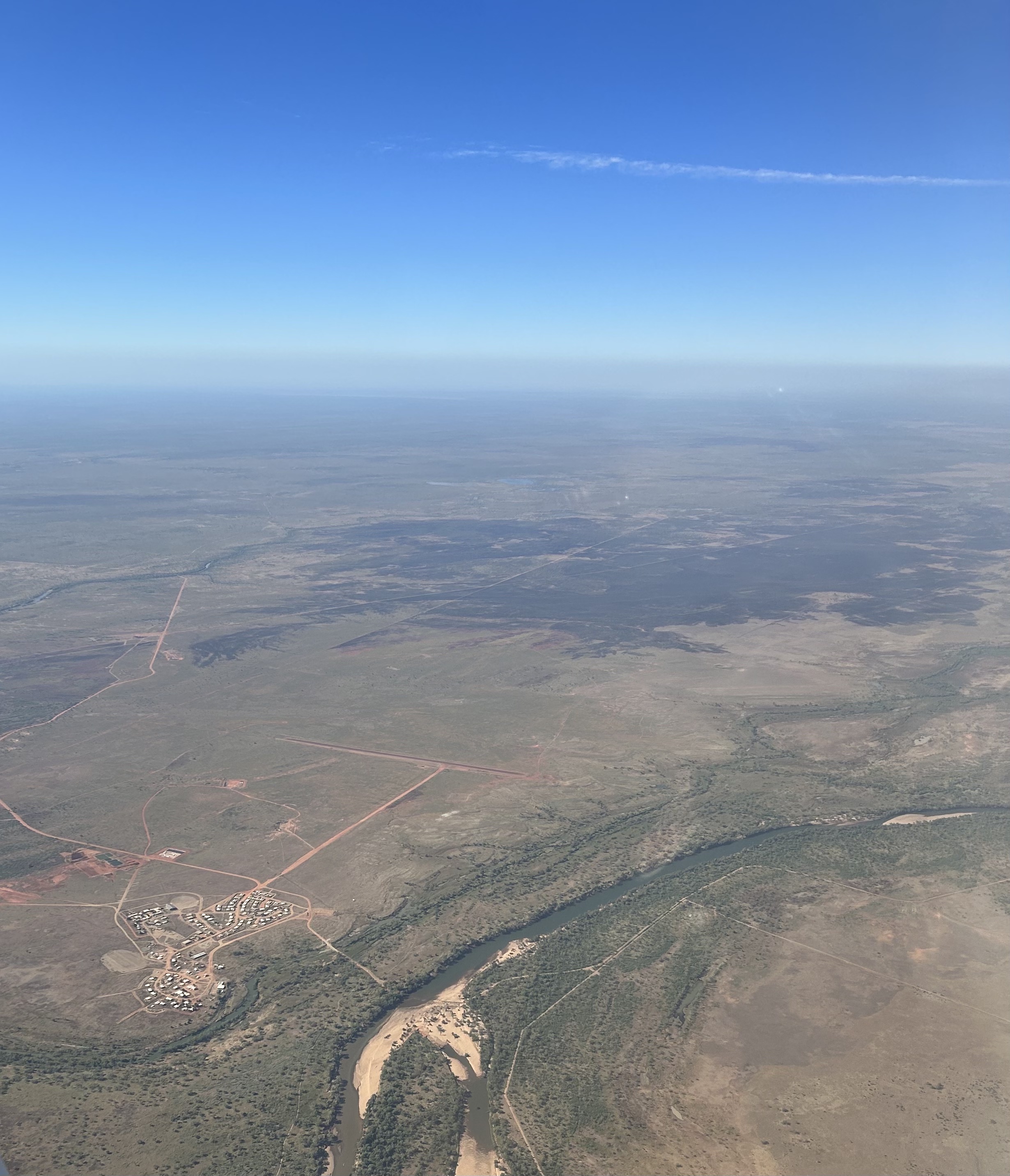
Then it was Broome Broome out to the airport for an IFR departure from RWY10. Our track was 101 so straight ahead for just over two hours at 7000 feet over the southern reaches of the mighty Fitzroy River. There was a fair headwind (our first for the whole trip!) and some smoke so we climbed to non standard 8000 for the second half.
As we approached Wolfe Creek we descended to 6000 ft and ATC anticipated our requirements by asking what our air work would be over the crater. “Two orbits please. One right, one left.” “No IFR traffic for air work”. All good. The crater is impressive even if “only” 1km in diameter. Must’ve made quite a bang on the day.
It was only 20 minutes from there to Halls Creek where the local ARO jogged past and showed us the best spot to tie down. A refreshing plunge in the pool at the Kimberley Hotel 5 minutes walk down the road was followed by a great steak at the Sportsman’s Bar. Being asked to blow in a breath test at the entrance to the bar was a first. Apparently they have a lot of problems with preloaded patrons. You can’t enter if you’re over the limit. And they don’t discriminate. Everyone has to blow. As a result the place was a very pleasant venue.
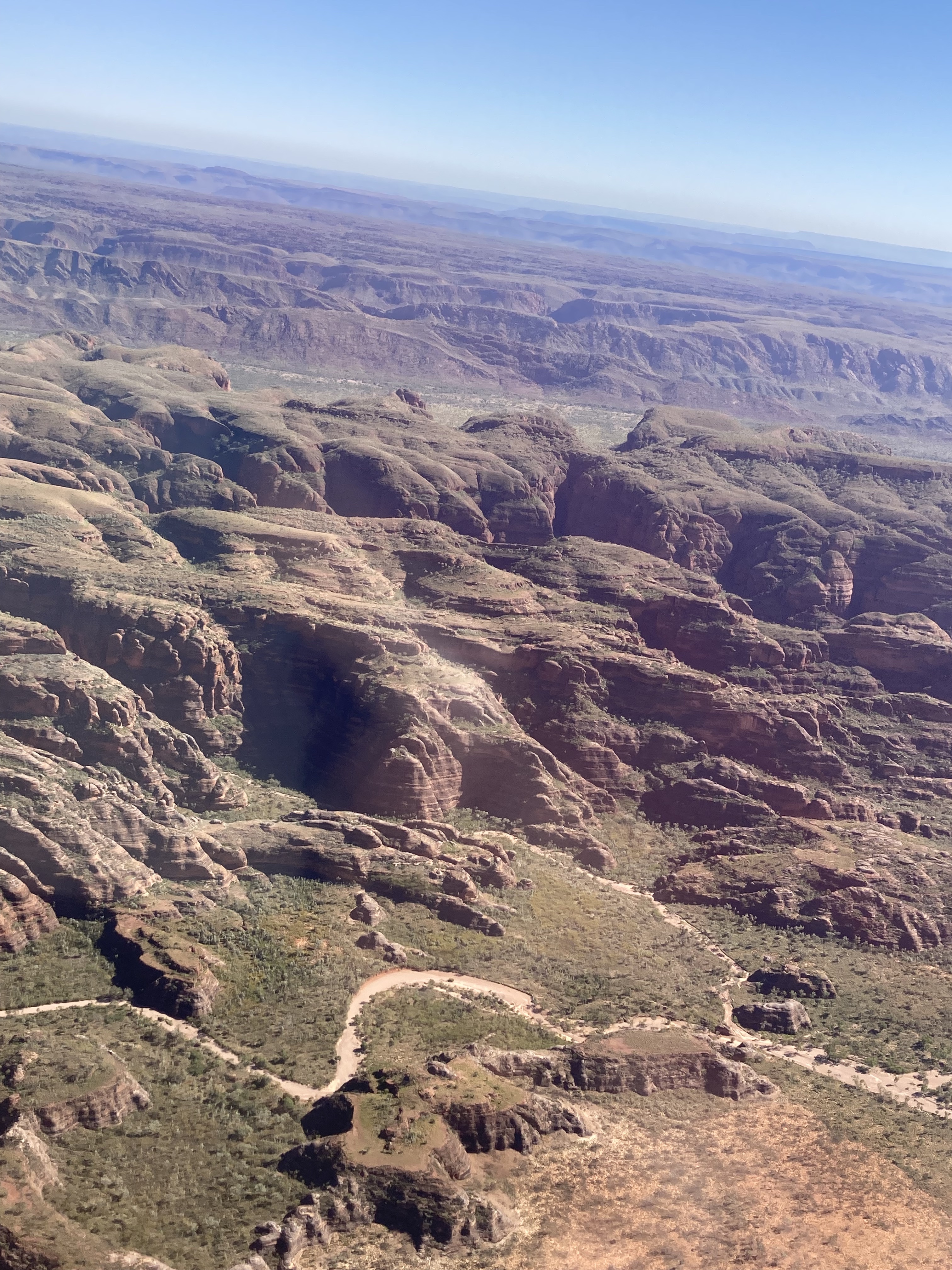
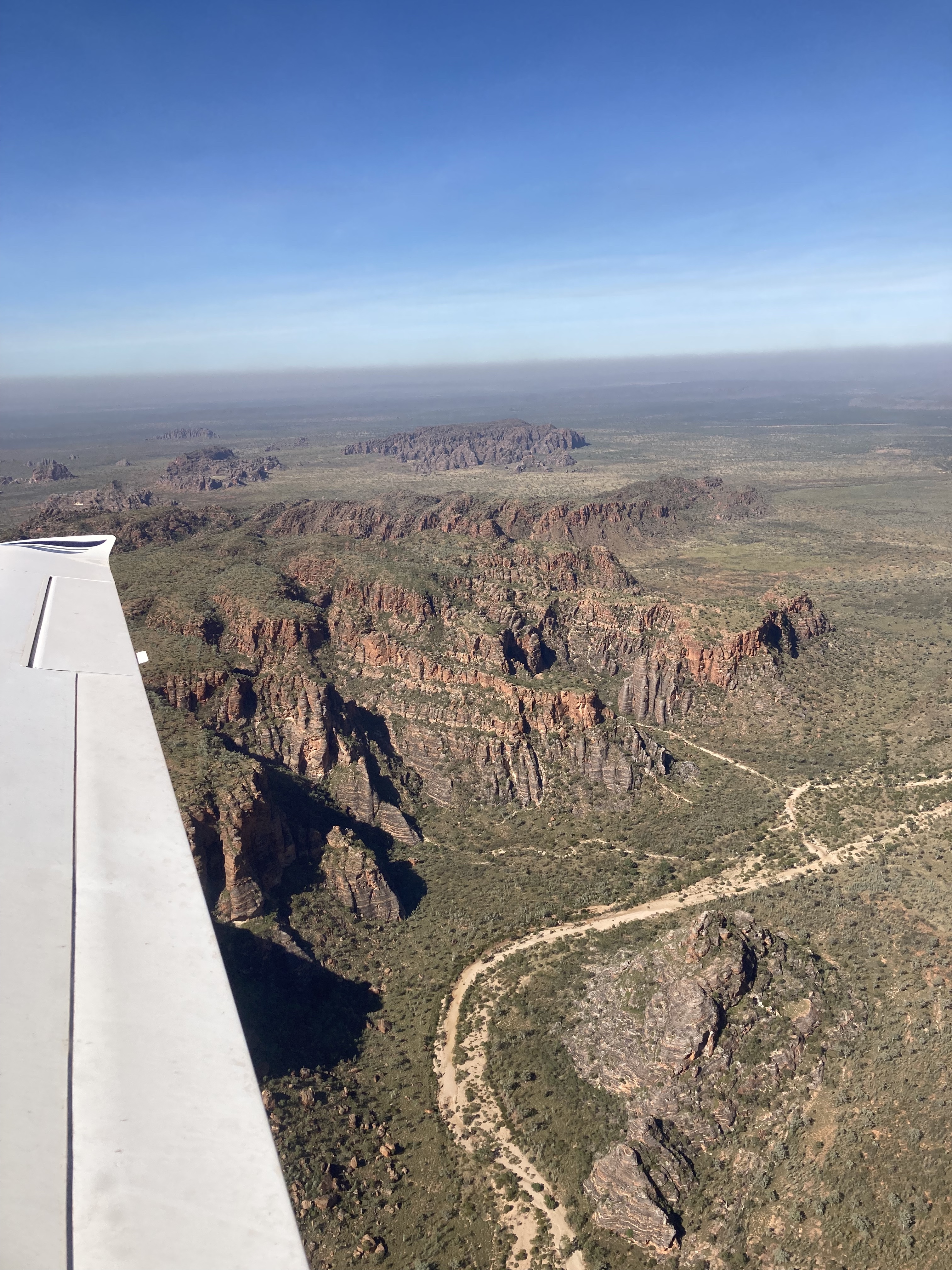
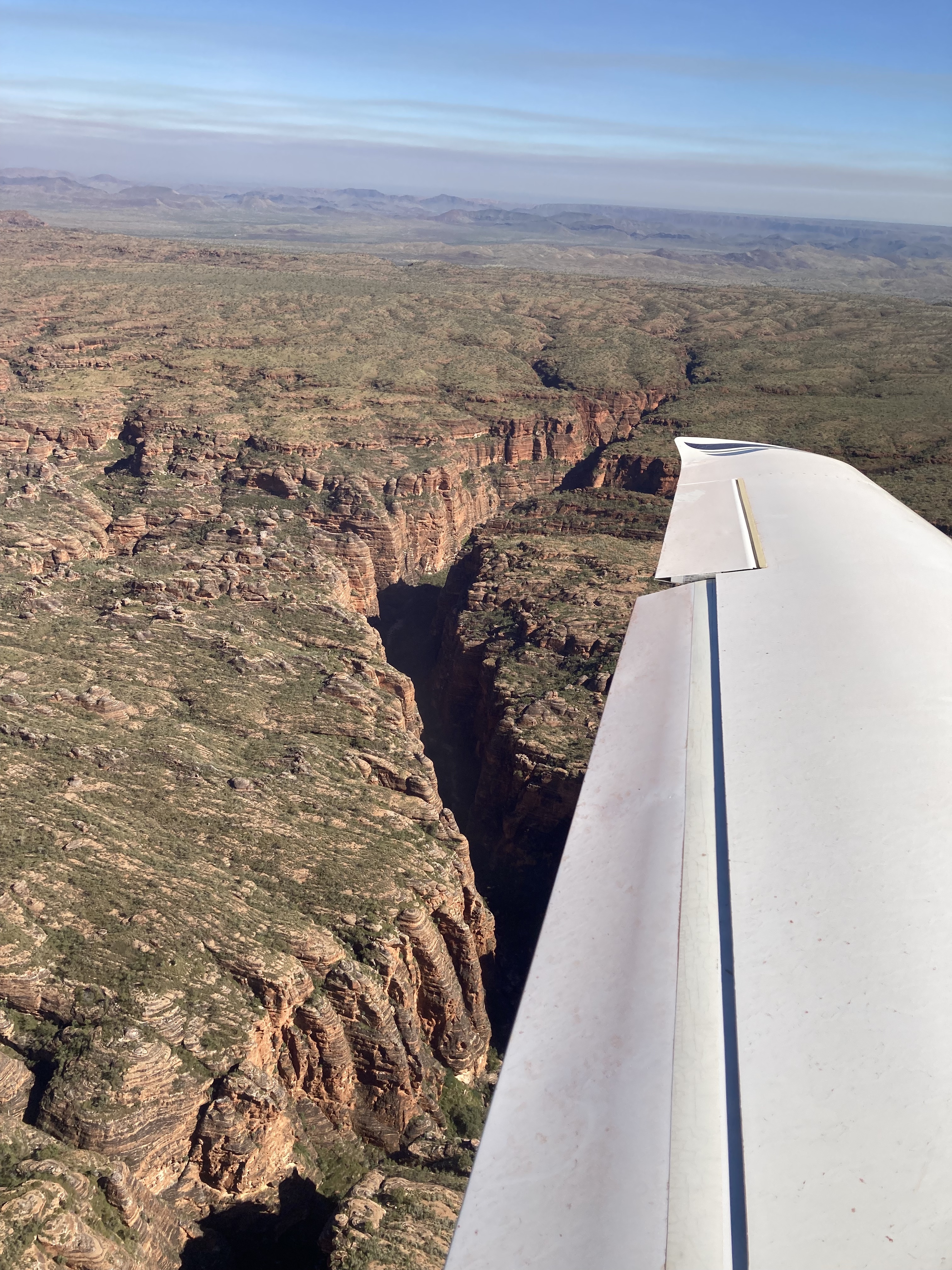
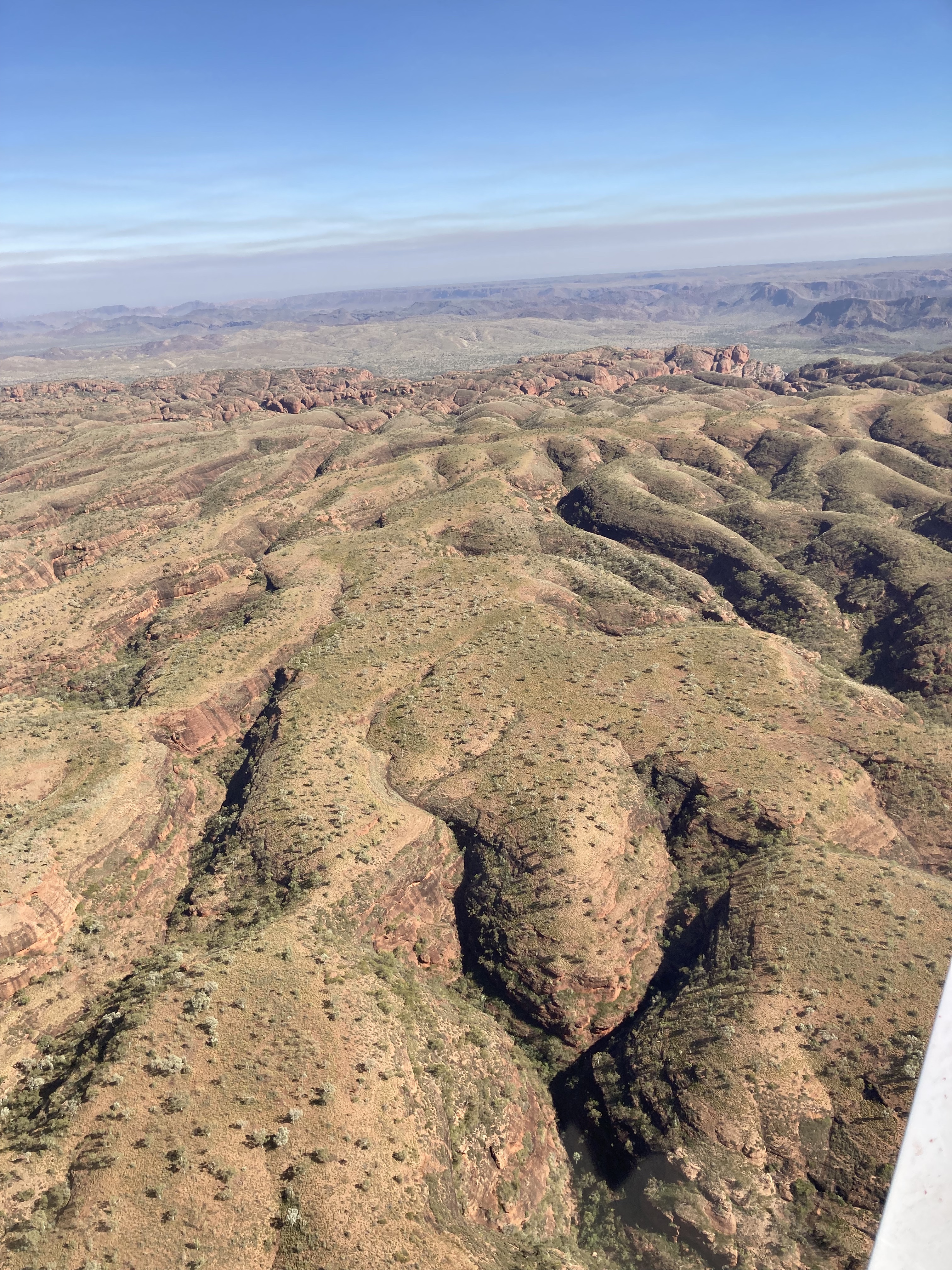
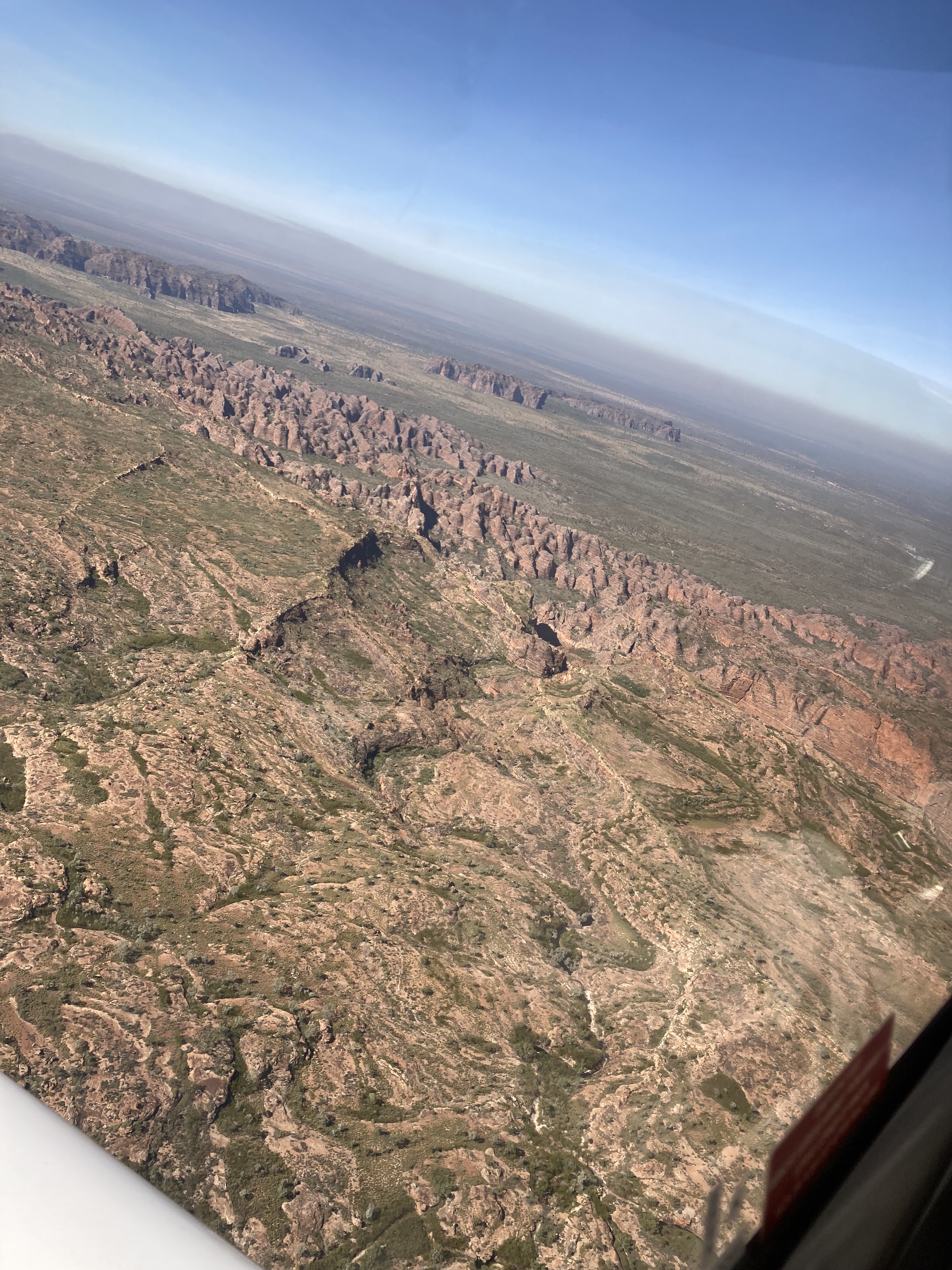
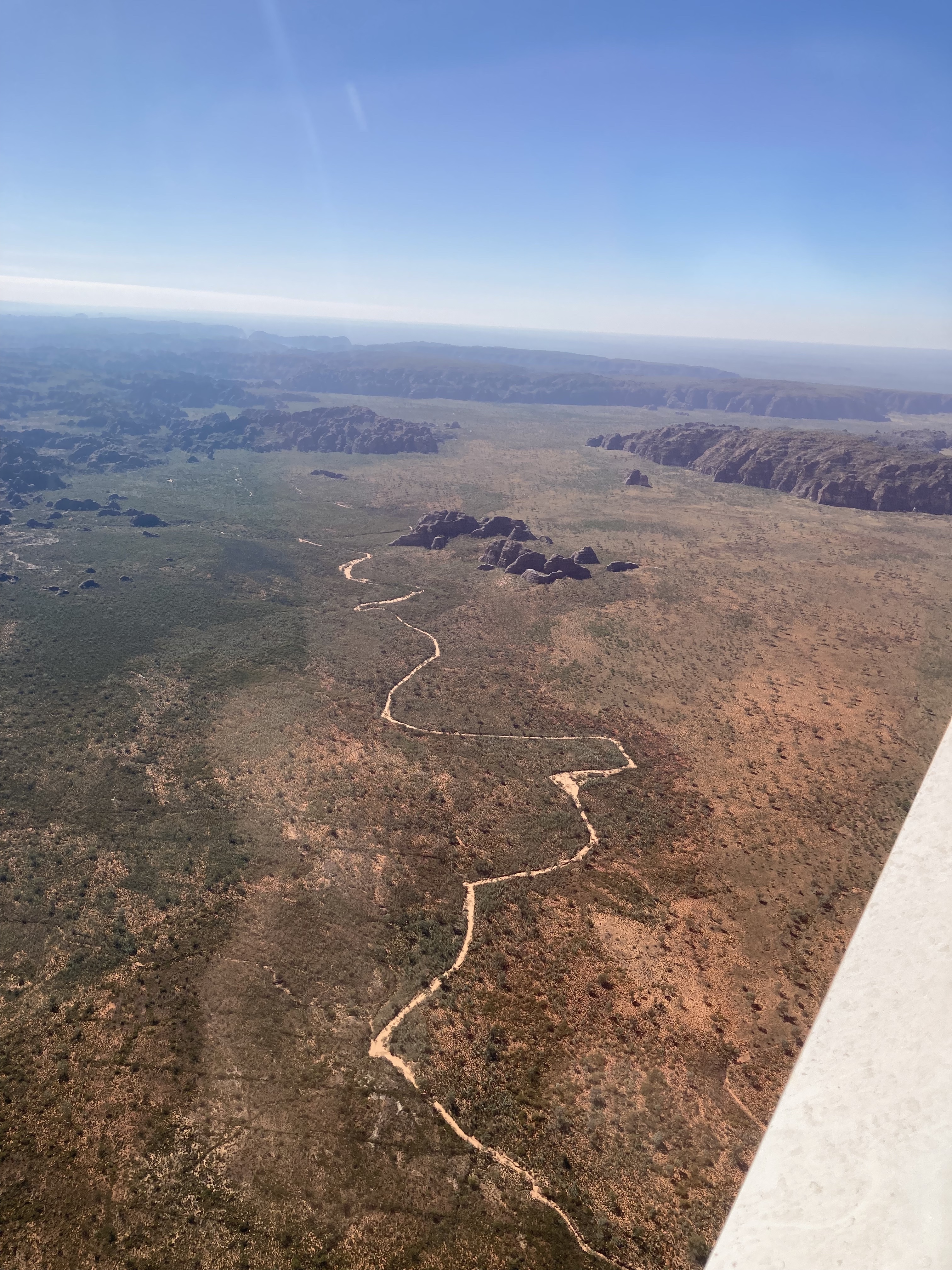
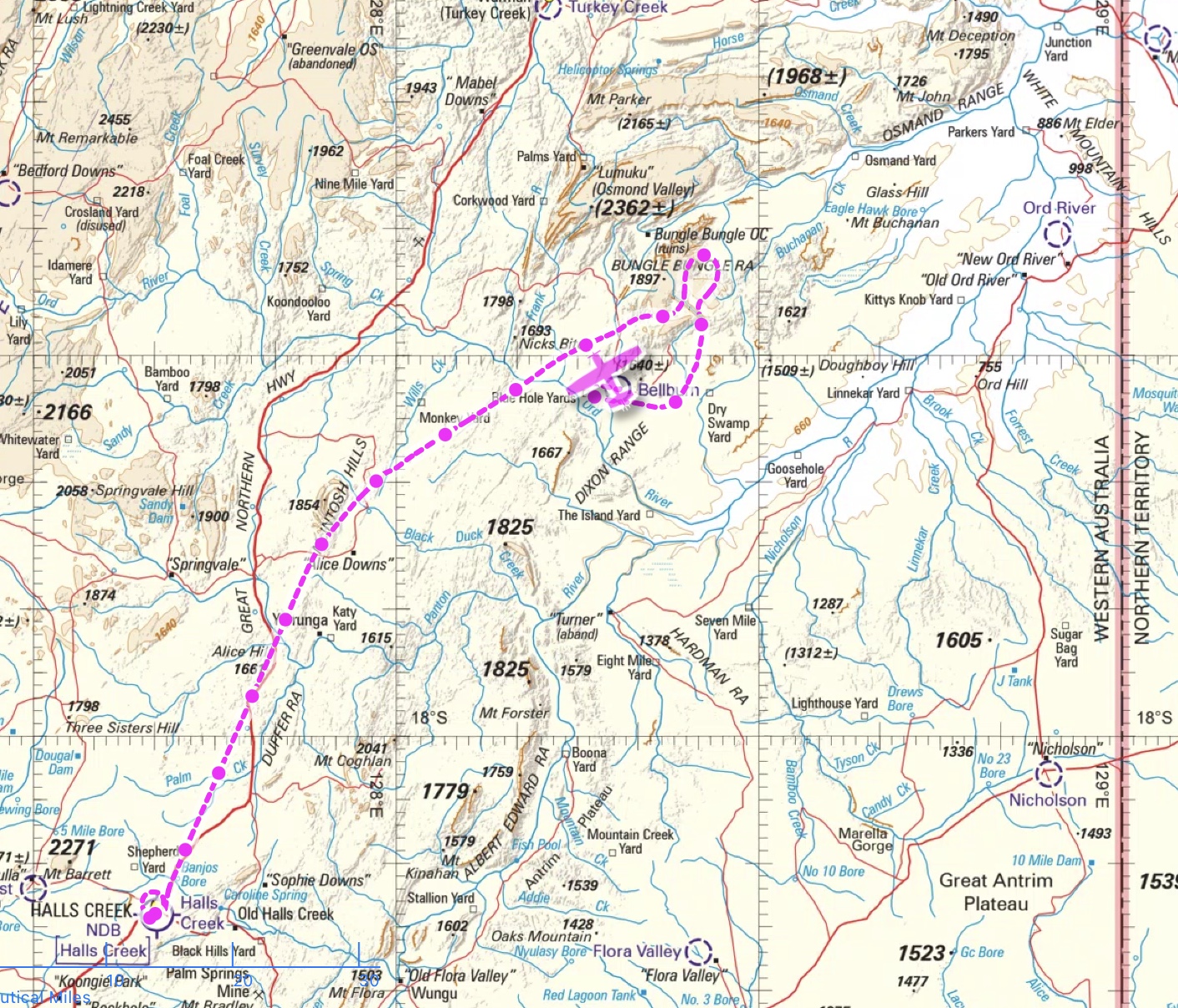
It was an early-ish start from Halls Creek to Purnululu National Park (Bungles). We lifted off at 8:30 and tracked via the Macintosh Hills then on towards the south west entry for a spectacular scenic flight around the Bungles at 3000ft, as described in ERSA. It was a maze of gorges in between plateaus for the most part, with the iconic stripy mounds mainly concentrated on the south eastern edge.
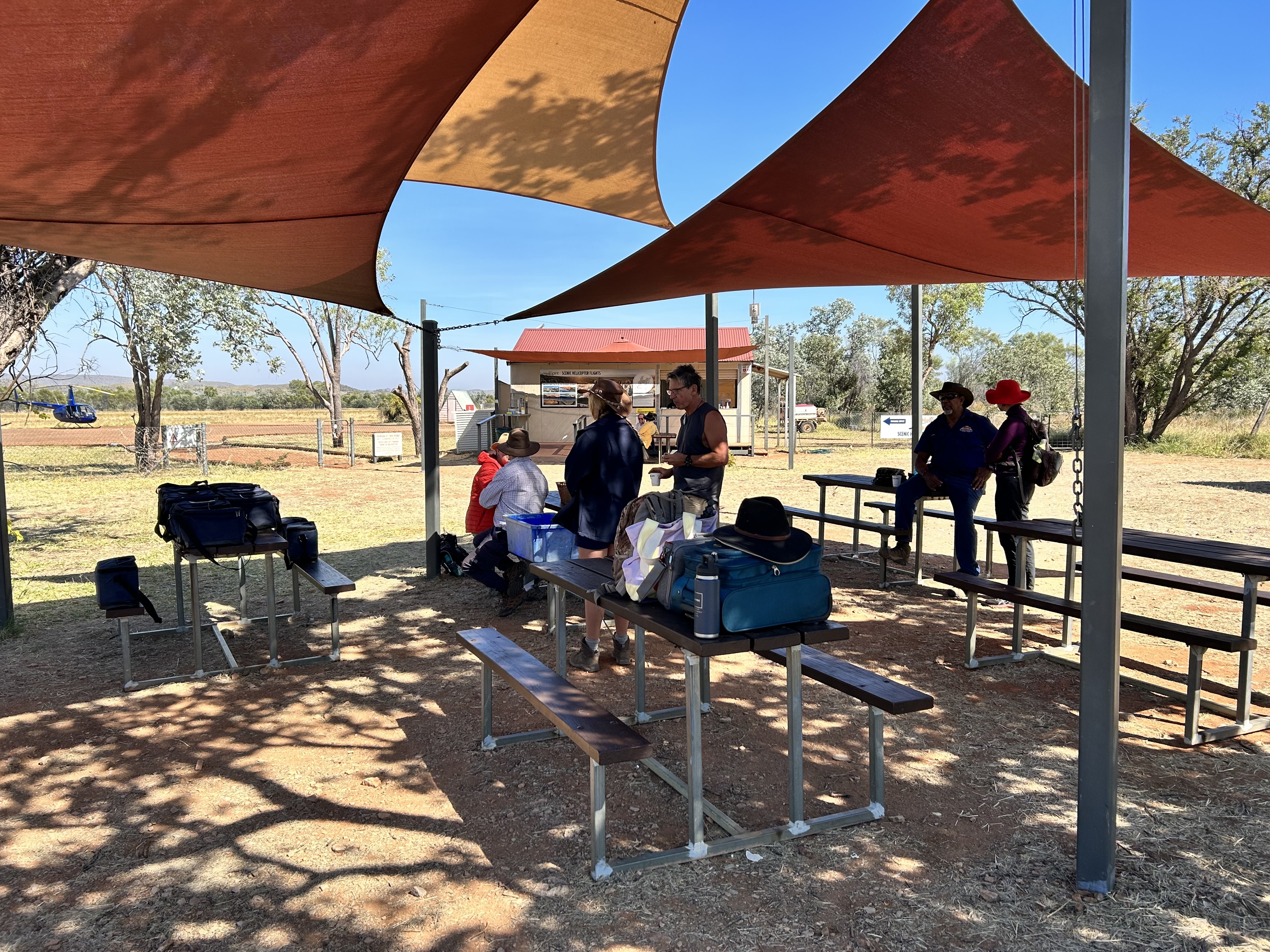
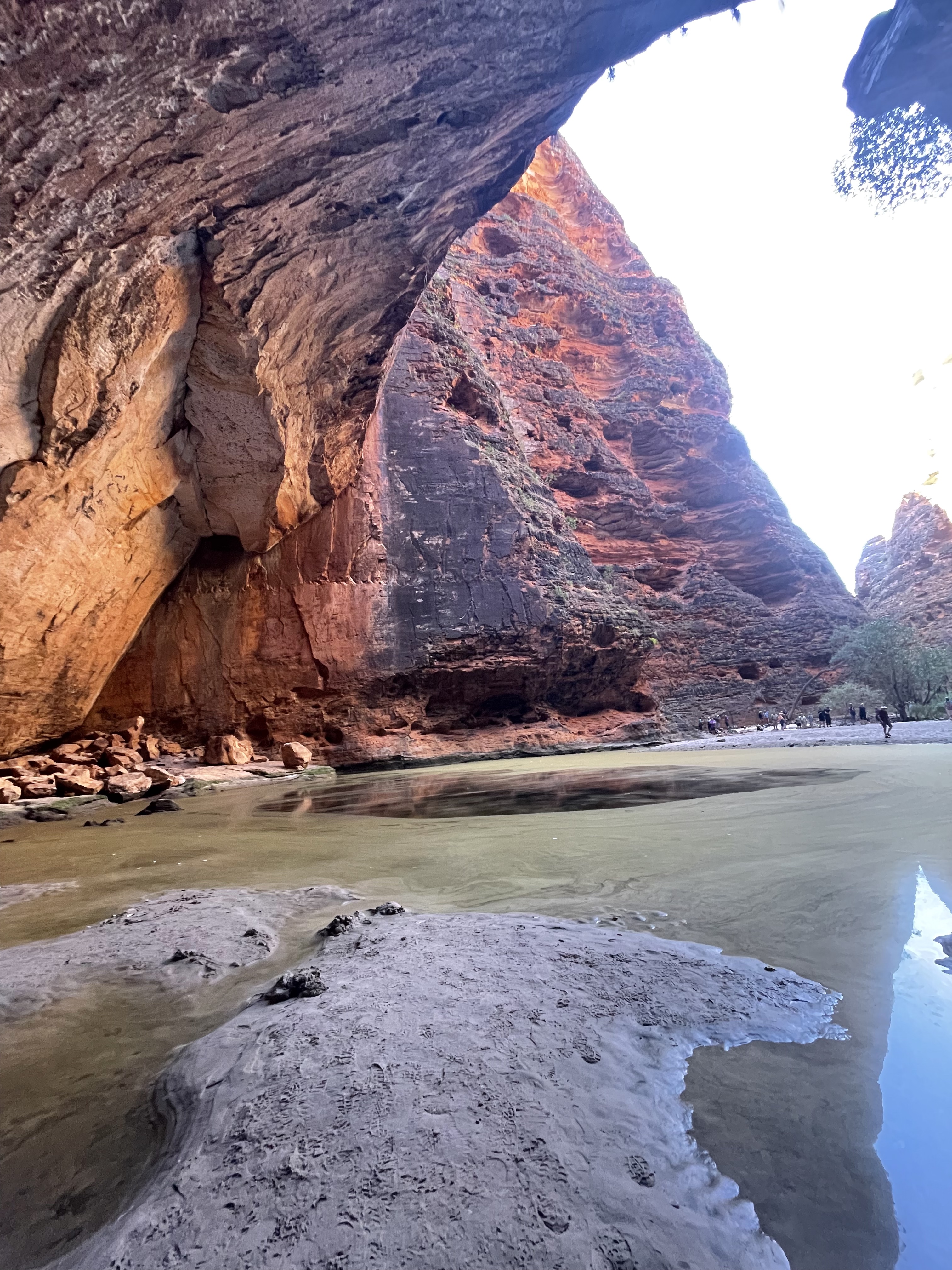
Landing at Bellburn airstrip at 9:30 we were greeted with morning tea before bring whisked away on a Bungle Bungle Guided Tours bus for a walking tour to Cathderal Gorge.
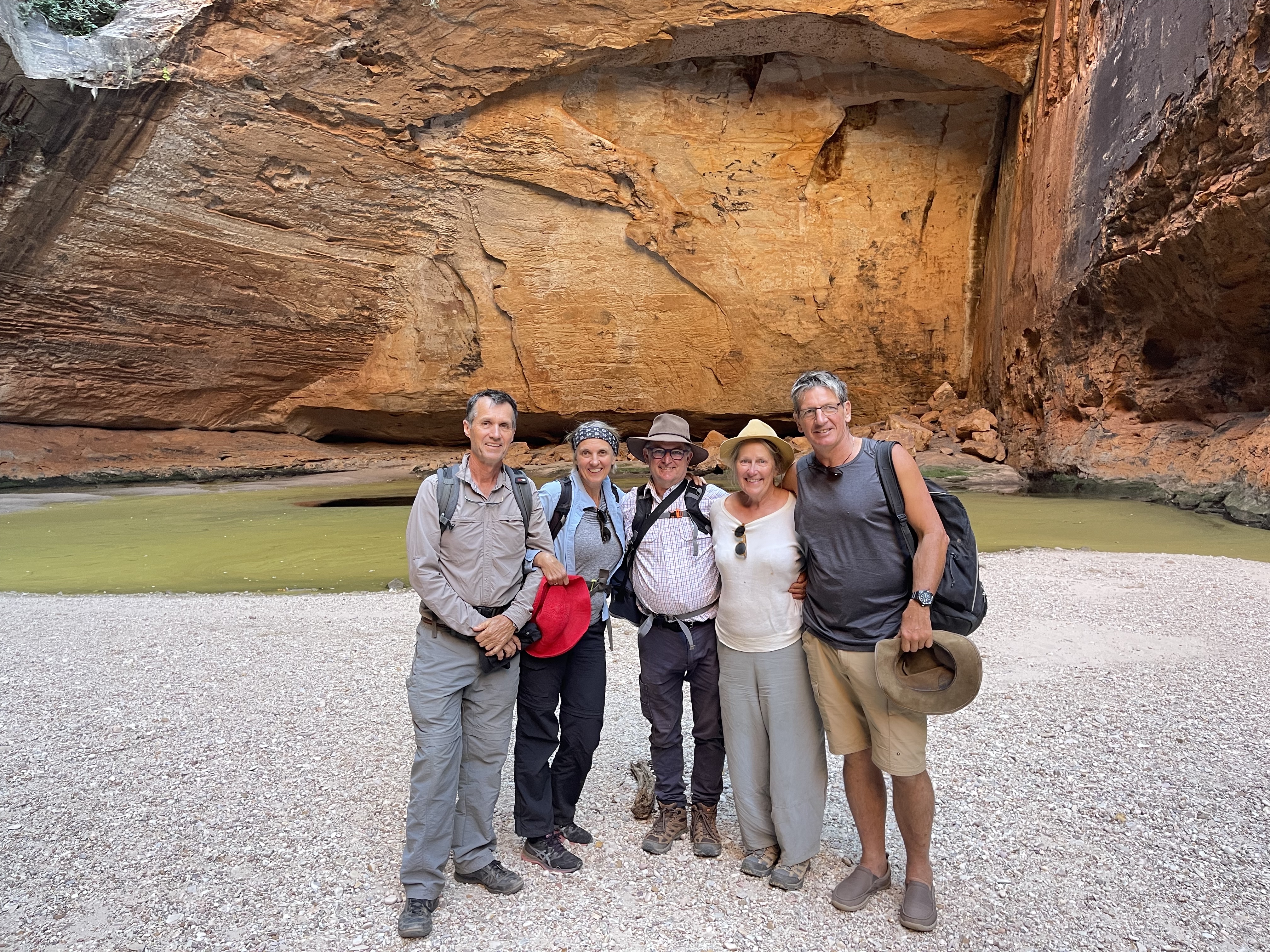
It involved about a 4km stroll through the park with lively descriptions of the geology and history by Gabriel and Wesley, two local Gidja people. Gabriel put on quite a show with his banter and clear descriptions while Wesley was more measured in his explanations. Lunch was in the bottom of the Cathedral Gorge itself.
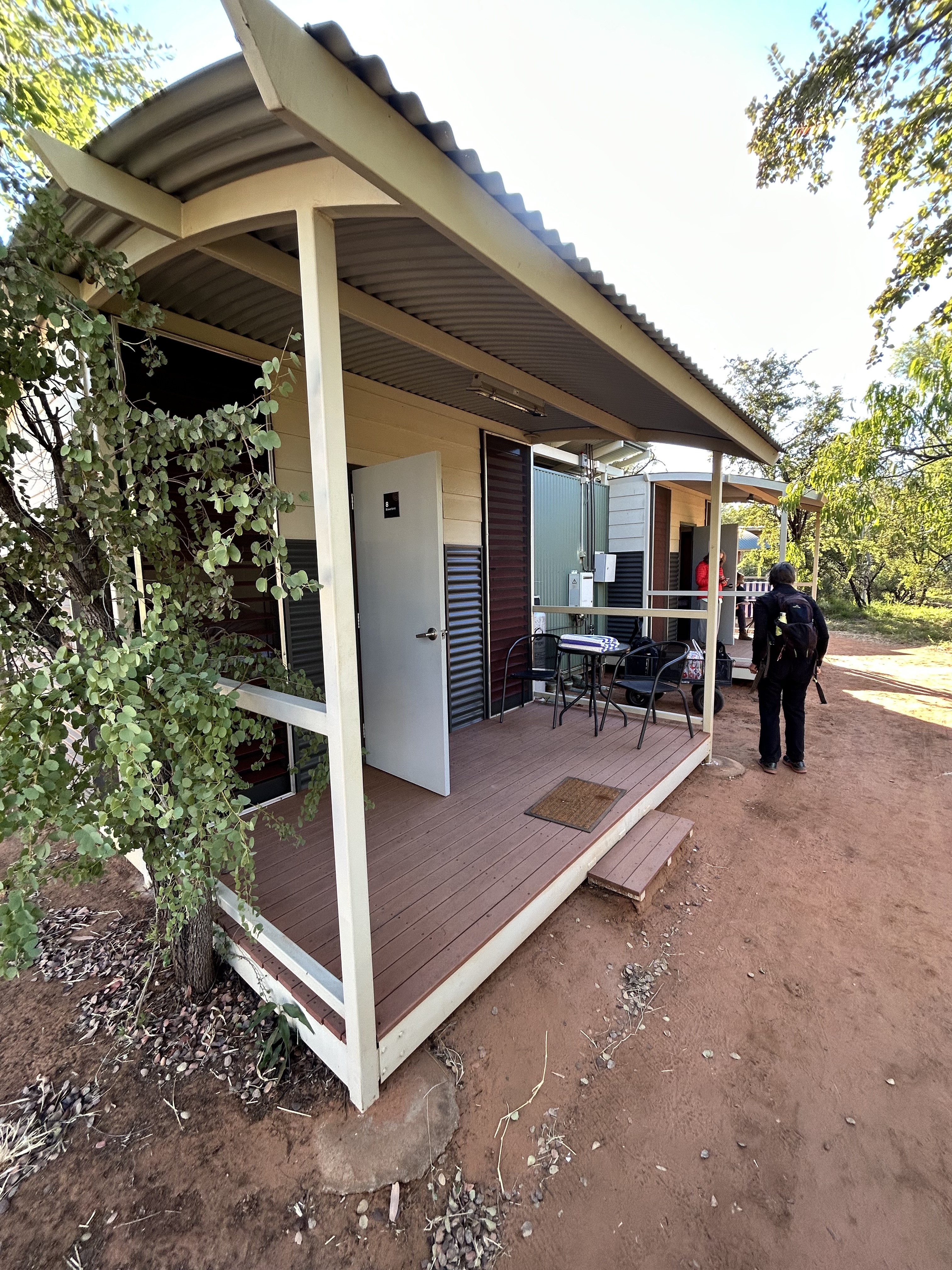
The bus took us back to the Bungle Bungle Savannah Lodge where we checked in, had a quick dip then enjoyed the sunset on the opposite rock faces of the surrounding hills before enjoying dinner on the deck. Our tour of the Kimberley had come to an end and it was time to head for home.
The story concludes under “Destinations – Heading home from the Kimberley”